
Parenting and Children's Book Author

diversity

Avenging Childhood~The Change Makers

As I drove out of my driveway this afternoon, I glanced up and saw The Avengers racing around my neighbor’s yard, intent on fighting crime (or each other or the dog or some dragonflies, lol). It made my heart so happy to see childhood…just real, everyday, the-way-children-through-the-ages-have-played kind of childhood at its most honest and robust and carefree. I jumped out of my van and proceeded to confirm my neighbor’s suspicions that I’m a little off my rocker by wildly waving my camera in the air and pointing at her adorable boys roughhousing, silently asking for permission to play paparazzi. She nodded, and the boys hammed it up for me for a few minutes, posing and posturing in their wonderful world of make-believe.
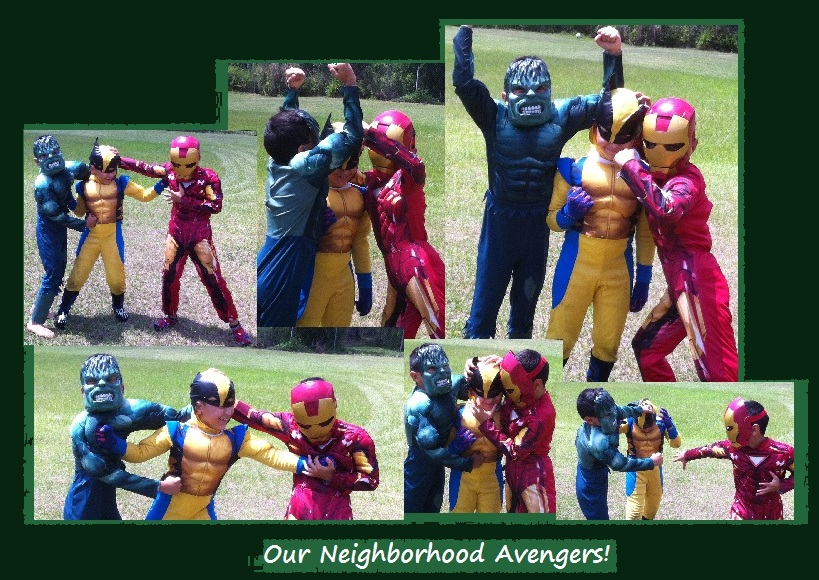
I climbed back into my van amidst my little girls’ giggles (pretty sure they were laughing more at me for taking pictures of the neighbors rather than laughing at the boys’ antics). As we headed off on our afternoon errands, I thought about how the world has changed, but children haven’t. Yes, over time the world will do its share of influencing or corrupting, as the case may be, but children are born children just like they have been since the beginning of time.


Every child is born a fresh, new, open book with pages and pages waiting to be filled. Everything is new. Every day is an adventure. Every experience is an opportunity for discovery. Whether they’re boys or girls, whether they have average or advanced or impaired cognitive or motor abilities, whether they’re Asian or Caucasian, Black or Middle Eastern, Hispanic or (as a growing number are worldwide) a unique blend of races and ethnicities, they all start out the same…brand-new, innocent, precious beyond compare.

I am passionate about helping parents fill the first pages of their children’s lives with messages of gentle welcome, of needs met, of trust. I’m equally passionate about helping parents transition into later stages where they are simply there to offer guidance, support, and encouragement as their children begin filling the pages of their lives with their own choices, interests, and gifts.

I’ve heard it said that only those crazy enough to think they can change the world actually do change it. I honestly believe that changing the world starts at home with how we parent our children. Maybe my neighbor is right about me, after all. :)

*Book art via Anagram Bookshop*

Related posts:

The sWord and The sTone

The Butterfly Effect

Communication vs. Miscommunication

A Return to Childhood

Playground Confessions~Look Who’s Talking!

Toddlers: Teens in the Making

Jesus, The Gentle Parent

The Measure of Success~Chinese Parents and French Parents Can’t BOTH Be Superior!


The Butterfly Effect

In the 2004 movie, The Butterfly Effect, 20-year-old Evan (Ashton Kutcher) goes back in time to try to change events from his traumatic childhood in an attempt to change his dysfunctional adulthood. The movie’s title is based on a mathematical prediction concept in chaos theory.

“In chaos theory, the butterfly effect is the sensitive dependence on initial conditions, where a small change at one place in a nonlinear system can result in large differences to a later state. The name of the effect, coined by Edward Lorenz, is derived from the theoretical example of a hurricane’s formation being contingent on whether or not a distant butterfly had flapped its wings several weeks before.

Although the butterfly effect may appear to be an esoteric and unusual behavior, it is exhibited by very simple systems: for example, a ball placed at the crest of a hill might roll into any of several valleys depending on slight differences in initial position.

The phrase refers to the idea that a butterfly’s wings might create tiny changes in the atmosphere that may ultimately alter the path of a tornado or delay, accelerate, or even prevent the occurrence of a tornado in another location. The flapping wing represents a small change in the initial condition of the system, which causes a chain of events leading to large-scale alterations of events. Had the butterfly not flapped its wings, the trajectory of the system might have been vastly different.” (Wikipedia)


So what does chaos theory have to do with parenting? Besides the obvious connection between chaos and parenting, it’s about understanding the concept of “sensitive dependence on initial conditions,” in other words, the power of early parenting choices to affect a child’s future.

It is a well-documented fact that early childhood experiences powerfully influence later adulthood. A childhood marred by abuse, violence, trauma, has profound implications in adulthood. From continued cycles of abuse to depression and other mental illnesses to relational and life-satisfaction issues, the negative effects are often far-reaching and destructive.

Not so well-documented is how the smaller differences in ‘initial conditions,’ or early parenting choices, can have significantly divergent outcomes. In these cases, it isn’t abusive or neglect-filled childhoods versus normal childhoods that create the different outcomes, but instead more subtle differences in parenting that may have differing and often unforeseen long-term effects.

One family may breastfeed, another formula-feed. One family may bed-share, another room-share, while another sleeps entirely separately. One family may homeschool, another chooses private school, while another chooses a public education. One family may discipline through connection, another through negative or positive reinforcement, while another may focus on punitive behavioral controls. Each parenting choice is a different ‘initial condition’ which can affect the overall trajectory of a child’s life in powerful ways with the resulting ‘valley’ of adult behavior, relationships, career choices, etc. varying widely.

It is beyond the scope of this article to go into the many studies that have connected specific parenting choices with their statistical outcomes. Here are some links to studies on the long-term causal effects of breastfeeding, spanking, and a Harvard study on health as it pertains to early childhood experiences. But just the understanding that our decisions as parents do have a long-range impact on our children’s futures is enough to encourage careful consideration in making those decisions.

The goal in parenting, however, can never be perfection because we are imperfect people raising imperfect people in an imperfect world. So, while being aware of the import of our decisions and making wise, educated choices is important, it is just as important to expect and account for parental missteps. Our mistakes can, in fact, become a vital part of raising our children to be gracious, forgiving adults. If we model taking personal responsibility for our mistakes along with forgiving ourselves, then our missteps can become virtual ‘butterflies’ on the slope into adulthood, redirecting the trajectory of our children’s lives in a positive direction.

That concept, the redirective effect of the ‘butterfly’ on the slope into adulthood applies elsewhere, as well. If we find that parental choices we’ve made in the past have sent our children in a direction we are unhappy with, we can redirect by setting in motion a butterfly’s wings, in other words, we can shift our parenting style and reroute the trajectory of our children’s lives.


Here are a few illustrations of The Butterfly Effect as it applies to parenting redirections…

A young girl with dyslexia comes home from school day after day in tears, exhausted and overwhelmed, only to have to spend hours at night struggling through homework, more tears, and then get up the next day to do it all over again. Her father realizes that with his daughter’s unique learning style, traditional schooling is like teaching a butterfly to swim, with the result that his little butterfly’s wings would be forever damaged, and she’d never learn to fly. He turns his life upside down to make the time to homeschool her and find ways to emphasize her strengths and turn her weaknesses into gifts. His daughter transforms from a withdrawn child with low self-worth into a confident young lady soaring into a bright future.


A young mother brings home a precious newborn she loves with every fiber of her being. She wants the absolute best for her child and has read book after book saying that proper training of a child has to start right from the beginning. It hurts her all the way down to her soul as each night she gently and lovingly tucks her sweet baby into his crib and walks away, closing the door on his cries and sliding down onto her knees in the hallway to spend night after sleepless night crying right along with him. After the first torturous nights, she finds that her baby isn’t nursing well on the strict schedule the books suggested, and her milk supply hadn’t come in as expected. The pediatrician diagnoses failure-to-thrive and suggests supplementing with formula. As the young mother leaves the doctor’s office in tears, feeling like her body has failed her, an older mother sees her distress and approaches her in the parking lot. When the young mother pours out her story, the older mother shares her own struggles and discoveries over the years, ending by encouraging the young mother to bring her baby into her room at night and nurse him on demand to see if her milk supply increases. The young mother is relieved to hear there are alternatives to the rigid training methods she’d read about. She takes the older mother’s advice and, over the next days discovers that not only does her milk supply increase substantially, but both her and her new baby are finally getting some sleep! She tosses the parenting books and spreads her parenting wings, parenting from the heart, making every parenting decision by first asking herself how she would want someone to respond to her if she were the child. Her son grows up strong and healthy, with a deep respect and empathy for others.


A father is struggling with his three-year-old’s temper. He has poured himself into raising his daughter ‘right’ from birth, reading her stories every night, feeding her nutritious foods, getting her into the best preschool, correcting her with carefully controlled spankings dealt in love and followed by hugs and kisses. As he heads to pick up his daughter from preschool, his stomach tightens in dread. For the second time that week they’ve called him to report another incidence of aggressive behavior by his daughter, and he knows when they get home he’ll have to punish her. He sighs in discouragement. She used to be such a sweet, bubbly little girl. Now she just seems to simmer, anger hovering just beneath the surface ready to burst out at the slightest provocation. He signs his daughter out, then reaches out to help her into her coat. She flinches at his touch and flings her tiny hands up instinctively to protect herself. For one moment, their eyes meet, and the father’s heart freezes. Fear. Ever so briefly, instead of that too-familiar anger clouding his little girl’s eyes, fear had stared back at him. Feeling sick, the father gently helps his daughter into her coat and picks her up, hiding his tears by hugging her close as he walks to the car. Never again, he vows. Never again will his precious daughter look at him in fear. At home, he sits his daughter down and tells her that he’s sorry, that hands are for helping, not hitting, and that they’re going to work together to find better ways to handle things when people don’t do what they want. His daughter’s anger eases over time and trust returns. She grows into a compassionate young woman, serving her community with a gentle passion that wins hearts everywhere she goes.


In each case, the parent was faced with the reality that the track their parenting choices had placed their child was on wasn’t optimal, and each parent responded by shifting course and altering the trajectory of their child’s lives, in turn altering their child’s future in immeasurable ways.

The message here is this…our parental choices matter. They matter in life-defining ways that we can’t even imagine when we wrap those precious new lives in the cocoon of our love and set them on a path which we hope and pray will help them to spread their wings and fly. Choose wisely, parents, and don’t be afraid to change course in mid-flight if the winds are blowing in the wrong direction.


On the importance of early childhood experiences:


Related posts:

The sWord and The sTone

Communication vs. Miscommunication

A Mile in Their Shoes

A Return to Childhood

Playground Confessions~Look Who’s Talking!

Toddlers: Teens in the Making

Jesus, The Gentle Parent

The Measure of Success~Chinese Parents and French Parents Can’t BOTH Be Superior!


In the Best Interests of the Child

You are peacefully breastfeeding your 15 month old baby, cuddled up together in bed like every other night, when a hard pounding on the door jolts your little one awake. As you try to soothe her tears, two police officers and a social worker come into the room. The police read a warrant while the social worker snatches your little one out of your arms and marches out of the room, and the sound of your precious baby’s traumatized screams fade into the night.


Your homeschool year has ended and your family is boarding a flight, happily anticipating an exciting move back to your family’s country of origin. Suddenly, a fully armed police unit storms the plane and snatches your son out of his seat. You rush after them, begging them to give your son back to you, only to watch helplessly as your son is taken away by social services, bewildered tears running down his face.


You arrive to pick up your preschooler from daycare and are suddenly surrounded, handcuffed, and taken into custody where you are strip-searched with no explanation. Meanwhile, a contingent of officers has stormed your house, and Social Services has seized your children and is interrogating your pregnant wife, again with no explanation


While these scenes may seem like they’re straight out of a made-for-tv movie script, they are actually based on real events. In 2011, fifteen-month-old baby Alma was taken from her young mother when Spanish officials decided that breastfeeding and cosleeping were not acceptable forms of parenting. In Sweden in 2009, seven-year-old Dominic was snatched off of a plane and taken into protective custody where he remains to this day. His parents were accused of homeschooling him. And in Canada in March of 2012, little four-year-old Nevaeh set off a firestorm in the life of her family when she drew a picture of her daddy fighting monsters with a gun.


Scenes like these and others are played out in nations around the world when parental choices come into conflict with governmental controls. In nations governed by dictatorships, military rule, and communist parties, the abuses of the power wielded by officials are unfortunate facts of life, and parental choice is a foreign concept. But in democratic nations, parents expect to be able to exercise their rights to make life decisions for their family, including their underage children, without undue interference from their government. Increasingly, however, these parents are discovering just how vulnerable they are to governmental incursion into the heart of their homes. 


The desire to give every child a safe, healthy, and happy upbringing and stellar education is certainly a worthy cause. However, the belief that government, that faceless entity populated by an ever-shifting power base and mercurial agenda, should have the final say in what is ‘best for the child’ is an idealistic hope at best and a dangerous arsenal at worst. Enacting and enforcing laws to protect and provide for children is a wise course, but cultures vary world-wide in what is defined as child abuse, what is viewed as proper housing and provision, and what is considered effective education.


In Bali, a thatch, open-air bungalow would be considered perfectly acceptable accommodation, while in the United States a home with no windows or electricity would be grounds for removal of a child into protective services. In Finland, children aren’t expected to even begin formal education until a minimum of age seven, whereas in Japan such educational standards would be considered seriously deficient and even harmful. In the Middle East, young boys are often subject to physical punishment in their religious training, but such actions in Switzerland would result in prosecution.


Having a one-world standard is, then, clearly problematic. But even on a smaller scale, the idea that government is a better caretaker and decision-maker for a nation’s children than their parents is insidiously taking root. Children in the U.K. have been removed from their homes due to educational choices that were once considered the prerogative of parents. Parents have gone into hiding in Australia for making vaccination choices for their children that went against their government’s edicts. U.S. children not old enough to see a pediatrician for an ear infection without having a parent present have been given access to abortion and vaccination without parental consent or notification.


In an era where cultural diversity has become a cultural icon in and of itself, one would expect the idea of whitewashing childhood into an institutional lunch-line to be rejected out-of-hand. But the emotional tug of sensationalized stories of child abuse and neglect is powerful and a far too alluring force for power-mongers to ignore. Harnessing that emotional train to usurp parental choice and enforce government controls is a pattern used to great and terrible effect in the past in Nazi Germany and more recently in The People’s Republic of China, among others, with human rights always, always, suffering in the process. The idea of allowing the same ideology of governmental controls to be implemented to protect human rights, specifically children’s rights, is counter-intuitive and doomed to the same misuse of power history has revealed time and time again.


There is absolutely no doubt that laws and regulations need to be in place to protect children. The question is, should the power to define what constitutes the rights of a child be given to an unelected global council which does not and cannot share a common culture? Even on a national level, how much power and control should government have over the private lives of its citizens?


Clearly there must be some norm, some agreement on what constitutes a safe and healthy childhood. But how far should it be permitted to go? Should government be given the power to co-parent, as claimed by the Canadian officials in the case of little Nevaeh? Should they be allowed to determine whether the turkey sandwich you sent to school with your child fits their standards and replace your choices with chicken nuggets as occurred in a North Carolina elementary school or send your five-year-old home with welts on his bottom from being paddled with a 16″ board without your knowledge or permission as happened to a Florida preschooler? And who should decide? A faceless global council? A distant national committee? Local government officials? Parents?


There are no easy answers, and yet the stakes are huge. We must protect those who can’t protect themselves…these small humans who come into the world so perfect and so helpless, who contain the next generation of scientists and sculptors in their ranks, who will one day run our world.


The question is this: Who has ‘the best interests of the child’ in their hearts and minds for your child? Should you have the right and privilege of deciding if and for how long to breastfeed, whether or not to vaccinate, how and where your child should be educated? Or should the government have the right to dictate those choices and more for you and your child?


Abuses of rights will always exist as long as humans are human. But taking away those rights from the many because of the abuses of the few would be a crime in and of itself. We so often hear, “I’ll make my choices and you make yours and we’ll all get along.” But just as often we hear, “There ought to be a law…” And the truth is that there do need to be laws, laws to protect the helpless and laws to enforce those protections. But who do you want those laws to be written by? Someone you elect and can un-elect if they become power-hungry and corrupt? Or someone distant, unconnected, unaccountable who can and, historically speaking, will misuse their power because they, too, are human?


I don’t have all the answers, but I’m willing to have the conversations, explore the possibilities, and evaluate the options so I can do my part to contribute an educated and thoughtful voice to a global issue that is sure to be an ever-evolving and ever-controversial dialogue. And I’m willing to do the ‘boots on the ground’ work of educating parents about the needs of their children and about gentle, effective parenting choices. I’m willing to step up and step in if I see a child in need. I’m willing to spend my time and resources helping organizations such as Bead For Life empower women in third world countries to become strong, independent people so they can provide food, shelter, and an education to their children. And I’m willing to stand firmly and openly against so-called ‘parenting experts’ such as Gary Ezzo and Michael Pearl who promote rigid child-training and corporal punishment of small children. 


If we as individuals, the grassroots ingredients of change, commit to support and educate families, protect and speak up for children, and provide a helping hand to those in need, we can shrink a global mountain into a local molehill. I’m in. Are you? 


Related posts:

The Measure of Success~Chinese Parents and French Parents Can’t BOTH Be Superior!

A Return to Childhood

Toddlers: Teens in the Making

The Seven Wonders of the World of Childhood

Spare the Rod: The Heart of the Matter


A Mile in Their Shoes


The Measure of Success~Chinese Parents & French Parents Can’t BOTH Be Superior!

The Measure of Success 

  • Mother Teresa never went to medical school, never married, never had children, begged for food at some points in her life…and won a Nobel Peace Prize, established 610 Missions in 123 countries before her death in 1997, and brought hope, healing, and comfort to millions.
  • Steve Jobs dropped out of college after only one semester, returned soda bottles for money to buy food, got fired from a company he helped to found…and, by Forbes estimates, was worth $8.3 billion dollars at the time of his death.
  • Thomas Edison spent a total of three months in public school before being labeled ‘addled’ and removed to be homeschooled, never attended college, bounced from one job to another, often being fired due to work accidents…and at the time of his death in 1931 held more than 1,093 patents including the phonograph and motion picture camera and had founded four companies including General Electric, which is still in existence today. 

The perception of success is multifarious: professional standing, educational accomplishments, athletic achievement, celebrity status, humanitarian impact, political clout, financial freedom, personal fulfillment, etc. But what is success, exactly? 

Success, put simply, is the accomplishment of a purpose…which leads us to the definition of purpose. 

Purpose is defined as the reason for which something exists. The eternal question…. “Why are we here?” 

Ah, now we begin to see why success has such a seemingly ephemeral definition, shifting like a mercurial mist, there and gone again before it can be grasped and examined and quantified. 

Those of us who believe in a Creator may be said to have an edge in deciphering the matter, but even then there are endless debates about what our Creator’s purposes are for His creation, how those purposes are to be fulfilled, etc, etc, etc… 


The definition of success…

The determination of purpose…

These are not simply matters for philosophers and theologians to discuss. 

Every moment of every day, we live out what we believe. Every decision is based on an inner set of values that guide us and determine our direction in life. If we don’t consciously evaluate our inner guidance system and make informed, intentional choices about what we believe, we end up operating on the ‘default setting,’ a reactive position dictated by our past. Childhood experiences, adult traumas, things we’ve read and heard, things we’ve done and things that have been done to us, what we’ve witnessed and what we’ve participated in, all combine into a mishmash of knee-jerk responses to circumstances that often take even us by surprise! 


Purposeful Parenting 

When it comes to parenting, our definition of purpose dictates our definition of parental success, which, in turn, determines our daily parenting choices. 

Consider… 


The Tiger Mother

This term, popularized by Yale Law School professor and author of Battle Hymn of the Tiger Mother, Amy Chua, reflects the belief that “academic achievement reflects successful parenting,” a belief held by the vast majority of Asian parents. Based on this, the Tiger Mother believes that “the solution to substandard performance is always to excoriate, punish and shame the child.” If a child comes home with a B on a test, “there would first be a screaming, hair-tearing explosion. The devastated Chinese mother would then get dozens, maybe hundreds of practice tests and work through them with her child for as long as it takes to get the grade up to an A.” The Tiger Mother believes that children owe their parents everything and “must spend their lives repaying their parents by obeying them and making them proud.” Success to a Tiger Mother equals perfect performance, period. Amy Chua shares an example of this mindset in “The Wall Street Journal” essay, Why Chinese Mothers Are Superior

Here’s a story in favor of coercion, Chinese-style. Lulu was about 7, still playing two instruments, and working on a piano piece called “The Little White Donkey” by the French composer Jacques Ibert. The piece is really cute—you can just imagine a little donkey ambling along a country road with its master—but it’s also incredibly difficult for young players because the two hands have to keep schizophrenically different rhythms.

Lulu couldn’t do it. We worked on it nonstop for a week, drilling each of her hands separately, over and over. But whenever we tried putting the hands together, one always morphed into the other, and everything fell apart. Finally, the day before her lesson, Lulu announced in exasperation that she was giving up and stomped off.

“Get back to the piano now,” I ordered.

“You can’t make me.”

“Oh yes, I can.”

Back at the piano, Lulu made me pay. She punched, thrashed and kicked. She grabbed the music score and tore it to shreds. I taped the score back together and encased it in a plastic shield so that it could never be destroyed again. Then I hauled Lulu’s dollhouse to the car and told her I’d donate it to the Salvation Army piece by piece if she didn’t have “The Little White Donkey” perfect by the next day. When Lulu said, “I thought you were going to the Salvation Army, why are you still here?” I threatened her with no lunch, no dinner, no Christmas or Hanukkah presents, no birthday parties for two, three, four years. When she still kept playing it wrong, I told her she was purposely working herself into a frenzy because she was secretly afraid she couldn’t do it. I told her to stop being lazy, cowardly, self-indulgent and pathetic.

Jed took me aside. He told me to stop insulting Lulu—which I wasn’t even doing, I was just motivating her—and that he didn’t think threatening Lulu was helpful. Also, he said, maybe Lulu really just couldn’t do the technique—perhaps she didn’t have the coordination yet—had I considered that possibility?

“You just don’t believe in her,” I accused.

“That’s ridiculous,” Jed said scornfully. “Of course I do.”

“Sophia could play the piece when she was this age.”

“But Lulu and Sophia are different people,” Jed pointed out.

“Oh no, not this,” I said, rolling my eyes. “Everyone is special in their special own way,” I mimicked sarcastically. “Even losers are special in their own special way. Well don’t worry, you don’t have to lift a finger. I’m willing to put in as long as it takes, and I’m happy to be the one hated. And you can be the one they adore because you make them pancakes and take them to Yankees games.”

I rolled up my sleeves and went back to Lulu. I used every weapon and tactic I could think of. We worked right through dinner into the night, and I wouldn’t let Lulu get up, not for water, not even to go to the bathroom. The house became a war zone, and I lost my voice yelling, but still there seemed to be only negative progress, and even I began to have doubts.

Then, out of the blue, Lulu did it. Her hands suddenly came together—her right and left hands each doing their own imperturbable thing—just like that.

Lulu realized it the same time I did. I held my breath. She tried it tentatively again. Then she played it more confidently and faster, and still the rhythm held. A moment later, she was beaming.

To the Tiger Mother, the performance is what matters, not the process or the person. Success equals perfect performance, period.


The Helicopter Parent-

Coined by Foster W. Cline, M.D. and Jim Fay in the 1990 book Parenting with Love and Logic: Teaching Children Responsibility, the term Helicopter Parent refers to the over-protective, over-involved, over-indulgent parent who seeks to ‘bubble wrap’ their children to protect them from every possible danger, every potential failure, and every conceivable disappointment. The Helicopter Parent is heavily invested in the emotional health and safety of their child based on the belief that success equals comfort and ease in life.


The Cadre Parent-

Loosely defined by author Pamela Druckerman in her book Bringing Up Bebe, and summed up in “The Wall Street Journal” essay, Why French Parents Are Superior, the Cadre Parent is one who compartmentalizes parenting into routines and rhythms. There is adult time and child time, eating time and snacking time, interaction time and play-alone time, etc. The Cadre Parent believes that successful parenting equals autonomy, and they train their children toward independence by maintaining a distant authority, a cadre (framework) of non-negotiable boundaries and schedules within which their children have the freedom to operate independently and with little to no adult interaction.

 ~~~~~~~~~~

There are, of course, many other distinctive parenting types as well as endless possible combinations of attributes from the different styles. The key to choosing a parenting style (or falling into one, as the case may be) is the basic belief system of the parent(s) as to what constitutes parental success based on their definition of purpose…in other words, their personal answer to the question, “Why are we here?”


Parenting On My Terms

For my part, I am a Gentle Parent based on my personal belief system. Success, to me, is defined as contributing to the world according to the gifts we’ve been given, which leads to my definition of parental success as raising children who are aware of their unique gifts and are able and willing to use them to benefit others and not just themselves. All of this is based on my belief that we are here for a higher purpose than any of mankind’s achievements could possibly reach, a purpose rooted in my belief in God’s personal involvement in and care for the world as evidenced by His sacrifice on the Cross.

So what does my parenting, based on this belief system, look like? Well, there’s a whole blog written about that subject! But for reference sake, my parenting can be summed up like this:


The Gentle Parent-

I model my responses to my children based on Jesus’ interactions with His disciples. I live what I want my children to learn. I want my children to respect me, so I show them respect and model respect in my interactions with others. I want my children to be compassionate, so I treat them and others with compassion and empathy. I want my children to honor God, so I model His unconditional love for them and for others. I want my children to love to learn, so I encourage their natural curiosity and joy of discovery. I want my children to listen, so I actively listen to them. I want my children to serve others, so I serve others with and in front of them. I want my children to actively engage in our society, so I participate with and in front of them in civic activities. I want my children to practice self-discipline and restraint, so I stop and think before I speak or act. I want my children to enjoy the life they’ve been given, so I enjoy the life in each of them.

For the record (and to forestall the “that’s great in theory” comments!) of my six children, I have raised a 24 year old Pastor and a 22 year old Family Therapist, and I have a 17 year old in his third year of pre-med, 12 and 6 year olds I’m homeschooling (as I did the others), and a 21 month old toddling around delighting all of our hearts.

As to the age-old question… “Why are we here?” …my answer is quite simple, “I believe we’re here for the same reason my own children are here. My children are here because I wanted to bring into the world children to love and to care for and to share with the world, and we are here because our Father wanted to bring into a world He created children He loves and cares for and through whom He has special gifts to share with the world.”


 Related posts:

Babes and Boundaries~A Gentle Parenting Perspective

Pinky or The Brain?

Toddlers: Teens in the Making


Parenting in Public: Toddler Time


The Beauty of You and Me

“We have flown the air like birds and swum the sea like fishes, but have yet to learn the simple act of walking the earth like brothers. ”
Martin Luther King Jr.


A Colorless World

I grew up in a primarily black neighborhood in the 1970’s, a little white girl with mostly Black, Filipino, and Hispanic friends…a little white girl whose favorite babysitter was a black teenager named Cassandra…a little white girl who carefully tossed rose petals one by one down the aisle as the flower girl in a biracial wedding…a little white girl who never even knew racism existed until she became a teenager and found her friends divided, angry, mistrusting, no longer friends, now just ‘us’ and ‘them.’ I didn’t grow up color-blind, seeing only ugly shades of grey. I saw and understood and appreciated the different colors and backgrounds and cultures in my poor socioeconomic, but richly diverse neighborhood. I never felt the need to change to be like them or to change them to be like me. We all went to the same school, worshipped at the same church, played in the same streets, shopped at the same stores, but that was where the sameness ended. The unique flavor of each family filled their homes with tastes and colors and sounds my child’s heart delighted in, never knowing what exotic new treat my babysitter would produce or what dazzling hue would grace the hat on my neighbor’s head, and never, ever, knowing what in the world my Filipino friend’s sweet grandma was saying, bless her heart! And now, in a world where color-blindness is the supposed path to peace and gender-blindness the new chant of tolerance, my adult heart aches, wondering when we lost the wonder and the beauty of difference, why we reject who and what we were created to be instead of embracing and celebrating our uniqueness, and how we can “become like little children” again. God has created an amazing array of beautiful masterpieces splashed across the earth in a stunning mosaic. What tragedy if we reduce His majestic display to a series of canvases turned to the wall in uniform rows of monotony!