A Sea Change: Obedience is Not the Goal
[Excerpt reprinted from Jesus, the Gentle Parent: Gentle Christian Parenting by L.R.Knost. Two Thousand Kisses a Day: Gentle Parenting Through the Ages and Stages; Whispers Through Time: Communication Through the Ages and Stages of Childhood; and The Gentle Parent: Positive, Practical, Effective Discipline by L.R.Knost also available on Amazon and through other major retailers.]
“Look also at ships: although they are so large and are driven by fierce winds, they are turned by a very small rudder wherever the pilot desires.”
James 3:4
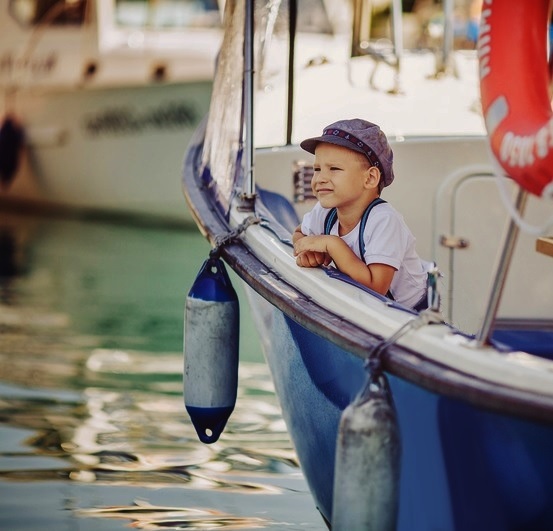 Oh, the toddler years, those delightful days when little ones begin to discover that they are, indeed, separate individuals from their parents and begin to test the waters to see how far out to sea their little boats can take them when they’ve got a full head of steam. This is the age when parents begin to wonder how in the world to tether their little steamboats to the docks or scuttle them in shallow waters to slow them down.
Obedience becomes a hot topic at moms’ groups and men’s breakfasts, at playdates and on park benches as parents wrestle with this new developmental stage that often shows up, unwelcome and unannounced, and the desperate, bewildered question being debated is always the same:
“How can I get my child to obey?”
Take a moment and examine what that question really means, though. Does it mean, “How can I control my child?” or does it mean, “How can I help my child learn self-control?” It’s an important distinction because the first meaning is external and temporary (i.e. only effective as long as the controlling factors are ever-present and escalate as the child grows) and the second meaning is internal and intrinsic. In the first, the rudder of a child’s ship is firmly removed from the child’s hands again and again as the parent and child struggle for control of the ship. In the second, the rudder remains in the child’s hands as the parent guides, instructs, and leads the way with their little steamboat sheltered alee of the parent ship.
Parents often feel lost at sea, themselves, when it comes to the best course for guiding and growing their children in the storm-tossed waves and murky waters of childhood behaviors, and many churches try to meet parent’s needs by offering parenting books and classes. A vast number of those resources are, unfortunately, based on a punitive, authoritarian model. These books, and the classes based on the books, claim to be Biblical, but miss the heart of the Father entirely and mislead and even intimidate parents into believing that they must train their children into instant, unquestioning obedience in order to raise their children ‘God’s way.’
Consider, though, that Jesus said, “You will know them by their fruit.” (Matthew 7:16) referring to how we will recognize his children. And what is the fruit of the Spirit? Love. Joy. Peace. Patience. Kindness. Goodness. Gentleness. Faithfulness. Self-control. What’s missing? Nothing. God’s Word is perfect. And yet obedience is not included as a fruit of the Spirit. It is not mentioned as a measure of love for God or evidence of a relationship with God. That certainly doesn’t mean that God doesn’t want us to listen to his wise counsel and remain within the safe boundaries he’s shared with us. What it does mean is that it’s a heart issue, not an obedience issue, and he wants our trust and thoughtful, considered cooperation, not our fear-driven, mindless obedience.
Did you know, in fact, that the word obey doesn’t even appear in the original texts of the Bible? When the English translators of the King James version of the Bible encountered the Hebrew words hupakouo/hupakoe and shema/lishmoa they discovered that there wasn’t an exact English equivalent, so they chose the word hearken in their translations which subsequently became an archaic term and was later changed to obey.24 So, what exactly do the original words in the Bible mean?
Hupakouo/hupakoe – to hear from above; to listen for; to lend an ear to1,2,3
Shema/lishmoa – to understand, to internalize, to ponder, to reflect upon1,2,3
And, in the negative form, rather than the word disobedience in the original texts, there is…
Parakouo – to close one’s ears to; to ignore1,2,3
The same mistranslation also occurs from the original Greek texts of the New Testament where peitho and peitharcheo are translated into, respectively, obey and disobey but actually mean…
Peitho – to be persuaded; to be moved; to respond25
Peitharcheo – to remain unpersuaded; to be unmoved by; to be unresponsive to25
Also translated into obey in English are the Greek words phulasso and teron and their various conjugations, all of which mean to watch, to observe carefully, to give consideration to25.
Taken together, the meaning of what is now translated obey in the original text of the Bible is more accurately read ‘listen to, thoughtfully consider, and respond to.’ That is a far, far different meaning than the ‘instant obedience’ often held up as the epitome of Christian faith and evidence of love for God and, by extension, the goal of so-called ‘Biblical parenting.’
Before we address the parenting conundrum of instant obedience versus thoughtful consideration, let’s look at several verses in the Bible with the original meanings restored:
He replied, “Blessed rather are those who hear the Word of God and obey listen to, thoughtfully consider, and respond to it.” (Luke 11:28)
Jesus replied, “Anyone who loves me will obey listen to, thoughtfully consider, and respond to my teaching. My Father will love them, and we will come to them and make our home with them. (John 14:23)
Children, obey listen to, thoughtfully consider, and respond to your parents in the Lord, for this is right. (Ephesians 6:1)
One other interesting note is that the word translated punish in the English versions of the Bible is from the Hebrew word avon and from the Greek kolasis/kolazo. Look at the contrast in meanings:
Punish (English) – to inflict a penalty upon; to exact retribution; to make suffer26
Avon (Hebrew) – to carry guilt; to bear one’s own iniquity1,2,3
Kolasis/kolazo (Greek) – removed; separated25
The word used in English translations of the Bible, punish, conveys an external infliction of negative consequences, while the original words, avon (Hebrew) and kolasis/kolazo (Greek) convey internal, self-imposed consequences (i.e. carrying the weight of guilt/shame) and natural consequences (i.e. being estranged).
There is no fear in love. But perfect love drives out fear, because fear has to do with punishment bearing one’s own iniquity, carrying guilt, feeling shame, being estranged. (1 John 4:18)
Jesus came to take our place, to bear our iniquities, to carry our guilt, to free us from shame, and to reunite us with our Father, and the literal translation conveys that truth perfectly.
The thing is, instant obedience and thoughtless compliance based on fear of punishment will always be an external and temporary ‘fix’ for behavior issues, as evidenced by the increasingly defiant and disconnected Israelite nation in the Old Testament, while thoughtful consideration and cooperation are internal, a heart-deep and soul-to-soul connection inspired by compassion, respect, and communication. Consider this passage from The Gentle Parent: Positive, Practical, Effective Discipline:
Someone once wrote, “Obedience is doing what you’re told, no matter what’s right. Morality is doing what’s right, no matter what you’re told.” History preserved the quote, but not the source with any credibility, but it’s a wise statement nonetheless.
Growing children with an inner compass that guides their steps toward kindness and compassion and generosity of spirit is far, far and away superior to training children to operate on automatic pilot. Parents often focus so much time and energy on trying to make their children obey in the small moments of life that they forget to step back and take a panoramic view of how their parenting choices may affect their children’s life course.
‘Instant obedience’ is the new catch-phrase in many popular parenting articles and books, but the reality is that, while instant obedience may be convenient for parents in the moment, it can have powerful negative impacts on the adults their children will become.
Training children into instant obedience is the equivalent of disabling their inner guidance system and strapping on a remote-controlled rocket. The end result may be adults who are easily controlled by others or adults who are deeply divided, constantly fighting the external controls, but hampered by an erratic, immature inner compass that never had the chance to develop properly.
Equipping children with a healthy, well-functioning internal guidance system, an inner compass, takes time, patience, and self-control on the part of the parents. Certainly not a convenient alternative! While it may not be convenient to slow down our hectic life pace and really connect with our children, it’s that connection that enables their internal guidance system to come online. While taking the time to really communicate may be a sacrifice, it’s in that communication that the directions on their inner guidance system are set. And, while working cooperatively with our children may take more time and effort, the fact is that inviting cooperation rather than forcing compliance raises leaders instead of reaping followers.
Clearly, teaching our children to control themselves is far more effective in the long-term than trying to control our children, but how, specifically, can we go about equipping them with those all-important internal controls?
- Model instead of manipulate.
- Invite instead of intimidate.
- Support instead of shame.
- Encourage instead of enrage.
- Teach instead of threaten.
- Listen instead of lecture.
- Help instead of hurt.
- Parent instead of punish.
Instant obedience and mindless compliance are poor goals, indeed, when raising children. A thoughtfully questioning, passionately curious, and humorously resourceful child who delights in inventing ‘compromises’ and who endlessly pushes the boundaries tends to become a thoughtful, passionate, resourceful adult who will change the world rather than being changed by the world.These are simple truths, and yet their effects are profound when we embrace them and incorporate them into our parenting. Connection, Communication, and Cooperation, the Three C’s of gentle parenting, are powerful and effective tools in guiding our children toward self-control to help them learn to steer their own ships, and, if we are to be fishers of men, then isn’t a ship headed out to sea exactly what each of us should be, anyway? Instead of mooring our children to the shore, let’s sail alongside them in the sometimes calm, sometimes stormy, but always glorious sea of life, keeping them sheltered on our leeward side until they are ready to sail alone.
“For I am the Lord your God who takes hold of your right hand and says to you, Do not fear; I will help you.”
Isaiah 41:13
Related posts:
Stealing God’s Gift: Free Will is a Gift to be Nurtured, Not a Curse to be Broken
Spare the Rod: The Heart of the Matter
Did Jesus Have a Temper Tantrum?
Jesus, the Gentle Parent: Gentle Christian Parenting
Tattered Tapestries: Weaving Trust Through the Chaos
Fear Doesn’t Lead to Faith: Becoming Your Child’s Safe Place
Where Did You Learn Love, Child?
Practical, Gentle, Effective Discipline
 Award-winnning author, L.R.Knost, is the founder and director of the children's rights advocacy and family consulting group, Little Hearts/Gentle Parenting Resources, and Editor-in-Chief of Holistic Parenting Magazine. Books by L.R.Knost include Whispers Through Time: Communication Through the Ages and Stages of Childhood ; Two Thousand Kisses a Day: Gentle Parenting Through the Ages and Stages ; The Gentle Parent: Positive, Practical, Effective Discipline ; and Jesus, the Gentle Parent: Gentle Christian Parenting the first four books in the Little Hearts Handbook gentle parenting series, and children’s picture books Petey’s Listening Ears and the soon-to-be-released Grumpykins series.

Reading Challenge 2014!
[Portions reprinted from Raising Bookworms: Life, Learning, and Literacy by L.R.Knost available 2014; Two Thousand Kisses a Day: Gentle Parenting Through the Ages and Stages, Whispers Through Time: Communication Through the Ages and Stages of Childhood, and The Gentle Parent: Positive, Practical, Effective Discipline now available on Amazon]
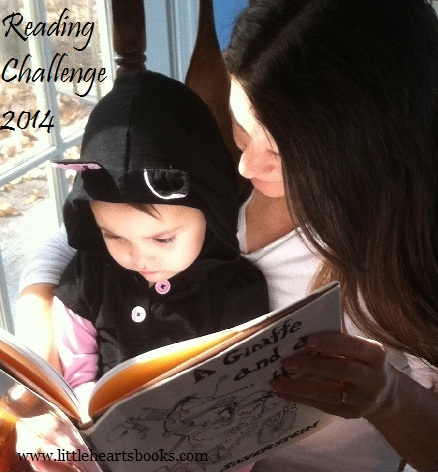 Experts agree that the single best way to turn children on to a life-long love of reading is to simply read to them. Not only is reading to our little ones wonderful for their education, though, but it is also a fun and easy way to build and maintain a strong parent/child connection. Let’s join together this year and commit to reading to our children (or with them if they’re older!) every day of 2014.
Old books, new books, read books, glued books (a nod to my favorite children’s author, Dr. Seuss!), it doesn’t matter what you read. Just read! Read old familiar books your children ask for over and over and over. Read new books you check out from the library or buy from your local independent bookstore. Read books from your own childhood that are passed down through your family. Read books you write together with your children and glue into construction paper pages tied together with yarn. Just read, read, read! (And stop back by and leave a comment with an update now and then to share how you’re doing and which books are your children’s favorites!)
Here are a few links to some book lists to get you started:
Bookworm weighs in on must-have books for your children in Little Hearts’ How to Build a Home Library for Bookworms from Tots to Teens series. Check out…
25 Must-Have Books for Baby Bookworms
25 Must-Have Books for Toddler Bookworms
25 Must-Have Books for Preschool Bookworms
For more ideas about sharing a love of learning with your children, here is my virtual reading room, its bookshelves filled with literacy tips, book recommendations, literary quotes, learning through play ideas, and more. Pour yourself a cup of coffee, grab a cozy chair, and join me on the journey of a lifetime…
- When it comes to reading, do you want your children to become readers or just learn the mechanics of reading? Do you want them to love to read or just to know how? If a love of reading is your goal for your children, here are some ideas to get you started… 8 Tips for Raising Bookworms
- Fairy tales in childhood are stepping-stones throughout life, leading the way through trouble and trial. The value of fairy tales lies not in a brief literary escape from reality, but in the gift of hope that goodness truly is more powerful than evil and that even the darkest reality can lead to a Happily Ever After. Do not take that gift of hope lightly. It has the power to conquer despair in the midst of sorrow, to light the darkness in the valleys of life, to whisper “One more time” in the face of failure. Hope is what gives life to dreams, making the fairy tale the reality. Fairy Tales~The Lost Value of ‘Once upon a time…’
- Imagination is the language of childhood, so speaking their language when introducing our language only makes sense. Let’s ditch the flashcards, turn off the educational dvd’s, and throw out the worksheets…because learning is child’s play! Alphabet Fun~Imagination From A to Z!
- Successful reading means far more than possessing the ability to read. Engaging the hearts of students moves reading success beyond a life skill and turns it into a life style. And graphic novels are too powerful of a tool in our arsenal to be disregarded because of pride or prejudice… Raising Super Readers~The MARVELous Power of Comic Books!
- There is such a rush these days to get children sleeping through the night, weaned off the breast, eating solid foods, potty trained, reading independently, and on and on, that we seem to have lost the ability to simply enjoy life as it happens and let our children do the same. A Return to Childhood
- In the world of a child wonders are as simple as sticks and sheets, leaves and books, boxes and giggles, and the promise in a rainy day. The Seven Wonders of the World of Childhood
- Albert Einstein said, “Everybody is a genius. But if you judge a fish on its ability to climb a tree, it will live its whole life believing that it is stupid.” Unique learners have beautiful minds just waiting to find their genius. We just need to look outside of the box to help them find it. Helping Unique Learners Find Their Genius
- Think homeschooled children are unsocialized, over-controlled, locked-away-from-the-world misfits? Think again! My Renaissance Girl
- My SPD/SLD/ADD (Sensory Processing Disorder, Specific Learning Disability-Dyslexia, Visual and Auditory Processing Disorders, Attention Deficit Disorder, etc) sweetie, aka Renaissance Girl, has raised the bar on my homeschooling skills more times than I can count. Her beautiful mind sees the world through a unique lens similar to those of historical icons such as Thomas Edison, Leonardo Da Vinci, Benjamin Franklin, and Albert Einstein…Beautiful Minds
- Books + Time + Imagination = Endless possibilities! 25 Reasons NOT to Keep Your Children Busy
- I’ve been scouring the web, the bookshelves, and my scattered brain for all the Seussical fun I could find for my little people and yours. Here are a few of my finds… Seuss-ified~Craft-astic~Snack-errific~Education-cool~Fun!
- Parenting choices strongly impact the level and type of attachment a child develops and, by extension, the development of a love of learning. A love of learning grows when it isn’t stifled by fear or stress or regimented by over-structuring or a focus on achievement or competition. Parents fostering a healthy attachment are thus also fostering a life-long love of learning in their children. Love, Play, Learn!
- Truly, what is our goal for our children? Knowledge memorized in lists and tables and regurgitated on bubble-in tests? Or knowledge coupled with experience that leads to understanding and, ultimately, wisdom? Benjamin Franklin said it best when he said, “Tell me and I forget. Teach me and I remember. Involve me and I learn.” The Many Adventures of My Little Pooh Bear
- If you give a toddler a book | He’ll climb into your lap | While he’s in your lap | He might lay his head on your chest | When he lays his head on your chest | He’ll hear your heartbeat | When he hears your heartbeat | He’ll probably ask if you can hear his… If You Give A Toddler A Book…
Award-winnning author, L.R.Knost, is the founder and director of the children's rights advocacy and family consulting group, Little Hearts/Gentle Parenting Resources, and Editor-in-Chief of Holistic Parenting Magazine. Books by L.R.Knost include Whispers Through Time: Communication Through the Ages and Stages of Childhood ; Two Thousand Kisses a Day: Gentle Parenting Through the Ages and Stages ; The Gentle Parent: Positive, Practical, Effective Discipline ; and Jesus, the Gentle Parent: Gentle Christian Parenting the first four books in the Little Hearts Handbook gentle parenting series, and children’s picture books Petey’s Listening Ears and the soon-to-be-released Grumpykins series.
Helping Unique Learners Find Their Genius ♥

[From Raising Bookworms: Life, Learning, and Literacy by L.R.Knost available 2014; Two Thousand Kisses a Day: Gentle Parenting Through the Ages and Stages, Whispers Through Time: Communication Through the Ages and Stages of Childhood, and The Gentle Parent: Positive, Practical, Effective Discipline now available on Amazon]
~~~~~~~~~~~~~~~~~~~~~
 Homeschooling a unique learner can be challenging simply because they don’t get the benefit of access to testing and professional support without a lot of initiative, research, phone calls, and door-knocking on your part. But the trade-off is the freedom to tailor your teaching and learning environment to your child’s needs, and that is of incredible value when educating a unique learner.
Albert Einstein said, “Everybody is a genius. But if you judge a fish on its ability to climb a tree, it will live its whole life believing that it is stupid.” Unique learners have beautiful minds just waiting to find their genius. We just need to look outside of the box to help them find it!
Here are some of the tips, tools, and techniques I’ve learned through years of homeschooling my unique learners to help them work through the challenges they face on a daily basis:
1.) Lighten up…Everything in life is easier if you take it with a grain of salt and learn to laugh. Our unique learners will have more struggles and challenges than the average person throughout life, not just during their school years. That is an unavoidable fact. But who wants to be ‘average’ anyway? Help them to celebrate their uniqueness and embrace the future with grace and humor by sharing your own struggles, modeling coping techniques, and being able to laugh at your own mistakes. Make ‘even missteps are valuable steps on the road to success’ your homeschool motto!
2.) Play…Children learn best through play, and that applies to therapy, as well. Experience is the only true path to learning, so let their imaginations soar as they do the hard work of learning to cope with their unique challenges. (See some play-based, brain-enriching, and eye-tracking activities below)
3.) Jazz it up…Music truly is medicine for the soul. Buy a good set of headphones (not earbuds) and play classic instrumentals softly while your unique learner is trying to concentrate, whether it be on reading or writing or drawing, etc. Filtering out the cacophony of life and soothing their stress levels with the gentle strains of Mozart are only some of the benefits of music. Another benefit is that the rhythms, cadence, and timing of music actually have an organizing effect on the brain!
4.) Exercise…Invest in an exercise bicycle (We got ours for $15 from a yard sale!) that lets your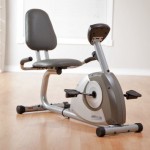 unique learner sit in a comfortable seat while pedaling. The cross-over action of pedaling also has an organizing effect on the brain, and, if used while reading or playing video games (Video games can be great exercises for eye-tracking if you choose the right ones!) can actually increase the speed and effectiveness of learning.
5.) Get crunchy…Believe it or not, another ‘brain organizing’ activity is chewing, particularly crunchy foods, while reading, etc. Some good choices are pretzels, carrot sticks, celery, granola, and nuts. (If you’ve got a sensory sweetie like I do, be careful to let them choose something that won’t send their senses into overdrive.) Sugarless chewing gum can be substituted when you go places where foods aren’t appropriate, but still would like to offer your child a calming, organizing aid.
6.) Listen, listen, listen…Your unique learner will have more than their share of stress and possibly a harder time articulating it than others might. Slow down and really focus on what they are communicating. Listen ‘between the lines’ to their heart, their hurts, their fears, their needs. Be their safe place, their source of comfort and renewal.
7.) Hug it out…Physical closeness is healing, and so make sure that along with the extra struggles and challenges your unique learner faces, they get lots of extra cuddles, snuggles, and hugs. When they get older, a gentle touch on their shoulder or a light hand on their arm will be instantly calming and comforting because it will tap into those feelings of comfort and closeness from earlier childhood.
8.) Watch and learn…Just as every child is different, every child with challenges is unique in how they manifest those challenges and how they handle them. Paying careful attention to your own unique learner’s personality, struggles, aversions, triggers, etc. will give you clues as to how to help them learn to cope. With SPD (Sensory Processing Disorder), for example, avoiding unpleasant stimulus and providing needed stimulus is the name of the game. Typically, you’ll want to provide a quiet learning area at home, lots of freedom to move, permission to step away and de-stress when they feel overwhelmed, etc. and, when going out, avoid buffet-style restaurants and loud, crowded shopping and entertainment venues.
9.) Guide them gently…Discipline (guiding, modeling, teaching, etc.) invites communication and strengthens your parent/child connection. Punishment stifles communication and strains parent/child connections. Keep those vital lines of communication open and your parent/child connection healthy by providing consistent boundaries and gentle guidance, being open to discussion, and modeling the desired behavior.
10.) Read, read, read…Successful readers are not simply those who understand the mechanics of reading any more than successful biking is understanding the mechanics of a bicycle. Readers are born when a love for reading is fostered. Let them see you reading often. Cuddle up and read to them when they are young. Co-read (you read a sentence, they read a sentence, etc) when they are new readers or when they are tired or struggling. Let them read comics (The relation of pictures to words is a huge aid in reading comprehension.). For more reading tips, see Raising Bookworms.
Here are some exercises and activities that have helped my Renaissance Girl with her challenges with SPD, dyslexia, ADD, visual/auditory processing disorders, dyscalculia, etc:
Gross motor and fine motor cross-over exercises to get the two sides of the brain communicating more efficiently…
~Bouncing a brightly colored ball back and forth between us using alternate hands (left, right, left, right, etc.)
~Skipping, marching, swinging while singing 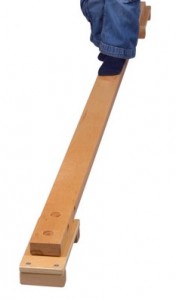
~Climbing
~Balance beam
~Bicycling
~Piano
~Sorting 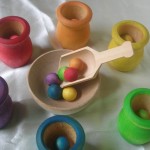
Brain-organizing activities…
~Memory matching
~Tonal music
~Free-style building with blocks, Tinker Toys, Legos, etc.
~Design-matching building
~Sensory bins
Eye-tracking activities…
~Laser pointer games-following a laser pointer light in a darkened room, pointing to moving targets (i.e. bubbles), etc.
~Ceiling tracing-following the seam of the wall and ceiling from corner to corner moving only the eyes
~Video games-Flash Focus and Brain Age are good choices for the Gameboy. Wii Fit, Carnival Games, and Sports Games are good for the Wii. There are also great games for improving eye-tracking for the X-box, Playstation, and online. If you do the research to find what best fits your child’s interests, you’ll have much better participation!
Visual-motor learning…
~Clay letters-tactile learning by forming letters and words on a template with clay or dough 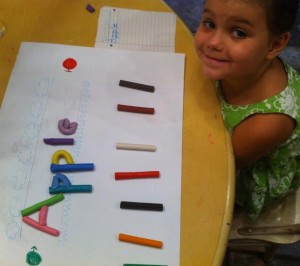
~Contextual learning-Children with dyslexia tend to learn better in context than by breaking things down to their parts, so phonics-based learning is often mind-boggling for them. Flashcards are a no-go because speed and movement impede their attempts to focus rather than help them. Writing-based learning such as copying and illustrating short poems, copying a short sentence from a wall-mounted chalkboard or large paper taped to the wall and illustrating it, writing and illustrating their own stories, and writing stories on the computer are great ways to help them learn to read.
~Once they are beginning to read, graphic novels, large-print chapter books on topics that interest them, and continued creative writing are excellent practice.
~Online reading games can be helpful, but only if they are untimed (Timed anything is a huge stressor and sets them up for frustration and failure.) and your child feels comfortable with the level of activity and brightness on the screen as otherwise these can cause headaches and their eyes to tire quickly.
These tips are not, of course, exhaustive or a replacement for professional therapies. But as you work your way through what can often be a labyrinth of paperwork, meetings, appointments, etc. on your way to finding the services your child needs, these may help to ease the wait a bit. 🙂
Related posts:
Children who love to read…READ! Engaging children’s hearts in the wonder of reading instead of just training their minds in its mechanics. Raising Bookworms
It’s time for a return to childhood, to simplicity, to running and climbing and laughing in the sunshine, to experiencing happiness instead of being trained for a lifetime of pursuing happiness…it’s time to let children be children again. A Return to Childhood
Think homeschooled children are unsocialized, over-controlled, locked-away-from-the-world misfits? Think again! My Renaissance Girl
Successful reading means far more than possessing the ability to read. Engaging the hearts of students moves reading success beyond a life skill and turns it into a life style. And graphic novels are too powerful of a tool in our arsenal to be disregarded because of pride or prejudice. Raising Super Readers~The MARVELous Power of Comic Books!
In the world of a child wonders are as simple as sticks and sheets, leaves and books, boxes and giggles, and the promise in a rainy day. The Seven Wonders of the World of Childhood
Parenting choices strongly impact the level and type of attachment a child develops and, by extension, the development of a love of learning. A love of learning grows when it isn’t stifled by fear or stress or regimented by over-structuring or a focus on achievement or competition. Parents fostering a healthy attachment are thus also fostering a life-long love of learning in their children. Live to Play~Play to Learn~Learn to Live!
If you give a toddler a book
He’ll climb into your lap
While he’s in your lap
He might lay his head on your chest
When he lays his head on your chest
He’ll hear your heartbeat
When he hears your heartbeat
He’ll probably ask if you can hear… If You Give A Toddler A Book…
Einstein recognized his unique lens and often commented about it and about how organized education systems didn’t accommodate individuality and creativity. Here is a look into this ‘unique learner’s’ mind in his own words…Beautiful Minds
Award-winnning author, L.R.Knost, is the founder and director of the children's rights advocacy and family consulting group, Little Hearts/Gentle Parenting Resources, and Editor-in-Chief of Holistic Parenting Magazine. Books by L.R.Knost include Whispers Through Time: Communication Through the Ages and Stages of Childhood ; Two Thousand Kisses a Day: Gentle Parenting Through the Ages and Stages ; The Gentle Parent: Positive, Practical, Effective Discipline ; and Jesus, the Gentle Parent: Gentle Christian Parenting the first four books in the Little Hearts Handbook gentle parenting series, and children’s picture books Petey’s Listening Ears and the soon-to-be-released Grumpykins series.
Rethinking Tattling
[Portions reprinted from Whispers Through Time: Communication Through the Ages and Stages of Childhood by L.R.Knost. Two Thousand Kisses a Day: Gentle Parenting Through the Ages and Stages and The Gentle Parent: Positive, Practical, Effective Discipline also available through Amazon and other major retailers.]
~~~~~~~~~~~~~~~~~~~~~
 “She won’t share!”
“He took my crayon!”
“They won’t let me play with them!”
“He looked at me!”
“She poked me!”
“They’re jumping on the couch!”
“He won’t be my friend!”
Few things irritate adults as quickly as a tattle-tale. The kneejerk response is often “Stop tattling!” or “Handle it yourself!” or even to shame or punish little tattlers.
But stop for a moment and think: What is being communicated? What is a child actually trying to tell us when they tattle? What message is a child getting by our response?
Tattling is, in effect, a child seeking wise counsel for a situation they don’t know how to handle. When faced with a conflict that just weeks or months earlier would have resulted in tears or snatching or hitting or some combination of all three, a child who has matured and begun to develop some self-control is learning to stop and think instead of just react. But what do they do if no solution presents itself? What if they’ve tried to reason or negotiate with the object of their conflict and been unable to come to a resolution?
What do adults do when they don’t know what to do? Typically, they either respond with maturity and seek out someone they respect and trust to help them deal with the situation, or they degenerate into chaotic emotions and resort to anger, power-plays, and manipulation. Often their response is influenced by their own childhood and how they were taught or not taught, as the case may be, to handle conflict.
When a child tattles, what they are actually doing is a rudimentary form of the advanced life skill of ‘Pause. Think. Respond.’ but they need help finding an appropriate and effective response. The child who seeks out an adult for guidance is indicating trust in the adult and respect for the adult’s opinions and abilities. If the adult reacts with irritation, “Stop tattling!” or rejection, “Handle it yourself!” or punishment, the child learns not to trust, not to seek guidance, and not to share struggles and problems with those entrusted with their care, a potentially dangerous mentality, as we’ll discuss later. In addition, an excellent teachable moment is lost.
When a child approaches a trusted adult with a problem, the child is saying, “This is important. Hear me. Help me.” This is a wonderful opportunity to guide the child through the process of conflict resolution. So often we relegate life skills such as conflict resolution to textbooks and worksheets, if we address them at all. But learning is far more powerful and effective if it is tied to real-life, real-time issues that are important to us, that impact our lives, that matter.
So how do we handle the kneejerk irritation response when confronted with a tattling child? First, tossing out the tattling label entirely helps to adjust our mindset and focus on the child’s need for guidance. We can rename it ‘sharing’ or whatever else will help us in the rethinking process (though in our home it is just a normal and accepted part of our parent/child interaction and doesn’t have a name of its own to distinguish it from any other kind of communication).
Next, we can have prepared responses ready so that we aren’t ‘stuck’ when we’re trying to cope with our instinctive irritation in the same moment that we need to focus on helping an upset child in need of guidance.
Here are some possible responses:
If the child is over-wrought…
- “I can see you’re upset. Let’s take a minute and breathe together, and then we’ll be able to think clearly.”
When the child is calm enough to talk…
- “Can you tell me what happened to upset you?”
- “Why do you think they did that?”
- “How do you think we should handle that?”
- “What could you have done differently?”
- “What would you want them to do if you had been the one to do that?”
Often just feeling heard is enough to help the child find their own solution to the problem, but if further guidance is needed we can brainstorm solutions with them, walk them through some possible scenarios, or step in and help them to resolve the problem.
In addition to teaching valuable conflict resolution skills, giving our children the sure knowledge that they aren’t alone in the world and don’t have to cope with life on their own is a vital message. Logically speaking, does it really make sense to teach our children that they can’t trust us with their problems, can’t come to us when they’re stressed and don’t know how to cope, can’t seek wise counsel when confronted with situations that are beyond their ability to handle?
The potential ramifications of that mindset are chilling. Can we really expect children to have the mental clarity and emotional maturity to be able to distinguish ‘good’ telling from ‘bad’ telling when faced with bullying or peer pressure or sexual predators? It’s well known that sexual predators manipulate children with threats such as, “No one will believe you,” and, “No one will listen, anyway.”
Guarding our children against those lies, against the bullies, against pressure from their peers is essential, and keeping the communication doors flung wide open is certainly a powerful step in the right direction.
Related posts:
The Thoughtful Parent’s Guide to Positive Parenting Guides
The Gift of a Strong-Willed Child
When Children Hit~10 Tips for Parents
Backtalk is Communication…LISTEN
Practical, Gentle, Effective Discipline
Award-winnning author, L.R.Knost, is the founder and director of the children's rights advocacy and family consulting group, Little Hearts/Gentle Parenting Resources, and Editor-in-Chief of Holistic Parenting Magazine. Books by L.R.Knost include Whispers Through Time: Communication Through the Ages and Stages of Childhood ; Two Thousand Kisses a Day: Gentle Parenting Through the Ages and Stages ; The Gentle Parent: Positive, Practical, Effective Discipline ; and Jesus, the Gentle Parent: Gentle Christian Parenting the first four books in the Little Hearts Handbook gentle parenting series, and children’s picture books Petey’s Listening Ears and the soon-to-be-released Grumpykins series.
25 Must-Have Books for Baby Bookworms
 Bookworm weighs in on must-have books for your children in Little Hearts’ How to Build a Home Library for Bookworms from Tots to Teens series. Check out 25 Must-Have Books for Toddler Bookworms and 25 Must-Have Books for Preschool Bookworms, and watch for 25 Must-Have Books for Early Elementary Bookworms, 25 Must-Have Books for Tween Bookworms, 25 Must-Have Books for Teen Bookworms, and 25 Must-Have Books for Young Adult Bookworms in the coming weeks as well as literacy tips, book activities, and book nook ideas!
1.)
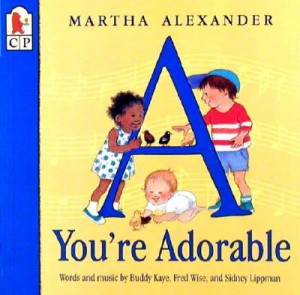 ‘A’ You’re Adorable by Martha Alexander
This sweet alphabet board book is based on a song popularized by Perry Como in the 1940’s.
Preview:
A, you‘re adorable; B, you’re so beautiful; C, you’re a cutie full of charms; D, you’re a darling; and E, you’re exciting; and F, you’re a feather in my arms; G, you look good to me; H, you’re so heavenly…
2.)
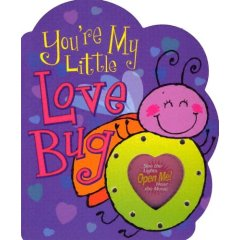 You’re My Little Lovebug by Heidi R. Weimer
My own little lovebug adores this book with its catchy and silly rhymes and sweet message.
Preview:
You’re my little lovebug/My cuddly kangaroo/My funny bunny sweet as honey/All of this is true…
3.)
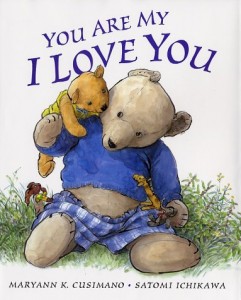 You Are My I Love You by Maryann K. Cusimano
This is one of my all-time favorites with its gentle cadence and touching rhymes.
Preview:
I am your parent; You are my child / I am your quiet place; You are my wild / I am your calm face; You are my giggle / I am your wait; You are my wiggle…
4.)
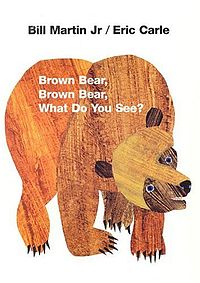 Brown Bear, Brown Bear, What Do You See? by Bill Martin Jr.
This iconic book from the 1960’s offers an energetic, rhythmic introduction to colors and animals in a unique collage of tissue-paper art.
Preview:
Brown Bear, Brown Bear, what do you see? I see a Red Bird looking at me. Red bird, Red bird, what do you see? I see a Yellow Duck looking at me…
5.)
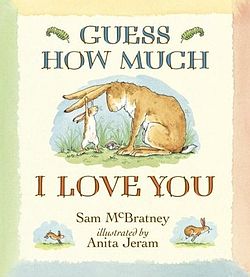 Guess How Much I Love You by Sam McBratney
With artwork as sweet and mellow as its gently humorous message, this is one of the best bedtime books I’ve ever read to my little ones.
Preview:
Little Nutbrown Hare, who was going to bed, held on tight to Big Nutbrown Hare’s very long ears. He wanted to be sure that Big Nutbrown Hare was listening. “Guess how much I love you,” he said…
6.)
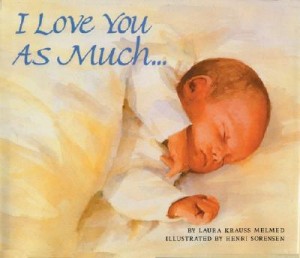 I Love You As Much… by Laura Krauss Melmed
The gorgeous illustrations of mother animals with their babies are enough to make this book a keeper, but the lilting lullaby quality of the wording make it a lovely and thoughtful baby shower gift, as well!
Preview:
Said the mother camel to her child, “I love you as much as the desert is dry”. Said the mother goose to her child, “I love you as much as the endless blue sky”…
7.)
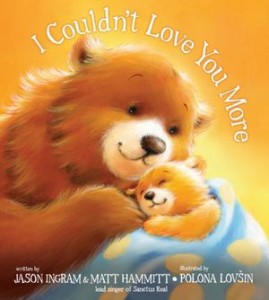 I Couldn’t Love You More by Jason Ingram
Written by singer/songwriter Jason Ingram for his unborn son diagnosed with a serious heart defect, this gorgeously illustrated book is based on the words to a touching and lovely lullaby your little ones will enjoy cuddling up to again and again.
Preview:
I couldn’t love you more. But Somebody does. In the night, He is with you. At morning’s light, He is with you. Do not fear…
8.)
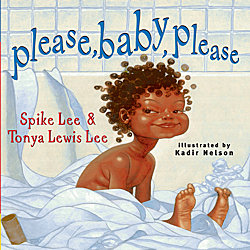 Please, Baby, Please by Spike Lee
Not only is the artwork in this book heart-meltingly adorable, but this little person getting into one thing after another with her natural curiosity and playful demeanor are so, so, so real that mamas and daddies everywhere will be grinning and nodding their heads while reading this to their own adorable little explorers.
Preview:
Go back to bed, please, baby, please. Not on your head, baby, baby, baby, please…
9.)
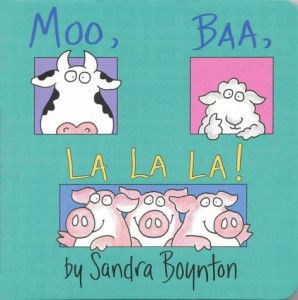 Moo Baa La La La by Sandra Boynton
This is a cute little rhyming board book that will make your little one giggle while introducing them to animal sounds (Although, if you want to be strictly literal, pigs don’t actually say, “La, la, la,” in case there was any confusion 🙂 )
Preview:
The cow says MOO! The sheep says BAA! Three singing pigs say LA LA LA…
10.)
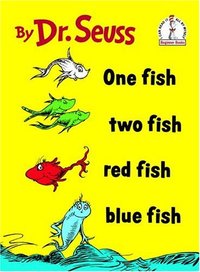 One fish, two fish, red fish, blue fish by Dr Seuss
Always one of my children’s first Dr. Seuss favorites with its fun and silly rhymes, lively cadence, and engagingly colorful illustrations!
Preview:
One fish, two fish, red fish, blue fish. Black fish, blue fish, old fish, new fish. This one has a little star. This one has a little car. Say! What a lot of fish there are…
11.)
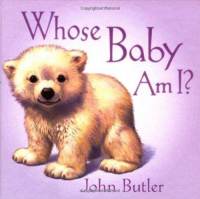 Whose Baby Am I? by John Butler
These baby animal illustrations by top wildlife artist John Butler are beyond adorable! And while sharing this sweet little book with your baby, you’ll be introducing the concept of which animal babies belong with which mothers. So, so cute!
Preview:
Whose baby am I? I am an owl baby! Whose baby am I? I am a koala baby…
12.)
 Global Babies by The Global Fund for Children
My baby loves looking at pictures of other babies, and this book with its gorgeous photos of babies from around the world kept her riveted. I loved the many cultures and ethnicities represented along with the message of sameness in the midst of our differences.
Preview:
Wherever they live, wherever they go, whatever they where, whatever they feel…
13.)
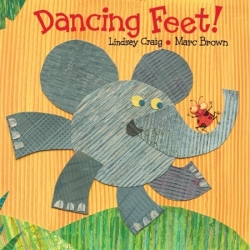 Dancing Feet by Lindsey Craig
A cute little board book with a lively rhythm and musical rhymes that will have your little ones dancing along with the beat!
Preview:
Ladybugs are dancing on tippety feet! Tippety! Tippety! Happy feet! Stompity! Stompity! Big grey feet! Who is dancing that stompity beat? Elephant is dancing on stompity feet…
14.)
 Baby’s First Bible by Colin and Moira MacLean
This cute and colorful board book introduces little ones to Bible stories in simple rhymes, verses, and engaging illustrations. One of my children’s favorites!
Preview:
Flowers and tress, the sun way up high, fish in the ocean, birds that can fly! All kinds of creatures, big ones and small, with Adam and Eve taking care of them all…
15.)
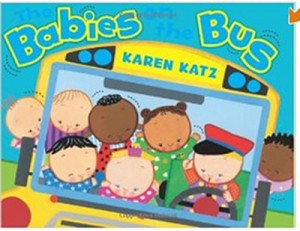 Babies on the Bus by Karen Katz
This is a cute way to introduce babies to the many beautiful colors people come in around the world while entertaining them with the classic children’s song ‘Wheels on the Bus.’
Preview:
The babies on the bus sing, “La, la, la. La, la, la. La, la, la.” The babies on the bus sing, “La, la, la.” All through the town. The wheels on the bus go round and round, round and round…
16.)
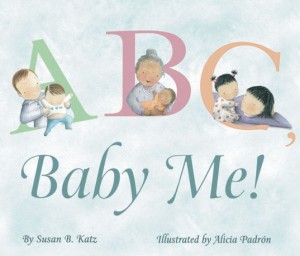 ABC Baby Me! by Susan B. Katz
This little board book isn’t the least bit boring with its gentle rhythm and sweet artwork that also introduces little ones to the alphabet!
Preview:
Adore me. Bathe me. Cuddle me, too. Diaper me. Encourage me. Fix my boo-boo…
17.)
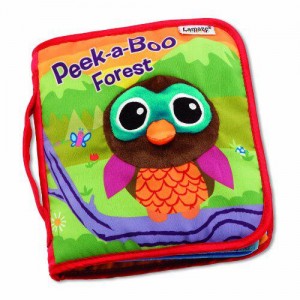 Peek-a-boo Forest by Lamaze Books
What baby doesn’t love peek-a-boo? This adorable cloth book combines a baby’s love for peek-a-boo with cute little rhythms and rhymes…win-win!
Preview:
Who is sleeping deep down there? Peek-a-boo! It’s the bear!
18.)
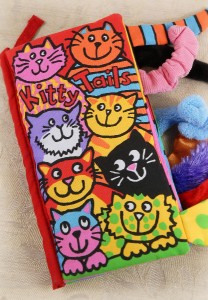 Kitten Tails by Jellycat
This is a brilliant cloth book for little bookworms who enjoy munching on books as much as they enjoy you reading them!
Preview:
Wrinkly tail, Smooth tail, Furry tail, Skinny tail…
19.)
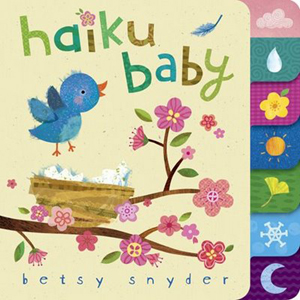 Haiku Baby by Betsy E. Snyder
This small book with its simple illustrations of birds and animals, sunshine and snowflakes, will capture your little ones’ interest as you read them one delightful haiku after another.
Preview:
In tickley-toe grass,
a buttercup offers up
yellow nose kisses
20.)
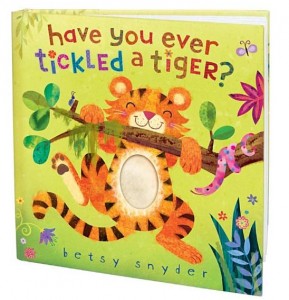 Have You Ever Tickled a Tiger? by Betsy E. Snyder
This adorable little interactive board book invites little ones to touch and poke and tickle their way through a jungle of cute animals and silly rhymes.
Preview:
Have you ever fluffed an ostrich? Say “coochie-coo” when you tickle her wing-it’s a fluffy, puffy, feathery thing…
21.)
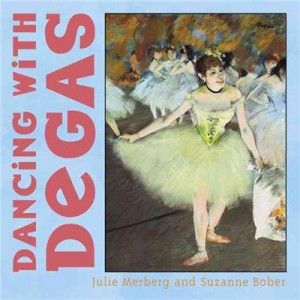 Dancing with Degas by Julie Merberg
Lovely in form and flowing with poetry that honors the spirit of Degas, this small book moves with the cadence of the dancers as they plie and pirouette through painting after painting.
Preview:
Stretching legs and pointing toes, practice makes perfect for each pretty pose. The teacher counts 1, 2, 3, 4, and dancers spin across the floor…
22.)
 In the Garden with Van Gogh by Julie Merberg
In poetic form that is a little dreamy, a little staccato, just like Van Gogh’s distinctive painting style, this little board book captures the essence of this eclectic and earthy artist beautifully.
Preview:
Plant and pick, sow and reap, all things that grow need time for sleep, in the quiet light of a starry night…
23.)
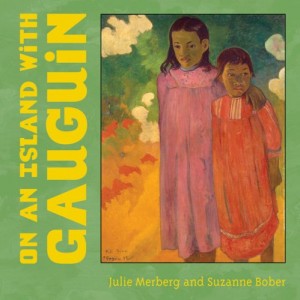 On an Island with Gauguin by Julie Merberg
I absolutely love this introduction to the art of Gauguin with its rhythmic pacing and lyrical poetry that weaves the spirit of Gauguin’s paintings into words. So, so beautiful!
Preview:
On an island in the warm South Seas, there a village nestled among the trees. Down a bright green path from a small brown hut, a man chops wood while peacocks strut…
24.)
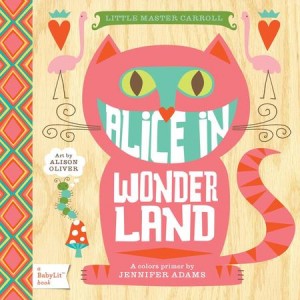 Alice in Wonderland: A Babylit Board Book by Jennifer Adams
Vintage-looking artwork honors the era of this classic Lewis Carroll novel while introducing little ones to the timeless characters, making quirky references to classic scenes, and sharing some color fun along the way.
Preview:
White rabbit (Don’t be late!). Black shoes (Down the rabbit hole!). Purple bottle (Drink me!). Blue caterpillar (Who are you?)…
25.)
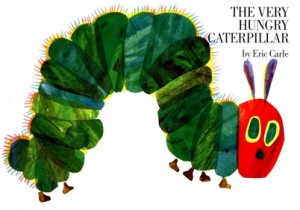 The Very Hungry Caterpillar by Eric Carle
In this popular story, a little caterpillar gets bigger and bigger and bigger as he eats his way through the days of the week, introducing numbers, foods, and the life-cycle of a butterfly along the way!
Preview:
In the light of the moon, a little egg lay on a leaf. One Sunday morning the warm sun came up and ‘Pop!’ out of the egg came a tiny and very hungry caterpillar. He started to look for some food. On Monday, he ate through one apple. But he was still hungry…
~~~~~~~~~~~~~~
 Don’t forget to check out 25 Must-Have Books for Toddler Bookworms and 25 Must-Have Books for Preschool Bookworms!
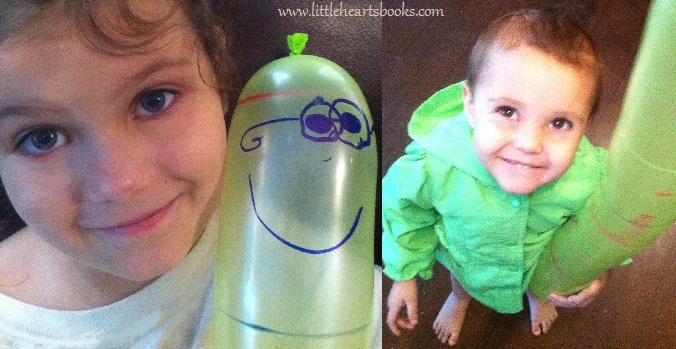
Here are my two youngest playing with bookworms they made from super long ‘rocket’ balloons. ♥
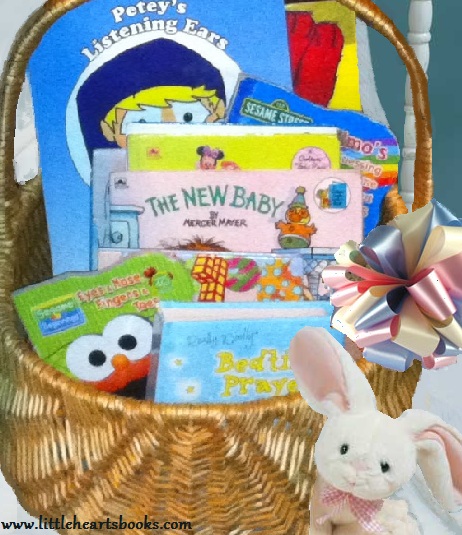 If you’re looking for baby shower ideas or new arrival gifts, how about a gift basket with a set of starter library books! Click on the pictures below to check out some links with more awesome ideas:
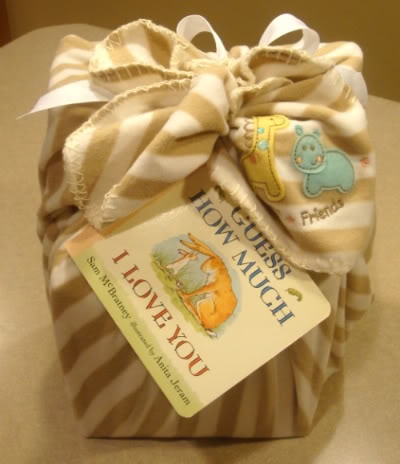

Source: bumpsmitten.com via Laughing Giraffe Books on Pinterest
Related posts:
Children who love to read…READ! Engaging children’s hearts in the wonder of reading instead of just training their minds in its mechanics. Raising Bookworms
In the world of a child wonders are as simple as sticks and sheets, leaves and books, boxes and giggles, and the promise in a rainy day. The Seven Wonders of the World of Childhood
Fairy tales in childhood are stepping stones throughout life, leading the way through trouble and trial. The value of fairy tales lies not in a brief literary escape from reality, but in the gift of hope that goodness truly is more powerful than evil and that even the darkest reality can lead to a Happily Ever After. Do not take that gift of hope lightly. It has the power to conquer despair in the midst of sorrow, to light the darkness in the valleys of life, to whisper “One more time” in the face of failure. Hope is what gives life to dreams, making the fairy tale the reality. Fairy Tales~The Lost Value of ‘Once upon a time…’
There is such a rush these days to get children sleeping through the night, weaned off the breast, eating solid foods, potty trained, reading independently, and on and on, that we seem to have lost the ability to simply enjoy life as it happens and let our children do the same. A Return to Childhood
On a Winnie the Pooh style ‘long explore’ my little Pooh Bear discovered the world in ways only a toddler can in…The Many Adventures of My Little Pooh Bear
Successful reading means far more than possessing the ability to read. Engaging the hearts of students moves reading success beyond a life skill and turns it into a life style. And graphic novels are too powerful of a tool in our arsenal to be disregarded because of pride or prejudice. Raising Super Readers~The MARVELous Power of Comic Books!
Parenting choices strongly impact the level and type of attachment a child develops and, by extension, the development of a love of learning. A love of learning grows when it isn’t stifled by fear or stress or regimented by over-structuring or a focus on achievement or competition. Parents fostering a healthy attachment are thus also fostering a life-long love of learning in their children. Love, Play, Learn!
If you give a toddler a book
He’ll climb into your lap
While he’s in your lap
He might lay his head on your chest
When he lays his head on your chest
He’ll hear your heartbeat
When he hears your heartbeat
He’ll probably ask if you can hear… If You Give A Toddler A Book…
Award-winnning author, L.R.Knost, is the founder and director of the children's rights advocacy and family consulting group, Little Hearts/Gentle Parenting Resources, and Editor-in-Chief of Holistic Parenting Magazine. Books by L.R.Knost include Whispers Through Time: Communication Through the Ages and Stages of Childhood ; Two Thousand Kisses a Day: Gentle Parenting Through the Ages and Stages ; The Gentle Parent: Positive, Practical, Effective Discipline ; and Jesus, the Gentle Parent: Gentle Christian Parenting the first four books in the Little Hearts Handbook gentle parenting series, and children’s picture books Petey’s Listening Ears and the soon-to-be-released Grumpykins series.
Helping Unique Learners Find Their Genius
[From Raising Bookworms: Life, Learning, and Literacy by L.R.Knost available 2014; Two Thousand Kisses a Day: Gentle Parenting Through the Ages and Stages, Whispers Through Time: Communication Through the Ages and Stages of Childhood, and The Gentle Parent: Positive, Practical, Effective Discipline now available on Amazon and through other major retailers.]
Homeschooling a unique learner can be challenging simply because they don’t get the benefit of access to testing and professional support without a lot of initiative, research, phone calls, and door-knocking on your part. But the trade-off is the freedom to tailor your teaching and learning environment to your child’s needs, and that is of incredible value when educating a unique learner.
Albert Einstein said, “Everybody is a genius. But if you judge a fish on its ability to climb a tree, it will live its whole life believing that it is stupid.” Unique learners have beautiful minds just waiting to find their genius. We just need to look outside of the box to help them find it!
Here are some of the tips, tools, and techniques I’ve learned through years of homeschooling my unique learners to help them work through the challenges they face on a daily basis:
1.) Lighten up…Everything in life is easier if you take it with a grain of salt and learn to laugh. Our unique learners will have more struggles and challenges than the average person throughout life, not just during their school years. That is an unavoidable fact. But who wants to be ‘average’ anyway? Help them to celebrate their uniqueness and embrace the future with grace and humor by sharing your own struggles, modeling coping techniques, and being able to laugh at your own mistakes. Make ‘even missteps are valuable steps on the road to success’ your homeschool motto!
2.) Play…Children learn best through play, and that applies to therapy, as well. Experience is the only true path to learning, so let their imaginations soar as they do the hard work of learning to cope with their unique challenges. (See some play-based, brain-enriching, and eye-tracking activities below)
3.) Jazz it up…Music truly is medicine for the soul. Buy a good set of headphones (not earbuds) and play classic instrumentals softly while your unique learner is trying to concentrate, whether it be on reading or writing or drawing, etc. Filtering out the cacophony of life and soothing their stress levels with the gentle strains of Mozart are only some of the benefits of music. Another benefit is that the rhythms, cadence, and timing of music actually have an organizing effect on the brain!
4.) Exercise…Invest in an exercise bicycle (We got ours for $15 from a yard sale!) that lets your unique learner sit in a comfortable seat while pedaling. The cross-over action of pedaling also has an organizing effect on the brain, and, if used while reading or playing video games (Video games can be great exercises for eye-tracking if you choose the right ones!) can actually increase the speed and effectiveness of learning.
5.) Get crunchy…Believe it or not, another ‘brain organizing’ activity is chewing, particularly crunchy foods, while reading, etc. Some good choices are pretzels, carrot sticks, celery, granola, and nuts. (If you’ve got a sensory sweetie like I do, be careful to let them choose something that won’t send their senses into overdrive.) Sugarless chewing gum can be substituted when you go places where foods aren’t appropriate, but still would like to offer your child a calming, organizing aid.
6.) Listen, listen, listen…Your unique learner will have more than their share of stress and possibly a harder time articulating it than others might. Slow down and really focus on what they are communicating. Listen ‘between the lines’ to their heart, their hurts, their fears, their needs. Be their safe place, their source of comfort and renewal.
7.) Hug it out…Physical closeness is healing, and so make sure that along with the extra struggles and challenges your unique learner faces, they get lots of extra cuddles, snuggles, and hugs. When they get older, a gentle touch on their shoulder or a light hand on their arm will be instantly calming and comforting because it will tap into those feelings of comfort and closeness from earlier childhood.
8.) Watch and learn…Just as every child is different, every child with challenges is unique in how they manifest those challenges and how they handle them. Paying careful attention to your own unique learner’s personality, struggles, aversions, triggers, etc. will give you clues as to how to help them learn to cope. With SPD (Sensory Processing Disorder), for example, avoiding unpleasant stimulus and providing needed stimulus is the name of the game. Typically, you’ll want to provide a quiet learning area at home, lots of freedom to move, permission to step away and de-stress when they feel overwhelmed, etc. and, when going out, avoid buffet-style restaurants and loud, crowded shopping and entertainment venues.
9.) Guide them gently…Discipline (guiding, modeling, teaching, etc.) invites communication and strengthens your parent/child connection. Punishment stifles communication and strains parent/child connections. Keep those vital lines of communication open and your parent/child connection healthy by providing consistent boundaries and gentle guidance, being open to discussion, and modeling the desired behavior.
10.) Read, read, read…Successful readers are not simply those who understand the mechanics of reading any more than successful biking is understanding the mechanics of a bicycle. Readers are born when a love for reading is fostered. Let them see you reading often. Cuddle up and read to them when they are young. Co-read (you read a sentence, they read a sentence, etc) when they are new readers or when they are tired or struggling. Let them read comics (The relation of pictures to words is a huge aid in reading comprehension.). For more reading tips, see Raising Bookworms.
Here are some exercises and activities that have helped my Renaissance Girl with her challenges with SPD, dyslexia, ADD, visual/auditory processing disorders, dyscalculia, etc:
Gross motor and fine motor cross-over exercises to get the two sides of the brain communicating more efficiently…
~Bouncing a brightly colored ball back and forth between us using alternate hands (left, right, left, right, etc.)
~Skipping, marching, swinging while singing
~Climbing
~Balance beam
~Bicycling
~Piano
~Sorting
Brain-organizing activities…
~Memory matching
~Tonal music
~Free-style building with blocks, tinkertoys, legos, etc.
~Design-matching building
~Sensory bins
Eye-tracking activities…
~Laser pointer games-following a laser pointer light in a darkened room, pointing to moving targets (i.e. bubbles), etc.
~Ceiling tracing-following the seam of the wall and ceiling from corner to corner moving only the eyes
~Video games-Flash Focus and Brain Age are good choices for the Gameboy. Wii Fit, Carnival Games, and Sports Games are good for the Wii. There are also great games for improving eye-tracking for the X-box, Playstation, and online. If you do the research to find what best fits your child’s interests, you’ll have much better participation!
Visual-motor learning…
~Clay letters-tactile learning by forming letters and words on a template with clay or dough
~Contextual learning-Children with dyslexia tend to learn better in context than by breaking things down to their parts, so phonics-based learning is often mind-boggling for them. Flashcards are a no-go because speed and movement impede their attempts to focus rather than help them. Writing-based learning such as copying and illustrating short poems, copying a short sentence from a wall-mounted chalkboard or large paper taped to the wall and illustrating it, writing and illustrating their own stories, and writing stories on the computer are great ways to help them learn to read.
~Once they are beginning to read, graphic novels, large-print chapter books on topics that interest them, and continued creative writing are excellent practice.
~Online reading games can be helpful, but only if they are untimed (Timed anything is a huge stressor and sets them up for frustration and failure.) and your child feels comfortable with the level of activity and brightness on the screen as otherwise these can cause headaches and their eyes to tire quickly.
These tips are not, of course, exhaustive or a replacement for professional therapies. But as you work your way through what can often be a labyrinth of paperwork, meetings, appointments, etc. on your way to finding the services your child needs, these may help to ease the wait a bit. 🙂
Related posts:
Children who love to read…READ! Engaging children’s hearts in the wonder of reading instead of just training their minds in its mechanics. Raising Bookworms
It’s time for a return to childhood, to simplicity, to running and climbing and laughing in the sunshine, to experiencing happiness instead of being trained for a lifetime of pursuing happiness…it’s time to let children be children again. A Return to Childhood
Think homeschooled children are unsocialized, over-controlled, locked-away-from-the-world misfits? Think again! My Renaissance Girl
Successful reading means far more than possessing the ability to read. Engaging the hearts of students moves reading success beyond a life skill and turns it into a life style. And graphic novels are too powerful of a tool in our arsenal to be disregarded because of pride or prejudice. Raising Super Readers~The MARVELous Power of Comic Books!
In the world of a child wonders are as simple as sticks and sheets, leaves and books, boxes and giggles, and the promise in a rainy day. The Seven Wonders of the World of Childhood
Parenting choices strongly impact the level and type of attachment a child develops and, by extension, the development of a love of learning. A love of learning grows when it isn’t stifled by fear or stress or regimented by over-structuring or a focus on achievement or competition. Parents fostering a healthy attachment are thus also fostering a life-long love of learning in their children. Live to Play~Play to Learn~Learn to Live!
If you give a toddler a book
He’ll climb into your lap
While he’s in your lap
He might lay his head on your chest
When he lays his head on your chest
He’ll hear your heartbeat
When he hears your heartbeat
He’ll probably ask if you can hear… If You Give A Toddler A Book…
Einstein recognized his unique lens and often commented about it and about how organized education systems didn’t accommodate individuality and creativity. Here is a look into this ‘unique learner’s’ mind in his own words…Beautiful Minds
Award-winnning author, L.R.Knost, is the founder and director of the children's rights advocacy and family consulting group, Little Hearts/Gentle Parenting Resources, and Editor-in-Chief of Holistic Parenting Magazine. Books by L.R.Knost include Whispers Through Time: Communication Through the Ages and Stages of Childhood ; Two Thousand Kisses a Day: Gentle Parenting Through the Ages and Stages ; The Gentle Parent: Positive, Practical, Effective Discipline ; and Jesus, the Gentle Parent: Gentle Christian Parenting the first four books in the Little Hearts Handbook gentle parenting series, and children’s picture books Petey’s Listening Ears and the soon-to-be-released Grumpykins series.
25 Reasons NOT to Keep Your Children Busy
1.) Books + Time + Imagination = Endless possibilities!

Want to raise a bookworm? Try interest-inspired summer reading instead of summer reading lists. Books come to life when read with our hearts, not just our minds!
2.) There are forts to be built, people!

It is in the nooks and niches we carve out for ourselves (even as adults!) that the world seems a little smaller, a little friendlier, a little less overwhelming.
3.) Boredom is the workshop of innovation!
This nine-year-old boy spent the summer kicking around in his father’s parts store, and this is the amazing result!
4.) Trees need friends, too!
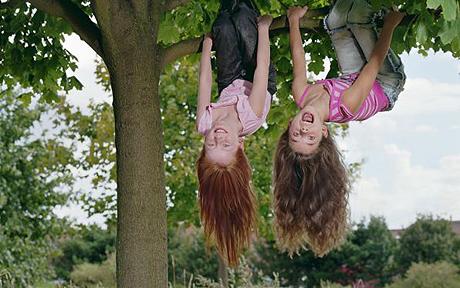
5.) Busyness left us in the dark (a.k.a. the struggle for survival kept us in the Dark Ages!), but the dawn of leisure led to the Age of Enlightenment!

Chill time is prime time for a Renaissance Girl 🙂
6.) Children don’t need to learn how to learn. They need to be allowed to learn.
The most beautiful thing we can experience is the mysterious. It is the source of all true art and science. Albert Einstein
7.) Who has time to cuddle when you’re always on the run?
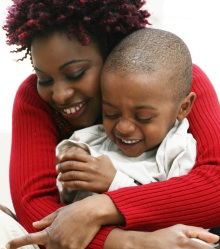
He’ll climb into your lap
While he’s in your lap
He might lay his head on your chest
When he lays his head on your chest
He’ll hear your heartbeat
When he hears your heartbeat…
8.) Downtime is uplifting when imaginations take flight!
 Let’s pack happiness into our children so the baggage they take into adulthood is goodness, confidence, and kindness instead of packing bags of hurt, struggle, and loneliness that will weigh them down for life. ~L.R.Knost
200 Ways to Bless Your Children with a Happy Childhood
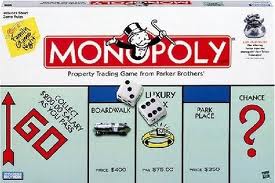
9.) Board games get bored when they’re ignored!
10.) Wonders of the world don’t discover (or invent!) themselves!
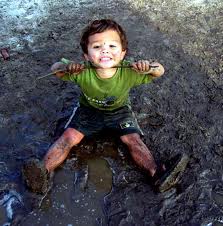
In the world of a child wonders are as simple as sticks and sheets, leaves and books, boxes and giggles, and the promise in a rainy day. The Seven Wonders of the World of Childhood
11.) Superheroes need time to practice their superpowers!

Successful reading means far more than possessing the ability to read. Engaging the hearts of students moves reading success beyond a life skill and turns it into a life style. And graphic novels are too powerful of a tool in our arsenal to be disregarded because of pride or prejudice. Raising Super Readers~The MARVELous Power of Comic Books!
12.) Playgrounds aren’t just for childsplay. Sandboxes can be soapboxes!
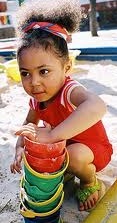
Children need to process, too!
Playground Confessions~Look Who’s Talking!
13.) Children discovering how fossils are made is great, but children discovering who they were created to be really rocks!
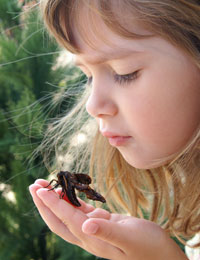
“Who am I? What inspires me? What will I be?”
Chatterboxes and Dreamers~Middle Childhood
14.) Someone has to take care of the zombie infestation!

While video game playing certainly needs to be monitored and in moderation, there is measurable value in it. “Early studies on psychomotor skills have demonstrated that videogame players have superior eye–hand coordination, visualization skills, and faster reaction times” which may result in advancements in micro-surgery, remote intelligence operation capabilities, etc. In addition, ‘zoning out’ so-to-speak, has inherent stress-reduction benefits that are harder to measure, but of value, nonetheless.
15.) Mad scientists and inventors need time and materials, not busyness and schedules!
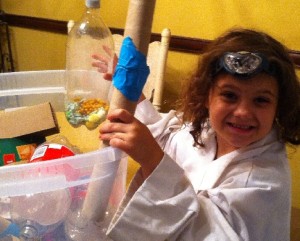
My inventor girl with her first creations, a calm-me-jar ‘shaker’ (don’t know how calming that will be, but that’s beside the point, lol!) and a super dooper telescope that can see anything no matter how far away it is!
16.) “Never underestimate the value of doing nothing” ~A.A.Milne
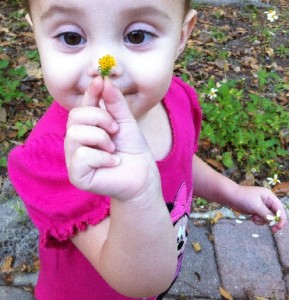
On a Winnie the Pooh style ‘long explore’ my little Pooh Bear discovered the world in The Many Adventures of My Little Pooh Bear
“What I like doing best is Nothing.”
“How do you do Nothing,” asked Pooh after he had wondered for a long time.
“Well, it’s when people call out at you just as you’re going off to do it, ‘What are you going to do, Christopher Robin?’ and you say, ‘Oh, Nothing,’ and then you go and do it.”
17.) Summertime is Muller Time!

The human brain needs time to process, categorize, prioritize, analyze, and otherwise make sense of all of the trillions of bits of information that it receives each day. Non-structured playtime for children functions much like sleep does for adults, giving their brains the time and space they need to move short-term memory to long term learning.
18.) There are dragons to be slain!
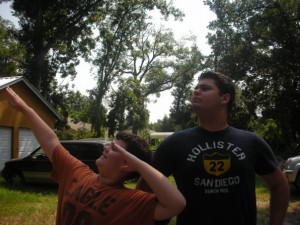
“Fairy tales do not tell children that dragons exist. Children already know that dragons exist. Fairy tales tell children the dragons can be beaten.” ~ G. K. Chesterton
Fairy Tales~The Lost Treasure of “Once Upon a Time…”
19.) When would they have time to come up with all of their amazing questions?
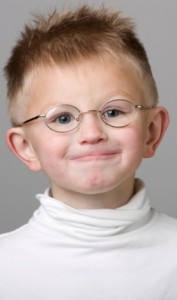
“Why don’t monkeys wear clothes?”
“Why don’t we live on the moon?”
“Why does ice have to be cold?”
“Why can’t my frog sleep in my bed?”
“Why do we have hair?”
“Why don’t clouds come in my window?”
Why, oh why do children always ask WHY?
20.) Creators need their rest, too!

Children are creating a whole new life for themselves in this great, big, beautiful world.
21.) Children live to play, play to learn, and learn to live!
“Play is often talked about as if it were a relief from serious learning. But for children play is serious learning. Play is really the work of childhood.”~Fred Rogers
22.) Children are happiness experts.
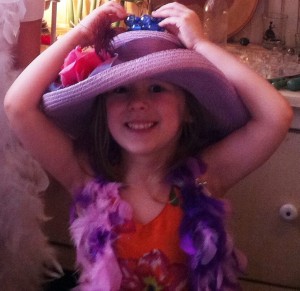
Perhaps it is time for a return to childhood, to simplicity, to running and climbing and laughing in the sunshine, to experiencing happiness instead of being trained for a lifetime of pursuing happiness…perhaps it is time to let children be children again. A Return to Childhood
23.) The impossible is possible in the carefree moments of childhood!
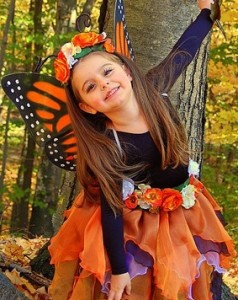
“Sometimes I’ve believed as many as six impossible things before breakfast.” ~Lewis Carroll
24.) Little Things think the bestest thoughts when Big People let them out of the box!
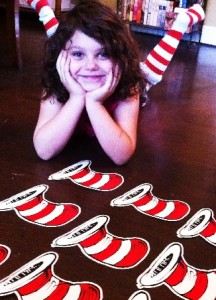
“Oh the thinks you can think, if only you try!” ~Dr. Seuss
Seussical Fun for Little Ones!
25.) Children need time to simply be…
Award-winnning author, L.R.Knost, is the founder and director of the children's rights advocacy and family consulting group, Little Hearts/Gentle Parenting Resources, and Editor-in-Chief of Holistic Parenting Magazine. Books by L.R.Knost include Whispers Through Time: Communication Through the Ages and Stages of Childhood ; Two Thousand Kisses a Day: Gentle Parenting Through the Ages and Stages ; The Gentle Parent: Positive, Practical, Effective Discipline ; and Jesus, the Gentle Parent: Gentle Christian Parenting the first four books in the Little Hearts Handbook gentle parenting series, and children’s picture books Petey’s Listening Ears and the soon-to-be-released Grumpykins series.
Play~Bubbles and Babies and Butterflies
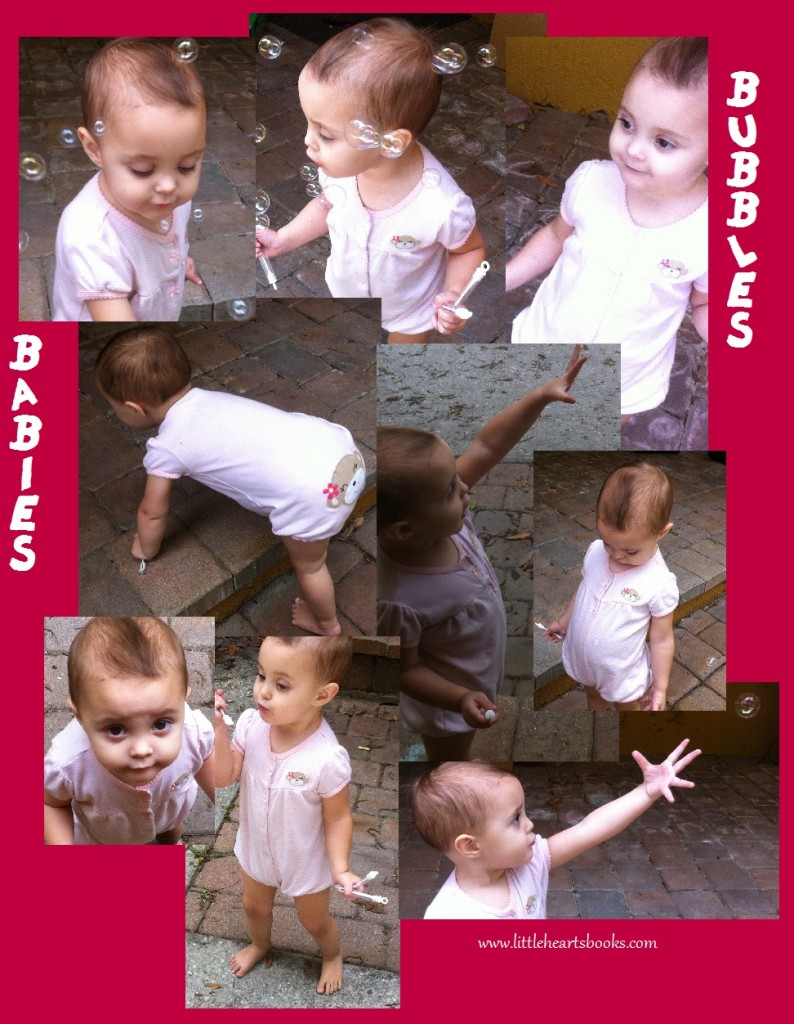 Sunshiny days fly on butterfly wings
Filled with wading pools, sidewalk chalk, springy-time things
Bubbles and babies and bear-bottomed rompers
Mudpies and magpies and jump-rope trick jumpers
Swinging and sliding and climbing and running
Learning, discovering, growing, becoming
No time to waste they are seizing the day
The work of a child is simply to play
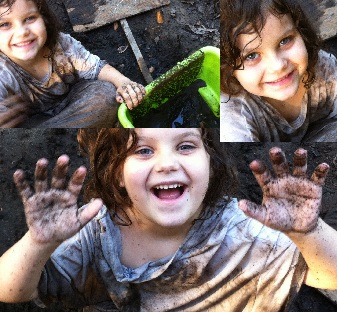
Best. Schoolday. Ever!
Related posts:
On a Winnie the Pooh style ‘long explore’ my little Pooh Bear discovered the world in The Many Adventures of My Little Pooh Bear
Children who love to read…READ! Engaging children’s hearts in the wonder of reading instead of just training their minds in its mechanics. Raising Bookworms
Think homeschooled children are unsocialized, over-controlled, locked-away-from-the-world misfits? Think again! My Renaissance Girl
In the world of a child wonders are as simple as sticks and sheets, leaves and books, boxes and giggles, and the promise in a rainy day. The Seven Wonders of the World of Childhood
There is such a rush these days to get children sleeping through the night, weaned off the breast, eating solid foods, potty trained, reading independently, and on and on, that we seem to have lost the ability to simply enjoy life as it happens and let our children do the same. A Return to Childhood
Parenting choices strongly impact the level and type of attachment a child develops and, by extension, the development of a love of learning. A love of learning grows when it isn’t stifled by fear or stress or regimented by over-structuring or a focus on achievement or competition. Parents fostering a healthy attachment are thus also fostering a life-long love of learning in their children. Live to Play~Play to Learn~Learn to Live!
Successful reading means far more than possessing the ability to read. Engaging the hearts of students moves reading success beyond a life skill and turns it into a life style. And graphic novels are too powerful of a tool in our arsenal to be disregarded because of pride or prejudice. Raising Super Readers~The MARVELous Power of Comic Books!
If you give a toddler a book
He’ll climb into your lap
While he’s in your lap
He might lay his head on your chest
When he lays his head on your chest
He’ll hear your heartbeat
When he hears your heartbeat
He’ll probably ask if you can hear…
Award-winnning author, L.R.Knost, is the founder and director of the children's rights advocacy and family consulting group, Little Hearts/Gentle Parenting Resources, and Editor-in-Chief of Holistic Parenting Magazine. Books by L.R.Knost include Whispers Through Time: Communication Through the Ages and Stages of Childhood ; Two Thousand Kisses a Day: Gentle Parenting Through the Ages and Stages ; The Gentle Parent: Positive, Practical, Effective Discipline ; and Jesus, the Gentle Parent: Gentle Christian Parenting the first four books in the Little Hearts Handbook gentle parenting series, and children’s picture books Petey’s Listening Ears and the soon-to-be-released Grumpykins series.
The Many Adventures of My Little Pooh Bear
“There is nothing that human beings do, know, think, hope, and fear that has not been attempted, experienced, practiced, or at least anticipated in children’s play.”~Heidi Britz-Crecelius
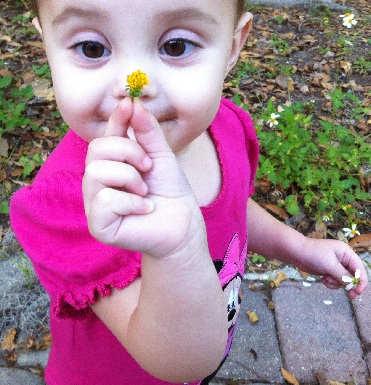
“Weeds are flowers, too, once you get to know them.” A.A.Milne
As A.A.Milne wrote in The Many Adventures of Winnie the Pooh, we went on a long ‘explore’ the other day simply because “It was a drowsy summer [well, actually, spring] afternoon, and the Forest was full of gentle sounds…”
My poor little Pooh Bear has been sick for weeks now, and I’ve been taking her out in the sunshine for a daily dose of vitamin D and fresh air to supplement her traditional medicines. On this particular day, which just happened to be the first day of spring, I played the role of adoring paparazzi and just snapped picture after picture as my little explorer wandered here and there at her own toddling pace. Looking over the myriad of pictures later was educational…for me!
My little explorer studied…
Light and Shadow as she danced with her shadow…
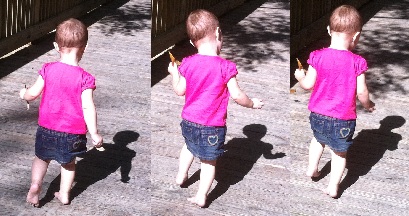
Me 'n my shadow
and moved leaves back and forth, back and forth from sun to shade and back again.
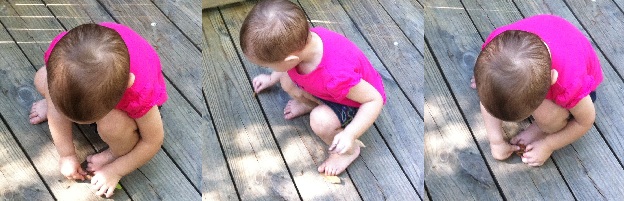
Leaf Shadows
Texture as she went from the wooden foot bridge to the concrete and studied the hard and soft, the rough and smooth, the cold and warm.
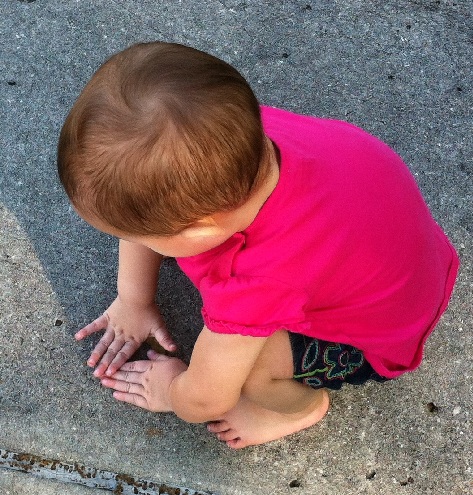
This feels different than the wooden bridge!
Physics as she threw leaves into the breeze and discovered how the small ones fluttered away and the big ones fell unless she crumpled them into smaller pieces.
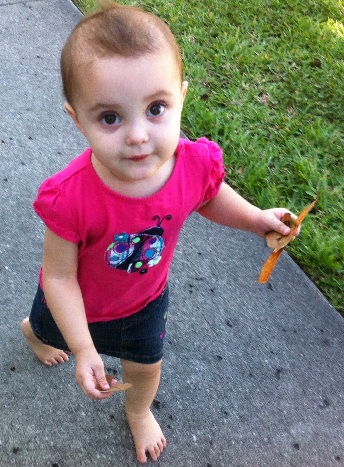
Ah Ha! Some leaves float in the wind when I throw them, and some drop to the ground!
Directionality as she put leaves over the railing, through the railing, and under the railing.
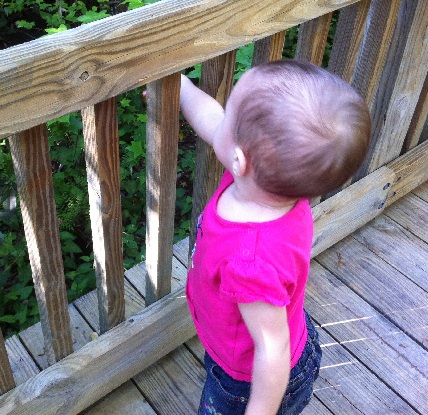
Over, Under, Through!
And so much more, all in a supervised, but undirected day of play!
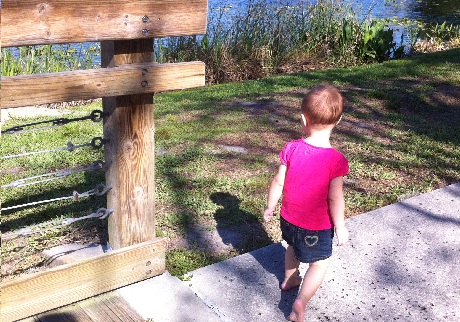
“Sometimes, if you stand on the bottom rail of a bridge and lean over to watch the river slipping slowly away beneath you, you will suddenly know everything there is to be known.”~A.A.Milne
Studies are confirming what early childhood education experts have known for years…Formal instruction can interfere with a preschooler’s creativity and problem-solving skills. A.A.Milne clearly understood that fact long ago when he included this thought-provoking dialogue in his classic children’s picture book,
“Rabbit’s clever,” said Pooh thoughtfully.
“Yes,” said Piglet, “Rabbit’s clever.”
“And he has a Brain.”
“Yes,” said Piglet, “Rabbit has a Brain.”
There was a long silence.
“I suppose,” said Pooh, “that that’s why he never understands anything.”
Gail Connel of Moving Smart puts it this way, “When we say ‘learning’ we actually mean ‘understanding,’ described by Merriam-Webster as ‘to grasp the meaning of.'” She goes on to give an example:
“Point to the top of your head, then point to the top of your toe. You pointed in two completely different directions. So what does ‘top’ mean? And if ‘top’ is in both of those places, then where is the top of the page?
Only after learning ‘top’ in many different ways will they begin to understand that ‘top’ is more than a location, it’s a concept. And to do that, they must experience it – literally and physically — by pointing to the top, touching the top, crawling along the top, running to the top, reaching the top, and on and on. And while they’re doing that, your use of the word ‘top’ helps them associate what they’re doing with what it’s called.
LANGUAGE + EXPERIENCE = UNDERSTANDING”
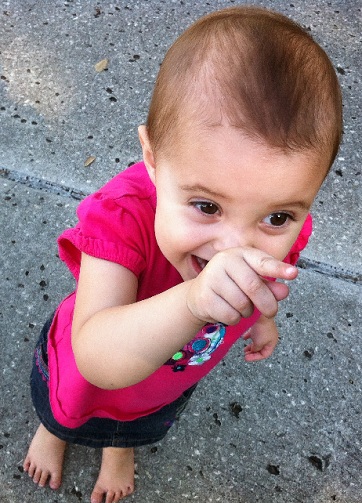
“Promise me you'll always remember: You're braver than you believe, and stronger than you seem, and smarter than you think.”~A.A.Milne
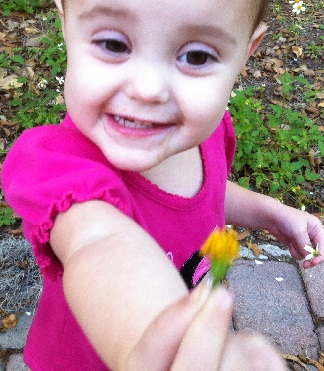
“Yesterday is history, tomorrow is a mystery, but today is a gift. That's why we call it the present." ~Winnie the Pooh
Related posts:
Children who love to read…READ! Engaging children’s hearts in the wonder of reading instead of just training their minds in its mechanics. Raising Bookworms
Think homeschooled children are unsocialized, over-controlled, locked-away-from-the-world misfits? Think again! My Renaissance Girl
In the world of a child wonders are as simple as sticks and sheets, leaves and books, boxes and giggles, and the promise in a rainy day. The Seven Wonders of the World of Childhood
There is such a rush these days to get children sleeping through the night, weaned off the breast, eating solid foods, potty trained, reading independently, and on and on, that we seem to have lost the ability to simply enjoy life as it happens and let our children do the same. A Return to Childhood
Parenting choices strongly impact the level and type of attachment a child develops and, by extension, the development of a love of learning. A love of learning grows when it isn’t stifled by fear or stress or regimented by over-structuring or a focus on achievement or competition. Parents fostering a healthy attachment are thus also fostering a life-long love of learning in their children. Live to Play~Play to Learn~Learn to Live!
Successful reading means far more than possessing the ability to read. Engaging the hearts of students moves reading success beyond a life skill and turns it into a life style. And graphic novels are too powerful of a tool in our arsenal to be disregarded because of pride or prejudice. Raising Super Readers~The MARVELous Power of Comic Books!
If you give a toddler a book
He’ll climb into your lap
While he’s in your lap
He might lay his head on your chest
When he lays his head on your chest
He’ll hear your heartbeat
When he hears your heartbeat
He’ll probably ask if you can hear…
Award-winnning author, L.R.Knost, is the founder and director of the children's rights advocacy and family consulting group, Little Hearts/Gentle Parenting Resources, and Editor-in-Chief of Holistic Parenting Magazine. Books by L.R.Knost include Whispers Through Time: Communication Through the Ages and Stages of Childhood ; Two Thousand Kisses a Day: Gentle Parenting Through the Ages and Stages ; The Gentle Parent: Positive, Practical, Effective Discipline ; and Jesus, the Gentle Parent: Gentle Christian Parenting the first four books in the Little Hearts Handbook gentle parenting series, and children’s picture books Petey’s Listening Ears and the soon-to-be-released Grumpykins series.