
A Sea Change: Obedience is Not the Goal
[Excerpt reprinted from Jesus, the Gentle Parent: Gentle Christian Parenting by L.R.Knost. Two Thousand Kisses a Day: Gentle Parenting Through the Ages and Stages; Whispers Through Time: Communication Through the Ages and Stages of Childhood; and The Gentle Parent: Positive, Practical, Effective Discipline by L.R.Knost also available on Amazon and through other major retailers.]
“Look also at ships: although they are so large and are driven by fierce winds, they are turned by a very small rudder wherever the pilot desires.”
James 3:4
 Oh, the toddler years, those delightful days when little ones begin to discover that they are, indeed, separate individuals from their parents and begin to test the waters to see how far out to sea their little boats can take them when they’ve got a full head of steam. This is the age when parents begin to wonder how in the world to tether their little steamboats to the docks or scuttle them in shallow waters to slow them down.
Obedience becomes a hot topic at moms’ groups and men’s breakfasts, at playdates and on park benches as parents wrestle with this new developmental stage that often shows up, unwelcome and unannounced, and the desperate, bewildered question being debated is always the same:
“How can I get my child to obey?”
Take a moment and examine what that question really means, though. Does it mean, “How can I control my child?” or does it mean, “How can I help my child learn self-control?” It’s an important distinction because the first meaning is external and temporary (i.e. only effective as long as the controlling factors are ever-present and escalate as the child grows) and the second meaning is internal and intrinsic. In the first, the rudder of a child’s ship is firmly removed from the child’s hands again and again as the parent and child struggle for control of the ship. In the second, the rudder remains in the child’s hands as the parent guides, instructs, and leads the way with their little steamboat sheltered alee of the parent ship.
Parents often feel lost at sea, themselves, when it comes to the best course for guiding and growing their children in the storm-tossed waves and murky waters of childhood behaviors, and many churches try to meet parent’s needs by offering parenting books and classes. A vast number of those resources are, unfortunately, based on a punitive, authoritarian model. These books, and the classes based on the books, claim to be Biblical, but miss the heart of the Father entirely and mislead and even intimidate parents into believing that they must train their children into instant, unquestioning obedience in order to raise their children ‘God’s way.’
Consider, though, that Jesus said, “You will know them by their fruit.” (Matthew 7:16) referring to how we will recognize his children. And what is the fruit of the Spirit? Love. Joy. Peace. Patience. Kindness. Goodness. Gentleness. Faithfulness. Self-control. What’s missing? Nothing. God’s Word is perfect. And yet obedience is not included as a fruit of the Spirit. It is not mentioned as a measure of love for God or evidence of a relationship with God. That certainly doesn’t mean that God doesn’t want us to listen to his wise counsel and remain within the safe boundaries he’s shared with us. What it does mean is that it’s a heart issue, not an obedience issue, and he wants our trust and thoughtful, considered cooperation, not our fear-driven, mindless obedience.
Did you know, in fact, that the word obey doesn’t even appear in the original texts of the Bible? When the English translators of the King James version of the Bible encountered the Hebrew words hupakouo/hupakoe and shema/lishmoa they discovered that there wasn’t an exact English equivalent, so they chose the word hearken in their translations which subsequently became an archaic term and was later changed to obey.24 So, what exactly do the original words in the Bible mean?
Hupakouo/hupakoe – to hear from above; to listen for; to lend an ear to1,2,3
Shema/lishmoa – to understand, to internalize, to ponder, to reflect upon1,2,3
And, in the negative form, rather than the word disobedience in the original texts, there is…
Parakouo – to close one’s ears to; to ignore1,2,3
The same mistranslation also occurs from the original Greek texts of the New Testament where peitho and peitharcheo are translated into, respectively, obey and disobey but actually mean…
Peitho – to be persuaded; to be moved; to respond25
Peitharcheo – to remain unpersuaded; to be unmoved by; to be unresponsive to25
Also translated into obey in English are the Greek words phulasso and teron and their various conjugations, all of which mean to watch, to observe carefully, to give consideration to25.
Taken together, the meaning of what is now translated obey in the original text of the Bible is more accurately read ‘listen to, thoughtfully consider, and respond to.’ That is a far, far different meaning than the ‘instant obedience’ often held up as the epitome of Christian faith and evidence of love for God and, by extension, the goal of so-called ‘Biblical parenting.’
Before we address the parenting conundrum of instant obedience versus thoughtful consideration, let’s look at several verses in the Bible with the original meanings restored:
He replied, “Blessed rather are those who hear the Word of God and obey listen to, thoughtfully consider, and respond to it.” (Luke 11:28)
Jesus replied, “Anyone who loves me will obey listen to, thoughtfully consider, and respond to my teaching. My Father will love them, and we will come to them and make our home with them. (John 14:23)
Children, obey listen to, thoughtfully consider, and respond to your parents in the Lord, for this is right. (Ephesians 6:1)
One other interesting note is that the word translated punish in the English versions of the Bible is from the Hebrew word avon and from the Greek kolasis/kolazo. Look at the contrast in meanings:
Punish (English) – to inflict a penalty upon; to exact retribution; to make suffer26
Avon (Hebrew) – to carry guilt; to bear one’s own iniquity1,2,3
Kolasis/kolazo (Greek) – removed; separated25
The word used in English translations of the Bible, punish, conveys an external infliction of negative consequences, while the original words, avon (Hebrew) and kolasis/kolazo (Greek) convey internal, self-imposed consequences (i.e. carrying the weight of guilt/shame) and natural consequences (i.e. being estranged).
There is no fear in love. But perfect love drives out fear, because fear has to do with punishment bearing one’s own iniquity, carrying guilt, feeling shame, being estranged. (1 John 4:18)
Jesus came to take our place, to bear our iniquities, to carry our guilt, to free us from shame, and to reunite us with our Father, and the literal translation conveys that truth perfectly.
The thing is, instant obedience and thoughtless compliance based on fear of punishment will always be an external and temporary ‘fix’ for behavior issues, as evidenced by the increasingly defiant and disconnected Israelite nation in the Old Testament, while thoughtful consideration and cooperation are internal, a heart-deep and soul-to-soul connection inspired by compassion, respect, and communication. Consider this passage from The Gentle Parent: Positive, Practical, Effective Discipline:
Someone once wrote, “Obedience is doing what you’re told, no matter what’s right. Morality is doing what’s right, no matter what you’re told.” History preserved the quote, but not the source with any credibility, but it’s a wise statement nonetheless.
Growing children with an inner compass that guides their steps toward kindness and compassion and generosity of spirit is far, far and away superior to training children to operate on automatic pilot. Parents often focus so much time and energy on trying to make their children obey in the small moments of life that they forget to step back and take a panoramic view of how their parenting choices may affect their children’s life course.
‘Instant obedience’ is the new catch-phrase in many popular parenting articles and books, but the reality is that, while instant obedience may be convenient for parents in the moment, it can have powerful negative impacts on the adults their children will become.
Training children into instant obedience is the equivalent of disabling their inner guidance system and strapping on a remote-controlled rocket. The end result may be adults who are easily controlled by others or adults who are deeply divided, constantly fighting the external controls, but hampered by an erratic, immature inner compass that never had the chance to develop properly.
Equipping children with a healthy, well-functioning internal guidance system, an inner compass, takes time, patience, and self-control on the part of the parents. Certainly not a convenient alternative! While it may not be convenient to slow down our hectic life pace and really connect with our children, it’s that connection that enables their internal guidance system to come online. While taking the time to really communicate may be a sacrifice, it’s in that communication that the directions on their inner guidance system are set. And, while working cooperatively with our children may take more time and effort, the fact is that inviting cooperation rather than forcing compliance raises leaders instead of reaping followers.
Clearly, teaching our children to control themselves is far more effective in the long-term than trying to control our children, but how, specifically, can we go about equipping them with those all-important internal controls?
- Model instead of manipulate.
- Invite instead of intimidate.
- Support instead of shame.
- Encourage instead of enrage.
- Teach instead of threaten.
- Listen instead of lecture.
- Help instead of hurt.
- Parent instead of punish.
Instant obedience and mindless compliance are poor goals, indeed, when raising children. A thoughtfully questioning, passionately curious, and humorously resourceful child who delights in inventing ‘compromises’ and who endlessly pushes the boundaries tends to become a thoughtful, passionate, resourceful adult who will change the world rather than being changed by the world.These are simple truths, and yet their effects are profound when we embrace them and incorporate them into our parenting. Connection, Communication, and Cooperation, the Three C’s of gentle parenting, are powerful and effective tools in guiding our children toward self-control to help them learn to steer their own ships, and, if we are to be fishers of men, then isn’t a ship headed out to sea exactly what each of us should be, anyway? Instead of mooring our children to the shore, let’s sail alongside them in the sometimes calm, sometimes stormy, but always glorious sea of life, keeping them sheltered on our leeward side until they are ready to sail alone.
“For I am the Lord your God who takes hold of your right hand and says to you, Do not fear; I will help you.”
Isaiah 41:13
Related posts:
Stealing God’s Gift: Free Will is a Gift to be Nurtured, Not a Curse to be Broken
Spare the Rod: The Heart of the Matter
Did Jesus Have a Temper Tantrum?
Jesus, the Gentle Parent: Gentle Christian Parenting
Tattered Tapestries: Weaving Trust Through the Chaos
Fear Doesn’t Lead to Faith: Becoming Your Child’s Safe Place
Where Did You Learn Love, Child?
Practical, Gentle, Effective Discipline
 Award-winnning author, L.R.Knost, is the founder and director of the children's rights advocacy and family consulting group, Little Hearts/Gentle Parenting Resources, and Editor-in-Chief of Holistic Parenting Magazine. Books by L.R.Knost include Whispers Through Time: Communication Through the Ages and Stages of Childhood ; Two Thousand Kisses a Day: Gentle Parenting Through the Ages and Stages ; The Gentle Parent: Positive, Practical, Effective Discipline ; and Jesus, the Gentle Parent: Gentle Christian Parenting the first four books in the Little Hearts Handbook gentle parenting series, and children’s picture books Petey’s Listening Ears and the soon-to-be-released Grumpykins series.

Sandbox Soapbox: Toddler Insights
[Excerpt from The Gentle Parent: Positive, Practical, Effective Discipline by L.R.Knost. Whispers Through Time: Communication Through the Ages and Stages of Childhood, Two Thousand Kisses a Day: Gentle Parenting Through the Ages and Stages, and Jesus, the Gentle Parent: Gentle Christian Parenting also available on Amazon and through other major retailers.]
~~~~~~~~~~~~~~~~~~~~~
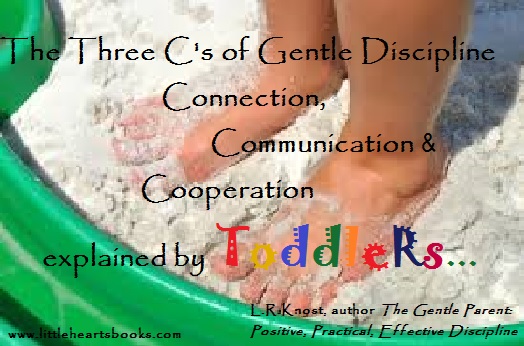 As we step into the toddler zone, let’s start where we should always start…with observing and understanding so that we can not only grow happy, well-rounded children, but also grow as parents and as humans ourselves. So to begin to implement the Three C’s of gentle discipline – Connection, Communication, and Cooperation – let’s take a peek inside the mind of the toddler by listening in on a sandbox conversation at the park:
 Toddler 1: You look a little frazzled, Dude. Hard day?
 Toddler 2: Hard doesn’t even begin to describe my day! I love my mommy to pieces, but seriously, she does NOT know how to share. I took one little thing out of her purse, and she freaked! Snatching and saying, “Mine!” and everything. And right in the middle of the store, too! So embarrassing. Everybody was looking at me, rolling their eyes. I felt like a total failure.
Toddler 1: I hear you! I have the same problem. And mine has been getting into EVERYTHING, too! Like, I stashed my cracker under the couch so I could have a little snack later, and she totally threw it in the trash! Who does that?
Toddler 2: You think that’s bad? Check this. I’m minding my own business, just chillin’ with my toys, and she just snatches me up and carts me off and straps me in the highchair, no warning at all. And I’m not even hungry! Then she gets all upset when I do a little physics with my food. Btw, so cool how sometimes it falls straight down and sometimes it splats against the wall. I think it has something to do with the consistency of the food and the angle of my trajectory. Just a working theory atm, though.
Toddler 1: Cool! Let me know what you figure out. How about this. I can’t get anything done! No joke! I spent all morning building this stellar block tower. Dude, you should have seen this thing. It was epic! So, I walk away for like one second, and she dumps the whole thing in the toy box! An entire morning’s work, gone. I don’t know why I bother sometimes.
Toddler 2: Same! And what’s with this new ‘time-out’ thing mine’s into all of a sudden? I get the slightest bit upset about something, and, just when I need a cuddle, she sticks me in this chair and won’t let me get up! Like a chair is a good hugger? Really?
Toddler 1: That is just wrong. Hey, how about this whole potty training dealio? She wants me to do my business in a little plastic bowl. We eat out of those things! Seriously, you gotta wonder what goes on in their brains sometimes.
Toddler 2: You’re lucky. Mine keeps propping me up on that big white contraption with water in it. I could drown! And you should see what happens when she pushes down that handle in the back. Can you say vortex of DOOM?!?
Toddler 1: Not cool, Dude, not cool at all! Are you dealing with tantrums yet? Mine has got a temper like you wouldn’t believe! Anytime she doesn’t get her way, watch out for the fireworks! She yells and flaps her arms and stomps around, and, I hate to say it, but she’s starting to hit. Like that’s going to solve anything. I have no idea how to handle these aggression issues! Why can’t they just be reasonable like us?
Toddler 2: I think it’s a communication issue, myself. I mean, they’re just barely starting to understand us when we talk to them, so I try to cut mine a little slack when she starts getting frustrated. I just stay close, maybe pat her arm or offer her a toy. Sometimes she settles down a bit and starts smiling again, but sometimes she just needs a little time to calm down. I stay present, though, so she knows I’m always there for her.
Toddler 1: I think you’re messing up there, Dude. You need to walk away, just walk away and let her deal. If you comfort her, she’ll expect you to help her process her emotions, and that’ll lead to dependency issues, mark my words! When she freaks, you’ve got to force her to control herself! When she’s ready to be reasonable and listen, then you can be friends again.
Toddler 2: I don’t know. Mine flat out won’t listen. I can’t tell you how many times I have to ask her to play with me before she finally looks up from her toy. What is it with parents and electronics, anyway? And then all she does is say, “Just a minute, hon.” What exactly is a minute, btw?
Toddler 1: ‘Just a minute’ means ‘This is more important than you,’ Dude. Come on, get with the program. You have to make them pay attention! Yell. Throw something. Bite the cat. Whatever it takes! Don’t let them get away with disrespecting you like that or they’ll never pay attention.
Toddler 2: Word. Talk about getting with the program, how do you handle the sleep issues? I just cannot take another sleepless night! She keeps me up for hours every. single. night. It starts out great, bath-time, a book and cuddles, but then she just clocks out like I’m some kind of a toy she can switch off when it gets dark! And, man, is it dark. I don’t know what’s living in my closet, but it is ginormous!
Toddler 1: Sleep training, Dude! It’s the only way. They turn that light out and shut the door, you follow them! Every. Time. Or, if you’re too scared (totally get that, btw) then just start hollering and don’t stop. If you can’t sleep, make sure they can’t, either! And don’t give in. Not even once. You let them get away with that stuff one time, and you’ll never get any sleep, ever! They have to learn that it’s their job to take care of you day and night, even if all you need is a hug!
Toddler 2: Got it. Oh, man, here she comes. Seriously, do you have this problem, too? We’re at the park. Everybody’s having a good time. And she just up and decides to leave. I think she’s got some anti-social tendencies. I’m thinking of having her tested.
Toddler 1: Same here! But I’m working on it. They’ve got to learn it’s not all about them, and it’s our job to teach them. Look, here comes mine, too. Watch and learn, Dude. I’m using the arched-back, flail and wail today. Deep breath and, “No! No! Noooooo…”
Seeing our own actions from another perspective is uncomfortable, no doubt, but the understanding we can achieve is well worth the discomfort if we can learn and grow from it as parents. As Maya Angelou, American author, poet, and self-described Renaissance Woman, wrote, “Do the best you can until you know better. Then when you know better, do better.”
Related posts:
Toddlers, Tantrums, and Time-in’s, Oh my!
The Gift of a Strong-Willed Child
Backtalk is Communication…LISTEN
When Children Act Out ~ Reflecting Our Emotions
Bridge Over Troubled Waters~Parenting a ‘Problem’ Child
The Taming of the Tantrum: A Toddler’s Perspective
Practical, Gentle, Effective Discipline
200 Ways to Bless Your Children with a Happy Childhood
When Things Get Physical: Hitting, Throwing, Kicking, and Biting
Award-winnning author, L.R.Knost, is the founder and director of the children's rights advocacy and family consulting group, Little Hearts/Gentle Parenting Resources, and Editor-in-Chief of Holistic Parenting Magazine. Books by L.R.Knost include Whispers Through Time: Communication Through the Ages and Stages of Childhood ; Two Thousand Kisses a Day: Gentle Parenting Through the Ages and Stages ; The Gentle Parent: Positive, Practical, Effective Discipline ; and Jesus, the Gentle Parent: Gentle Christian Parenting the first four books in the Little Hearts Handbook gentle parenting series, and children’s picture books Petey’s Listening Ears and the soon-to-be-released Grumpykins series.
Toxic Parenting: Spanking, Shaming, Threatening, Manipulating
[Excerpt from The Gentle Parent: Positive, Practical, Effective Discipline by L.R.Knost. Whispers Through Time: Communication Through the Ages and Stages of Childhood, Two Thousand Kisses a Day: Gentle Parenting Through the Ages and Stages, and Jesus, the Gentle Parent: Gentle Christian Parenting also available on Amazon and through other major retailers.]
~~~~~~~~~~~~~~~~~~~~~
 Want to help stop the bullying epidemic? Don’t act like a bully. Don’t hit, threaten, ignore, isolate, intimidate, ridicule, or manipulate your child. Children really do learn what they live…
I stood, frozen in shock, outside of the upscale bookstore where I would soon be signing my gentle parenting books and chatting with parents about alternatives to punishment-based parenting. A well-dressed young couple I’d spoken with just minutes before in a nearby pizzeria was getting into an expensive SUV several yards away from where I was standing, but the screams were crystal clear.
The young man was leaning over his wife who sat shrinking into her seat as he screamed in her face, “Get in the car! Get in the car!” over and over again. The woman was clearly confused, as was I. She was in the car, though not yet buckled up, so why in the world was the man screaming at his wife to get in? It suddenly dawned on me that what he wanted her to do was put her seatbelt on, but the man was too enraged to even realize that wasn’t what he was actually saying.
I glanced down at my little one who was shrinking back in fear and tried to organize my thoughts so I could cross the few yards separating me from the SUV and engage the man in conversation. If nothing else, I thought, reminding him that people were watching might help him to take a moment and compose himself.
But in the next second, the man suddenly yanked his wife out of her seat and landed several stinging blows on her bare skin before flinging her back into her seat, this time screaming at the sobbing woman, “You are not in charge! You are not in charge!” He then slammed her door shut, stomped around to his own seat, slammed his door, and pealed out of his parking space.
I quickly snapped a picture of the license plate with my iPhone and called the police to report the domestic violence I’d just witnessed. They immediately sent out an officer to track down the endangered woman and take the man into custody.
Now here’s the real story…
On a recent book tour I stood, frozen in shock, outside of the upscale bookstore where I would soon be signing my gentle parenting books and chatting with parents about alternatives to punishment-based parenting. A well-dressed woman and her two small children whom I’d chatted with just moments before in a nearby pizzeria were getting into an expensive SUV, but the screams were crystal clear.
The woman was leaning over her toddler and four-year-old who sat shrinking into their carseats as she screamed in their faces, “Get in the car! Get in the car!” at them over and over again. The children were clearly confused, as was I. They were in their carseats, though not yet buckled up, so why in the world was the woman screaming at her children to get in? It suddenly dawned on me that what she wanted was for the toddler to put her own arms in the straps, but the mother was too enraged to even realize that wasn’t what she was actually saying.
I glanced down at my little one who was shrinking back in fear and tried to organize my thoughts so I could cross the few yards separating me from the SUV and engage the woman in conversation. If nothing else, I thought, reminding the mother that people were watching might help her to take a moment and compose herself.
But in the next second, the woman suddenly yanked her toddler out of her carseat and landed several stinging blows to her chubby little legs before flinging her back into her carseat, this time screaming at the sobbing child, “You are not in charge! You are not in charge!” She then roughly buckled the little one in, stomped around to her own seat, slammed her door, and pealed out of her parking space.
As I stood there staring through tears at the tail lights speeding away, I realized that if I’d just witnessed a man doing that to his wife I could call the police who would intervene immediately because there are laws to protect adults from domestic violence, but there are no such laws protecting children in the US.
My opportunity was lost to touch those small children’s lives, and my heart aches for them. Was the mother just having a bad day? Was she angry at the snarky pizzeria cashier? Was she frustrated that dinner was pizza again because she’d been delayed at work? I don’t know, and, honestly, I don’t care. If a man was having a bad day, we wouldn’t accept that as an excuse for domestic violence.
Hitting any human being other than a child is against the law in the United States where it is legal for parents to hit their children whenever and wherever and with whatever they want to as long as it doesn’t leave lasting marks and, in nineteen states, for school officials to hit children with anything from rulers to two foot long boards. That is not acceptable. In fact, it is outrageous.
Though I know I can’t change the world for every child, I am determined to change the world for as many children as humanly possible. We don’t need new laws. We just need the domestic violence laws already in place to protect adults to be extended to protect our most vulnerable, voiceless, voteless citizens, our children.
Did you know that there is less evidence linking lead exposure to developmental delays in children and asbestos to cancer than there is of the short and long-term detrimental effects of spanking? Study after study has confirmed that spanking (not just physical abuse, but any physical act of correction – smacking, hitting, swatting, slapping, paddling, switching, etc.) is directly linked to greater aggression and other behavioral issues, impaired cognitive development, and increased risk of depression and anxiety in childhood as well as long-term mental issues in adulthood. And yet the American public is still reluctant to dismiss the physical punishment of children as an option for parents and school systems.
It is not unusual for public opinion to evolve slowly. Until recent years, husbands hitting their spouses in the US was considered “reasonable chastisement of wives” and “a private family matter” by the courts and by law enforcement even though it has technically been against the law in all fifty states for decades. Now domestic violence in the US is viewed with outrage and abusers with disdain.
While the tide is ever-so-slowly turning regarding public opinion of the physical punishment of children, in excess of eighty-percent of Americans still believe spanking is a necessary part of raising a child according to a survey cited by a UN report. And in the nineteen US states where corporal punishment is still legal in the public school system, wooden paddles are used on children as young as preschool, and parents’ permission or notification is often not even required. By contrast, in every branch of the US military and in the US penal system, physical punishment has long been outlawed as it was deemed ‘cruel and unusual’ and a ‘use of excessive force.’
Clearly there is a disconnect when it comes to physical punishment of the most vulnerable and defenseless of our citizens, our children. Even in the face of study after study detailing the detrimental effects of physical punishment on young children, more than ninety-percent of American parents still admit to spanking their toddlers and preschoolers, even if they don’t believe that it is a good alternative. The responses to a recently released study linking a significantly increased risk of mental illness in adulthood to being spanked as a child point to some possible reasons for that dichotomy:
1.”I was spanked, and I turned out okay.”
Not everyone who smokes gets lung cancer, but why take the risk?
2. “I don’t want to raise a rotten brat!”
Studies link spanking to increased aggression and other behavioral issues, not decreased.
3. “I spank my kids because the Bible commands me to.”
Not only is spanking not one of the Ten Commandments, but commanding or even suggesting that parents hit young children is not found anywhere in the Bible. The handful of Old Testament ‘rod’ and ‘training’ verses used to support this theory are misinterpreted to refer to physical punishment instead of guidance, and the word translated ‘child’ in those verses is translated ‘young man’ in every other instance.
4. “They’re my kids, and nobody has the right to tell me how to raise them!”
Our laws are civil agreements as to what is and is not acceptable in our society. We once agreed that slavery was acceptable. Now we know better, and our laws reflect that. As research continues to reveal the detrimental effects of spanking, public opinion will begin to shift and our laws will naturally follow suit. It is the way of a democratic society.
5. “Nothing else works!”
Thoughtful, compassionate, proactive parenting works.
Beyond even the issue of spanking, though, the mindset of controlling children through external forces rather than helping them learn how to and desire to control themselves is where the real changes need to happen. When humans, whether they are adults or children, are pushed, the inbuilt reaction is to push back. When humans are pulled, the inbuilt reaction is to pull back. When they are threatened, intimidated, or shamed, it is only the size and strength of their opponent that results in submission and that submission is temporary. As soon as the opponent is eliminated from the equation, humans will pursue their own course, often more angrily and rebelliously and single-mindedly.
Becoming our children’s opponent is not healthy parenting and it doesn’t create a healthy parent/child relationship. It creates a destructive dynamic primed for conflict, rebellion, and escalation. Even when parents choose non-violent means to control their children such as isolation (i.e. time-outs) and behavior charts and other punishment/reward tactics, the basic truth is that they are modelling manipulation and coercion and are focused on controlling a child’s behavior externally rather than working with them to help them learn to control their own behavior through an internal guidance system.
In parenting there will always be times when your child’s behavior doesn’t meet your expectations. Recognizing that you are two distinct individuals with differing opinions and plans and wants and needs will help you to work with your child instead of clashing with them and creating an unhealthy dynamic in your relationship. Be aware that unhealed hurts and unforgiveness, even of yourself, will get in the way of a healthy relationship and take the steps you need to take in order to heal your relationship and yourself (see Chapter Fifteen of The Gentle Parent: Positive, Practical, Effective Discipline).
Whenever things escalate to the point where you withhold affection and connection in order to punish or try to control behavior, and certainly if you are hitting or if you are hurting your child emotionally through threats, intimidation, and shaming, you can be sure you’ve stepped off the gentle discipline path. But there is always a way back, and that’s through reconnection, owning our mistakes, and starting again. The bottom line is that we cannot control another human being. We can force external obedience temporarily, but only by constantly escalating the threats, emotional manipulations, and punishments which accomplish nothing in the long run and do far greater damage than they are worth.
There is no doubt that the vast majority of parents not only deeply love their children, but, based on the information and experiences they have to work with, are also making the best parenting decisions they know how to make. Working with our children instead of against them is a foreign concept to most parents, but therein lies the secret to a peaceful, happy home and the healthy parent/child trust relationship that the Three C’s of gentle discipline—Connection, Communication, and Cooperation—are built upon.
Related posts:
Backtalk is Communication…LISTEN
The Gift of a Strong-Willed Child
Bridge Over Troubled Waters~Parenting a ‘Problem’ Child
Fear Doesn’t Lead to Faith: Becoming Your Child’s Safe Place
Spare the Rod: The Heart of the Matter
Award-winnning author, L.R.Knost, is the founder and director of the children's rights advocacy and family consulting group, Little Hearts/Gentle Parenting Resources, and Editor-in-Chief of Holistic Parenting Magazine. Books by L.R.Knost include Whispers Through Time: Communication Through the Ages and Stages of Childhood ; Two Thousand Kisses a Day: Gentle Parenting Through the Ages and Stages ; The Gentle Parent: Positive, Practical, Effective Discipline ; and Jesus, the Gentle Parent: Gentle Christian Parenting the first four books in the Little Hearts Handbook gentle parenting series, and children’s picture books Petey’s Listening Ears and the soon-to-be-released Grumpykins series.
Stealing God’s Gift: Free Will is a Gift to be Nurtured, Not a Curse to be Broken
[Excerpt reprinted from Jesus, the Gentle Parent: Gentle Christian Parenting by L.R.Knost. Two Thousand Kisses a Day: Gentle Parenting Through the Ages and Stages; Whispers Through Time: Communication Through the Ages and Stages of Childhood; and The Gentle Parent: Positive, Practical, Effective Discipline by L.R.Knost also available on Amazon and through other major retailers.]
~~~~~~~~~~~~~~~~~~~~~
“Let us then approach God’s throne of grace with confidence, so that we may receive mercy and find grace to help us in our time of need.”
Hebrews 4:16
“Many parents in using the rod of correction on their child do so with an obvious lack of vigor and often stop short of the child’s will being completely broken … Both my wife and I have often remarked that it is good that one of our children was not our firstborn. This particular child who came along later in our family was extremely willful and rebellious toward our authority and would often require sessions of correction lasting from one to two hours in length before the will would finally be broken … Even though you may think these methods of correction that God has ordered parents to carry out are bestial, abusive, and unloving, you are the one who is bestial, abusive, and unloving if you don’t obey God in this matter. Moreover, if you do not obey God your child likely will not be saved unless the Lord supernaturally in His mercy does so despite your disobedience.” (Ronald E. Williams, The Correction and Salvation of Children)
“She then administers about ten slow, patient licks on his bare legs. He cries in pain. If he continues to show defiance by jerking around and defending himself, or by expressing anger, then she will wait a moment and again lecture him and again spank him. When it is obvious he is totally broken, she will hand him the rag and very calmly say, “Johnny, clean up your mess.” He should very contritely wipe up the water [about spanking a 3-year-old]” (Pearl, p. 62) …“Never reward delayed obedience by reversing the sentence. And, unless all else fails, don’t drag him to the place of cleansing. Part of his training is to come submissively. However, if you are just beginning to institute training on an already rebellious child, who runs from discipline and is too incoherent to listen, then use whatever force is necessary to bring him to bay. If you have to sit on him to spank him then do not hesitate. And hold him there until he is surrendered. Prove that you are bigger, tougher, more patiently enduring and are unmoved by his wailing. Defeat him totally. Accept no conditions for surrender. No compromise. You are to rule over him as a benevolent sovereign. Your word is final (p. 49)” (Michael Pearl, To Train Up a Child)
Where, exactly, did the pseudo-Biblical idea that a parent must break a child’s will originate? How did a person’s God-given will, their freedom of choice, their strength and individuality, come to be seen as the root of all sin  that must be purged? At what point did “defeating” a child so that they are “totally broken” become the goal of Christian parenting?
Let’s go back to the model of servant leadership set by Jesus who said, “I stand at the door and knock…” (Revelations 3:20) Knock what? Knock humans on their backsides and pin them down while pummelling them until they are utterly defeated? Knock small children around until they are totally broken?
No, of course not. Jesus says, “I stand at the door and knock. If anyone hears my voice and opens the door, I will come in and eat with that person, and they with me.” Jesus doesn’t barge in making demands to prove how big and tough he is. Jesus invites us to open the door of our lives and to invite him in as an honored guest, in return.
Look also at Deuteronomy 30:19 where God shares that it is from him that our ability to choose originates, “I have set before you life and death, blessing and curse; therefore choose life, that you and your descendants may live.” Note that God doesn’t demand that we submit our free, God-given will, our ability to choose, to him. He simply invites us to align our will with his.
And look at James 4:8, “Draw near to God and He will draw near to you.” God doesn’t chase us down, “sit on” us, or “use whatever force is necessary” (see Pearl quote above) to strong-arm us into submission. He reaches out to us and inspires us and opens his arms to us, inviting us into the safety and comfort and wholeness of a relationship with Love Himself.
Our will is a gift, an opportunity to choose right from wrong, and the vehicle through which God calls us to choose his Son. Without this amazing and wonderful gift, without the freedom to use our free will, Jesus’ suffering and death on the Cross would be pointless.
Sin is a moot point in light of the grace we’ve been given. Grace is the point. The whole point. Everything leading up to the Cross pointed to the Cross, everything was settled on the Cross, and on the Cross in the outstretched  arms of Jesus grace was born. Sin only matters in the sense that when we voluntarily choose to stay within the boundaries God has given us, we are closer to him, more in-tune with him, and more aligned with his will. He does not stray from us, not ever. But we do stray from him. We are human, and as humans we learn by doing, by experiencing, by exercising our free will as we stretch and grow and discover and make mistakes and overcome life and are overcome by life, each trial and failure and success a learning experience. God doesn’t chase us down and crash through the walls we’ve put up and drag us back to repentance. He waits for us, always available, always forgiving, always loving us unconditionally, but never giving up as he calls out to us, inviting us gently to himself.
When it comes to parenting, we all know that some of God’s children are created with a remarkable strength of will, a powerful drive to explore and discover, an insatiable thirst for knowledge, an incredible need to know and be known, and with more energy than can be contained in a small body. Their frequent challenges to ‘the way things are’ can feel overwhelming to the most patient of parents, and their sometimes epic meltdowns when all of that extreme energy explodes out of their small frames can act like a tidal wave of emotion that gets everyone swept up in the maelstrom. These children who are given the gift of an indomitable spirit have all of the amazing characteristics of future world leaders, but their gifts need to be grown and nurtured and developed, not contained, stunted, and crushed.
A popular child-training book by Dr. James Dobson, The New Strong-Willed Child, has a markedly different approach to parenting strong-willed children, however: “Some strong-willed children absolutely demand to be spanked, and their wishes should be granted. . . two or three stinging strokes on the legs or buttocks with a switch are usually sufficient to emphasize the point, ‘You must obey me.’” In addition to the disputable Biblical interpretations of the ‘rod’ verses and the misuse of the word ‘obey’ in translating from the original language of the Bible, there is a fundamental difference in philosophies revealed here. In the positive parenting approach, children are born perfect and need only to be guided through the normal stages and behaviors of childhood. In the punitive parenting approach, children are born sinful and must be forced to submit to superior authority.
On a purely logical level, why would we fight a child for control when what we really want is for them to be in control of themselves? Why not, instead, help them to process those big emotions and learn how to direct their own energy and develop their own ability to control themselves? Why not follow Jesus’ example and invite our strong little future leaders to walk alongside us in tandem to learn and grow and discover together for the oh-so-brief season of their childhood?
On a practical level, though, the question is, “How can we partner with our children in positive and peaceful ways to guide them gently and effectively?”
Here is a chapter from The Gentle Parent: Positive, Practical, Effective Discipline to get you started on your gentle journey with your own little future leaders:
‘The Gift of a Strong-Willed Child’
There are some children who are born into the world with the incredible life-gift of a strong will and an indomitable spirit. These children are often deeply misunderstood, and there are rows of books lining bookstore shelves with instructions about how to break their will, how to subdue their spirit, how to force their obedience. What an incredible loss of leadership, passion, and insight this world suffers when parents follow these punitive parenting practices. Not only can we parent these gifted children with gentleness and respect, but the gifts we get in return are priceless!
Take a look at some of the common descriptions used when referring to the characteristics of a strong-willed child:
Demanding, Insistent, Stubborn, Bossy, Cocky, Difficult, Challenging, Fixated, Contrary, Rebellious, Defiant
Now look at some of the common characteristics of adults who are world leaders, CEO’s, entrepreneurs, innovators, world-class athletes, and the like:
Decisive, Determined, Persistent, Authoritative, Confident, Valiant, Gutsy, Committed, Resourceful, Nonconforming,Bold
Note that the characteristics are the same, but the characterizations are negative when applied to a child and positive when applied to an adult.
Other characteristics of strong-willed children that coincide with the characteristics of adult leaders in their fields are:
- They are typically highly creative and intelligent.
- They are usually passionate and intense in their interests and beliefs.
- They often have an insatiable need to know ‘why.’
- They typically learn by doing.
- They tend to have an intense need to test the status quo.
- They are typically highly perfection-oriented, but often that is focused on their expectations of themselves instead of others.
- They tend to need high levels of validation.
- They usually have an intense need to be heard.
- They often have a strong need for emotional safety.
- They tend to be resistant to change unless they feel like they have some control over the change.
- They are often highly sensitive.
- They are typically intensely focused on their latest project or interest.
- They tend to be conscientious and highly committed.
- They are usually intensely independent.
While there’s no doubt that it’s a challenge having a child who seems to challenge everything, there are ways to work with them rather than against them to preserve and nurture their unique gifts. Maintaining a healthy parent/child relationship is vital as you work to find a balance between setting limits with your richly spirited child while not limiting their freedom to stretch and grow and develop into the person they were created to be.
The key to preserving your trust relationship with your child is remaining calm and present and supportive, even while setting and maintaining reasonable boundaries. It is helpful to remember that the most strong-willed children tend to be the ones who identify the most strongly with their parents. So instead of viewing their seemingly constant challenges as defiance or attempts to thwart authority, work to parent from a place of understanding that your strong-willed child is actually on a discovery mission and is doing endless ‘research’ on you by testing and retesting and digging and chiseling to discover all of your quirks and foibles and ups and downs and strengths and weaknesses. This kind of testing isn’t negative unless you make it into a battle of wills instead of responding with gentle, respectful guidance. Taking this stance will help you to keep from seeing the challenges as personal insults and, instead, see the challenges as attempts to learn and grow and understand.
There is no doubt, though, that parenting a child with the gift of a strong will is a constant exercise in patience and self-regulation. The personal growth you will experience is invaluable as you seek to parent with empathy and wisdom and compassion, but it can be draining and will often stretch you far, far out of your comfort zone. Knowing that and being prepared for it will help you cope with the inevitable stresses, and being ready ahead of time with some specific strategies for handling the challenges will help you to respond calmly and effectively.
This is a good place to revisit the Three C’s of gentle discipline—Connection, Communication, and Cooperation.
Connection ~ Maintaining a secure connection with your spirited child is vital. It is the springboard from which all of your interactions with your child will originate, and it is the touchstone to which you will both return, again and again and again, when your relationship gets strained and stained and stretched.
- Play word games, board games, rough-and-tumble outdoor games, silly face in the mirror games. Play is the language of childhood, so make sure to speak your child’s language every day.
- Laugh together. Humor is an undervalued parenting tool. But it lowers defenses, inspires smiles, brings people together, and reconnects hearts.
- Read storybooks, chapter books, travel brochures, encyclopedias, anything that will inspire you to dream together, talk, plan, get excited, share interests.
- Focus more on who your child is than on what your child does. Remember, you’re growing a person, not fixing a problem. So make sure to spend time getting to know the person, not just the child. It doesn’t have to cost anything. Just walk together, talk together, share ice cream cones, spot shapes in the clouds, and enjoy each other.
Communication ~ Children have their own ‘inner world’ of thoughts and plans and problems and worries and hopes and dreams that are occupying their time and attention, so a lack of cooperation is often simply the result of having a different agenda than we do. Getting some insight into that ‘inner world’ is key in guiding and growing them respectfully.
- Listen with your heart. Listen ‘between the lines’ to what your child is communicating through their behavior. Listen and listen and listen some more. That is always, always the first step in communicating with your child.
- Reflect, connect, and redirect. Reflect what you hear, whether it’s communicated by your child’s behavior or their words. This not only validates their emotions and lets them know that you hear and understand them, but it also helps them to understand their own emotions. For instance, if your child is upset that he can’t have a cookie after brushing his teeth for bedtime, try saying, “I hear you. You’re upset because you want a cookie.” Then reestablish your connection, “I like cookies, too!” and offer a solution, “How about we go pick out the two best cookies and put them in a special container that we can take to the park in the morning?”
- Don’t take non-compliance as a personal insult. A strong-willed child is very much their own person with their own agenda. Focus on inviting cooperation instead of demanding obedience. Whether it’s staying in bed or cleaning up or whatever the issue, make it a team effort and come up with a game plan ahead of time. For example, you could say, “You seem to be having trouble staying in bed at night. What do you think would help you to be more ready to go to sleep when it’s time for bed?” or “It’s important to pick up our things so they don’t get broken, let’s put on the timer and work together for ten minutes and see who gets the most picked up.”
- Make a firm commitment not to resort to punishments to control behavior. The resentment that comes from being punished absolves children in their own minds of responsibility. It doesn’t teach them responsibility, and resentment can actually cause a lot of the behaviors you are trying to avoid.
- Communicate daily, outwardly to your child and inwardly to yourself, the positive aspects of your child’s personality. When the focus is on ‘fixing’ a child, they get the message that they are somehow broken, and that is not a healthy self-image to take into adulthood.
- ‘No’ is not a complete thought. It is an imperative, a command. It doesn’t teach. It tells. If you want your child to learn to think like an adult, take the time to explain your adult thinking.
- Remember that children, especially when they are upset, open ‘conversations’ through their behavior, and it’s up to us, the only adults in the relationship, to gently guide them toward continuing those conversations verbally as well as equipping them with the resources to be able to do so.
- Also keep in mind that the social mores of rudeness simply aren’t inborn and don’t apply to early interactions with our children. They are learned by imitating how we as parents behave. Politeness is a heart issue that cannot be imposed by the will of another unless we want it to only be an external façade instead of a heartfelt courtesy. Helping your strong-willed child learn to speak kindly means speaking kindly to your child as well as offering guidance when they’ve been rude such as saying, “That is not a nice tone of voice” or “That isn’t a kind thing to say” and then offering a do-over “Can you try saying that to me again more nicely? I’ll always try my best to be nice to you, and I would like you to try to do the same for me.”
Cooperation ~ Always keep at the forefront of your parenting goals that you are seeking thoughtful cooperation, not mindless compliance. That way you will remember to treat your child as a thoughtful individual with ideas and needs and feelings of their own instead of a mindless drone there to do your bidding.
- Set clear limits and explain them in age-appropriate terms. Remember, if you want to invite cooperation, you have to actually issue the invitation to cooperate!
- Limit the number of limits. Spirited children are often stressed children simply because of their own intense emotions and reactions to things, so set them up for success by keeping your limits few and clear and by maintaining them consistently.
- Make sure to let your child have a voice in determining the limits so they feel like they have some control over their lives and so they feel some ownership over the limits.
- Brainstorm together ways of helping everyone to work together. Some ideas are to come up with hand signals or words that remain your little secret codes to indicate when it’s time to leave the park or to do homework or to dial the activity level or noise volume down a few notches.
- Invite cooperation by creating daily routines together. Don’t be surprised if your child ends up being the one who is a stickler for following the routine, even to the point of nagging you to follow it. These gifted children tend to be all-in, fully focused and committed, and they’ll expect you to be the same!
- Cooperate with your child’s needs and personality by working with them rather than against them. For instance, if you know that your child has a hard time leaving a project, give them plenty of time to find a good stopping point when you need them to leave it for a while. Or if you know that your child has a hard time following directions at bedtime, try writing or drawing the tasks that need to be done (i.e. toothbrushing, pajamas, etc.) on ping-pong balls and put them in a small ‘bedtime jar’ so your child can feel some control over their routine as they independently pick out the balls one by one for a ‘surprise’ nighttime order of tasks or take them all out and decide what order to do them in themselves.
- If you are already locked in a head-to-head power struggle, put away your boxing gloves so your child will (eventually!) feel safe putting away theirs. When you battle with your child, you may win a skirmish or two, but you will lose the treasure…your trust relationship. Putting away the gloves means slowing down, breathing through your own emotions, and finding a way to work through the issue together. Remember, you’re the adult in the relationship, but that doesn’t give you the right to overpower your child; it gives you the responsibility to empower your child. That involves modeling the tools of diplomacy—communication, cooperation, compromise—that you want your child to stock in their own emotional toolkit.
Remember, the children who come into the world with their ‘boxing gloves on’ so to speak are often the ones who become the biggest world changers. It’s not easy raising these little world-changers, I know (Believe me, I know. Two of my six are world-changers-in-the-making!), but the rewards are phenomenal!
“The Lord’s loving-kindnesses indeed never cease, for his compassions never fail.”
Lamentations 3:22
Related posts:
Spare the Rod: The Heart of the Matter
Jesus, the Gentle Parent: Gentle Christian Parenting
Tattered Tapestries: Weaving Trust Through the Chaos
Fear Doesn’t Lead to Faith: Becoming Your Child’s Safe Place
Where Did You Learn Love, Child?
Gentle Journeys: A Book Club for a New Generation
Practical, Gentle, Effective Discipline
Award-winnning author, L.R.Knost, is the founder and director of the children's rights advocacy and family consulting group, Little Hearts/Gentle Parenting Resources, and Editor-in-Chief of Holistic Parenting Magazine. Books by L.R.Knost include Whispers Through Time: Communication Through the Ages and Stages of Childhood ; Two Thousand Kisses a Day: Gentle Parenting Through the Ages and Stages ; The Gentle Parent: Positive, Practical, Effective Discipline ; and Jesus, the Gentle Parent: Gentle Christian Parenting the first four books in the Little Hearts Handbook gentle parenting series, and children’s picture books Petey’s Listening Ears and the soon-to-be-released Grumpykins series.
Spare the Rod: The Heart of the Matter
[Excerpt reprinted from Jesus, the Gentle Parent: Gentle Christian Parenting by L.R.Knost. Two Thousand Kisses a Day: Gentle Parenting Through the Ages and Stages; Whispers Through Time: Communication Through the Ages and Stages of Childhood; and The Gentle Parent: Positive, Practical, Effective Discipline by L.R.Knost also available on Amazon and through other major retailers.]
~~~~~~~~~~~~~~
“Your rod and your staff, they comfort me…”
Psalm 23:4
 One of the hot-button issues when it comes to discipline and children is, of course, spanking, and the more Christian and conservative the audience, the more hot the debate becomes. And yet there are no verses in the New Testament that support spanking, smacking, whipping, or otherwise hitting children.
In the Old Testament there are a total of five verses that have been interpreted to encourage, or even command, the use of physical punishment on children. All five of those verses are in the book of Proverbs. The word ‘proverb’ in the original Hebrew text is mashal and defined as a parable, prophetic and figurative discourse, symbolic poem, pithy maxim (i.e.a collection of wise metaphors and adages).
Of interest is that ancient Hebrew had many words for children, each denoting a specific stage of childhood and many a specific gender:
yeled or yaldah – newborn boy or girl
yonek or yanak – nursling baby
olel – nursling baby who also eats food (translated ‘young child’ in Lamentations 4:4 KJV)
gamal – weaned child (around 3-4 years old)
taph – young child, one who still clings to their mother
elem or almah – firm and strong, older child
na’ar (masc.) or na’arah (fem.) – independent child, young adult child (includes older adolescents and young adults)*
The word translated ‘child’ and ‘children’ in those Old Testament rod verses is na’ar, which when literally translated, means ‘young man.’
Let’s look, also, at the words translated ‘discipline’ and ‘punish’ and ‘rod’ and others:
The word muwcar is translated ‘discipline’ and means, literally, ‘verbal instruction and teaching.’ In Hebrew culture muwcar was vernacular for ‘let us reason with one another’ implying a mutual discussion for learning purposes. And towkechah is translated ‘reprove’ or ‘rebuke’ but also means ‘reason with, convince, prove, persuade.’ Neither of these words means to physically punish in any way, shape, or form.
The word nakah is translated ‘punish’ in most English translations of the Bible, though its literal translation is ‘beat’ as in “The sun beat down on his head,” implying a constant presence; or ‘hit’ as when beating back an enemy or punishing a slave or criminal; or ‘smite or smitten’ which can mean ‘hit or trigger the conscience’ or ‘be favorably impressed, enticed, or entranced’ as in, “He was smitten with the idea of a new bicycle.”
The word shebet is translated ‘rod’ and means, literally, ‘shepherd’s crook’ and, in Hebrew culture, was a means not only of guiding and protecting sheep, but also a symbol of leadership. The markings on the head of the shebet often identified the head of a family or tribe, letting everyone know who to go to for guidance and protection. The shebet, then, denotes wisdom, leadership, and protection.
The word muwth is translated ‘die’ and has several meanings related to death including ‘to follow a path of destruction.’
The word ‘ivveleth is translated ‘foolishness’ but also means ‘inexperience, naivety, silliness.’
And, finally, the Hebrew word sane is translated ‘hate’ and yet means ‘does not love’ or ‘does not choose or show a preference for.’
When we read the five ‘rod’ verses with the literal translations of the words above, the meanings become more clear.
So Proverbs 13:24 reads:
“He who spares his rod wisdom, leadership, protection hates does not love, does not choose or show a preference for his son, but he who loves him disciplines offers verbal instruction and teaching to him promptly.”
Proverbs 22:15 reads:
“Foolishness Naivety, silliness, inexperience is bound up in the heart of a child young man; the rod of correction wisdom, leadership, protection will drive it far from him.”
Proverbs 29:15 reads:
“The rod Wisdom, leadership, protection and rebuke reasoning with, convincing, proving, persuading give wisdom, but a child young man left to himself brings shame to his mother.”
And, the last two ‘rod’ verses, found in Proverbs 23:12-26 read:
“Apply your heart to instruction and your ears to words of knowledge.
Do not withhold discipline verbal instruction and teaching, reasoning together from a child young man; if you punish guide, trigger his conscience, favorably impress, entice/entrance them with the rod wisdom, leadership, protection, they will not die follow a path of destruction.
Punish Guide, trigger his conscience, favorably impress, entice/entrance them with the rod wisdom, leadership, protection and save them from death following a path of destruction.
My son, if your heart is wise, then my heart will be glad indeed; my inmost being will rejoice when your lips speak what is right.
Do not let your heart envy sinners, but always be zealous for the fear of the Lord. There is surely a future hope for you, and your hope will not be cut off.
Listen, my son, and be wise, and set your heart on the right path: Do not join those who drink too much wine or gorge themselves on meat, for drunkards and gluttons become poor, and drowsiness clothes them in rags.
Listen to your father, who gave you life, and do not despise your mother when she is old.
Buy the truth and do not sell it—wisdom, instruction and insight as well. The father of a righteous child young man has great joy; a man who fathers a wise son rejoices in him. May your father and mother rejoice; may she who gave you birth be joyful!
My son, give me your heart and let your eyes delight in my ways.”
Such a beautiful image of a father tenderly and diligently sharing his wisdom with his son, isn’t it? Clearly, applying these scriptures to small children is not in line with a literal interpretation. It actually makes more sense to apply them to the disciples, which is exactly what Jesus does with his twelve ‘sons.’
Beyond translations and interpretations, though, and of far greater import, what seems to get lost in the spanking debate is that Jesus brought grace and mercy as his methods and message for a reason. The purpose of the law in the Old Testament was to highlight the need for a Savior because humans simply cannot live perfectly.
Jesus came to fulfill the outward requirements of the law that highlighted man’s sins and replace them with an inner heart change. He demonstrated in many ways that the law (outer governance and control through fear of punishment) was no longer to be a rigid yoke with its heavy burden of cleansing and rituals and sacrifices and punishments, but instead was to be a kingdom of the heart, of mercy not sacrifice, because the sacrifice was Himself.
Jesus stopped the people from stoning the prostitute (John 8:2-11) which was a requirement in the Old Testament. (Deuteronomy 22:21-22)
Jesus healed people and traveled on the Sabbath (Matthew 12:1-14) which was punishable by death in the Old Testament. (Exodus 31:14-17 and Numbers 15:32-36)
Jesus consorted with ‘sinners’ and ate with them (Luke 15:1-2) despite the admonitions in Proverbs 13:20. (the same book in the Bible with the ‘rod’ scriptures)
Jesus showed again and again that if we accept him as our Savior, we are called to be “ministers of a new covenant—not of the letter but of the Spirit; for the letter kills, but the Spirit gives life.” (2 Corinthians 3:6)
We accept that Jesus brought a new and better way, a way of the heart, “Not on tablets of stone but on tablets of human hearts.” (2 Corinthians 3:3b), but don’t seem to want to acknowledge that better way with our children. We accept God’s grace and forgiveness for ourselves, but often don’t share those gifts with, and model them for, our children. But we are our children’s first taste of God. Is it any wonder people have such a hard time understanding grace and mercy and unconditional love when they may not have been taught those things by their earthly parents and don’t exercise them with their own children?
Through Jesus’ sacrifice, he tore open the veil dividing man from God and brought a new kingdom, a kingdom of inner governance through the Holy Spirit whose fruit is “peace, patience, kindness, goodness, faithfulness, gentleness, and self-control.” Nowhere does Jesus say to follow him except when it comes to our children. He doesn’t say to offer grace and mercy and forgiveness to everyone except our children. The Bible doesn’t tell us to show the fruit of the Spirit to everyone except our children.
If we truly believe that, based on five verses in the Old Testament with disputable translations and debatable interpretations, we are being disobedient to God’s commands if we don’t spank our children, then we must take that belief and walk it out fully.
In other words, if we must obey that supposed command, then we must obey all the other commands such as,,,
- an “eye for an eye” (Exodus 21:24) and stoning adulterers (Leviticus 20:10) …but didn’t Jesus bring forgiveness?
- we shouldn’t feed the homeless because “if a man doesn’t work, neither shall he eat” (2 Thessalonians 3:10) …but aren’t we supposed to be the heart and hands of Jesus?
- we shouldn’t give Christmas shoeboxes to prisoners’ children because “the sins of the father are visited on the children” (Exodus 20:5) …but isn’t the “kingdom of heaven made up of such as these?” (Matthew 19:14)
My point is summed up in this verse:
“For whoever keeps the whole law and yet stumbles at just one point is guilty of breaking all of it.” (James 2:10)
In other words, if you feel bound by those five verses, then you must be bound by all.
If you truly believe that those five verses have been interpreted correctly and that “spare the rod, spoil the child” (Note: There is no verse in the Bible that says ”spare the rod, spoil the child.” That phrase is actually from a satirical poem called Hudibras by Samuel Butler first published in 1662.) refers to an actual physical rod (instead of a symbol of guidance and loving correction…i.e. discipleship) and that the word used for ‘child’ refers to a toddler or small child instead of the actual linguistic translation meaning ‘young man,’ then so be it.
But do you really believe that Jesus’ New Covenant is for everyone except children? That grace, mercy, unconditional love, and forgiveness are for adults only?
The disciples made that mistake, and Jesus said to them,
“Let the little children come to me, and do not hinder them, for the kingdom of God belongs to such as these.” (Luke 18:16)
Five verses with questionable interpretations versus following Jesus’ example…no contest. [end excerpt]
…….
*Note: Hebrew is a very descriptive, picturesque (i.e. visual) language. In describing something that is out of the ordinary, words were often used to convey a deeper meaning using word pictures. That is the case with the word na’ar which means, literally, ‘independent male’ and refers to a young man, but is also used as a word picture in rare circumstances to convey an unnatural independence when referring to an infant or young child who has been ‘ripped away’ or become unnaturally ‘independent’ from the nurturing presence of a parent. This is the case with Moses as he was placed in a basket and sent away from his mother as an infant (yeled in Hebrew throughout the text of the Exodus account except for one word picture, na’ar, indicating the baby’s separation from his mother) and with Samuel who was left at the temple by his mother at a young age. In those unique instances, the word picture of a male made independent by unnatural circumstances is conveyed by the use of the word na’ar. In every other instance, na’ar literally means a male of independent age, a young man.
Related posts:
Jesus, the Gentle Parent: Gentle Christian Parenting
Tattered Tapestries: Weaving Trust Through the Chaos
Fear Doesn’t Lead to Faith: Becoming Your Child’s Safe Place
Where Did You Learn Love, Child?
Gentle Journeys: A Book Club for a New Generation
Award-winnning author, L.R.Knost, is the founder and director of the children's rights advocacy and family consulting group, Little Hearts/Gentle Parenting Resources, and Editor-in-Chief of Holistic Parenting Magazine. Books by L.R.Knost include Whispers Through Time: Communication Through the Ages and Stages of Childhood ; Two Thousand Kisses a Day: Gentle Parenting Through the Ages and Stages ; The Gentle Parent: Positive, Practical, Effective Discipline ; and Jesus, the Gentle Parent: Gentle Christian Parenting the first four books in the Little Hearts Handbook gentle parenting series, and children’s picture books Petey’s Listening Ears and the soon-to-be-released Grumpykins series.
Fear Doesn’t Lead to Faith: Becoming Your Child’s Safe Place
[Excerpt reprinted from Jesus, the Gentle Parent: Gentle Christian Parenting by L.R.Knost. Two Thousand Kisses a Day: Gentle Parenting Through the Ages and Stages; Whispers Through Time: Communication Through the Ages and Stages of Childhood; and The Gentle Parent: Positive, Practical, Effective Discipline by L.R.Knost also available on Amazon and through other major retailers.]
“Truly I tell you, unless you change and become like little children, you will never enter the kingdom of heaven.”
Matthew 18:3
~~~~~~~~~~~~~~
 “I need prayer to help me trust God.”
“I need to learn to trust God more.”
“I’m really struggling with trusting God.”
Over and over and over in Christian circles we hear these prayer requests and confessions. Again and again we try and struggle and fail to trust God with our lives, our decisions, our hopes, our dreams, our plans, our needs, our fears, our mistakes. We assign accountability partners and prayer buddies to help each other in our struggle to trust. We take classes and read books and attend seminars. And yet still, we struggle and we fail and we wonder why we find it so hard to trust.
Maybe the problem is that we aren’t asking the right question, though. Perhaps the question isn’t, “Why can’t we trust?” but rather…
“How can we trust someone we’ve been trained not to trust?”
Consider this scene:
“Father: You didn’t obey Daddy, did you?
Child: No.
Father: Do you remember what God says Daddy must do if you disobey?
Child: Spank me?
Father: That’s right. I must spank you. If I don’t, then I would be disobeying God. You and I would both be wrong. That would not be good for you or for me, would it?
Child: No. (A reluctant reply)”
(Tedd Tripp, Shepherding a Child’s Heart, p. 31)
“I have to hurt you to please God.” That is the message this child hears. And, one day, this child will be an adult who asks for prayer to learn to trust, if he even wants a relationship with Someone he believes demands that he be hurt by those he loves most, Someone he has been trained to distrust.
Parents systematically breaking down a child’s innate ability to trust simply makes no sense. The world will hurt, disappoint, and disillusion our children through the years, no doubt, but the brief season of childhood is a time to strengthen our children, not weaken them, and true strength is forged in gentleness, guided by wisdom, and steeped in peace. Our children need us to be their guardians, their protectors, their safe harbor in life’s storms:
Imagine a ship damaged at sea, broken and sinking fast, heading for the safety and shelter of the harbor only to be stopped at the end of the breakwaters, the line between storm-tossed sea and calm waters, and told to clean up their deck, fix their rudders, and examine their ship logs to see where they went wrong, all while still in danger of sinking in the rough seas.
Now imagine a child, roughed up by his own bad choices or suffering at the hands of her own human weaknesses, hoping to find a safe harbor in a parent’s healing embrace, but instead being punished, spanked, or sent to isolation in a corner or in their room…leaving them all alone in a stormy sea of human emotions when what they really need in that moment is to reconnect with us. In their most difficult moments, they need our wisdom and guidance and the reassurance that, no matter what mistakes they make, no matter how badly they fail, no matter how far they fall, we will always, always be there to help them and heal them and forgive them and love them.” (Two Thousand Kisses a Day: Gentle Parenting Through the Ages and Stages)
Isn’t that what God offers us, even in our most difficult moments? Wisdom. Guidance. Reassurance. Forgiveness. Unconditional love.
“While we were yet sinners, Christ died for us.” (Romans 5:8)
And yet isn’t that what we have so much trouble trusting in as adults?
Trust and fear cannot coexist, and God certainly doesn’t intend them to. That is why Jesus says over and over, “Do not be afraid,” throughout the New Testament. One stumbling block, though, is the use of the word ‘fear’ in translations of verses such as, “The fear of the Lord is the beginning of wisdom,” (Proverbs 9:10) which lead us to believe that we must be afraid of God in order to honor him. But, while fear repels, wonder invites. The Hebrew word, yirah, which is translated ‘fear’ actually means, ‘to see or be seen clearly’ or ‘to have a heightened awareness of’ or ‘to flow’ as in ‘to flow with overwhelming emotion.’ In Hebrew, it is taken to mean ‘to overflow with or be overcome by trepidation’ only when used in the context of danger, but ‘to overflow with or be overcome by awe and wonder’ when used in the context of a good and mighty God. So, “The fear of the Lord is the beginning of wisdom” would more accurately read, “Being overcome with awe and wonder at the Lord is the beginning of wisdom.”
Perhaps if we parent our children the way God parents us, with mercy, understanding, and gentle guidance, our children’s ability to trust will be strengthened rather than broken, and as adults they won’t struggle to trust God as we so often do. Then, instead of running and hiding from God when life hits hard and the world batters and bewilders our children, perhaps they will go running to him, trusting that he will be there with outstretched arms… [end excerpt]
Related posts:
Jesus, the Gentle Parent: Gentle Christian Parenting
Tattered Tapestries: Weaving Trust Through the Chaos
Where Did You Learn Love, Child?
Gentle Journeys: A Book Club for a New Generation
Award-winnning author, L.R.Knost, is the founder and director of the children's rights advocacy and family consulting group, Little Hearts/Gentle Parenting Resources, and Editor-in-Chief of Holistic Parenting Magazine. Books by L.R.Knost include Whispers Through Time: Communication Through the Ages and Stages of Childhood ; Two Thousand Kisses a Day: Gentle Parenting Through the Ages and Stages ; The Gentle Parent: Positive, Practical, Effective Discipline ; and Jesus, the Gentle Parent: Gentle Christian Parenting the first four books in the Little Hearts Handbook gentle parenting series, and children’s picture books Petey’s Listening Ears and the soon-to-be-released Grumpykins series.
Tattered Tapestries: Weaving Trust Through the Chaos
[Reprinted from Jesus, the Gentle Parent: Gentle Christian Parenting by L.R.Knost. Two Thousand Kisses a Day: Gentle Parenting Through the Ages and Stages; Whispers Through Time: Communication Through the Ages and Stages of Childhood; and The Gentle Parent: Positive, Practical, Effective Discipline by L.R.Knost also available on Amazon and through other major retailers.]
“For I know the plans I have for you,” declares the Lord, “plans to prosper you and not to harm you, plans to give you hope and a future.”
Jeremiah 29:11~~~~~~~
 The old preacher’s slightly shaky voice and once-hearty arthritic hands spoke of life and experience and hard-won wisdom as he held up a dusty tapestry with the back facing us. The tangle of threads that seemed to go nowhere and the snarl of multicolored knots gave no hint of the picture on the other side. “This is what we see,” he said. Then he turned the tapestry around to display the intricate, painstakingly crafted, exquisite picture on the front side. “And this is what God is doing.” He looked around the room, a kind and gentle understanding in his age-dimmed gaze. “Faith is trusting that your Father’s hands are carefully weaving a beautiful life’s story, even when all you can see is chaos.”
I remember this story often when life feels overwhelming, when big things like layoffs and sicknesses hit, and when small things like cranky toddlers, piles of laundry, and broken refrigerators annoy. What feels to me like an endless cycle of dishes and diapers, punctuated by the odd disaster, must look like brilliant threads of golden perseverance, scarlet sacrifice, and soft blue-grey shades of faith, all woven tenderly into my life’s tapestry by my Father’s skillful hands.
I imagine life feels this way to my children, as well. They may not see the picture I am trying to weave as I teach and guide and nourish and encourage them to grow into the beautiful humans they were created to be.
They may not understand why they’re gently redirected when they try to crawl up the stairs or why bugs don’t make a good afternoon snack. They may not be able to fathom why their new dragonfly ‘pet’ can’t live in the house or why they can’t hide in “the best hiding place EVER” in a hot car on a steamy Florida afternoon. They may not be entirely thrilled with the agreement on no laptops in their rooms or no cell phone in their tween years, and they may not fully get why the mall is not a safe hangout spot and why periodic texts to check in when out with friends are part of our family dynamic in their teen years.
As my children grow old enough to participate in the decision making, though, we share our thoughts about these things, discuss them together, and come up with mutually agreed upon boundaries. While these things may seem like meaningless threads or even unnecessary knots and tangles in their lives, the trust that we share helps them to accept and cooperate with what they may not fully understand, knowing that I have a purpose for each of these things even if they can’t see it.
It is that trust, that faith in my motives, my wisdom, my love, that makes gentle parenting possible. I don’t have to ‘lay down the law’ or enforce ‘rules’ with punishments or ‘control’ my children with threats or intimidation because they know that I have their best interests at heart and that I will always, always listen to their concerns, even if I can’t change things or give them what they want.
I start building that trust from the moment my children are born and continue building it throughout their childhood. I respond quickly, consistently, and with empathy to their cries or whines or troubles whether they are eight days, eight years, or eighteen years old. I meet their needs as fully as I am able, whether those needs are a clean diaper, a full belly, a listening ear, or a warm hug. I try to always respond gently and thoughtfully to their behaviors, whether they are having a meltdown, whining, tattling, questioning, or even challenging me.
And, perhaps most importantly, I’m honest about my own imperfections. I’m willing to apologize when I make one of my many human parenting mistakes, and I don’t expect perfection from my equally human children.
Motherhood is very simple to me. It’s a gift to me, but it’s not about me. I’m the one who chose to bring these little people into the world, so the pervading belief in our modern culture that somehow they have the responsibility to fit into my life, and work around my schedule, and not disrupt my pursuits completely mystifies me. They aren’t interlopers; they are guests, invited guests. And how do we treat our guests? Do we ignore their needs or make incomprehensible demands on them or ridicule, name-call, and hit them when they misstep? Of course not. We welcome our guests with special dinners, make accommodations for their needs, and forgive their lack of knowledge of our ways. And our children deserve no less. In fact, they deserve much more.
In our home, when our newest little invited guests arrive, they are welcomed with open arms that are always available, day or night. They are provided nature’s best provision for their nutritional needs. And they are gently guided by example and lovingly encouraged to become a part of a healthy family dynamic. In short, when I invite these little people into my life, it stops being my life, and it becomes our lives.
Parenthood is, very simply, a beautiful sacrifice that mothers and fathers willingly and lovingly live for their children, day after day, night after night, as a reflection of the sacrifice Jesus made for his children on the Cross. Parenthood is a lovely, lively retelling of the Cross played out in the arms of mamas and daddies, again and again and again.
Consider the young mother who gives up night after night of sleep to soothe her little one’s cries, or the middle aged man who still gets up before dawn each day to provide for his family, or the elderly parents who give up the peace of their golden years to welcome the child of their youth back into their home when life hits hard. This laying down of self, this giving up of comforts and rights and dreams, these are losses, sacrifices, even hardships, but they are lovely, beautiful beyond belief. Their loveliness lies in the soft warmth of a sleepy baby with a full belly and a trusting heart. Their beauty lies in the joyful chaos of a messy, noisy, welcoming family to come home to each night. Their beauty lies in the spark of hope in the tear-filled eyes of a weary adult whose life has turned dark, but who finds that home is still a safe refuge.
My children, all six of them, are precious gifts straight from God’s heart to my home. I have had other precious gifts, babies whom God gave for a time to fill my womb, but who weren’t meant to fill my arms, and one He gave to fill my arms for a just a moment in time, but who wasn’t meant to stay. My stillborn son, Sammy’s, birthday is in just a few weeks. While he’s always in my heart, as his birthday approaches my heart tightens in my chest a bit more each day until the ache becomes almost unbearable, and then finally the day comes and goes and I can breathe again.
These times always make me wonder how tragedy must look from Heaven’s side. I wonder about my Sammy, and I wonder about my other lost babies, gone before they even had birthdays. What colors did they add to my story? What eternal beauty did they bring that would have made my tapestry incomplete if they had not come and gone, so heartbreakingly briefly, into my life? While I feel holes in my heart, one for each much-wanted child, and an aching cavern of loss for my Sammy, would my life have been complete without them?
I can’t answer these questions. I won’t even try. But I imagine that is where faith stretches its silken blue-grey threads across my story like the fragile gossamer wings of a butterfly. Each one of them brought with them the unique knowledge of how breathtakingly exquisite every living, breathing child is and how priceless and fragile and brief life itself can be. I do not take this knowledge lightly. I have learned to treasure the moments of life with my children. I’ve learned that it’s not about me; it’s about us. And I’ve learned that sacrifice lights up the dark places in the world, making it a more beautiful place for all of us to live.
Life is messy. No one has all the answers, at least not earth-side. But we can all trust that this sometimes bewildering, sometimes joyful, sometimes flat-out painful chaos called life has meaning and purpose and beauty beyond the scope of human sight. And as we carefully and gently weave the strands of our children’s days into a beautiful childhood, we can trust that our Father is thoughtfully and tenderly doing the same for us.
“Now we see through a glass darkly; then we shall see clearly, face to face. Now I know in part, then I shall know fully, even as I am fully known.” 1 Corinthians 13:12
Related posts:
Fear Doesn’t Lead to Faith: Becoming Your Child’s Safe Place
Spare the Rod: The Heart of the Matter
Practical, Gentle, Effective Discipline
Bridge Over Troubled Waters~Parenting a ‘Problem’ Child
200 Ways to Bless Your Children with a Happy Childhood
Jesus, the Gentle Parent: Gentle Christian Parenting
Award-winnning author, L.R.Knost, is the founder and director of the children's rights advocacy and family consulting group, Little Hearts/Gentle Parenting Resources, and Editor-in-Chief of Holistic Parenting Magazine. Books by L.R.Knost include Whispers Through Time: Communication Through the Ages and Stages of Childhood ; Two Thousand Kisses a Day: Gentle Parenting Through the Ages and Stages ; The Gentle Parent: Positive, Practical, Effective Discipline ; and Jesus, the Gentle Parent: Gentle Christian Parenting the first four books in the Little Hearts Handbook gentle parenting series, and children’s picture books Petey’s Listening Ears and the soon-to-be-released Grumpykins series.
Jesus, the Gentle Parent: Gentle Christian Parenting
Jesus, the Gentle Parent: Gentle Christian Parenting
by
L.R.Knost
Intelligent, Well-Researched, Compassionate ~ L.R.Knost has done it again. With her compassionate tone, relational style, and intelligent, well-researched writing, Jesus, the Gentle Parent is like a refreshing, peaceful  walk through the scriptures with a friendly and knowledgeable tour guide. This book differs from Two Thousand Kisses a Day, Whispers Through Time, and The Gentle Parent: Positive, Practical, Effective Discipline in that it takes a Christian approach to parenting as L.R. takes on big names in the Christian child-training sect such as Dr. James Dobson, Tedd Tripp, Gary Ezzo, and Michael Pearl, breaking down their doctrine and reexamining such issues as spanking, instant obedience, submission, free will, and more in light of the original Hebrew and Greek texts of the scriptures. As always, L.R. offers gentle parenting alternatives along with real-life examples of their applications, but in Jesus, the Gentle Parent she goes even further and shares parenting insights based on the life of Jesus that will turn the mainstream Christian world on its head. This is truly a grace-based parenting book which shows parents how to be “their children’s first taste of God” by following in the gentle, wise, grace-filled footsteps of Jesus. ~ The Parenting Review
Back cover: In this examination of mainstream Christian parenting practices and the doctrinal beliefs behind them, best-selling author, L.R.Knost, debunks common cultural and theological beliefs about spanking, original sin, sin nature, submission, authority, obedience, breaking a child’s will, and more, along with providing grace-filled, gentle solutions to behavior issues.
Here’s a bit from the foreword by Samuel S. Martin (Biblical scholar and author residing in Israel):
“Jesus, the Gentle Parent is a book to read, reread, and internalize.
In these pages, you will find keen insights and powerful Scriptural truths which I am only beginning to grasp the significance of, myself. Before agreeing to write the foreword for Jesus, The Gentle Parent, I carefully read and examined how L.R. had engaged the subject, and I can say without hesitation that I am a better person, a better father, a better human being, and a better Christian for doing so.
I come from a background of high academic achievement in the area of Biblical studies. My late father, Dr. Ernest L. Martin (1932-2002) was one of the founding members of the Foundation for Biblical Research and an internationally recognized Biblical scholar with multiple books and academic credits to his name.
Growing up, I lived in Israel (my permanent adult residence since 2001) for five summers, living in the Bible lands while my father was involved in the largest excavation taking place in the Middle East at that time. For my summer vacations, I toured Biblical sites in Israel as well visiting Greece and seeing where St. Paul journeyed.
I grew up in a house with a room dedicated to my father’s library which numbered over 10,000 volumes when he passed away. These are the tools that I was taught to use. I’ve been exercising these tools now for some twenty years as I have studied and written exhaustively about doctrinal issues, including publishing a book on corporal punishment (spanking) in the Bible in the hope of shedding new light on that issue.”
Check out Samuel Martin’s book: Thy Rod and Thy Staff, They Comfort Me: Christians and the Spanking Controversy
Other gentle parenting resources you may find helpful:
 Two Thousand Kisses a Day: Gentle Parenting Through the Ages and Stages Calm, Reassuring, Likable ~ Written in L.R.Knost’s signature easy-to-read and conversational style, ‘Two Thousand Kisses a Day’ offers an overview of gentle parenting from birth through young adulthood along with concrete suggestions and insights into how to implement gentle parenting in each stage of childhood. Her seasoned and practical approach based on extensive child development research and years of parent mentoring as well as over twenty-five years of parenting her six children is as likable as it is reassuring. Parents with children of any age will find this information-packed book with its bite-sized chapters and practical approach to parenting a helpful and encouraging addition to their home library, as well as a welcome gift for new or struggling parents. ~The Parenting Review
 Whispers Through Time: Communication Through the Ages and Stages of Childhood Sweet, Funny, Insightful ~ Award-winning ‘Whispers Through Time’ by L.R. Knost is destined to be a dog-eared favorite, passed down from generation to generation. L.R. Knost shows parents how to find their own answers for their own children and their own families in this guidebook as she challenges conventional thinking with a wisdom born of experience and a healthy dose of research to back it up. Written with the same unique blend of sweetness and humor, grit and honesty, reassurance and insight that made L.R. Knost’s first book, ‘Two Thousand Kisses a Day: Gentle Parenting Through the Ages and Stages,’ a best-seller, ‘Whispers Through Time’ has become a runaway hit in its own right. ~The Parenting Review
 The Gentle Parent: Positive, Practical, Effective Discipline Relaxed, Reassuring, Practical ~ Written by L.R.Knost, best-selling, award-winning author of ‘Two Thousand Kisses a Day’ and ‘Whispers Through Time,’ ‘The Gentle Parent: Positive, Practical, Effective Discipline’ shares the simple secrets of a peaceful, happy home in the Three C’s of gentle discipline–Connection, Communication, and Cooperation. In her signature relaxed and poetic style, L.R.Knost gently guides parents through the steps of applying the Three C’s in real-life scenarios from tantrums to defiance to parenting a strong-willed child to healing a broken parent/child relationship. Practical and proven, this newest installment in the Little Hearts Handbook parenting series will be tucked into diaper bags, kept handy on nightstands, and shared with good friends for its research-backed, experience-based, and humor-rich insights, ideas, and inspiration. ~The Parenting Review
 Gentle Parenting Workshop 1: Getting Started on Your Gentle Journey The Gentle Parenting Workshop series from award-winning author, L.R.Knost, is a companion series to her best-selling parenting books, ‘Two Thousand Kisses a Day,’ ‘Whispers Through Time,’ and the newest release, ’The Gentle Parent.’ This first workshop in the series, ‘Gentle Parenting Workshop 1: Getting Started on Your Gentle Journey,’ will help you set your gentle parenting goals, identify specific parenting problems, and target practical solutions to help you along on your journey to gentle parenting.
 Gentle Parenting Workshop 2: Healing from Your Past so You Don’t Pass it Along to Your Children, will help you walk through the steps of recovery from a painful past, leading you on a journey of healing and forgiveness, of unloading negative emotional baggage into the past where it belongs instead of unloading it onto your children and passing it along to the next generation, and of renewal to open the pathway to a more peaceful and gentle approach to parenting.
“Forgiving someone doesn’t mean telling them that hurting us was okay. It means telling ourselves that it’s okay to stop hurting. It doesn’t mean we have to trust them again. It means we can learn to trust ourselves again because we deserve it. It doesn’t mean we have to give them a free pass back into our lives. It means we are free to take our lives back again. Forgiving is letting the hurts of the past go so that we can move freely into the future.”
The Gentle Parenting Workshop 2 walks you through five stages of healing and emotional freedom, including multiple action steps for you to take along the way from making the decision to change to identifying your triggers to forgiving your own mistakes of the past to coping when life hits hard.
“When a tragedy strikes in the form of a death or a life-changing illness or an accident, or when our lives are suddenly turned upside-down due to a divorce or other major life event, we need to grieve the loss of our old lives, our old ‘normal,’ our younger, more carefree, and unwounded selves, so that we can embrace our new normal and learn to live fully and joyfully again. Just as if a person had hurt us, we are hurting humans and we need to take the time and make the investment in self-care to work through the hurt and emerge a wiser, more mature, and more compassionate human.”
Award-winnning author, L.R.Knost, is the founder and director of the children's rights advocacy and family consulting group, Little Hearts/Gentle Parenting Resources, and Editor-in-Chief of Holistic Parenting Magazine. Books by L.R.Knost include Whispers Through Time: Communication Through the Ages and Stages of Childhood ; Two Thousand Kisses a Day: Gentle Parenting Through the Ages and Stages ; The Gentle Parent: Positive, Practical, Effective Discipline ; and Jesus, the Gentle Parent: Gentle Christian Parenting the first four books in the Little Hearts Handbook gentle parenting series, and children’s picture books Petey’s Listening Ears and the soon-to-be-released Grumpykins series.
Jesus, the Gentle Parent – Cover Reveal!
 My next book will be released early in May, and I’m so excited and yet so nervous about it. This book is a departure from my first three books in that it focuses on Christian parenting and takes on Dobson, Ezzo, Pearl, Tripp, and others who use the Bible to intimidate parents into believing that they have to demand instant obedience, threaten, control, spank their children, etc. in order to parent ‘God’s way.’ The backlash may be unpleasant, but this book needed to be written to debunk the supposedly Biblical doctrines that these child-training manuals are based upon. My hope is that Jesus, The Gentle Parent: Gentle Christian Parenting will release Christian parents from the hold these punitive, graceless ideas have over mainstream Christianity so that they can study and pray and listen for God’s leading on their parenting journeys, and I hope that the next generation of children raised by Christian parents will spend their childhood having the concept of grace lived out in their homes and families. Excerpts coming soon!
Back cover: In this examination of mainstream Christian parenting practices and the doctrinal beliefs behind them, best-selling author L.R.Knost debunks common cultural and theological beliefs about spanking, original sin, sin nature, submission, authority, obedience, breaking a child’s will, and more along with providing grace-filled, gentle solutions to behavior issues.
Other gentle parenting resources you may find helpful:
Two Thousand Kisses a Day: Gentle Parenting Through the Ages and Stages
Calm, Reassuring, Likable ~ Written in L.R.Knost’s signature easy-to-read and conversational style, ‘Two Thousand Kisses a Day’ offers an overview of gentle parenting from birth through young adulthood along with concrete suggestions and insights into how to implement gentle parenting in each stage of childhood. Her seasoned and practical approach based on extensive child development research and years of parent mentoring as well as over twenty-five years of parenting her six children is as likable as it is reassuring. Parents with children of any age will find this information-packed book with its bite-sized chapters and practical approach to parenting a helpful and encouraging addition to their home library, as well as a welcome gift for new or struggling parents. ~The Parenting Review
Whispers Through Time: Communication Through the Ages and Stages of Childhood
Sweet, Funny, Insightful ~ Award-winning ‘Whispers Through Time’ by L.R. Knost is destined to be a dog-eared favorite, passed down from generation to generation. L.R. Knost shows parents how to find their own answers for their own children and their own families in this guidebook as she challenges conventional thinking with a wisdom born of experience and a healthy dose of research to back it up. Written with the same unique blend of sweetness and humor, grit and honesty, reassurance and insight that made L.R. Knost’s first book, ‘Two Thousand Kisses a Day: Gentle Parenting Through the Ages and Stages,’ a best-seller, ‘Whispers Through Time’ has become a runaway hit in its own right. ~The Parenting Review
The Gentle Parent: Positive, Practical, Effective Discipline
Relaxed, Reassuring, Practical ~ Written by L.R.Knost, best-selling, award-winning author of ‘Two Thousand Kisses a Day’ and ‘Whispers Through Time,’ ‘The Gentle Parent: Positive, Practical, Effective Discipline’ shares the simple secrets of a peaceful, happy home in the Three C’s of gentle discipline–Connection, Communication, and Cooperation. In her signature relaxed and poetic style, L.R.Knost gently guides parents through the steps of applying the Three C’s in real-life scenarios from tantrums to defiance to parenting a strong-willed child to healing a broken parent/child relationship. Practical and proven, this newest installment in the Little Hearts Handbook parenting series will be tucked into diaper bags, kept handy on nightstands, and shared with good friends for its research-backed, experience-based, and humor-rich insights, ideas, and inspiration. ~The Parenting Review
Gentle Parenting Workshop 1: Getting Started on Your Gentle Journey
The Gentle Parenting Workshop series from award-winning author, L.R.Knost, is a companion series to her best-selling parenting books, ‘Two Thousand Kisses a Day,’ ‘Whispers Through Time,’ and the newest release, ’The Gentle Parent.’ This first workshop in the series, ‘Gentle Parenting Workshop 1: Getting Started on Your Gentle Journey,’ will help you set your gentle parenting goals, identify specific parenting problems, and target practical solutions to help you along on your journey to gentle parenting.
Gentle Parenting Workshop 2: Healing from Your Past so You Don’t Pass it Along to Your Children, will help you walk through the steps of recovery from a painful past, leading you on a journey of healing and forgiveness, of unloading negative emotional baggage into the past where it belongs instead of unloading it onto your children and passing it along to the next generation, and of renewal to open the pathway to a more peaceful and gentle approach to parenting.
“Forgiving someone doesn’t mean telling them that hurting us was okay. It means telling ourselves that it’s okay to stop hurting. It doesn’t mean we have to trust them again. It means we can learn to trust ourselves again because we deserve it. It doesn’t mean we have to give them a free pass back into our lives. It means we are free to take our lives back again. Forgiving is letting the hurts of the past go so that we can move freely into the future.”
The Gentle Parenting Workshop 2 walks you through five stages of healing and emotional freedom, including multiple action steps for you to take along the way from making the decision to change to identifying your triggers to forgiving your own mistakes of the past to coping when life hits hard.
“When a tragedy strikes in the form of a death or a life-changing illness or an accident, or when our lives are suddenly turned upside-down due to a divorce or other major life event, we need to grieve the loss of our old lives, our old ‘normal,’ our younger, more carefree, and unwounded selves, so that we can embrace our new normal and learn to live fully and joyfully again. Just as if a person had hurt us, we are hurting humans and we need to take the time and make the investment in self-care to work through the hurt and emerge a wiser, more mature, and more compassionate human.”
Award-winnning author, L.R.Knost, is the founder and director of the children's rights advocacy and family consulting group, Little Hearts/Gentle Parenting Resources, and Editor-in-Chief of Holistic Parenting Magazine. Books by L.R.Knost include Whispers Through Time: Communication Through the Ages and Stages of Childhood ; Two Thousand Kisses a Day: Gentle Parenting Through the Ages and Stages ; The Gentle Parent: Positive, Practical, Effective Discipline ; and Jesus, the Gentle Parent: Gentle Christian Parenting the first four books in the Little Hearts Handbook gentle parenting series, and children’s picture books Petey’s Listening Ears and the soon-to-be-released Grumpykins series.
Hitting Doesn’t Lead to Hugging: Parenting an Angry Teen
 [Reprinted from The Gentle Parent: Positive, Practical, Effective Discipline by L.R.Knost. Whispers Through Time: Communication Through the Ages and Stages of Childhood and Two Thousand Kisses a Day: Gentle Parenting Through the Ages and Stages also available on Amazon and through other major retailers.]
~~~~~~~~~~~~~~~~~~~~~
The teen years can hit a family with the force of a hurricane. Parents who practice control-based parenting and have felt confident in their control over their children up until this point often find themselves lost, dazed, and bewildered, entangled in a parenting morass of their own making. The truths they discover shock them and leave them vulnerable and defenseless in the face of outright or passive mutiny:
- Hitting doesn’t lead to hugging. Just ask the mother struggling with her teenage daughter who had become withdrawn around the age of twelve or thirteen, often spending hours in her room and refusing to engage with the rest of the family. The mother recognized that there was a problem at the time, but interpreted it as laziness, selfishness, and rebellion and responded with correction instead of connection. The mother says, “My daughter won’t accept discipline given in love anymore, and I don’t know how to control her behavior.” The ‘discipline given in love’ her daughter refused to accept was being spanked with a paddle wielded by a parent who then demanded an apology from the child for her behavior, followed by a hug. This mother is discovering that, now that her daughter has reached her teen years, she no longer accepts the hitting, and she no longer accepts the hugs, either.
- Lectures don’t lead to learning. Just ask the father who complained that every time he sat his son down to read him the riot act for something, he could see his son’s eyes glaze over as the teen retreated to an inner world. The father would repeatedly demand that his son pay attention, and his son would then quote his lecture verbatim, but nothing worked to change his son’s behavior. The father shared, “I don’t know what to do. How can I control my son if I can’t reach him?” What this father is discovering is that lecturing instead of listening is a one-way street that leads nowhere.
- Coercion doesn’t lead to cooperation. Just ask the mother who was so frustrated with her son’s inability to finish his math homework that she began to take his things and hold them as ransom to try to force him to cooperate. She emptied his room piece by piece, day after day, until she’d literally taken away everything he owned, including every article of clothing except for the clothes on his back. After six weeks of her son wearing the same clothes and sleeping on the floor, she said, “I don’t know what else I can take away from him. He doesn’t have anything left! How can I control him now?” What this mother is finding is that you can’t force cooperation and children outgrow coercion just like they outgrow clothing.
- Ridicule doesn’t lead to respect. Just ask the father who made his daughter post on Facebook that she had lied to her parents about her screen-time and couldn’t be trusted to have a laptop, so she wouldn’t be online for a month. The father was infuriated to then discover that his daughter was using her friends’ computers to go online, so he made her call every one of her friends’ parents and explain why she wouldn’t be visiting for the next month. When the father later found out his daughter was using the computers at the library to go online, he made her stand in front of the library with a sign that said, “I’m a liar.” A week later the father found his daughter online in the middle of the night, using a laptop borrowed from a friend. The father says, “What can I do? Every time I find a way to control my daughter, she finds a way around it. How can I make her respect me?” What this father is finding is that you can’t force respect. Ridicule and shame are disrespectful and only breed more disrespect.
What these parents are discovering, and what you may have already discovered yourself as your children have reached adolescence, is that no matter how much you escalate punishments, they won’t work to get your children under your control because one human can never really control another. Yes, you can overpower a small child, and you can use fear and intimidation and manipulation to force children to comply, but only for a season. Once they reach the teen years and their own identity begins to fully emerge, they gain enough separation to realize that they can finally say no to the hitting and threats and manipulations. They may say no with outright rebellion or by withdrawing into passive resistance, but they will say no, and then you are lost because you haven’t built a relationship based on mutual respect and cooperation. You’ve simply spent years forcing your will on a smaller, weaker human.
Can you make changes, even this late in parenting? Yes. Stop hitting, threatening, intimidating, coercing, shaming, and trying to control your child. Wipe the slate clean with a sincere apology, and then start rebuilding your relationship from the ground up:
- Create a foundation of trust by proving yourself trustworthy. That means honoring your word that you won’t punish or manipulate your teen to try to control them, no matter what.
- Sacrifice your own hopes and dreams for your teen and support their hopes and dreams. Will they make mistakes? Yes. That’s part of life. Let them make the mistakes without repercussion from you, and help them through the natural results of those mistakes so they will know they can count on you when life hurts.
- Set limits with your teen instead of for your teen. Ask their opinion about curfews and relationships and housework. Tell them that it’s an honor system from this point on, no punishments, and ask them how you can help them to honor the limits they’ve helped set.
- Remember that, while your teen is rapidly approaching adulthood, they are still a child and still need guidance. Don’t disconnect (i.e. give up) and just let your teen figure things out for themselves. Yes, they do need to try and fail and try again so they can learn from their mistakes, but that doesn’t mean they don’t need you. Your role at this point is supportive as you stay in-tune and available and help them to process all of the big transitions and emotions and events that happen in adolescence. Walk them through the problem-solving steps (see The Gentle Parent: Positive, Practical, Effective Discipline, Chapter Twenty-Five) as many times as they need you to so that they can learn how to become problem solvers themselves.
- If they backtalk, LISTEN (see The Gentle Parent: Positive, Practical, Effective Discipline, Appendix B). If they struggle with homework, help them. If they lie, forgive them and work with them to come to a place where they feel safe to be truthful. If they break curfew, ask them why and work with them to sort out the problem.
- Memorize these words, “I’m here. I hear you. How can I help?” They encapsulate the Three C’s of gentle parenting—Connection. Communication. Cooperation. Use them every day to rebuild your relationship.
The thing to remember is that you are the only adult in the relationship for the time being, so be the first one to listen, the first one to forgive, the first one to apologize, the first one to understand, the first one to back down and try to find another way when the going gets tough. Before you know it, your teen will be an adult, just like you… Just. Like. You. Make sure the ‘you’ they see is the ‘you’ that you want them to become.
Related posts:
Backtalk is Communication…LISTEN
The Gift of a Strong-Willed Child
Bridge Over Troubled Waters~Parenting a ‘Problem’ Child
Two Thousand Connection Points a Day: Attachment Parenting Beyond Infancy
Award-winnning author, L.R.Knost, is the founder and director of the children's rights advocacy and family consulting group, Little Hearts/Gentle Parenting Resources, and Editor-in-Chief of Holistic Parenting Magazine. Books by L.R.Knost include Whispers Through Time: Communication Through the Ages and Stages of Childhood ; Two Thousand Kisses a Day: Gentle Parenting Through the Ages and Stages ; The Gentle Parent: Positive, Practical, Effective Discipline ; and Jesus, the Gentle Parent: Gentle Christian Parenting the first four books in the Little Hearts Handbook gentle parenting series, and children’s picture books Petey’s Listening Ears and the soon-to-be-released Grumpykins series.
When Things Get Physical: Hitting, Throwing, Kicking, and Biting
[Reprinted from The Gentle Parent: Positive, Practical, Effective Discipline by L.R.Knost. Whispers Through Time: Communication Through the Ages and Stages of Childhood and Two Thousand Kisses a Day: Gentle Parenting Through the Ages and Stages also available on Amazon and through other major retailers.]
~~~~~~~~~~~~~~~~~~~~~
 Toddlers and preschoolers are still in the early stages of learning to communicate verbally. Add to that the fact that they have little-to-no impulse control and very immature social skills, and you’ve got a recipe for an instinctive physical response (i.e. hitting, kicking, biting, hair pulling, throwing things, etc.) to situations when they are frustrated, angry, excited, scared, or just tired and out-of-sorts.
Many parents who practice gentle discipline wonder where their little one picked up the behavior, not realizing that it is a normal and age-appropriate reaction, albeit an undesirable one. Very often parents are advised to spank their child to train them not to hit others, especially those who are smaller and weaker than they are.
The concept of using consequences, physical or otherwise, as a deterrent for hitting is based on the misconception that small children have the capacity for forethought (i.e. “If I hit, I will get in trouble. Therefore I will not hit.”) and that they are choosing to disobey. As mentioned in the last chapter, though, the prefrontal cortex, where reasoning, logic, and forethought take place, is highly immature in toddlers and preschoolers and actually doesn’t develop fully until the mid-twenties. Small children act instinctively and impulsively even when not stressed simply because that is what they are developmentally capable of, but when they are stressed, even the small amount of self-control they may have attained flies right out the window, and before they know it they’ve reacted physically to their stress.
The plain truth is, though, that even if punishment was effective as a deterrent, a gentle response to physical aggression is literally the only response that a parent can make that won’t actually reinforce the aggression. Responding with counter-aggression by powering-up on a child, whether physically or verbally, merely reinforces the idea that ‘might makes right’ and that whoever is the dominant figure at any given moment has the right to force others to bend to their will.
Obviously, parents who practice gentle discipline don’t believe that hitting a child to teach them not to hit others is an appropriate or even logical option. But knowing that they don’t want to resort to physical punishment and knowing what to do instead are two different things entirely.
So, what other options does a gentle parent have when confronted with a little one who has started lashing out physically whether from anger, frustration, or excitement?
- Supervision! Supervision! Supervision! When you have a child who is acting out physically, it’s vital to remain in visual contact with them whenever they are with other children. Easier said than done, I know, but it’s important not to leave small children alone with a child who is struggling with physical aggression. Some steps you can take are to either take the child with you when you have to leave the room, take the other child/children with you, or use baby gates to section off areas where you can separate the children to play (in a non-punitive manner) when you have to be out of visual range momentarily.
- Intervention. Consistent intervention by an observant parent, preferably before the situation escalates to physical aggression, is essential in order to protect the other children. When you see your child heading toward a physical response to a situation, reminding them to use their words or offering a solution to the problem will often help avert a lash out. If your child has already started to become physical, but hasn’t fully escalated, reminding them to “Use your gentle hands” will give them a little head’s up that they are headed in the wrong direction and give them an opportunity to redirect themselves. Suggesting alternative options will equip your child with the tools they need to handle their feelings in acceptable ways.
- Prevention. If scratching or biting are issues be sure to keep your little one’s nails trimmed and try to stay on top of teething pain. When it comes to teething, small children are frequently either dealing with swollen gums from a tooth starting to come in or one that has just come in, so being aware of that and using amber necklaces, keeping a supply of damp, frozen washcloths available, and giving a bit of ibuprofen when needed are good preventatives to biting.
- Remind and redirect. If hitting, biting, scratching, etc. are the result of over-exuberance, consistently reminding a little one to “Use your gentle hands. Can you show me your gentle hands?” or that “Teeth are for smiling, not biting. Can you show me your smile?” and offering specific alternatives such as clapping their hands to show their excitement will help to redirect them to more appropriate expressions of their big emotions.
- Respect. Respecting a child’s possessions helps them to share by offering them the chance to choose. Feeling more in control of what does or does not need to be shared is a proactive step toward a child feeling more in control of their body and impulses. You might allow their room to be off-limits to their siblings or possibly have a ‘special’ toy box where they can keep a select few toys that they don’t have to share, but can only play with in their room or when the other children are sleeping or otherwise occupied. If a situation arises where they aren’t willing to share something, they can have the option to choose to put that toy in the ‘special’ toy box, but will need to decide which toy to take out of the box to share in its place.
- Outlets. Children who feel out-of-control need outlets for their big feelings. If they’re angry, they can go to their room and punch a bop bag or go outside and throw or kick a ball around. But if they’re headed toward a meltdown, they may need help processing their feelings, and a Calm-Me-Jar and time-in (see Chapter Eight) may be the best option.
- Practice. Role playing can be helpful with a child who repeatedly lapses into physical aggression. You can take turns being the ‘hit-ee’ and ‘hitter’ (avoid using labels such as ‘victim’ and ‘aggressor’ with your child) and show them different ways of handling situations that you know have caused them difficulties in the past.
- Silliness. One of my favorite tools when dealing with toddler’s and preschooler’s aggression is playing the ‘I’m the boss of you, hands!’ game (can also be used for teeth, feet, etc.) in which I remind them that they are the ‘boss’ of their hands and ask them to tell their hands what they can or cannot do. (i.e. Me: “What are you going to tell your hands if they try to snatch a toy?” Child: “I’ll tell them, ‘No way, hands! I’m the boss of you!”) Little ones love the idea of being the boss and generally respond well to this type of play.
- More silliness. For younger, non-verbal children who may not be ready for the “I’m the boss of you, hands!” game yet, if they’ve hit, pinched, snatched, etc. try ‘checking’ to see if they have gentle hands by exaggeratedly examining their hands and then kissing each palm and declaring, “Yep, that’s a gentle hand, all right!” The positive, declarative statement will help them to develop a positive self-image and set the foundation for self-control as they grow up believing that, yes, they are good and gentle little people!
- Modeling. If your child has already hit someone, you will need to first address the injured child’s needs. If you’re angry with your child for hitting, and you very well may be, it’s okay to share that with them in a calm voice and let them know that you need a moment to console the injured child and to calm down before you will be ready to talk with them. What you are actually doing is modeling self-control and coping mechanisms, important components for your child to learn in order to master their impulse to lash out.
- Teaching empathy. Reflect what the other person might be feeling, “It hurts your sister when you scratch her. Why don’t we go ask her if she’s okay? If she has an owie, we might need to get a bandage for her.” It’s very intriguing for little ones to feel like they can ‘fix’ something, and often the idea that they have that kind of power makes them more likely to feel they have the power to use their gentle hands, too. The positive impact of learning to think and care about the feelings of others, though, is the real power that will enable them to begin to control the impulse to lash out.
- Verbalize. Offering words to express your child’s feelings of anger or frustration when they have lashed out (i.e. “I see that you don’t want to share the ball. That makes you angry. I’m sorry you’re angry, but I can’t let you hit. What can you do instead of hitting when you’re angry?”) will help your child learn how to verbalize their feelings over time instead of simply acting on them as well as reminding them of the options you’ve provided for them to redirect their big feelings into acceptable outlets.
- A place for time-outs. When a toy is misused (i.e. thrown, used to hit, etc.) and a gentle redirection has already been given, another option is to try the Time-Out Toy Box. Little ones generally find the concept of a toy being put in time-out rather humorous and go along with the removal without a fuss. When your child decides that the toy is ready to behave, you can have your little one tell the toy it has to listen to them because they are the boss. Again, humor is a great communicator! Remember, though to listen and be flexible. If the removal of a toy brings about a strong negative response, a time-in with your little one might be needed. Remaining in-tune with your child will help you to read the situation and respond appropriately.
- Expectations. It’s important in all aspects of parenting to frequently take a step back and examine your expectations to make sure that they are reasonable in regard to your child’s age, developmental stage, temperament, etc. Unrealistic expectations can put significant pressure on a child and cause a great deal of frustration and stress which can lead to aggressive behaviors as well as conflict in your parent/child relationship.
- Honesty. If physical punishment has been a part of your parenting, removing that entirely from your parenting toolbox is a great start toward easing some of the anger, stress, and frustration that is fueling your child’s aggression. Being honest with your child about your own struggles with handling things physically as well as apologizing for using threats, intimidation, and physical pain to control them in the past will begin the healing process in your relationship.
Always try to keep in mind that behaviors are communication. Listening ‘between the lines’ to your child’s aggression will help you to discern whether your child’s behavior is communicating an unmet need such as hunger, a nap, or attention (Yes, attention is a valid need!) or if they are communicating a big emotion that they’re having trouble processing or if they are simply out of their depth and need an adult to help them handle a situation. Children are actually great communicators, just not necessarily verbally. It’s up to us adults to ‘listen’ carefully, empathetically, and calmly to our children’s behavior and then offer them our gentle guidance, wisdom, and support.
Related posts:
Toddlers, Tantrums, and Time-in’s, Oh My!
The Gift of a Strong-Willed Child
Backtalk is Communication…LISTEN
When Children Act Out ~ Reflecting Our Emotions
Bridge Over Troubled Waters~Parenting a ‘Problem’ Child
The Taming of the Tantrum: A Toddler’s Perspective
Practical, Gentle, Effective Discipline
200 Ways to Bless Your Children with a Happy Childhood
Award-winnning author, L.R.Knost, is the founder and director of the children's rights advocacy and family consulting group, Little Hearts/Gentle Parenting Resources, and Editor-in-Chief of Holistic Parenting Magazine. Books by L.R.Knost include Whispers Through Time: Communication Through the Ages and Stages of Childhood ; Two Thousand Kisses a Day: Gentle Parenting Through the Ages and Stages ; The Gentle Parent: Positive, Practical, Effective Discipline ; and Jesus, the Gentle Parent: Gentle Christian Parenting the first four books in the Little Hearts Handbook gentle parenting series, and children’s picture books Petey’s Listening Ears and the soon-to-be-released Grumpykins series.
‘The Gentle Parent: Positive, Practical, Effective Discipline’
I’m so excited to share the release of The Gentle Parent: Positive, Practical, Effective Discipline, the third book in the Little Hearts Handbook series! The first reviews are in, and The Gentle Parent has already received 5-Star ratings and been called “food for a gentle parent’s soul” and “reassuring, relevant, and relatable for parents with children of all ages.” The Parenting Review shared this about The Gentle Parent:
“Relaxed, Reassuring, Practical ~ Written by L.R.Knost, best-selling, award-winning author of ‘Two Thousand Kisses a Day’ and ‘Whispers Through Time,’ ‘The Gentle Parent: Positive, Practical, Effective Discipline’ shares the simple secrets of a peaceful, happy home in the Three C’s of gentle discipline–Connection, Communication, and Cooperation. In her signature relaxed and poetic style, L.R.Knost gently guides parents through the steps of applying the Three C’s in real-life scenarios from tantrums to defiance to parenting a strong-willed child to healing a broken parent/child relationship. Practical and proven, this newest installment in the Little Hearts Handbook parenting series will be tucked into diaper bags, kept handy on nightstands, and shared with good friends for its research-backed, experience-based, and humor-rich insights, ideas, and inspiration.”
Here’s a peek at the book trailer:
Back cover copy
Written by best-selling parenting and children’s book author and mother of six, L.R.Knost, ‘The Gentle Parent: Positive, Practical, Effective Discipline’ provides parents with the tools they need to implement the Three C’s of gentle discipline–Connection, Communication, and Cooperation–to create a peaceful home and a healthy parent/child relationship. Presented in bite-sized chapters perfect for busy parents and written in L.R.Knost’s signature conversational style, ‘The Gentle Parent’ is packed with practical suggestions and real-life examples to help parents through the normal ups and downs of gentle discipline on the road to raising a generation of world changers.
Table of Contents
~Introduction
Chapter 1 The Problem with Punishment offers insight on the punishment versus discipline debate.
~A Gentle Beginning
Chapter 2 Foundations: Setting the Stage for Discipline shares how our parenting choices in the first days and weeks and months of our children’s lives affect discipline in later stages.
Chapter 3 Castles in the Air: Building on Trust shows how laying a foundation of trust and building on it day by day, night by night, gentle response by gentle response creates the parent/child relationship essential to gentle discipline.
Chapter 4 Safe Surroundings shares simple ways to use baby proofing as visual boundaries to begin gentle limit-setting.
Chapter 5 Reasonable Expectations offers insight into normal child development and how our expectations affect our parenting.
Chapter 6 The Three C’s of Gentle Discipline presents the basic tools of gentle discipline and their components.
~Toddler Time
Chapter 7 Sandbox Soapbox: Toddler Insights shares parenting insights from a toddler’s perspective.
Chapter 8 Toddlers, Tantrums, and Time-In’s, Oh my! gives specific interventions and preventions for coping with and preventing tantrums.
Chapter 9 When Things Get Physical: Hitting, Kicking, Throwing, and Biting offers tools for working through the physical stage with toddlers and preschoolers.
Chapter 10 Testing the Boundaries shares insights and parenting techniques for guiding children through testing behaviors.
Chapter 11 Parenting in Public provides specific parenting tools for coping with behaviors in public places such as parks, shops, and restaurants.
Chapter 12 Crying Wolf: Don’t Be an Old Yeller! gives insight into the consequences of yelling at children.
Chapter 13 Toxic Parenting: Spanking, Shaming, Threatening, Manipulating contrasts peaceful, connected parenting with punitive, controlling parenting and their outcomes.
Chapter 14 All the ‘Right’ Parenting Moves gives insight into the basic truth that we are imperfect humans raising imperfect humans in an imperfect world and therefore no parenting will produce perfection.
~A Preschooler with a Plan
Chapter 15 Hurting Parents, Hurting Children shares ways parents can heal from their emotional baggage instead of passing that baggage along to the next generation.
Chapter 16 The Gift of a Strong-Willed Child offers parents with the tools to help children gifted with a rich and vibrant spirit blossom while still providing them with guidance and limits.
Chapter 17 You’re Not the Boss of Me redefines defiance to give parents a new perspective and offers insights to help parents work through the more challenging behaviors of childhood.
Chapter 18 A Place for Me shares the value of children having a small space of their own to escape from the stresses and sensory overload that can often spark behavioral issues.
Chapter 19 When Children Act Out: Reflecting Our Emotions provides insight into the often unexpected outbursts that signal a child’s need for help in coping with family issues.
Chapter 20 For Everything There is a Season encourages parents to slow down and recognize the basic truth that children are not small adults and to appreciate the beauty of childhood through the eyes of their children.
~Middle Childhood: Becoming Their Own Person
Chapter 21 Thoughtful Cooperation vs. Thoughtless Compliance offers tools for equipping children with inner guidance systems rather than external controls.
Chapter 22 The Butterfly Effect shares intentional shifts we can make in our parenting choices to change the trajectory of our children’s future.
Chapter 23 The Color of Change provides step-by-step changes parents can make to move from a punitive, control-based parenting style to connected, communication-based parenting.
Chapter 24 Bridge Over Troubled Waters: Parenting a ‘Problem’ Child offers insight into the world of the sensitive child and offers parents the tools to guide and support their sensory-gifted children gently and successfully.
Chapter 25 Raising Problem Solvers shares strategies to help parents provide their children with effective problem-solving tools to take into the future.
~Gentle Parenting: Teens and Beyond
Chapter 26 Children of Violence gives a glimpse into a real-world scenario that children experience every day and offers insight into the root of violence and bullying in our society.
Chapter 27 The Discipline of Choice examines the life lessons learned through a teen’s their own choices and the value of unconditional support from a connected parent.
Chapter 28 Helping Hurting Teens compares and contrasts the results of punitive, control-based parenting on adolescents and offers parents alternatives to punishments.
Chapter 29 Twelve Life Lessons for Daughters and Chapter 30 Twelve Life Lessons for Sons reach out and touch parents’ hearts to reawaken their memories of their own adolescent struggles and esteem issues to help them connect with where their teens are so that they can more empathetically and effectively guide them through the often turbulent adolescent years.
Appendix A
Five Gentle Tools for Handling Lying shares a practical and gentle approach to lying.
Appendix B
Backtalk is Communication – LISTEN tackles the startling truth that when children talk back they are actually communicating.
Appendix C
Twelve Steps to Gentle Parenting: Setting Yourself Up for Success offers a twelve month, step-by-step approach to work toward a more gentle style of parenting.
Sample Chapters
The Gift of a Strong-Willed Child
Bridge Over Troubled Waters~Parenting a ‘Problem’ Child
Book Reviews and Author Interviews
I’m so honored to have these wonderful people and organizations participating in the book tour for The Gentle Parent: Positive, Practical, Effective Discipline. (Links will be added as the tour stops go live!)
The Natural Parent Magazine – Australia
Dr. Laura Markham – Clinical Child Psychologist
Green Child Magazine Holiday Gift Guide
Kidlutions: Solutions for Kids
Synergy: Gentle Parenting Resources ~ South Africa
Susan Heim, author/editor ‘Chicken Soup for the Soul’
Family Review Center
The San Francisco Review
The Peaceful Housewife
Littles Rule the Roost
The Mahogany Way
You can check out more reviews here: The Gentle Parent: Positive, Practical, Effective Discipline
*Note: For those outside the US who would like to purchase books by L.R.Knost without Amazon’s high international shipping costs, a limited supply is available directly from the author here.
Also, *FREE!* to download on Kindle (can be downloaded to your computer, iPhone, or iPad) all day on November 1st and 10th ~ Gentle Parenting Workshop 1: Getting Started on Your Gentle Journey
Award-winnning author, L.R.Knost, is the founder and director of the children's rights advocacy and family consulting group, Little Hearts/Gentle Parenting Resources, and Editor-in-Chief of Holistic Parenting Magazine. Books by L.R.Knost include Whispers Through Time: Communication Through the Ages and Stages of Childhood ; Two Thousand Kisses a Day: Gentle Parenting Through the Ages and Stages ; The Gentle Parent: Positive, Practical, Effective Discipline ; and Jesus, the Gentle Parent: Gentle Christian Parenting the first four books in the Little Hearts Handbook gentle parenting series, and children’s picture books Petey’s Listening Ears and the soon-to-be-released Grumpykins series.
Letter from a Teenage Son Who Was Spanked as a Small Child
[L.R.Knost, best-selling author of The Gentle Parent: Positive, Practical, Effective Discipline, Whispers Through Time: Communication Through the Ages and Stages of Childhood and Two Thousand Kisses a Day: Gentle Parenting Through the Ages and Stages available on Amazon and through other major retailers.]
~~~~~~~~~~~~~~~~~~~~~
 A gentle mama overseas gave me permission to share parts of our email exchange that spanned several months and ended with a deeply touching letter from her son:
Hi, I spanked my three elder sons when they were younger. I am a very gentle person so it was never in anger ( I struggled to do it but read how I had to gain control). My teenage sons love me very much and seem to have no hassles at all with listening and respecting me. I have raised my younger two daughters, aged 8 years and 19 months without hidings. As I read up on gentle parenting only after their births, I am struggling with both of them to respect and listen. Ok the baby is still so little! But my oldest daughter is really loving and kind, but does not listen! My sons spoke to me the other day and said I have no authority with them and why don’t I just spank them already. I am at a cross roads. My older daughter of 8 is too old to spank! Have I made a mistake? My baby girl is so sweet and I don’t want to smack her on her bottom but I feel like when she throws tantrums it takes me ages to negotiate and in the end she gets her way, whereas when my boys were little they threw a tantrum and all I said in a calm voice was “stop or you will get a smack on the bottom” and they stopped shortly. I want to be a good parent, but above all I want my babies to be safe and know to listen. Please encourage me with facts as to why I must stick to no spanking for defiance, because I am very confused now.
I shared You’re Not the Boss of Me! and Practical, Gentle, Effective Discipline with this gentle mama and discussed how changing parenting styles is hard on parents, but sometimes we forget how hard it can be for children, too. Her older sons were upset with their mother for not spanking their little sisters as they were spanked. They felt like spanking was good enough for them and remembered being forced to obey and didn’t understand why their mother was letting their sisters get away with not listening. In our discussion, I asked her to look at it another way–she would never allow her older sons to hit their little sisters, but her boys wanted the little girls to be hit like they were. Thinking of it that way understandably upset her…
My boys are very gentle boys and have never hurt their sisters and would never HIT their sisters and they don’t wish for them to be HURT. They are incredibly protective. And a lot more polite and caring than almost all of their friends. I have a lot of children over to play and I really don’t see a mean bone in my boys’ bodies. They just feel that their sister is disrespectful towards me and at times her not listening makes it unpleasant for everyone. They feel there should be consequences to her actions.
Here is the rest of our email conversation: I hear you, mama. Replacing euphemisms like spanking, smacking, hidings, etc. by their definition, hitting, is very uncomfortable. The thing is, even domestic violence used to have euphemisms such as “reasonable smacking of wives” and “necessary chastisement” in order to make them more palatable. It wasn’t until society began to call it what it was, hitting, abuse, beating, violence, that society’s views changed. The same is true for parenting. If we want to change, we have to face the reality of what we are trying to change from. If we whitewash it with euphemisms, our motivation to change will be diminished and our chances of success limited. Your sons sound like wonderful boys, and I’m sure they love their sisters in the same way you loved your boys even while you were spanking them. But now you want something better for your little ones, and it’s not too late for you to want that same better thing for your boys, either. Yes, they got hit when they were little and misbehaved. And now they think hitting is the way to control small children, which is why they want you to hit their little sisters. But if you talk with them honestly about regretting having hit them and ask for their support as you try to move away from using threats and hitting to control their sisters and trying to work toward a communication-based, peaceful parenting style, then your sons will begin to learn that maybe hitting children isn’t they best way to raise them. And, since you will be communicating with your sons respectfully and honestly, you will actually be modeling the exact kind of parenting you are wanting to use with their little sisters…connection, communication, respect–an invitation to cooperate. It’s not easy, mama, but your boys will end up more peaceful parents themselves if you take the time to involve them in your transition to gentle parenting with not only them, but their little sisters, too.
I am trying to wrap my head around it all. We were raised with abuse and my older four children’s dad, who is no longer around, abused us too. But I am remarried to a very gentle man who does not agree with spanking, so he supports me now in trying. I will persevere. Thank you.
I know you are, mama. And it is so, so hard. The Little Hearts community of parents are all here for one reason, to support and encourage and share with each other on our gentle parenting journeys. None of us are perfect, and all of us have things to learn and struggles to overcome. Working together will help all of us do better, though, and that’s why we’re here. ♥
(A few days later): I have been reading your work and thinking about my parenting ways so much! I considered myself a gentle parent all these years, simply because I never smacked in anger but out of a duty almost to stick to the “rules” I had been taught in Christian Parenting books on disciplining etc. I am a loving Mommy and meant well, but something always bothered me about smacking my boys. I was told it bothered me because I had not been properly raised. Anyhow I was praying as I was washing the dishes today and felt my heart swell and a rush of emotions. I am so positive that the Lord spoke to me. I felt completely determined to follow your advice and believe now in my heart that this gentle parenting is the right way to love and care for children. I sat my sons down and read a few of your quotes etc. to them. I then apologized for smacking their little bottoms when they were younger when they were defiant instead of talking it through with them better. My sons all hugged me tight and my 16 year old son said, “Mom, we’re sorry we didn’t listen to you because we don’t care that you smacked us but we care that you had to be someone you aren’t to feel you had control of us. It’s not in your nature to smack, Mom, that’s why you were always so upset after you smacked us, because it changed how you felt about YOU. Now you can be the parent you will be proud of.” Ah it broke my heart. I am so grateful I found your wisdom. I will never meet you to thank you, but I am sending you gratitude across the oceans!!
Oh, mama, that’s so beautiful. Your boys sound like amazing young men!
(Weeks later): Things are working well. Thank you for your wise kind heart. I am loving raising my children this way!! I am truly happy for the first time. I have always loved being a mother, but hated the confusion and regret after hidings, never sat well with me. Always had to psych myself up to go get the wooden spoon, take them to smack bottom…ahhhhhhggggg the knot I get in my tummy just thinking if it! Really pleased I saw the light and had the strength of my convictions at last TO CHANGE. I found your site two years after I decided no more hidings! So I had been doing the gentle parenting thing already, but I almost gave up. I am so grateful to you for encouraging us all to wait for the greater long term reward.
Thank you, mama. You don’t know how much that means to me to hear that! ♥
(Months later): My son wrote a letter to me. I thought it may help other parents. I cried so much I felt sick. I regret the past. I used to think I was such a great mom. I thought I was fair and set good boundaries and tried to protect them from their biological dad’s temper by ‘keeping them in line.’ I am working daily to heal my older sons. This letter was confirmation and also the realization that we cannot escape consequences. My son is loving and affectionate towards me, but is this letter ok? I mean in your opinion is he ok?
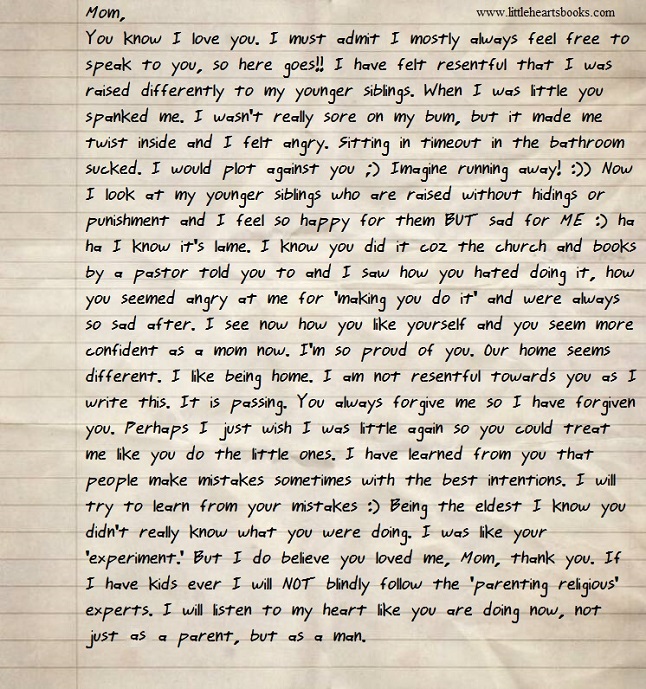 Oh, mama, that made me tear up. Your guy is more than okay. He’s brilliantly more than okay! He’s thoughtfully working through his feelings and sharing them with you honestly because he trusts you with his big emotions. And he’s extrapolating from his experiences and yours and coming up with a life plan based on a strength of character that is very, very evident in his writing. ♥
~~~~~~~~~~~~~~
♥ Changing the World, One Little Heart at a Time ♥
Related posts: When Children Act Out ~ Reflecting Our Emotions The Problem with Punishment Backtalk is Communication…LISTEN Changing the World, One Little Heart at a Time 12 Steps to Gentle Parenting Practical, Gentle, Effective Discipline The Color of Change Children of Violence
Award-winnning author, L.R.Knost, is the founder and director of the children's rights advocacy and family consulting group, Little Hearts/Gentle Parenting Resources, and Editor-in-Chief of Holistic Parenting Magazine. Books by L.R.Knost include Whispers Through Time: Communication Through the Ages and Stages of Childhood ; Two Thousand Kisses a Day: Gentle Parenting Through the Ages and Stages ; The Gentle Parent: Positive, Practical, Effective Discipline ; and Jesus, the Gentle Parent: Gentle Christian Parenting the first four books in the Little Hearts Handbook gentle parenting series, and children’s picture books Petey’s Listening Ears and the soon-to-be-released Grumpykins series.
The Color of Change
[Portions reprinted from The Gentle Parent: Positive, Practical, Effective Discipline by L.R.Knost. Whispers Through Time: Communication Through the Ages and Stages of Childhood and Two Thousand Kisses a Day: Gentle Parenting Through the Ages and Stages also available on Amazon and through other major retailers.]
~~~~~~~~~~~~~~~~~~~~~

So few parents today were raised peacefully and respectfully by their own parents that it’s no surprise that a big issue in the gentle parenting community is how to overcome the stumbling blocks of change. Moving from a control-based parenting style, whether you’re used to spanking or time-outs or reward charts or some combination of the three, to a connection-based parenting style is a heart and mindset change as much as it is a lifestyle change. The undeniable fact is that change is hard work. Whether you’re trying to overcome your own childhood or your own already-established parenting habits, you can expect it to get harder before it gets easier. Just like with any lifestyle change, you will hit walls along the way, and they might even knock you back a step or two. Here are five tips to help you keep calm and carry on to achieve your parenting goals:
1) Commit to no hitting or other physical expressions of anger or frustration, and let that be your starting point, the line in the sand that you absolutely won’t cross. Just like in marriage, if you don’t make a commitment, there’s nothing to keep you from straying back into old patterns.
2) Rethink your parenting role and move from trying to force or manipulate or plead or coerce or use any other tactic to try to control your child’s behavior and instead build a desire in your child to cooperate because they trust you to make good decisions and to want them to be happy and safe. Do that by taking all of that energy that’s been going into trying to control their behavior (external controls) and focusing it on trying to build your connection and modeling the behavior you want to encourage (building internal controls).
3) Examine what you’re modeling. If right now you are insisting on your own way and reacting emotionally with anger and power-plays to your child’s lack of cooperation, what are you modeling? Stubbornness and lack of emotional regulation (i.e. adult-style tantrums). If, instead, you connect with your child, engage them in creative problem-solving, and work together with them toward a resolution to whatever issue you’re having, what are you modeling? Compromise, resourcefulness, and cooperation. Definitely worthwhile life lessons!
4) Keep working on you. Remind yourself that it’s your emotions and experiences and expectations that are causing your outbursts, not your little one’s behavior. Ask yourself why you’re so upset. Let yourself explore your inner triggers. Work through that internally instead of reacting to it externally.
5) Choose a touchstone in a color that will help to keep you grounded, something to look at or hold on to when you feel yourself slipping back into old thinking and behavior patterns. It could be a necklace or bracelet or key chain in a color that captures the essence of the parent you want to be to help you stay focused as you work your way toward becoming that parent. Colors have psychological implications, so some good choices might be blue which is the color of peace and trust; turquoise which is the color of communication; pink which is the color of unconditional love; or magenta which is the color of harmony. You can also place the color around your house as a reminder of the peaceful home you’re trying to create and as a symbol of change and renewal to help you remember to stop and breathe and think before responding to your child.
Remember, it’s a huge change to go from demanding obedience to inviting cooperation, and if you are already in an adversarial pattern with your child, that process will take extra time and patience. And keep in mind that no parenting ‘works’ to change a child into an adult or into a perfect little puppet. Children are imperfect humans being raised by imperfect humans in an imperfect world, after all! But shifting your thinking from expecting, or demanding, obedience to working with your child, understanding them, connecting with them, and inviting them to cooperate (i.e. Instead of “If you don’t put your dinner dishes in the sink, you won’t get ice cream for dessert” try “Let me know when your dishes are in the sink so I can get your ice cream for you.”) is the first and most important step toward a gentler style of parenting and a more peaceful home.
*Having gentle parenting tools ready and available in your ‘toolbox’ will go a long way toward helping you to stick to your commitment to be a more gentle parent. Here are some links to practical alternatives to punishment:
Practical, Gentle, Effective Discipline
Testing the Boundaries~What’s a Parent to Do?
*Also published in The Natural Parent Magazine
Related posts:
When Children Act Out ~ Reflecting Our Emotions
Backtalk is Communication…LISTEN
Bridge Over Troubled Waters~Parenting a ‘Problem’ Child
The Taming of the Tantrum: A Toddler’s Perspective
The Thoughtful Parent’s Guide to Positive Parenting Guides
Award-winnning author, L.R.Knost, is the founder and director of the children's rights advocacy and family consulting group, Little Hearts/Gentle Parenting Resources, and Editor-in-Chief of Holistic Parenting Magazine. Books by L.R.Knost include Whispers Through Time: Communication Through the Ages and Stages of Childhood ; Two Thousand Kisses a Day: Gentle Parenting Through the Ages and Stages ; The Gentle Parent: Positive, Practical, Effective Discipline ; and Jesus, the Gentle Parent: Gentle Christian Parenting the first four books in the Little Hearts Handbook gentle parenting series, and children’s picture books Petey’s Listening Ears and the soon-to-be-released Grumpykins series.
Two Thousand Kisses a Day: Gentle Parenting Through the Ages and Stages
 Two Thousand Kisses a Day: Gentle Parenting Through the Ages and Stages now available on Amazon:
~The birth story of a book~
A mother is born…
Many years ago (26 to be exact!), a small, scared, pregnant, teenage girl walked down the aisle to her tall, scared, clueless, young man and they said their “I do’s.”
But what were they going to do? No earthly idea! They didn’t have the internet to surf for blogs about parenting and marriage, couldn’t afford the few paltry magazines available on those subjects at the time, and weren’t convinced that the way their parents had raised them was exactly how they wanted to raise their unexpected little blessing. So, they simply joined hands and hearts and figured it out the old-fashioned way…through trial and error.
The young girl gave birth prematurely and, after a terrifying NICU stay, brought home her barely 5 lb baby boy. Since the young couple were living on one income and were barely able to feed themselves, it made sense to them to breastfeed their little one. Neither one had ever even seen a mother breastfeeding her baby or even heard of a lactation consultant and no one at the hospital had mentioned breastfeeding at all, so the two young people just kept working through the cracked, bleeding nipples, engorgement, over-supply, and other issues until they got it figured out…and then they were breastfeeders!
Neither one of the young couple had ever read a parenting book or had ever even heard the words ‘cry-it-out,’ and the young girl discovered their first night home how much easier it was to clear away all of the pillows and blankets to keep her baby safe and then simply take her little guy into bed with her and breastfeed him when he was hungry…and then they were co-sleepers!
‘Self-soothing’ was another term the two young people had never heard, so the two of them just did what came naturally and picked up their baby when he fussed or grunted or just looked cute and finally found it easier to just snuggle their little preemie into a baby carrier and tote him around with them wherever they went…and then they were babywearers!
As their precious little guy got bigger and began to explore his new world, the young couple delighted in everything he did and simply moved him or distracted him with songs and toys if he got into things. They couldn’t bear the thought of hurting their son, so punitive parenting just wasn’t an option. They decided to treat their little guy like a person instead of a possession and communicate with him instead of punishing him…and then they were gentle discipliners!
Now, this journey might sound like an easy one when summed up this way, but I can assure you it wasn’t. The young couple, my amazing husband and I, encountered strong criticism of our parenting choices through the years:
- We were warned that our marriage would suffer at the very least, and our babies would suffocate at the worst, if we slept with them in our bed instead of putting them in isolation to sleep.
- We were informed that my breasts would look like deflated balloons and reach my knees by my thirties if I breastfed more than a few weeks.
- We were admonished that our children would grow into spoiled brats if we responded to their needs instead of teaching them to ‘deal with it’ and ‘self-soothe’ their own, and would end up as social outcasts or criminals if we encouraged and guided them instead of spanking them.
These challenges to our parenting style were difficult at the time, and they sometimes even resulted in people choosing to de-friend us (not Facebook de-friending, in real life!), but that had the powerful positive effect of making us really examine what our beliefs were and, as a result, strengthening and solidifying our values, our marriage, and our family.
As for the dire warnings listed above:
- Our beautiful, strong, loving marriage is in its 27th year.
- Our children all survived and thrived on co-sleeping (our littlest is still safely and contentedly sleeping in our bed) and have, in their own time, moved happily to their own rooms.
- Except for being a couple of cup sizes larger at the moment since I’m breastfeeding a toddler, lol, my breasts are normal despite the fact that I’ve breastfed little ones for a cumulative 10+ years of my adult life!
- Our children are, in order, a 25-year-old Pastor (our firstborn son mentioned in the story above who is now a husband and father of two!), a 23-year-old Family Therapist, an 18-year-old pre-med university student on scholarship, 13- and 7-year-old beautiful and well-behaved homeschooled girls with lots of friends (soooo not social outcasts!), and a sweet and happy 2-year-old baby girl. Not a spoiled brat or criminal in the bunch!
Our journey to gentle parenting has had another, somewhat unexpected, effect. While we may not agree with others’ parenting choices, we have been on the receiving end of criticism far too long not to have learned this lesson: Gentle parenting is for parents, too! We have learned to respond gently to our friends who don’t agree with us, even when they don’t respond gently to us. Responding with harshness and criticism doesn’t work with adults any better than it does with children! Responding gently to those who disagree with us may or may not affect their parenting choices, but what it does do is model respectful behavior and conflict resolution to our children and, most of the time, preserve dear friendships.
A gentle parenting advocate is born…
This journey also resulted in a passion for children and family harmony that launched me many years ago into the world of parent coaching and child advocacy and later initiated the creation of Little Hearts/Gentle Parenting Resources as a consulting and educational resource for parents, caregivers, and educators. The culmination of this work led to the development of a series of gentle parenting handbooks designed to equip parents with the information and tools they need to gently guide their children from infancy through toddlerhood and the preschool years and on through middle childhood, the teen years, and beyond.
A book is born…
Two Thousand Kisses a Day: Gentle Parenting Through the Ages and Stages is the first in the series. It is an introduction to the ideas behind gentle parenting and provides practical examples of its application in each of the developmental stages of childhood such as the transition from diapers to potty, problems with sharing, coping with picky eaters, guiding children gently through behavioral issues, and more!
*also published in The Natural Parent Magazine
Award-winnning author, L.R.Knost, is the founder and director of the children's rights advocacy and family consulting group, Little Hearts/Gentle Parenting Resources, and Editor-in-Chief of Holistic Parenting Magazine. Books by L.R.Knost include Whispers Through Time: Communication Through the Ages and Stages of Childhood ; Two Thousand Kisses a Day: Gentle Parenting Through the Ages and Stages ; The Gentle Parent: Positive, Practical, Effective Discipline ; and Jesus, the Gentle Parent: Gentle Christian Parenting the first four books in the Little Hearts Handbook gentle parenting series, and children’s picture books Petey’s Listening Ears and the soon-to-be-released Grumpykins series.
The Problem with Punishment
[Reprinted from Two Thousand Kisses a Day: Gentle Parenting Through the Ages and Stages by L.R.Knost. Whispers Through Time: Communication Through the Ages and Stages of Childhood and The Gentle Parent: Positive, Practical, Effective Discipline also now available on Amazon and through other major retailers.]
~~~~~~~~~~~~~~~~~~~~~
 Want to know a dirty, little secret about punishment?
It doesn’t work.
Punishment may be able to control a child’s behavior temporarily while they’re small or when they are in their parents’ presence, but it cannot control the person. As with all humans, outward behavior is merely a reflection of our inner selves: our needs, our hurts, our emotional states.
While the temporary ‘payoff’ of punishment may be compliance, the need behind the behavior is never addressed and those needs merely get driven underground and often emerge later in more potentially damaging behaviors such as lying, sneaking, anger, outright rebellion, depression, aggression, addictions, etc.
In the same way that treating a brain tumor by merely taking a pain reliever doesn’t address the underlying issue, masking the symptoms of an underlying need with punishment-induced compliance doesn’t solve the problem; it intensifies it.
Want to know another dirty, little secret about punishment?
It requires constant escalation.
In order to maintain the temporary effect of controlling behavior, the punishment, or threats of punishment, must constantly be ramped up. Parents who start out with popping a tiny hand escalate to smacking a chubby little leg, then paddling a small bottom. Over time, as their children’s needs which have been driven underground emerge in ever-increasing behavioral issues, parents often find that they are resorting to yelling and threats and physical punishment more and more often.
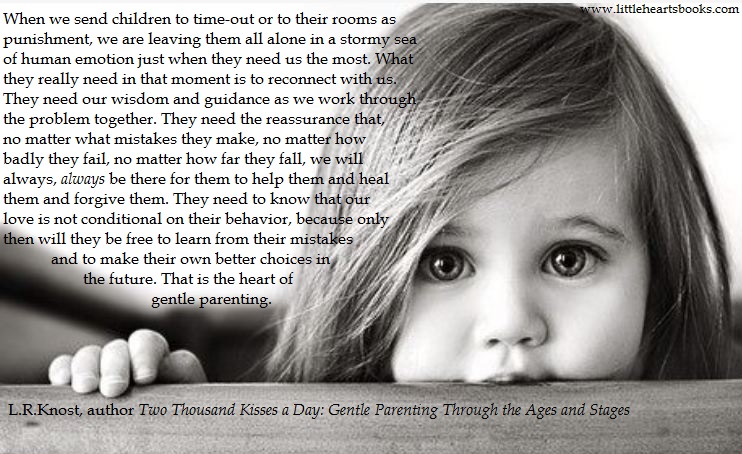 Even parents who use punishment-based parenting approaches other than physical punishment find that they must escalate and escalate to keep their children under ‘control.’ Behavior charts, time-outs, grounding, and removing privileges are some examples of non-physical punishment-based parenting. While these behavior modification techniques may be less painful to children physically, they still don’t address the underlying needs being communicated by the behavior and often are nearly as destructive to the parent/child relationship.
Using isolation such as time-outs or sending children to their room separates them from their source of guidance and comfort just when they need it the most and not only misses a golden opportunity to help the child learn coping mechanisms for dealing with their emotions, but also fractures the very connection that should provide the safety for expressing those emotions. Using behavior charts, removal of privileges, grounding, etc. separates children from their parents by creating an us-against-them mentality that inevitably leads to conflict instead of creating a teamwork mentality that leads to cooperation.
Here’s the thing, effective parenting and, more specifically, effective discipline, doesn’t require punishment. Equating discipline with punishment is an unfortunate, but common misconception. The root word in discipline is actually disciple which in the verb form means to guide, lead, teach, model, and encourage. In the noun form disciple means one who embraces the teaching of, follows the example of, and models their life after.
On the flip side, the root word in punishment is the Latin word punire which in verb form means to penalize, chastise, castigate, inflict harm, humiliate. There is no noun form of punire or its English equivalent, punishment.
Many of today’s most popular self-proclaimed parenting ‘experts’ equate physical punishment with discipline and go to great lengths to describe the best methods and tools for hitting children as well as instructing parents to maintain a calm, controlled, and even cheerful demeanor as they ‘lovingly’ hit their children.
It is interesting to note here that, when it comes to the law, crimes of passion are treated as less heinous than premeditated, planned, and purposefully executed crimes which are termed ‘in cold blood.’ And yet when physically punishing a child, a crime in many places across the globe, hitting in anger or frustration (i.e. passion) is deemed wrong by proponents of spanking, while hitting children with calm and deliberate intent (i.e. premeditation) is encouraged.
It is also interesting to note that, in the not-too-distant past, husbands hitting their wives was also viewed as not only a societal norm, but also a necessary part of maintaining a harmonious, successful marriage. In fact, a man who epitomizes the words calm and controlled, Sean Connery, shared his thoughts on the ’reasonable smacking’ of his wife in a 1987 interview with Barbara Walters in which he explained the necessity of using punitive methods to control women.
The core belief behind ‘reasonable smacking’ of wives was that there was no other effective way to control them. I agree. If controlling another human being is the goal, then force is necessary. Fear, intimidation, threats, power-plays, physical pain, those are the means of control.
But, if growing healthy humans is the goal, then building trust relationships, encouraging, guiding, leading, teaching, and communicating are the tools for success.
Many parents simply don’t know what else to do. They were raised with spanking and other punishment-based parenting methods as a means of control and “turned out okay” so they default to their own parents’ choices without researching alternatives to spanking or considering whether “okay” could be improved upon.
Consider this, more than 90% of American parents admit to spanking their children, and yet the common contention is that it’s a decline in spanking that is responsible for the purportedly escalating  rates of youth violence and crime. Is it really the less than 10% of children who aren’t spanked who are responsible for all the problems of our society? Or could it be that the 90% of children who are subject to violence at home in the form of being slapped, paddled, smacked, yanked, whipped, popped, spanked, etc. are taking those lessons out into the world? Is it just possible that children who are hit learn to hit? That children who are hurt learn to hurt? Perhaps the lesson they are learning is that ‘might is right’ and violence is the answer to their problems, the outlet for their stress, the route to getting others to do what they want.
People throughout history have complained about ‘the trouble with kids today’ and they’ve pinned all the ills of their society on supposedly permissive parenting. They’ve ranted about out-of-control children, disrespectful youth, entitlement, spoiling, disobedience, violence, self-centeredness, etc:
“The children now love luxury. They have bad manners, contempt for authority, they show disrespect to their elders…. They no longer rise when elders enter the room. They contradict their parents, chatter before company, gobble up dainties at the table, cross their legs, and are tyrants over their teachers.” ~Socrates, 5th Century BC
“What is happening to our young people? They disrespect their elders, they disobey their parents. They ignore the law. They riot in the streets inflamed with wild notions. Their morals are decaying. What is to become of them?” ~Plato, 5th Century BC
“I see no hope for the future of our people if they are dependent on frivolous youth of today, for certainly all youth are reckless beyond words… When I was young, we were taught to be discreet and respectful of elders, but the present youth are exceedingly wise [disrespectful] and impatient of restraint” ~Hesiod, 8th Century BC
“The world is passing through troublous times. The young people of today think of nothing but themselves. They have no reverence for parents or old age. They are impatient of all restraint. They talk as if they knew everything, and what passes for wisdom with us is foolishness with them. As for the girls, they are forward, immodest and unladylike in speech, behavior and dress.” ~Peter the Hermit, 13th Century AD
Sounds familiar, doesn’t it? Maybe, though, there isn’t really any ‘trouble with kids today.’ Maybe the problem is with parents who repeat the patterns their own parents set or with societies who view normal stages of development as somehow abnormal.
Maybe ’kid’s today’ are just kids like they have been through the ages, full of exuberance and curiosity and learning their way in a great big world, and a listening ear, gentle guidance, and trusted arms to turn to when inevitable mistakes are made are really all children need to grow up into kind, helpful, responsible, productive members of our society.
The bottom line is that addressing our children’s underlying needs, the actual causes of their behavior instead of just the behavior itself, is a far more effective parental approach as well as being significantly better for a healthy, mutually respectful parent/child relationship. Sending our children out into the world as adults with their needs met, with coping mechanisms in place for those times when the stresses overwhelm them, and with the knowledge of a safe haven where comfort is always available when the world hurts them is a powerful way to change the world for the better.
Maybe, just maybe, sowing peace in our homes is the answer for our children, our families, and our world, after all.
*Also printed in The Natural Parent Magazine
Related posts:
Practical, Gentle, Effective Discipline
The Gift of a Strong-Willed Child
Backtalk is Communication…LISTEN
Bridge Over Troubled Waters~Parenting a ‘Problem’ Child
200 Ways to Bless Your Children with a Happy Childhood
12 Tips for Gently Parenting Your Adult Children (Hint: It starts when they’re newborns!)
The Measure of Success~Chinese Parents and French Parents Can’t BOTH Be Superior!
Award-winnning author, L.R.Knost, is the founder and director of the children's rights advocacy and family consulting group, Little Hearts/Gentle Parenting Resources, and Editor-in-Chief of Holistic Parenting Magazine. Books by L.R.Knost include Whispers Through Time: Communication Through the Ages and Stages of Childhood ; Two Thousand Kisses a Day: Gentle Parenting Through the Ages and Stages ; The Gentle Parent: Positive, Practical, Effective Discipline ; and Jesus, the Gentle Parent: Gentle Christian Parenting the first four books in the Little Hearts Handbook gentle parenting series, and children’s picture books Petey’s Listening Ears and the soon-to-be-released Grumpykins series.
Bringing Up Binary: Raising an Obedient Computer
Dear Customer Service,
I think my computer needs professional help. I just don’t know what to do anymore. It won’t respond to me half of the time, and the other half its response is so slow it might as well not respond at all! I need help, and I don’t know where else to turn. Here’s the story:
 I remember how excited I was when I first got my computer. I carefully cut the tape on the box, gently lifted it out, and gingerly settled it in the well-appointed and super organized office I’d had decorated and waiting for what seemed like forever.
Now what to do? I’d never owned a computer before and was so nervous I’d somehow break it. I searched through manuals and how-to’s for dummies, looking for tips from experts and guidance from other computer owners with years of experience. It was so frustrating because everyone seemed to have a different opinion about what to expect and what was important and how to handle all the hardware and software issues that were bound to crop up with computer ownership.
Over time, though, I got more comfortable in my new role as a computer owner. My tentative key tapping became more confident, and I operated my computer like a pro. But then minor irritations began to creep up. I’d input a command and have to wait for my computer to process before it responded, but why should I have to wait? I’d issued the same commands hundreds of times since my computer had arrived. Shouldn’t it obey instantly? I certainly thought so! So, I’d push the enter button a couple more times, and then a couple more, then some other buttons, and the darn thing would freeze up on me!!! Seriously?!?
I’m no push-over, believe me, and I wasn’t about to be manipulated by my own computer! So, I started unplugging it every time it froze. After a few minutes, I’d plug it back in again, but even after extending its time-out of the outlet to longer and longer periods, my computer was still giving me that ring of delayed obedience and then freezing when I pushed its buttons. So, I started giving it a gentle whack on its CPU. (No, I was not abusing it. I was just giving it a little tap to get its attention!) But nothing seemed to be working. I was still having to wait for it to process my commands, and it was actually getting worse!
Then my computer started popping up demands, right in front of what I was working on! “Updates needed.” “Virus software update available.” Me, me, me. I want. I want. I want. Isn’t it amazing how completely self-absorbed computers are? Didn’t my computer realize I had a schedule to keep? I had things that needed to get done, an agenda, a life! And on top of all that, I’d just purchased a new little laptop that needed my attention. Why couldn’t my computer understand that it just had to do what it was told and stop giving me a hard time?!? Selfish, that’s why!
Well, time went on and my computer kept up it’s delayed obedience and just kept escalating its constant demands with pop up after pop up after pop up. But I knew better than to give in. All it wanted was attention! So I alternated between time-out of the outlet and well-deserved whacks to the CPU, but all I got was slower and slower obedience, longer and longer freezes, and just general unresponsiveness.
I’ve tried to be a good computer owner, but I’m at the end of my tether. Please help!
Sincerely,
Frustrated
Dear Frustrated,
Computers are designed to process input. Basically, that means you get out what you put in. That “demand for attention” is actually your computer communicating a need for input from you, whether it’s for an update  or a virus scan or whatever it’s indicating it needs. If you meet it’s needs, that will not only stop the “demands” but also free it up to run more smoothly and responsively for you. As far as the “delayed obedience,” that’s just how computers are built. It needs time to process your input so that it can respond appropriately. Pushing its buttons over and over is actually causing the freezing you’re concerned about, and unplugging your computer when it freezes just shuts it down right when it’s trying its hardest to work things out. Remember, interaction between owner and computer is the core of computer processing. Finally, stop “whacking” your computer. Call it what you want…hitting, tapping, popping, or whatever…it’s just causing internal damage and resulting in the very problems you’re trying to solve.
Sincerely,
Shak N. Mihed
Related posts:
The Measure of Success~Chinese Parents and French Parents Can’t BOTH Be Superior!
Spare the Rod: The Heart of the Matter
Tots to Teens~Communication Through the Ages and Stages
Toddlers, Tantrums, and Time-Ins, Oh My!
Award-winnning author, L.R.Knost, is the founder and director of the children's rights advocacy and family consulting group, Little Hearts/Gentle Parenting Resources, and Editor-in-Chief of Holistic Parenting Magazine. Books by L.R.Knost include Whispers Through Time: Communication Through the Ages and Stages of Childhood ; Two Thousand Kisses a Day: Gentle Parenting Through the Ages and Stages ; The Gentle Parent: Positive, Practical, Effective Discipline ; and Jesus, the Gentle Parent: Gentle Christian Parenting the first four books in the Little Hearts Handbook gentle parenting series, and children’s picture books Petey’s Listening Ears and the soon-to-be-released Grumpykins series.
When Children Hit~10 Tips for Parents
[Portions reprinted from The Gentle Parent: Positive, Practical, Effective Discipline by L.R.Knost. Two Thousand Kisses a Day: Gentle Parenting Through the Ages and Stages and Whispers Through Time: Communication Through the Ages and Stages of Childhood also available on Amazon and through other major retailers.]
 Toddlers and preschoolers are still in the early stages of learning to communicate verbally. Add to that the fact that they have little-to-no impulse control and very immature social skills, and you’ve got a recipe for an instinctive physical response (i.e. hitting, kicking, biting, hair pulling, throwing things, etc.) to situations in which they are frustrated, angry, scared, or just tired and out-of-sorts.
Many parents who practice gentle discipline wonder where their little one picked up the behavior, not realizing that it is a normal and age-appropriate reaction, albeit an unacceptable one. Very often parents are advised to spank their child to train them not to hit others, especially those who are smaller and weaker than they are. (more…)
Award-winnning author, L.R.Knost, is the founder and director of the children's rights advocacy and family consulting group, Little Hearts/Gentle Parenting Resources, and Editor-in-Chief of Holistic Parenting Magazine. Books by L.R.Knost include Whispers Through Time: Communication Through the Ages and Stages of Childhood ; Two Thousand Kisses a Day: Gentle Parenting Through the Ages and Stages ; The Gentle Parent: Positive, Practical, Effective Discipline ; and Jesus, the Gentle Parent: Gentle Christian Parenting the first four books in the Little Hearts Handbook gentle parenting series, and children’s picture books Petey’s Listening Ears and the soon-to-be-released Grumpykins series.
The Trouble With Kids Today
[Portions reprinted from Two Thousand Kisses a Day: Gentle Parenting Through the Ages and Stages by L.R.Knost available on Amazon]
 “People are telling parents like me that we are failing our children because we practice controlled discipline in our homes. I say: the children that are raised without it are the ones being abused and robbed of the chance of success in adulthood.” Controlled discipline in the eyes of this author of I Don’t Like Spanking My Kids, But I Do It Anyway is physical punishment. Equating discipline with punishment is a common misconception, but she is, unfortunately, not alone in her stance.
Many of today’s most popular self-proclaimed parenting ‘experts’ also equate physical punishment with discipline and go to great lengths to describe the best methods and tools for hitting children along with instructing parents to maintain a calm, controlled, and even cheerful demeanor as they ‘lovingly’ hit their children.
It is interesting to note here that, when it comes to the law, crimes of passion are treated as less heinous than premeditated, planned, and purposefully executed crimes which are termed ‘in cold blood.’ And yet when physically punishing a child, a crime in many places across the globe, hitting in anger or frustration (i.e. passion) is deemed wrong by proponents of spanking, while hitting children with calm and deliberate intent (i.e. premeditation) is encouraged.
It is also interesting to note that, in the not-too-distant past, husbands hitting their wives was also viewed as not only a societal norm, but a necessary part of maintaining a harmonious, successful marriage. In fact, a man who epitomizes the words calm and controlled, Sean Connery, shared his thoughts on the ‘reasonable smacking’ of his wife in a 1987 interview with Barbara Walters:
The core belief behind ‘reasonable smacking’ of wives was that there was no other effective way to control them. I have to agree. If controlling another human being is the goal, then force is necessary. Fear, intimidation, threats, power-plays, physical pain, those are the means of control.
But if growing healthy humans is the goal, then building trust relationships, encouraging, guiding, leading, teaching, communicating, those are the tools for success.
Many parents simply don’t know what else to do. They were raised with spanking as a means of control and “turned out okay” so they default to their own parents’ parenting choices without researching alternatives to spanking or considering whether “okay” could be improved upon.
As to the I Don’t Like Spanking My Kids, But I Do It Anyway author’s contention that “We are raising a generation of children who are over-sensitive because they eventually find out that they aren’t as good at baseball or ballet as some other kid and their parents promised them that everyone is equal. They feel entitled because we teach them that they should. They throw tantrums when life doesn’t go their way because their parents have tiptoed around them to make sure that it does,” that reasoning sounds strangely familiar.
People throughout history have complained about ‘the trouble with kids these days.’ They’ve pinned all the ills of their society on permissive parenting. They’ve ranted about out-of-control children, disrespectful youth, entitlement, spoiling, disobedience, violence, self-centeredness, etc:
“The children now love luxury. They have bad manners, contempt for authority, they show disrespect to their elders…. They no longer rise when elders enter the room. They contradict their parents, chatter before company, gobble up dainties at the table, cross their legs, and are tyrants over their teachers.”
~Socrates, 5th Century BC“What is happening to our young people? They disrespect their elders, they disobey their parents. They ignore the law. They riot in the streets inflamed with wild notions.
Their morals are decaying. What is to become of them?”
~Plato, 5th Century BC“I see no hope for the future of our people if they are dependent on frivolous youth of today, for certainly all youth are reckless beyond words… When I was young, we were taught to be discreet and
respectful of elders, but the present youth are exceedingly wise [disrespectful] and impatient of restraint”
~Hesiod, 8th Century BC“The world is passing through troublous times. The young people of today think of nothing but themselves. They have no reverence for parents or old age. They are impatient of all restraint. They talk as if they knew everything, and what passes for wisdom with us is foolishness with them. As for the girls, they are forward, immodest and unladylike in speech, behavior and dress.”
~Peter the Hermit, 13th Century ADMy grandpa notes the world’s worn cogs
And says we’re going to the dogs.
His grandpa in his house of logs
Said things were going to the dogs.
His grandpa in the Flemish bogs
Said things were going to the dogs.
His grandpa in his hairy togs
Said things were going to the dogs.
But this is what I wish to state:
The dogs have had an awful wait.
~Unknown, circa 1936Small children disturb your sleep, big children your life.
~Yiddish Proverb
Perhaps, just perhaps, there isn’t any ‘trouble with kids today.’ Maybe the trouble is with societies who view normal stages of development as somehow abnormal. Maybe the problem is with parents who repeat the patterns their own parents set and don’t delve into the belief system they are now passing along to their children. Or maybe the problem is simply the rose-colored glasses older generations tend to have about their own youth when they share idealized versions of ‘the good old days.’
Could it be that ‘kid’s today’ are just kids like they have been through the ages, full of exuberance and curiosity and learning their way in a great big world? Could it be that a listening ear, gentle guidance, and trusted arms to turn to when inevitable mistakes are made are really all children need to grow up into kind, helpful, responsible, productive members of our society?
Consider this, “Since more than 90% of American parents admit to spanking their children, it’s hard to accept that a decline in spanking is responsible for the purportedly escalating rates of youth violence and crime. Could it be that the 90% of children who are subject to violence at home in the form of being slapped, paddled, smacked, yanked, whipped, popped, spanked, etc. are taking those lessons out into the world? Is it just possible that children who are hit learn to hit? That children who are hurt learn to hurt? Perhaps the lesson they are learning is that ‘might is right’ and violence is the answer to their problems, the outlet for their stress, the route to getting others to do what they want.” Better Children, Better World
Could it be that sowing peace in our homes is the answer after all?
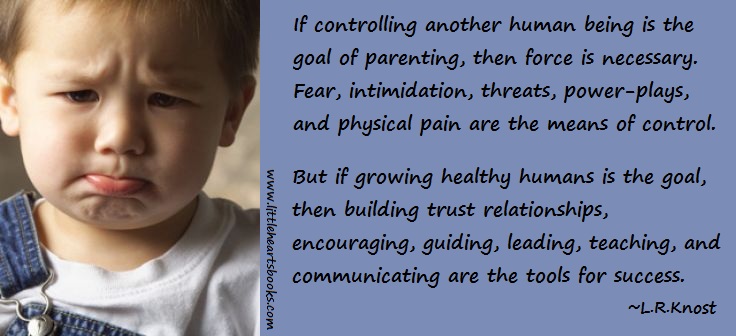
Related posts:
Practical, Gentle, Effective Discipline
Spare the Rod: The Heart of the Matter
Tots to Teens~Communication Through the Ages and Stages
Testing the Boundaries~What’s A Parent To Do?
One Slippery Sock & Other Silly Tools for your Parenting Toolbox!
The Measure of Success~Chinese Parents and French Parents Can’t BOTH Be Superior!
Award-winnning author, L.R.Knost, is the founder and director of the children's rights advocacy and family consulting group, Little Hearts/Gentle Parenting Resources, and Editor-in-Chief of Holistic Parenting Magazine. Books by L.R.Knost include Whispers Through Time: Communication Through the Ages and Stages of Childhood ; Two Thousand Kisses a Day: Gentle Parenting Through the Ages and Stages ; The Gentle Parent: Positive, Practical, Effective Discipline ; and Jesus, the Gentle Parent: Gentle Christian Parenting the first four books in the Little Hearts Handbook gentle parenting series, and children’s picture books Petey’s Listening Ears and the soon-to-be-released Grumpykins series.