
A Sea Change: Obedience is Not the Goal
[Excerpt reprinted from Jesus, the Gentle Parent: Gentle Christian Parenting by L.R.Knost. Two Thousand Kisses a Day: Gentle Parenting Through the Ages and Stages; Whispers Through Time: Communication Through the Ages and Stages of Childhood; and The Gentle Parent: Positive, Practical, Effective Discipline by L.R.Knost also available on Amazon and through other major retailers.]
“Look also at ships: although they are so large and are driven by fierce winds, they are turned by a very small rudder wherever the pilot desires.”
James 3:4
 Oh, the toddler years, those delightful days when little ones begin to discover that they are, indeed, separate individuals from their parents and begin to test the waters to see how far out to sea their little boats can take them when they’ve got a full head of steam. This is the age when parents begin to wonder how in the world to tether their little steamboats to the docks or scuttle them in shallow waters to slow them down.
Obedience becomes a hot topic at moms’ groups and men’s breakfasts, at playdates and on park benches as parents wrestle with this new developmental stage that often shows up, unwelcome and unannounced, and the desperate, bewildered question being debated is always the same:
“How can I get my child to obey?”
Take a moment and examine what that question really means, though. Does it mean, “How can I control my child?” or does it mean, “How can I help my child learn self-control?” It’s an important distinction because the first meaning is external and temporary (i.e. only effective as long as the controlling factors are ever-present and escalate as the child grows) and the second meaning is internal and intrinsic. In the first, the rudder of a child’s ship is firmly removed from the child’s hands again and again as the parent and child struggle for control of the ship. In the second, the rudder remains in the child’s hands as the parent guides, instructs, and leads the way with their little steamboat sheltered alee of the parent ship.
Parents often feel lost at sea, themselves, when it comes to the best course for guiding and growing their children in the storm-tossed waves and murky waters of childhood behaviors, and many churches try to meet parent’s needs by offering parenting books and classes. A vast number of those resources are, unfortunately, based on a punitive, authoritarian model. These books, and the classes based on the books, claim to be Biblical, but miss the heart of the Father entirely and mislead and even intimidate parents into believing that they must train their children into instant, unquestioning obedience in order to raise their children ‘God’s way.’
Consider, though, that Jesus said, “You will know them by their fruit.” (Matthew 7:16) referring to how we will recognize his children. And what is the fruit of the Spirit? Love. Joy. Peace. Patience. Kindness. Goodness. Gentleness. Faithfulness. Self-control. What’s missing? Nothing. God’s Word is perfect. And yet obedience is not included as a fruit of the Spirit. It is not mentioned as a measure of love for God or evidence of a relationship with God. That certainly doesn’t mean that God doesn’t want us to listen to his wise counsel and remain within the safe boundaries he’s shared with us. What it does mean is that it’s a heart issue, not an obedience issue, and he wants our trust and thoughtful, considered cooperation, not our fear-driven, mindless obedience.
Did you know, in fact, that the word obey doesn’t even appear in the original texts of the Bible? When the English translators of the King James version of the Bible encountered the Hebrew words hupakouo/hupakoe and shema/lishmoa they discovered that there wasn’t an exact English equivalent, so they chose the word hearken in their translations which subsequently became an archaic term and was later changed to obey.24 So, what exactly do the original words in the Bible mean?
Hupakouo/hupakoe – to hear from above; to listen for; to lend an ear to1,2,3
Shema/lishmoa – to understand, to internalize, to ponder, to reflect upon1,2,3
And, in the negative form, rather than the word disobedience in the original texts, there is…
Parakouo – to close one’s ears to; to ignore1,2,3
The same mistranslation also occurs from the original Greek texts of the New Testament where peitho and peitharcheo are translated into, respectively, obey and disobey but actually mean…
Peitho – to be persuaded; to be moved; to respond25
Peitharcheo – to remain unpersuaded; to be unmoved by; to be unresponsive to25
Also translated into obey in English are the Greek words phulasso and teron and their various conjugations, all of which mean to watch, to observe carefully, to give consideration to25.
Taken together, the meaning of what is now translated obey in the original text of the Bible is more accurately read ‘listen to, thoughtfully consider, and respond to.’ That is a far, far different meaning than the ‘instant obedience’ often held up as the epitome of Christian faith and evidence of love for God and, by extension, the goal of so-called ‘Biblical parenting.’
Before we address the parenting conundrum of instant obedience versus thoughtful consideration, let’s look at several verses in the Bible with the original meanings restored:
He replied, “Blessed rather are those who hear the Word of God and obey listen to, thoughtfully consider, and respond to it.” (Luke 11:28)
Jesus replied, “Anyone who loves me will obey listen to, thoughtfully consider, and respond to my teaching. My Father will love them, and we will come to them and make our home with them. (John 14:23)
Children, obey listen to, thoughtfully consider, and respond to your parents in the Lord, for this is right. (Ephesians 6:1)
One other interesting note is that the word translated punish in the English versions of the Bible is from the Hebrew word avon and from the Greek kolasis/kolazo. Look at the contrast in meanings:
Punish (English) – to inflict a penalty upon; to exact retribution; to make suffer26
Avon (Hebrew) – to carry guilt; to bear one’s own iniquity1,2,3
Kolasis/kolazo (Greek) – removed; separated25
The word used in English translations of the Bible, punish, conveys an external infliction of negative consequences, while the original words, avon (Hebrew) and kolasis/kolazo (Greek) convey internal, self-imposed consequences (i.e. carrying the weight of guilt/shame) and natural consequences (i.e. being estranged).
There is no fear in love. But perfect love drives out fear, because fear has to do with punishment bearing one’s own iniquity, carrying guilt, feeling shame, being estranged. (1 John 4:18)
Jesus came to take our place, to bear our iniquities, to carry our guilt, to free us from shame, and to reunite us with our Father, and the literal translation conveys that truth perfectly.
The thing is, instant obedience and thoughtless compliance based on fear of punishment will always be an external and temporary ‘fix’ for behavior issues, as evidenced by the increasingly defiant and disconnected Israelite nation in the Old Testament, while thoughtful consideration and cooperation are internal, a heart-deep and soul-to-soul connection inspired by compassion, respect, and communication. Consider this passage from The Gentle Parent: Positive, Practical, Effective Discipline:
Someone once wrote, “Obedience is doing what you’re told, no matter what’s right. Morality is doing what’s right, no matter what you’re told.” History preserved the quote, but not the source with any credibility, but it’s a wise statement nonetheless.
Growing children with an inner compass that guides their steps toward kindness and compassion and generosity of spirit is far, far and away superior to training children to operate on automatic pilot. Parents often focus so much time and energy on trying to make their children obey in the small moments of life that they forget to step back and take a panoramic view of how their parenting choices may affect their children’s life course.
‘Instant obedience’ is the new catch-phrase in many popular parenting articles and books, but the reality is that, while instant obedience may be convenient for parents in the moment, it can have powerful negative impacts on the adults their children will become.
Training children into instant obedience is the equivalent of disabling their inner guidance system and strapping on a remote-controlled rocket. The end result may be adults who are easily controlled by others or adults who are deeply divided, constantly fighting the external controls, but hampered by an erratic, immature inner compass that never had the chance to develop properly.
Equipping children with a healthy, well-functioning internal guidance system, an inner compass, takes time, patience, and self-control on the part of the parents. Certainly not a convenient alternative! While it may not be convenient to slow down our hectic life pace and really connect with our children, it’s that connection that enables their internal guidance system to come online. While taking the time to really communicate may be a sacrifice, it’s in that communication that the directions on their inner guidance system are set. And, while working cooperatively with our children may take more time and effort, the fact is that inviting cooperation rather than forcing compliance raises leaders instead of reaping followers.
Clearly, teaching our children to control themselves is far more effective in the long-term than trying to control our children, but how, specifically, can we go about equipping them with those all-important internal controls?
- Model instead of manipulate.
- Invite instead of intimidate.
- Support instead of shame.
- Encourage instead of enrage.
- Teach instead of threaten.
- Listen instead of lecture.
- Help instead of hurt.
- Parent instead of punish.
Instant obedience and mindless compliance are poor goals, indeed, when raising children. A thoughtfully questioning, passionately curious, and humorously resourceful child who delights in inventing ‘compromises’ and who endlessly pushes the boundaries tends to become a thoughtful, passionate, resourceful adult who will change the world rather than being changed by the world.These are simple truths, and yet their effects are profound when we embrace them and incorporate them into our parenting. Connection, Communication, and Cooperation, the Three C’s of gentle parenting, are powerful and effective tools in guiding our children toward self-control to help them learn to steer their own ships, and, if we are to be fishers of men, then isn’t a ship headed out to sea exactly what each of us should be, anyway? Instead of mooring our children to the shore, let’s sail alongside them in the sometimes calm, sometimes stormy, but always glorious sea of life, keeping them sheltered on our leeward side until they are ready to sail alone.
“For I am the Lord your God who takes hold of your right hand and says to you, Do not fear; I will help you.”
Isaiah 41:13
Related posts:
Stealing God’s Gift: Free Will is a Gift to be Nurtured, Not a Curse to be Broken
Spare the Rod: The Heart of the Matter
Did Jesus Have a Temper Tantrum?
Jesus, the Gentle Parent: Gentle Christian Parenting
Tattered Tapestries: Weaving Trust Through the Chaos
Fear Doesn’t Lead to Faith: Becoming Your Child’s Safe Place
Where Did You Learn Love, Child?
Practical, Gentle, Effective Discipline
 Award-winnning author, L.R.Knost, is the founder and director of the children's rights advocacy and family consulting group, Little Hearts/Gentle Parenting Resources, and Editor-in-Chief of Holistic Parenting Magazine. Books by L.R.Knost include Whispers Through Time: Communication Through the Ages and Stages of Childhood ; Two Thousand Kisses a Day: Gentle Parenting Through the Ages and Stages ; The Gentle Parent: Positive, Practical, Effective Discipline ; and Jesus, the Gentle Parent: Gentle Christian Parenting the first four books in the Little Hearts Handbook gentle parenting series, and children’s picture books Petey’s Listening Ears and the soon-to-be-released Grumpykins series.

Did Jesus have a Temper Tantrum?
[Excerpt reprinted from Jesus, the Gentle Parent: Gentle Christian Parenting by L.R.Knost. Two Thousand Kisses a Day: Gentle Parenting Through the Ages and Stages; Whispers Through Time: Communication Through the Ages and Stages of Childhood; and The Gentle Parent: Positive, Practical, Effective Discipline by L.R.Knost also available on Amazon and through other major retailers.]
~~~~~~~~~~~~~~~~~~~~~
 “Jesus entered the temple courts and drove out all who were buying and selling there. He overturned the tables of the money changers and the benches of those selling doves. “It is written,” he said to them, “‘My house will be called a house of prayer but you are making it a den of robbers.’”
Matthew 21:12-13
Temper tantrum: (n.) a loss of mental balance or composure, esp. an outburst of anger or irritation
It may seem a bit disrespectful to label Jesus’ takedown in the temple courtyard as a temper tantrum, but according to the dictionary definition of a tantrum, that would be an accurate designation. He acted out his overwhelming emotions by flipping over tables and throwing chairs and chasing people away in a God-sized, epic tantrum that must have shocked the religious to their core and rocked the pharisaical back on their heels.
So what’s the deal? Are temper tantrums signs of a child’s sinful, selfish nature, as the child-training set are so quick to accuse, or are they normal expressions of overwhelming emotions? Let’s see what the child-trainers have to say:
“A temper tantrum is an absolute rejection of parental authority. Parents should isolate the child (with a promise of consequences), then follow through with chastisement [spanking] after the child settles down.” (Gary Ezzo, Growing Kid’s God’s Way)
“…tantrums are a form of challenging behavior that can be eliminated by one or more appropriate spankings.(p. 108)” (Dr. James Dobson, The New Dare to Discipline)
“A seven-month-old boy had, upon failing to get his way, stiffened, clenched his fists, bared his toothless gums and called down damnation on the whole place. At a time like that, the angry expression on a baby’s face can resemble that of one instigating a riot. The young mother, wanting to do the right thing, stood there in helpless consternation, apologetically shrugged her shoulders and said, “What can I do?” My incredulous nine-year-old whipped back, “Switch him.” The mother responded, “I can’t, he’s too little.” With the wisdom of a veteran who had been on the little end of the switch, my daughter answered, “If he is old enough to pitch a fit, he is old enough to be spanked.(p. 79)” (Michael Pearl, To Train Up a Child)
“If your child is still angry, it’s time for another round. ‘Daddy has spanked you, but you are not sweet enough yet. We are going to have to go back upstairs for another spanking.’”(Tedd Tripp, Shepherding a Child’s Heart)
So, what do you think, parents? Is acting out of overwhelming emotions a sin that must be punished as the child-trainers claim or is it normal human behavior? Is there even such a thing as normal human behavior, or is human behavior itself sinful by its very nature? Is having overwhelming emotions, in and of itself, a sin?
Sin, Biblically speaking, is acting outside of God’s nature. Since Jesus is God in the flesh, he was clearly acting within God’s nature at all times, even though he was also fully human. So, Jesus’ actions and his human behaviors, his normal human behaviors, all fell within the boundaries of God’s nature and therefore were and are not sinful.
Let’s go back to Jesus and breakdown the takedown in the temple. He was angry. He toppled tables. He threw things. He chased people away. But Jesus was and is sinless, so clearly being angry, being overwhelmed by big emotions, and acting on those emotions are not sins, in and of themselves.
When does acting on emotions become sinful, then? The answer lies in Ephesians 4:26-27, “In your anger do not sin: Do not let the sun go down while you are still angry, and do not give the devil a foothold.” Note that it doesn’t say, “Getting angry is a sin.”
Emotions can lead to sin when they remain unsettled, are left to burrow deeply into our hearts and take root, and when we subsequently respond with spite, bitterness, vengeance, or rage.
As parents, then, how can we help our children when they are overwhelmed by their emotions, when they tantrum and cry and act out their big feelings? Does it make sense to expect them to cope with their big emotions alone or to suppress their emotions so they remain unsettled?
Of course not. Our children need us to parent them, not punish them.
“God is our refuge and strength, an ever-present help in times of trouble.”
(Psalm 46:1b)
Just as God is “our refuge and strength” and “an ever-present help” that is what we need to be for our children, to reflect the heart of our Father to our own little ones. We can help them to process their emotions. We can work with them to resolve their problems. And we can equip them with the life skills they’ll need to handle their emotions on their own when they grow into adulthood.
As you read on, remind yourself that having emotions is not a sin and needing help processing those emotions is a normal part of childhood:
When a little person feels frustrated, overwhelmed, or just plain old out-of-sorts (read: tantrum time!), it’s tempting for parents to focus on correction rather than connection. But when children are intensely stressed, the prefrontal cortex of the brain, which in early childhood is an underdeveloped, mushy grey sponge waiting to be formed, is flooded with cortisol, the ‘stress hormone.’ The result is what is known as the fight-freeze-or-flight syndrome in which higher brain functions (learning, reason, self-control) are markedly hampered and lower brain functions (instinct, physical reactions) take over. This is an in-built survival mechanism that gradually comes under conscious control through years of growth in a safe and supportive environment. Interestingly, it is theorized that this underdeveloped ‘sponginess’ is why small children are able to learn new languages more quickly than older children and adults. They are, in a very literal way, absorbing information raw, unhampered by the processing and reason of a more mature brain.
Expecting young children to have the maturity and self-control to overcome this God-given survival instinct is unrealistic. Threatening, punishing, or even reasoning with them while their higher brain functions are suppressed is futile and actually just adds more stress to the situation (more stress = fuel on the tantrum-fire!).
What they really need is help…
- First, help coping with their big emotions
- Then, help reconnecting with their source of safety and security (you!)
- And last, help processing the problem that sent them into a maelstrom of emotion in the first place.
Punishing them, yelling at them, sending them to their room, or putting them in time-out disconnects them even further from their source of security and not only delays a resolution of the issue, but misses an opportunity to equip them with the tools they need to handle future problems.
This is where the Three C’s of gentle discipline come into play:
Connection:
- Remaining present and supportive until they are able to calm down enough to accept your help
- Drawing them close when they’re ready (time-in)
Communication:
- Validating their emotions by labeling them and empathizing (i.e. “You’re sad because we have to leave the park. I’m sad, too. The park is fun!”)
- Offering words to help them express their frustrations using reflective language (i.e. “It’s hard to do things we don’t like, isn’t it?”)
Cooperation:
- Helping them move on by redirecting their attention to the future (i.e. “When we get home we’re going to make a snack. Would you like grapes or bananas today?”)
- Modeling coping skills and self-control by calming your own reaction to their meltdown and helping them process their big emotions
These are all ways of reconnecting with your toddler or preschooler to help them successfully navigate their present difficulty as well as to cope with difficulties they’re confronted with in the future.
One effective tool for use in helping little ones cope with big emotions is a Calm-Me-Jar made from small, round, plastic bottles such as Aquapod water bottles. They are perfect for small hands to shake and manhandle to their heart’s content.
To make your own Calm-Me-Jar, fill up a plastic water bottle with warm water and basic craft glitter glue in whatever color you like. You can add some extra glitter and a drop of food coloring to customize your glitter jar to your child’s tastes, and then when you have the look you want, be sure to hot glue the top on to prevent spills.
When my little ones have meltdowns, or, if I can catch it, before they reach that point, I pull out one of the Calm-Me-Jars and shake it up and just let them hold it while I hold them (when they are ready to be held) and talk or sing quietly. When I feel their body relaxing and their breathing slow down, I might say something like, “It’s sad when we can’t have a toy, isn’t it?” or whatever else will reflect what they seem to be unable to express.
When an older preschooler or early elementary-aged child has a meltdown, or, again, before if I can catch it, I first connect, “I’m here. I can see you’re upset. How can I help?” and listen as they try to verbalize their feelings. If they’re having trouble with the words, instead of immediately supplying the words for them, I’ll offer them a Calm-Me-Jar and ask if they’d like to show me how they’re feeling. They will often shake the Calm-Me-Jar vigorously while jumping up and down and twisting all around, which is a great physical outlet for their intense feelings. I watch until I see their movements slowing and their breathing evening out, and when they’ve calmed just enough to hear me, I quietly talk them through the calming process, “Look at all that fairy dust bouncing around like crazy! I bet that’s how it feels inside when you’re so upset. Look at how it’s starting to slow down and settle to the bottom. If we breathe really slowly, we can feel ourselves settling like the fairy dust. Want to try it with me?” Then, if there are any behavior issues we need to address, we’ll work through those afterward when they’re calm, connected, and capable of interacting and understanding.
Here’s an example of how Calm-Me-Jars are helpful in ‘listening between the lines’ to my children’s behavior so I can meet them where they are and help them process their big feelings:
My five-year-old is a tiny girl with BIG emotions, and she really likes using Calm-Me-Jars to work through her feelings. We’ve put several together such as a silvery one she named Goodnight Moon, a light blue one she named Nemo Under the Sea, a pink one she named Hello Kitty Princess Ballerina, and a dark blue one she named Starry, Starry Night. When she is mad at one of her siblings, she’ll often bring me one of her Calm-Me-Jars (Goodnight Moon is a favorite in the evening!) and work out some of her upset physically by shaking the jar like crazy while she jumps up and down and tells me how mad she is. When she’s a bit calmer, we’ll have a little cuddle and watch the glitter settle while saying goodnight to the moon, all the furniture, and whatever other silliness we come up with until she’s calm. If there’s a discipline issue or she needs some help working things out with a sibling, we’ll work through it at that point because I know that’s when she can hear me and really process what I’m saying. If she chooses Starry, Starry Night we might sing Twinkle, Twinkle Little Star or step outside and see if there are any stars out yet. If she decides on Hello Kitty Princess Ballerina she’ll often dance her frustrations away while shaking her Calm-Me-Jar. And if she picks out Nemo Under the Sea we’ll ‘speak whale’ like Dory from Finding Nemo or we’ll make fishy faces at each other until we’re both giggling.
As you can see, my feisty little girl’s choice of Calm-Me-Jar shows me what she needs to do to work through her emotions of the moment, whether it’s to act things out physically in acceptable ways or to connect through song or through silliness.
The key is being in tune with your little one enough to understand their personality and work with it instead of against it. My five-year-old is spunky and silly, so having a long, serious talk would drive her crazy and accomplish nothing. We quickly decide together how she’ll approach whatever the problem was the next time she encounters it, and then she’s ready to move on, whereas when some of my older ones were little they really liked to talk things through (and still do!). My toddler, on the other hand, doesn’t have tantrums because that simply isn’t part of her own unique personality, but she’s still fascinated by her Calm-Me-Jar and loves to sit with me and watch the “pintess faywe dut” (“princess fairy dust”) glitter settle when she’s feeling a bit cranky or out-of-sorts.
Remember, there is no cure for tantrums because they are simply a normal result of a normal developmental stage of childhood. Trying to avoid tantrum triggers (tiredness, hunger, overstimulation, etc.) is always a good first step, along with remaining in-tune, responsive, and available, but when all else fails and a tantrum does occur, reacting with an adult tantrum is tantamount to throwing fuel on a toddler-tantrum-fire. So instead of losing it when your little one loses it, take an adult time-out, breathe deeply to gain control of your own emotions, and then grab the Three C’s of gentle discipline from your parenting toolbox and work with your child, not against them. (Two Thousand Kisses a Day: Gentle Parenting Through the Ages and Stages)
Reactors react to a crisis with a meltdown. Responders respond to a crisis with help. To raise a mature, stable adult, be a first responder, not a nuclear reactor!
“God is our refuge and our strength,
an ever-present help in times of trouble”
Psalm 46:1b
Related posts:
Stealing God’s Gift: Free Will is a Gift to be Nurtured, Not a Curse to be Broken
Spare the Rod: The Heart of the Matter
Jesus, the Gentle Parent: Gentle Christian Parenting
Tattered Tapestries: Weaving Trust Through the Chaos
Fear Doesn’t Lead to Faith: Becoming Your Child’s Safe Place
Where Did You Learn Love, Child?
Practical, Gentle, Effective Discipline
Award-winnning author, L.R.Knost, is the founder and director of the children's rights advocacy and family consulting group, Little Hearts/Gentle Parenting Resources, and Editor-in-Chief of Holistic Parenting Magazine. Books by L.R.Knost include Whispers Through Time: Communication Through the Ages and Stages of Childhood ; Two Thousand Kisses a Day: Gentle Parenting Through the Ages and Stages ; The Gentle Parent: Positive, Practical, Effective Discipline ; and Jesus, the Gentle Parent: Gentle Christian Parenting the first four books in the Little Hearts Handbook gentle parenting series, and children’s picture books Petey’s Listening Ears and the soon-to-be-released Grumpykins series.
Toxic Parenting: Spanking, Shaming, Threatening, Manipulating
[Excerpt from The Gentle Parent: Positive, Practical, Effective Discipline by L.R.Knost. Whispers Through Time: Communication Through the Ages and Stages of Childhood, Two Thousand Kisses a Day: Gentle Parenting Through the Ages and Stages, and Jesus, the Gentle Parent: Gentle Christian Parenting also available on Amazon and through other major retailers.]
~~~~~~~~~~~~~~~~~~~~~
 Want to help stop the bullying epidemic? Don’t act like a bully. Don’t hit, threaten, ignore, isolate, intimidate, ridicule, or manipulate your child. Children really do learn what they live…
I stood, frozen in shock, outside of the upscale bookstore where I would soon be signing my gentle parenting books and chatting with parents about alternatives to punishment-based parenting. A well-dressed young couple I’d spoken with just minutes before in a nearby pizzeria was getting into an expensive SUV several yards away from where I was standing, but the screams were crystal clear.
The young man was leaning over his wife who sat shrinking into her seat as he screamed in her face, “Get in the car! Get in the car!” over and over again. The woman was clearly confused, as was I. She was in the car, though not yet buckled up, so why in the world was the man screaming at his wife to get in? It suddenly dawned on me that what he wanted her to do was put her seatbelt on, but the man was too enraged to even realize that wasn’t what he was actually saying.
I glanced down at my little one who was shrinking back in fear and tried to organize my thoughts so I could cross the few yards separating me from the SUV and engage the man in conversation. If nothing else, I thought, reminding him that people were watching might help him to take a moment and compose himself.
But in the next second, the man suddenly yanked his wife out of her seat and landed several stinging blows on her bare skin before flinging her back into her seat, this time screaming at the sobbing woman, “You are not in charge! You are not in charge!” He then slammed her door shut, stomped around to his own seat, slammed his door, and pealed out of his parking space.
I quickly snapped a picture of the license plate with my iPhone and called the police to report the domestic violence I’d just witnessed. They immediately sent out an officer to track down the endangered woman and take the man into custody.
Now here’s the real story…
On a recent book tour I stood, frozen in shock, outside of the upscale bookstore where I would soon be signing my gentle parenting books and chatting with parents about alternatives to punishment-based parenting. A well-dressed woman and her two small children whom I’d chatted with just moments before in a nearby pizzeria were getting into an expensive SUV, but the screams were crystal clear.
The woman was leaning over her toddler and four-year-old who sat shrinking into their carseats as she screamed in their faces, “Get in the car! Get in the car!” at them over and over again. The children were clearly confused, as was I. They were in their carseats, though not yet buckled up, so why in the world was the woman screaming at her children to get in? It suddenly dawned on me that what she wanted was for the toddler to put her own arms in the straps, but the mother was too enraged to even realize that wasn’t what she was actually saying.
I glanced down at my little one who was shrinking back in fear and tried to organize my thoughts so I could cross the few yards separating me from the SUV and engage the woman in conversation. If nothing else, I thought, reminding the mother that people were watching might help her to take a moment and compose herself.
But in the next second, the woman suddenly yanked her toddler out of her carseat and landed several stinging blows to her chubby little legs before flinging her back into her carseat, this time screaming at the sobbing child, “You are not in charge! You are not in charge!” She then roughly buckled the little one in, stomped around to her own seat, slammed her door, and pealed out of her parking space.
As I stood there staring through tears at the tail lights speeding away, I realized that if I’d just witnessed a man doing that to his wife I could call the police who would intervene immediately because there are laws to protect adults from domestic violence, but there are no such laws protecting children in the US.
My opportunity was lost to touch those small children’s lives, and my heart aches for them. Was the mother just having a bad day? Was she angry at the snarky pizzeria cashier? Was she frustrated that dinner was pizza again because she’d been delayed at work? I don’t know, and, honestly, I don’t care. If a man was having a bad day, we wouldn’t accept that as an excuse for domestic violence.
Hitting any human being other than a child is against the law in the United States where it is legal for parents to hit their children whenever and wherever and with whatever they want to as long as it doesn’t leave lasting marks and, in nineteen states, for school officials to hit children with anything from rulers to two foot long boards. That is not acceptable. In fact, it is outrageous.
Though I know I can’t change the world for every child, I am determined to change the world for as many children as humanly possible. We don’t need new laws. We just need the domestic violence laws already in place to protect adults to be extended to protect our most vulnerable, voiceless, voteless citizens, our children.
Did you know that there is less evidence linking lead exposure to developmental delays in children and asbestos to cancer than there is of the short and long-term detrimental effects of spanking? Study after study has confirmed that spanking (not just physical abuse, but any physical act of correction – smacking, hitting, swatting, slapping, paddling, switching, etc.) is directly linked to greater aggression and other behavioral issues, impaired cognitive development, and increased risk of depression and anxiety in childhood as well as long-term mental issues in adulthood. And yet the American public is still reluctant to dismiss the physical punishment of children as an option for parents and school systems.
It is not unusual for public opinion to evolve slowly. Until recent years, husbands hitting their spouses in the US was considered “reasonable chastisement of wives” and “a private family matter” by the courts and by law enforcement even though it has technically been against the law in all fifty states for decades. Now domestic violence in the US is viewed with outrage and abusers with disdain.
While the tide is ever-so-slowly turning regarding public opinion of the physical punishment of children, in excess of eighty-percent of Americans still believe spanking is a necessary part of raising a child according to a survey cited by a UN report. And in the nineteen US states where corporal punishment is still legal in the public school system, wooden paddles are used on children as young as preschool, and parents’ permission or notification is often not even required. By contrast, in every branch of the US military and in the US penal system, physical punishment has long been outlawed as it was deemed ‘cruel and unusual’ and a ‘use of excessive force.’
Clearly there is a disconnect when it comes to physical punishment of the most vulnerable and defenseless of our citizens, our children. Even in the face of study after study detailing the detrimental effects of physical punishment on young children, more than ninety-percent of American parents still admit to spanking their toddlers and preschoolers, even if they don’t believe that it is a good alternative. The responses to a recently released study linking a significantly increased risk of mental illness in adulthood to being spanked as a child point to some possible reasons for that dichotomy:
1.”I was spanked, and I turned out okay.”
Not everyone who smokes gets lung cancer, but why take the risk?
2. “I don’t want to raise a rotten brat!”
Studies link spanking to increased aggression and other behavioral issues, not decreased.
3. “I spank my kids because the Bible commands me to.”
Not only is spanking not one of the Ten Commandments, but commanding or even suggesting that parents hit young children is not found anywhere in the Bible. The handful of Old Testament ‘rod’ and ‘training’ verses used to support this theory are misinterpreted to refer to physical punishment instead of guidance, and the word translated ‘child’ in those verses is translated ‘young man’ in every other instance.
4. “They’re my kids, and nobody has the right to tell me how to raise them!”
Our laws are civil agreements as to what is and is not acceptable in our society. We once agreed that slavery was acceptable. Now we know better, and our laws reflect that. As research continues to reveal the detrimental effects of spanking, public opinion will begin to shift and our laws will naturally follow suit. It is the way of a democratic society.
5. “Nothing else works!”
Thoughtful, compassionate, proactive parenting works.
Beyond even the issue of spanking, though, the mindset of controlling children through external forces rather than helping them learn how to and desire to control themselves is where the real changes need to happen. When humans, whether they are adults or children, are pushed, the inbuilt reaction is to push back. When humans are pulled, the inbuilt reaction is to pull back. When they are threatened, intimidated, or shamed, it is only the size and strength of their opponent that results in submission and that submission is temporary. As soon as the opponent is eliminated from the equation, humans will pursue their own course, often more angrily and rebelliously and single-mindedly.
Becoming our children’s opponent is not healthy parenting and it doesn’t create a healthy parent/child relationship. It creates a destructive dynamic primed for conflict, rebellion, and escalation. Even when parents choose non-violent means to control their children such as isolation (i.e. time-outs) and behavior charts and other punishment/reward tactics, the basic truth is that they are modelling manipulation and coercion and are focused on controlling a child’s behavior externally rather than working with them to help them learn to control their own behavior through an internal guidance system.
In parenting there will always be times when your child’s behavior doesn’t meet your expectations. Recognizing that you are two distinct individuals with differing opinions and plans and wants and needs will help you to work with your child instead of clashing with them and creating an unhealthy dynamic in your relationship. Be aware that unhealed hurts and unforgiveness, even of yourself, will get in the way of a healthy relationship and take the steps you need to take in order to heal your relationship and yourself (see Chapter Fifteen of The Gentle Parent: Positive, Practical, Effective Discipline).
Whenever things escalate to the point where you withhold affection and connection in order to punish or try to control behavior, and certainly if you are hitting or if you are hurting your child emotionally through threats, intimidation, and shaming, you can be sure you’ve stepped off the gentle discipline path. But there is always a way back, and that’s through reconnection, owning our mistakes, and starting again. The bottom line is that we cannot control another human being. We can force external obedience temporarily, but only by constantly escalating the threats, emotional manipulations, and punishments which accomplish nothing in the long run and do far greater damage than they are worth.
There is no doubt that the vast majority of parents not only deeply love their children, but, based on the information and experiences they have to work with, are also making the best parenting decisions they know how to make. Working with our children instead of against them is a foreign concept to most parents, but therein lies the secret to a peaceful, happy home and the healthy parent/child trust relationship that the Three C’s of gentle discipline—Connection, Communication, and Cooperation—are built upon.
Related posts:
Backtalk is Communication…LISTEN
The Gift of a Strong-Willed Child
Bridge Over Troubled Waters~Parenting a ‘Problem’ Child
Fear Doesn’t Lead to Faith: Becoming Your Child’s Safe Place
Spare the Rod: The Heart of the Matter
Award-winnning author, L.R.Knost, is the founder and director of the children's rights advocacy and family consulting group, Little Hearts/Gentle Parenting Resources, and Editor-in-Chief of Holistic Parenting Magazine. Books by L.R.Knost include Whispers Through Time: Communication Through the Ages and Stages of Childhood ; Two Thousand Kisses a Day: Gentle Parenting Through the Ages and Stages ; The Gentle Parent: Positive, Practical, Effective Discipline ; and Jesus, the Gentle Parent: Gentle Christian Parenting the first four books in the Little Hearts Handbook gentle parenting series, and children’s picture books Petey’s Listening Ears and the soon-to-be-released Grumpykins series.
Stealing God’s Gift: Free Will is a Gift to be Nurtured, Not a Curse to be Broken
[Excerpt reprinted from Jesus, the Gentle Parent: Gentle Christian Parenting by L.R.Knost. Two Thousand Kisses a Day: Gentle Parenting Through the Ages and Stages; Whispers Through Time: Communication Through the Ages and Stages of Childhood; and The Gentle Parent: Positive, Practical, Effective Discipline by L.R.Knost also available on Amazon and through other major retailers.]
~~~~~~~~~~~~~~~~~~~~~
“Let us then approach God’s throne of grace with confidence, so that we may receive mercy and find grace to help us in our time of need.”
Hebrews 4:16
“Many parents in using the rod of correction on their child do so with an obvious lack of vigor and often stop short of the child’s will being completely broken … Both my wife and I have often remarked that it is good that one of our children was not our firstborn. This particular child who came along later in our family was extremely willful and rebellious toward our authority and would often require sessions of correction lasting from one to two hours in length before the will would finally be broken … Even though you may think these methods of correction that God has ordered parents to carry out are bestial, abusive, and unloving, you are the one who is bestial, abusive, and unloving if you don’t obey God in this matter. Moreover, if you do not obey God your child likely will not be saved unless the Lord supernaturally in His mercy does so despite your disobedience.” (Ronald E. Williams, The Correction and Salvation of Children)
“She then administers about ten slow, patient licks on his bare legs. He cries in pain. If he continues to show defiance by jerking around and defending himself, or by expressing anger, then she will wait a moment and again lecture him and again spank him. When it is obvious he is totally broken, she will hand him the rag and very calmly say, “Johnny, clean up your mess.” He should very contritely wipe up the water [about spanking a 3-year-old]” (Pearl, p. 62) …“Never reward delayed obedience by reversing the sentence. And, unless all else fails, don’t drag him to the place of cleansing. Part of his training is to come submissively. However, if you are just beginning to institute training on an already rebellious child, who runs from discipline and is too incoherent to listen, then use whatever force is necessary to bring him to bay. If you have to sit on him to spank him then do not hesitate. And hold him there until he is surrendered. Prove that you are bigger, tougher, more patiently enduring and are unmoved by his wailing. Defeat him totally. Accept no conditions for surrender. No compromise. You are to rule over him as a benevolent sovereign. Your word is final (p. 49)” (Michael Pearl, To Train Up a Child)
Where, exactly, did the pseudo-Biblical idea that a parent must break a child’s will originate? How did a person’s God-given will, their freedom of choice, their strength and individuality, come to be seen as the root of all sin  that must be purged? At what point did “defeating” a child so that they are “totally broken” become the goal of Christian parenting?
Let’s go back to the model of servant leadership set by Jesus who said, “I stand at the door and knock…” (Revelations 3:20) Knock what? Knock humans on their backsides and pin them down while pummelling them until they are utterly defeated? Knock small children around until they are totally broken?
No, of course not. Jesus says, “I stand at the door and knock. If anyone hears my voice and opens the door, I will come in and eat with that person, and they with me.” Jesus doesn’t barge in making demands to prove how big and tough he is. Jesus invites us to open the door of our lives and to invite him in as an honored guest, in return.
Look also at Deuteronomy 30:19 where God shares that it is from him that our ability to choose originates, “I have set before you life and death, blessing and curse; therefore choose life, that you and your descendants may live.” Note that God doesn’t demand that we submit our free, God-given will, our ability to choose, to him. He simply invites us to align our will with his.
And look at James 4:8, “Draw near to God and He will draw near to you.” God doesn’t chase us down, “sit on” us, or “use whatever force is necessary” (see Pearl quote above) to strong-arm us into submission. He reaches out to us and inspires us and opens his arms to us, inviting us into the safety and comfort and wholeness of a relationship with Love Himself.
Our will is a gift, an opportunity to choose right from wrong, and the vehicle through which God calls us to choose his Son. Without this amazing and wonderful gift, without the freedom to use our free will, Jesus’ suffering and death on the Cross would be pointless.
Sin is a moot point in light of the grace we’ve been given. Grace is the point. The whole point. Everything leading up to the Cross pointed to the Cross, everything was settled on the Cross, and on the Cross in the outstretched  arms of Jesus grace was born. Sin only matters in the sense that when we voluntarily choose to stay within the boundaries God has given us, we are closer to him, more in-tune with him, and more aligned with his will. He does not stray from us, not ever. But we do stray from him. We are human, and as humans we learn by doing, by experiencing, by exercising our free will as we stretch and grow and discover and make mistakes and overcome life and are overcome by life, each trial and failure and success a learning experience. God doesn’t chase us down and crash through the walls we’ve put up and drag us back to repentance. He waits for us, always available, always forgiving, always loving us unconditionally, but never giving up as he calls out to us, inviting us gently to himself.
When it comes to parenting, we all know that some of God’s children are created with a remarkable strength of will, a powerful drive to explore and discover, an insatiable thirst for knowledge, an incredible need to know and be known, and with more energy than can be contained in a small body. Their frequent challenges to ‘the way things are’ can feel overwhelming to the most patient of parents, and their sometimes epic meltdowns when all of that extreme energy explodes out of their small frames can act like a tidal wave of emotion that gets everyone swept up in the maelstrom. These children who are given the gift of an indomitable spirit have all of the amazing characteristics of future world leaders, but their gifts need to be grown and nurtured and developed, not contained, stunted, and crushed.
A popular child-training book by Dr. James Dobson, The New Strong-Willed Child, has a markedly different approach to parenting strong-willed children, however: “Some strong-willed children absolutely demand to be spanked, and their wishes should be granted. . . two or three stinging strokes on the legs or buttocks with a switch are usually sufficient to emphasize the point, ‘You must obey me.’” In addition to the disputable Biblical interpretations of the ‘rod’ verses and the misuse of the word ‘obey’ in translating from the original language of the Bible, there is a fundamental difference in philosophies revealed here. In the positive parenting approach, children are born perfect and need only to be guided through the normal stages and behaviors of childhood. In the punitive parenting approach, children are born sinful and must be forced to submit to superior authority.
On a purely logical level, why would we fight a child for control when what we really want is for them to be in control of themselves? Why not, instead, help them to process those big emotions and learn how to direct their own energy and develop their own ability to control themselves? Why not follow Jesus’ example and invite our strong little future leaders to walk alongside us in tandem to learn and grow and discover together for the oh-so-brief season of their childhood?
On a practical level, though, the question is, “How can we partner with our children in positive and peaceful ways to guide them gently and effectively?”
Here is a chapter from The Gentle Parent: Positive, Practical, Effective Discipline to get you started on your gentle journey with your own little future leaders:
‘The Gift of a Strong-Willed Child’
There are some children who are born into the world with the incredible life-gift of a strong will and an indomitable spirit. These children are often deeply misunderstood, and there are rows of books lining bookstore shelves with instructions about how to break their will, how to subdue their spirit, how to force their obedience. What an incredible loss of leadership, passion, and insight this world suffers when parents follow these punitive parenting practices. Not only can we parent these gifted children with gentleness and respect, but the gifts we get in return are priceless!
Take a look at some of the common descriptions used when referring to the characteristics of a strong-willed child:
Demanding, Insistent, Stubborn, Bossy, Cocky, Difficult, Challenging, Fixated, Contrary, Rebellious, Defiant
Now look at some of the common characteristics of adults who are world leaders, CEO’s, entrepreneurs, innovators, world-class athletes, and the like:
Decisive, Determined, Persistent, Authoritative, Confident, Valiant, Gutsy, Committed, Resourceful, Nonconforming,Bold
Note that the characteristics are the same, but the characterizations are negative when applied to a child and positive when applied to an adult.
Other characteristics of strong-willed children that coincide with the characteristics of adult leaders in their fields are:
- They are typically highly creative and intelligent.
- They are usually passionate and intense in their interests and beliefs.
- They often have an insatiable need to know ‘why.’
- They typically learn by doing.
- They tend to have an intense need to test the status quo.
- They are typically highly perfection-oriented, but often that is focused on their expectations of themselves instead of others.
- They tend to need high levels of validation.
- They usually have an intense need to be heard.
- They often have a strong need for emotional safety.
- They tend to be resistant to change unless they feel like they have some control over the change.
- They are often highly sensitive.
- They are typically intensely focused on their latest project or interest.
- They tend to be conscientious and highly committed.
- They are usually intensely independent.
While there’s no doubt that it’s a challenge having a child who seems to challenge everything, there are ways to work with them rather than against them to preserve and nurture their unique gifts. Maintaining a healthy parent/child relationship is vital as you work to find a balance between setting limits with your richly spirited child while not limiting their freedom to stretch and grow and develop into the person they were created to be.
The key to preserving your trust relationship with your child is remaining calm and present and supportive, even while setting and maintaining reasonable boundaries. It is helpful to remember that the most strong-willed children tend to be the ones who identify the most strongly with their parents. So instead of viewing their seemingly constant challenges as defiance or attempts to thwart authority, work to parent from a place of understanding that your strong-willed child is actually on a discovery mission and is doing endless ‘research’ on you by testing and retesting and digging and chiseling to discover all of your quirks and foibles and ups and downs and strengths and weaknesses. This kind of testing isn’t negative unless you make it into a battle of wills instead of responding with gentle, respectful guidance. Taking this stance will help you to keep from seeing the challenges as personal insults and, instead, see the challenges as attempts to learn and grow and understand.
There is no doubt, though, that parenting a child with the gift of a strong will is a constant exercise in patience and self-regulation. The personal growth you will experience is invaluable as you seek to parent with empathy and wisdom and compassion, but it can be draining and will often stretch you far, far out of your comfort zone. Knowing that and being prepared for it will help you cope with the inevitable stresses, and being ready ahead of time with some specific strategies for handling the challenges will help you to respond calmly and effectively.
This is a good place to revisit the Three C’s of gentle discipline—Connection, Communication, and Cooperation.
Connection ~ Maintaining a secure connection with your spirited child is vital. It is the springboard from which all of your interactions with your child will originate, and it is the touchstone to which you will both return, again and again and again, when your relationship gets strained and stained and stretched.
- Play word games, board games, rough-and-tumble outdoor games, silly face in the mirror games. Play is the language of childhood, so make sure to speak your child’s language every day.
- Laugh together. Humor is an undervalued parenting tool. But it lowers defenses, inspires smiles, brings people together, and reconnects hearts.
- Read storybooks, chapter books, travel brochures, encyclopedias, anything that will inspire you to dream together, talk, plan, get excited, share interests.
- Focus more on who your child is than on what your child does. Remember, you’re growing a person, not fixing a problem. So make sure to spend time getting to know the person, not just the child. It doesn’t have to cost anything. Just walk together, talk together, share ice cream cones, spot shapes in the clouds, and enjoy each other.
Communication ~ Children have their own ‘inner world’ of thoughts and plans and problems and worries and hopes and dreams that are occupying their time and attention, so a lack of cooperation is often simply the result of having a different agenda than we do. Getting some insight into that ‘inner world’ is key in guiding and growing them respectfully.
- Listen with your heart. Listen ‘between the lines’ to what your child is communicating through their behavior. Listen and listen and listen some more. That is always, always the first step in communicating with your child.
- Reflect, connect, and redirect. Reflect what you hear, whether it’s communicated by your child’s behavior or their words. This not only validates their emotions and lets them know that you hear and understand them, but it also helps them to understand their own emotions. For instance, if your child is upset that he can’t have a cookie after brushing his teeth for bedtime, try saying, “I hear you. You’re upset because you want a cookie.” Then reestablish your connection, “I like cookies, too!” and offer a solution, “How about we go pick out the two best cookies and put them in a special container that we can take to the park in the morning?”
- Don’t take non-compliance as a personal insult. A strong-willed child is very much their own person with their own agenda. Focus on inviting cooperation instead of demanding obedience. Whether it’s staying in bed or cleaning up or whatever the issue, make it a team effort and come up with a game plan ahead of time. For example, you could say, “You seem to be having trouble staying in bed at night. What do you think would help you to be more ready to go to sleep when it’s time for bed?” or “It’s important to pick up our things so they don’t get broken, let’s put on the timer and work together for ten minutes and see who gets the most picked up.”
- Make a firm commitment not to resort to punishments to control behavior. The resentment that comes from being punished absolves children in their own minds of responsibility. It doesn’t teach them responsibility, and resentment can actually cause a lot of the behaviors you are trying to avoid.
- Communicate daily, outwardly to your child and inwardly to yourself, the positive aspects of your child’s personality. When the focus is on ‘fixing’ a child, they get the message that they are somehow broken, and that is not a healthy self-image to take into adulthood.
- ‘No’ is not a complete thought. It is an imperative, a command. It doesn’t teach. It tells. If you want your child to learn to think like an adult, take the time to explain your adult thinking.
- Remember that children, especially when they are upset, open ‘conversations’ through their behavior, and it’s up to us, the only adults in the relationship, to gently guide them toward continuing those conversations verbally as well as equipping them with the resources to be able to do so.
- Also keep in mind that the social mores of rudeness simply aren’t inborn and don’t apply to early interactions with our children. They are learned by imitating how we as parents behave. Politeness is a heart issue that cannot be imposed by the will of another unless we want it to only be an external façade instead of a heartfelt courtesy. Helping your strong-willed child learn to speak kindly means speaking kindly to your child as well as offering guidance when they’ve been rude such as saying, “That is not a nice tone of voice” or “That isn’t a kind thing to say” and then offering a do-over “Can you try saying that to me again more nicely? I’ll always try my best to be nice to you, and I would like you to try to do the same for me.”
Cooperation ~ Always keep at the forefront of your parenting goals that you are seeking thoughtful cooperation, not mindless compliance. That way you will remember to treat your child as a thoughtful individual with ideas and needs and feelings of their own instead of a mindless drone there to do your bidding.
- Set clear limits and explain them in age-appropriate terms. Remember, if you want to invite cooperation, you have to actually issue the invitation to cooperate!
- Limit the number of limits. Spirited children are often stressed children simply because of their own intense emotions and reactions to things, so set them up for success by keeping your limits few and clear and by maintaining them consistently.
- Make sure to let your child have a voice in determining the limits so they feel like they have some control over their lives and so they feel some ownership over the limits.
- Brainstorm together ways of helping everyone to work together. Some ideas are to come up with hand signals or words that remain your little secret codes to indicate when it’s time to leave the park or to do homework or to dial the activity level or noise volume down a few notches.
- Invite cooperation by creating daily routines together. Don’t be surprised if your child ends up being the one who is a stickler for following the routine, even to the point of nagging you to follow it. These gifted children tend to be all-in, fully focused and committed, and they’ll expect you to be the same!
- Cooperate with your child’s needs and personality by working with them rather than against them. For instance, if you know that your child has a hard time leaving a project, give them plenty of time to find a good stopping point when you need them to leave it for a while. Or if you know that your child has a hard time following directions at bedtime, try writing or drawing the tasks that need to be done (i.e. toothbrushing, pajamas, etc.) on ping-pong balls and put them in a small ‘bedtime jar’ so your child can feel some control over their routine as they independently pick out the balls one by one for a ‘surprise’ nighttime order of tasks or take them all out and decide what order to do them in themselves.
- If you are already locked in a head-to-head power struggle, put away your boxing gloves so your child will (eventually!) feel safe putting away theirs. When you battle with your child, you may win a skirmish or two, but you will lose the treasure…your trust relationship. Putting away the gloves means slowing down, breathing through your own emotions, and finding a way to work through the issue together. Remember, you’re the adult in the relationship, but that doesn’t give you the right to overpower your child; it gives you the responsibility to empower your child. That involves modeling the tools of diplomacy—communication, cooperation, compromise—that you want your child to stock in their own emotional toolkit.
Remember, the children who come into the world with their ‘boxing gloves on’ so to speak are often the ones who become the biggest world changers. It’s not easy raising these little world-changers, I know (Believe me, I know. Two of my six are world-changers-in-the-making!), but the rewards are phenomenal!
“The Lord’s loving-kindnesses indeed never cease, for his compassions never fail.”
Lamentations 3:22
Related posts:
Spare the Rod: The Heart of the Matter
Jesus, the Gentle Parent: Gentle Christian Parenting
Tattered Tapestries: Weaving Trust Through the Chaos
Fear Doesn’t Lead to Faith: Becoming Your Child’s Safe Place
Where Did You Learn Love, Child?
Gentle Journeys: A Book Club for a New Generation
Practical, Gentle, Effective Discipline
Award-winnning author, L.R.Knost, is the founder and director of the children's rights advocacy and family consulting group, Little Hearts/Gentle Parenting Resources, and Editor-in-Chief of Holistic Parenting Magazine. Books by L.R.Knost include Whispers Through Time: Communication Through the Ages and Stages of Childhood ; Two Thousand Kisses a Day: Gentle Parenting Through the Ages and Stages ; The Gentle Parent: Positive, Practical, Effective Discipline ; and Jesus, the Gentle Parent: Gentle Christian Parenting the first four books in the Little Hearts Handbook gentle parenting series, and children’s picture books Petey’s Listening Ears and the soon-to-be-released Grumpykins series.
Breastfeeding: Manna from God
[Excerpt reprinted from Jesus, the Gentle Parent: Gentle Christian Parenting by L.R.Knost. Two Thousand Kisses a Day: Gentle Parenting Through the Ages and Stages; Whispers Through Time: Communication Through the Ages and Stages of Childhood; and The Gentle Parent: Positive, Practical, Effective Discipline by L.R.Knost also available on Amazon and through other major retailers.]
~~~~~~~~~~~~~~
“But we proved to be gentle among you, as a nursing mother tenderly cares for her own children.”
1 Thessalonians 2:7
 Jesus’ mother, Mary, didn’t practice attachment parenting when raising little Jesus. The Bible does tell us that she breastfed Jesus, “Blessed is the mother who gave you birth and nursed you.” (Luke 11:27). The culture of the time tells us that she likely coslept with him in the small, one or two room house typical of that period and that she wore him close to her heart in the daylight hours in a wrap to keep him safe from the snakes and scorpions and other dangers that populated the region. So it is certain that she was a breastfeeding mama and almost certain that she was a cosleeping and babywearing mama.
But Mary didn’t practice attachment parenting as she was growing a tiny Savior. She simply parented Jesus in the naturally instinctive way that mothers have mothered their little ones since time began. Attachment parenting is merely a term coined much later to tie these natural parenting choices and others in with the modern research of psychologists like John Bowlby who found that the healthiest emotional and relational adults tended to have strong early attachments with a parent or primary caregiver.
The Bible reinforces those research findings by not just referring to breastfeeding as providing life-sustaining nutrition, but also as a source of comfort and connection, “For you will nurse and be satisfied at her comforting breasts.” (Isaiah 66:11)
God’s biological design for breastfeeding weaves a developing infant’s needs with a mother’s needs into a delicately synchronized dance, and even daddies get in on the dance! There is an inbuilt, biochemical response to the birth of a baby that affects both sexes in similar, though somewhat different ways. As the birth of a new baby nears, a mother’s oxytocin level, known as the ‘love hormone’ because of its ability to create warm feelings of safety and attachment, increases as part of the preparation for bringing a new life into the world and sustaining that life at her breast. Daddies also experience a rise in oxytocin, as well as an increase in estrogen, which results in their brains being pre-wired to love and protect their mate and offspring. Then, after birth and throughout the breastfeeding relationship, oxytocin levels in mamas and daddies remain elevated, rising and falling in rhythmic peaks and valleys in response to a baby’s ever-changing needs. This is no accident of nature. This is a beautiful biological design.
This lovely and perfect design also reveals itself in the balance of nutrients present in breastmilk. Breastmilk has the perfect composition of calories, nutrients, fats, and other components to ensure the optimal development of a growing infant. The composition of breastmilk shifts to accommodate growth spurts, sicknesses, and other needs throughout a mother and child’s nursing relationship. Interestingly, the ratios of each of the components change throughout the day to offer the most energy during the daylight hours and the highest concentrations of sleep-inducing nucleotides during nighttime feeding, so if a mama is pumping and storing breastmilk, it’s important to label the time of day the milk was pumped to avoid giving the more stimulating daytime milk at night!
Beyond the nutritional and bonding benefits of breastfeeding, there are also amazing health benefits to both mama and baby:
A reduction in the risk of SIDS, asthma, childhood leukemia, diabetes, gastroenteritis, otitis media (ear infections), LRTIs (pneumonia, bronchitis, etc), necrotizing enterocolitis, and obesity are just some of the protective benefits for babies. For mothers, breastfeeding has been correlated with a significant decrease in the risk of diseases such as breast cancer, ovarian cancer, diabetes, and heart disease to name just a few.
Additionally, the Journal of the American Academy of Pediatrics released a study in April of 2010 that concluded, “The United States incurs $13 billion in excess costs annually and suffers 911 preventable deaths per year because our breastfeeding rates fall far below medical recommendations.” Those numbers are only based on breastfeeding benefits for the first six months of life. The World Health Organization, American Academy of Pediatrics, Centers for Disease Control, and others recommend breastfeeding for the first two years of a child’s life. Imagine the tally if the researchers had looked at the lives lost and billions of dollars spent unnecessarily in a two year breastfeeding scenario instead of a six month scenario. (Two Thousand Kisses a Day: Gentle Parenting Through the Ages and Stages)
Some stumbling blocks in the breastfeeding relationship that mamas may encounter include the modern societal view of breasts as solely sexual objects which often leads those in public places, including many churches, to shame mothers into hiding in restrooms or vehicles or at the very least using covers that make breastfeeding far more difficult and clumsy than it needs to be. Biblically speaking, breasts are referred to half as often in reference to sexual relationships as they are in reference to the God-designed breastfeeding relationship between mothers and their little ones. Again, that is no accident!
Breastfeeding is not shameful and should not be hidden. As one of our current world leaders, Pope Francis, said during a 2014 baptism ceremony at the historic Sistine Chapel,
“Today the choir will sing, but the most beautiful choir of all is the choir of the infants who will make a noise. Some will cry because they are not comfortable or because they are hungry,” Francis said, according to Reuters. “If they are hungry, mothers, feed them, without thinking twice. Because they are the most important people here.”
He didn’t tell them to leave or to cover up or to make their babies wait. He tenderly told the young mothers to feed their babies when they’re hungry. End of story.
Another stumbling block to a healthy, full-term breastfeeding relationship is the increasingly prevalent diagnosis of low milk supply:
Even though mothers’ bodies are capable of miraculously growing a human being for nine months and bringing that precious new life into the world, those same life-giving bodies seem to be failing in ever-increasing numbers to provide life-giving nutrition to those precious babies because of issues with low milk supply.
Why is this happening? For some, it is certainly just pediatricians using formula-fed babies’ growth charts instead of breastfed babies’ charts or family and friends who believe that all babies should be chubby and content that lead new mothers to believe they have low supply, but there does appear to be an increasing number of babies legitimately labeled as failure-to-thrive with low milk supply determined to be the cause. (Two Thousand Kisses a Day: Gentle Parenting Through the Ages and Stages)
Often the low milk supply is caused by forcing babies to sleep alone and training them to sleep through the night. The fact is that babies aren’t biologically designed to sleep through the night. They are, though, biologically programmed to crave closeness with their mothers, and their proximity to and access to the breast throughout the night stimulates ongoing production of breastmilk, keeping up the mother’s supply naturally.As a simple matter of survival, it makes biological sense that God would build into babies a need to be near their primary source of safety, nutrition, and comfort:
Babies biologically should not sleep through the night. Not only is the deep sleep required to sleep through the night actually a recognized factor in SIDS (Sudden Infant Death Syndrome), but babies who sleep through the night are also not nursing to stimulate breastmilk production, thus their mother’s milk may begin to dry up. Clearly, that’s not a healthy biological design. (Two Thousand Kisses a Day: Gentle Parenting Through the Ages and Stages)
The bottom line is that breastfeeding is a biological norm created by God to meet a baby’s needs in the healthiest and most convenient way. That said, there are certainly times when a mother can’t breastfeed due to a medical condition, life circumstances, adoption, or other factors. In those cases mamas can still achieve a healthy attachment and strong, loving relationship and even boost their oxytocin ‘love hormone’ levels by holding their little ones close to their hearts during feeding, making eye contact and exchanging smiles and coos and giggles, kissing and nuzzling their babies’ fuzzy little heads, keeping their little ones close during the day in a baby wrap or sling, taking time out for a few periods of ‘kangaroo care’ each day, and meeting nighttime needs quickly, gently, and consistently. (end excerpt)
Related posts:
Ten Steps to Surviving the First Three Months with a Newborn
Love in the Time of Cosleeping
300+ Nicknames for Your Babykins…Doodlebug…Snugglebunny…
Babywearing Basics Resource Guide
Breastfeeding, Babywearing, and Bouncing Back into Shape after Baby
Jesus, the Gentle Parent: Gentle Christian Parenting
Tattered Tapestries: Weaving Trust Through the Chaos
Fear Doesn’t Lead to Faith: Becoming Your Child’s Safe Place
Where Did You Learn Love, Child?
Spare the Rod: The Heart of the Matter
Gentle Journeys: A Book Club for a New Generation
Award-winnning author, L.R.Knost, is the founder and director of the children's rights advocacy and family consulting group, Little Hearts/Gentle Parenting Resources, and Editor-in-Chief of Holistic Parenting Magazine. Books by L.R.Knost include Whispers Through Time: Communication Through the Ages and Stages of Childhood ; Two Thousand Kisses a Day: Gentle Parenting Through the Ages and Stages ; The Gentle Parent: Positive, Practical, Effective Discipline ; and Jesus, the Gentle Parent: Gentle Christian Parenting the first four books in the Little Hearts Handbook gentle parenting series, and children’s picture books Petey’s Listening Ears and the soon-to-be-released Grumpykins series.
Spare the Rod: The Heart of the Matter
[Excerpt reprinted from Jesus, the Gentle Parent: Gentle Christian Parenting by L.R.Knost. Two Thousand Kisses a Day: Gentle Parenting Through the Ages and Stages; Whispers Through Time: Communication Through the Ages and Stages of Childhood; and The Gentle Parent: Positive, Practical, Effective Discipline by L.R.Knost also available on Amazon and through other major retailers.]
~~~~~~~~~~~~~~
“Your rod and your staff, they comfort me…”
Psalm 23:4
 One of the hot-button issues when it comes to discipline and children is, of course, spanking, and the more Christian and conservative the audience, the more hot the debate becomes. And yet there are no verses in the New Testament that support spanking, smacking, whipping, or otherwise hitting children.
In the Old Testament there are a total of five verses that have been interpreted to encourage, or even command, the use of physical punishment on children. All five of those verses are in the book of Proverbs. The word ‘proverb’ in the original Hebrew text is mashal and defined as a parable, prophetic and figurative discourse, symbolic poem, pithy maxim (i.e.a collection of wise metaphors and adages).
Of interest is that ancient Hebrew had many words for children, each denoting a specific stage of childhood and many a specific gender:
yeled or yaldah – newborn boy or girl
yonek or yanak – nursling baby
olel – nursling baby who also eats food (translated ‘young child’ in Lamentations 4:4 KJV)
gamal – weaned child (around 3-4 years old)
taph – young child, one who still clings to their mother
elem or almah – firm and strong, older child
na’ar (masc.) or na’arah (fem.) – independent child, young adult child (includes older adolescents and young adults)*
The word translated ‘child’ and ‘children’ in those Old Testament rod verses is na’ar, which when literally translated, means ‘young man.’
Let’s look, also, at the words translated ‘discipline’ and ‘punish’ and ‘rod’ and others:
The word muwcar is translated ‘discipline’ and means, literally, ‘verbal instruction and teaching.’ In Hebrew culture muwcar was vernacular for ‘let us reason with one another’ implying a mutual discussion for learning purposes. And towkechah is translated ‘reprove’ or ‘rebuke’ but also means ‘reason with, convince, prove, persuade.’ Neither of these words means to physically punish in any way, shape, or form.
The word nakah is translated ‘punish’ in most English translations of the Bible, though its literal translation is ‘beat’ as in “The sun beat down on his head,” implying a constant presence; or ‘hit’ as when beating back an enemy or punishing a slave or criminal; or ‘smite or smitten’ which can mean ‘hit or trigger the conscience’ or ‘be favorably impressed, enticed, or entranced’ as in, “He was smitten with the idea of a new bicycle.”
The word shebet is translated ‘rod’ and means, literally, ‘shepherd’s crook’ and, in Hebrew culture, was a means not only of guiding and protecting sheep, but also a symbol of leadership. The markings on the head of the shebet often identified the head of a family or tribe, letting everyone know who to go to for guidance and protection. The shebet, then, denotes wisdom, leadership, and protection.
The word muwth is translated ‘die’ and has several meanings related to death including ‘to follow a path of destruction.’
The word ‘ivveleth is translated ‘foolishness’ but also means ‘inexperience, naivety, silliness.’
And, finally, the Hebrew word sane is translated ‘hate’ and yet means ‘does not love’ or ‘does not choose or show a preference for.’
When we read the five ‘rod’ verses with the literal translations of the words above, the meanings become more clear.
So Proverbs 13:24 reads:
“He who spares his rod wisdom, leadership, protection hates does not love, does not choose or show a preference for his son, but he who loves him disciplines offers verbal instruction and teaching to him promptly.”
Proverbs 22:15 reads:
“Foolishness Naivety, silliness, inexperience is bound up in the heart of a child young man; the rod of correction wisdom, leadership, protection will drive it far from him.”
Proverbs 29:15 reads:
“The rod Wisdom, leadership, protection and rebuke reasoning with, convincing, proving, persuading give wisdom, but a child young man left to himself brings shame to his mother.”
And, the last two ‘rod’ verses, found in Proverbs 23:12-26 read:
“Apply your heart to instruction and your ears to words of knowledge.
Do not withhold discipline verbal instruction and teaching, reasoning together from a child young man; if you punish guide, trigger his conscience, favorably impress, entice/entrance them with the rod wisdom, leadership, protection, they will not die follow a path of destruction.
Punish Guide, trigger his conscience, favorably impress, entice/entrance them with the rod wisdom, leadership, protection and save them from death following a path of destruction.
My son, if your heart is wise, then my heart will be glad indeed; my inmost being will rejoice when your lips speak what is right.
Do not let your heart envy sinners, but always be zealous for the fear of the Lord. There is surely a future hope for you, and your hope will not be cut off.
Listen, my son, and be wise, and set your heart on the right path: Do not join those who drink too much wine or gorge themselves on meat, for drunkards and gluttons become poor, and drowsiness clothes them in rags.
Listen to your father, who gave you life, and do not despise your mother when she is old.
Buy the truth and do not sell it—wisdom, instruction and insight as well. The father of a righteous child young man has great joy; a man who fathers a wise son rejoices in him. May your father and mother rejoice; may she who gave you birth be joyful!
My son, give me your heart and let your eyes delight in my ways.”
Such a beautiful image of a father tenderly and diligently sharing his wisdom with his son, isn’t it? Clearly, applying these scriptures to small children is not in line with a literal interpretation. It actually makes more sense to apply them to the disciples, which is exactly what Jesus does with his twelve ‘sons.’
Beyond translations and interpretations, though, and of far greater import, what seems to get lost in the spanking debate is that Jesus brought grace and mercy as his methods and message for a reason. The purpose of the law in the Old Testament was to highlight the need for a Savior because humans simply cannot live perfectly.
Jesus came to fulfill the outward requirements of the law that highlighted man’s sins and replace them with an inner heart change. He demonstrated in many ways that the law (outer governance and control through fear of punishment) was no longer to be a rigid yoke with its heavy burden of cleansing and rituals and sacrifices and punishments, but instead was to be a kingdom of the heart, of mercy not sacrifice, because the sacrifice was Himself.
Jesus stopped the people from stoning the prostitute (John 8:2-11) which was a requirement in the Old Testament. (Deuteronomy 22:21-22)
Jesus healed people and traveled on the Sabbath (Matthew 12:1-14) which was punishable by death in the Old Testament. (Exodus 31:14-17 and Numbers 15:32-36)
Jesus consorted with ‘sinners’ and ate with them (Luke 15:1-2) despite the admonitions in Proverbs 13:20. (the same book in the Bible with the ‘rod’ scriptures)
Jesus showed again and again that if we accept him as our Savior, we are called to be “ministers of a new covenant—not of the letter but of the Spirit; for the letter kills, but the Spirit gives life.” (2 Corinthians 3:6)
We accept that Jesus brought a new and better way, a way of the heart, “Not on tablets of stone but on tablets of human hearts.” (2 Corinthians 3:3b), but don’t seem to want to acknowledge that better way with our children. We accept God’s grace and forgiveness for ourselves, but often don’t share those gifts with, and model them for, our children. But we are our children’s first taste of God. Is it any wonder people have such a hard time understanding grace and mercy and unconditional love when they may not have been taught those things by their earthly parents and don’t exercise them with their own children?
Through Jesus’ sacrifice, he tore open the veil dividing man from God and brought a new kingdom, a kingdom of inner governance through the Holy Spirit whose fruit is “peace, patience, kindness, goodness, faithfulness, gentleness, and self-control.” Nowhere does Jesus say to follow him except when it comes to our children. He doesn’t say to offer grace and mercy and forgiveness to everyone except our children. The Bible doesn’t tell us to show the fruit of the Spirit to everyone except our children.
If we truly believe that, based on five verses in the Old Testament with disputable translations and debatable interpretations, we are being disobedient to God’s commands if we don’t spank our children, then we must take that belief and walk it out fully.
In other words, if we must obey that supposed command, then we must obey all the other commands such as,,,
- an “eye for an eye” (Exodus 21:24) and stoning adulterers (Leviticus 20:10) …but didn’t Jesus bring forgiveness?
- we shouldn’t feed the homeless because “if a man doesn’t work, neither shall he eat” (2 Thessalonians 3:10) …but aren’t we supposed to be the heart and hands of Jesus?
- we shouldn’t give Christmas shoeboxes to prisoners’ children because “the sins of the father are visited on the children” (Exodus 20:5) …but isn’t the “kingdom of heaven made up of such as these?” (Matthew 19:14)
My point is summed up in this verse:
“For whoever keeps the whole law and yet stumbles at just one point is guilty of breaking all of it.” (James 2:10)
In other words, if you feel bound by those five verses, then you must be bound by all.
If you truly believe that those five verses have been interpreted correctly and that “spare the rod, spoil the child” (Note: There is no verse in the Bible that says ”spare the rod, spoil the child.” That phrase is actually from a satirical poem called Hudibras by Samuel Butler first published in 1662.) refers to an actual physical rod (instead of a symbol of guidance and loving correction…i.e. discipleship) and that the word used for ‘child’ refers to a toddler or small child instead of the actual linguistic translation meaning ‘young man,’ then so be it.
But do you really believe that Jesus’ New Covenant is for everyone except children? That grace, mercy, unconditional love, and forgiveness are for adults only?
The disciples made that mistake, and Jesus said to them,
“Let the little children come to me, and do not hinder them, for the kingdom of God belongs to such as these.” (Luke 18:16)
Five verses with questionable interpretations versus following Jesus’ example…no contest. [end excerpt]
…….
*Note: Hebrew is a very descriptive, picturesque (i.e. visual) language. In describing something that is out of the ordinary, words were often used to convey a deeper meaning using word pictures. That is the case with the word na’ar which means, literally, ‘independent male’ and refers to a young man, but is also used as a word picture in rare circumstances to convey an unnatural independence when referring to an infant or young child who has been ‘ripped away’ or become unnaturally ‘independent’ from the nurturing presence of a parent. This is the case with Moses as he was placed in a basket and sent away from his mother as an infant (yeled in Hebrew throughout the text of the Exodus account except for one word picture, na’ar, indicating the baby’s separation from his mother) and with Samuel who was left at the temple by his mother at a young age. In those unique instances, the word picture of a male made independent by unnatural circumstances is conveyed by the use of the word na’ar. In every other instance, na’ar literally means a male of independent age, a young man.
Related posts:
Jesus, the Gentle Parent: Gentle Christian Parenting
Tattered Tapestries: Weaving Trust Through the Chaos
Fear Doesn’t Lead to Faith: Becoming Your Child’s Safe Place
Where Did You Learn Love, Child?
Gentle Journeys: A Book Club for a New Generation
Award-winnning author, L.R.Knost, is the founder and director of the children's rights advocacy and family consulting group, Little Hearts/Gentle Parenting Resources, and Editor-in-Chief of Holistic Parenting Magazine. Books by L.R.Knost include Whispers Through Time: Communication Through the Ages and Stages of Childhood ; Two Thousand Kisses a Day: Gentle Parenting Through the Ages and Stages ; The Gentle Parent: Positive, Practical, Effective Discipline ; and Jesus, the Gentle Parent: Gentle Christian Parenting the first four books in the Little Hearts Handbook gentle parenting series, and children’s picture books Petey’s Listening Ears and the soon-to-be-released Grumpykins series.
Fear Doesn’t Lead to Faith: Becoming Your Child’s Safe Place
[Excerpt reprinted from Jesus, the Gentle Parent: Gentle Christian Parenting by L.R.Knost. Two Thousand Kisses a Day: Gentle Parenting Through the Ages and Stages; Whispers Through Time: Communication Through the Ages and Stages of Childhood; and The Gentle Parent: Positive, Practical, Effective Discipline by L.R.Knost also available on Amazon and through other major retailers.]
“Truly I tell you, unless you change and become like little children, you will never enter the kingdom of heaven.”
Matthew 18:3
~~~~~~~~~~~~~~
 “I need prayer to help me trust God.”
“I need to learn to trust God more.”
“I’m really struggling with trusting God.”
Over and over and over in Christian circles we hear these prayer requests and confessions. Again and again we try and struggle and fail to trust God with our lives, our decisions, our hopes, our dreams, our plans, our needs, our fears, our mistakes. We assign accountability partners and prayer buddies to help each other in our struggle to trust. We take classes and read books and attend seminars. And yet still, we struggle and we fail and we wonder why we find it so hard to trust.
Maybe the problem is that we aren’t asking the right question, though. Perhaps the question isn’t, “Why can’t we trust?” but rather…
“How can we trust someone we’ve been trained not to trust?”
Consider this scene:
“Father: You didn’t obey Daddy, did you?
Child: No.
Father: Do you remember what God says Daddy must do if you disobey?
Child: Spank me?
Father: That’s right. I must spank you. If I don’t, then I would be disobeying God. You and I would both be wrong. That would not be good for you or for me, would it?
Child: No. (A reluctant reply)”
(Tedd Tripp, Shepherding a Child’s Heart, p. 31)
“I have to hurt you to please God.” That is the message this child hears. And, one day, this child will be an adult who asks for prayer to learn to trust, if he even wants a relationship with Someone he believes demands that he be hurt by those he loves most, Someone he has been trained to distrust.
Parents systematically breaking down a child’s innate ability to trust simply makes no sense. The world will hurt, disappoint, and disillusion our children through the years, no doubt, but the brief season of childhood is a time to strengthen our children, not weaken them, and true strength is forged in gentleness, guided by wisdom, and steeped in peace. Our children need us to be their guardians, their protectors, their safe harbor in life’s storms:
Imagine a ship damaged at sea, broken and sinking fast, heading for the safety and shelter of the harbor only to be stopped at the end of the breakwaters, the line between storm-tossed sea and calm waters, and told to clean up their deck, fix their rudders, and examine their ship logs to see where they went wrong, all while still in danger of sinking in the rough seas.
Now imagine a child, roughed up by his own bad choices or suffering at the hands of her own human weaknesses, hoping to find a safe harbor in a parent’s healing embrace, but instead being punished, spanked, or sent to isolation in a corner or in their room…leaving them all alone in a stormy sea of human emotions when what they really need in that moment is to reconnect with us. In their most difficult moments, they need our wisdom and guidance and the reassurance that, no matter what mistakes they make, no matter how badly they fail, no matter how far they fall, we will always, always be there to help them and heal them and forgive them and love them.” (Two Thousand Kisses a Day: Gentle Parenting Through the Ages and Stages)
Isn’t that what God offers us, even in our most difficult moments? Wisdom. Guidance. Reassurance. Forgiveness. Unconditional love.
“While we were yet sinners, Christ died for us.” (Romans 5:8)
And yet isn’t that what we have so much trouble trusting in as adults?
Trust and fear cannot coexist, and God certainly doesn’t intend them to. That is why Jesus says over and over, “Do not be afraid,” throughout the New Testament. One stumbling block, though, is the use of the word ‘fear’ in translations of verses such as, “The fear of the Lord is the beginning of wisdom,” (Proverbs 9:10) which lead us to believe that we must be afraid of God in order to honor him. But, while fear repels, wonder invites. The Hebrew word, yirah, which is translated ‘fear’ actually means, ‘to see or be seen clearly’ or ‘to have a heightened awareness of’ or ‘to flow’ as in ‘to flow with overwhelming emotion.’ In Hebrew, it is taken to mean ‘to overflow with or be overcome by trepidation’ only when used in the context of danger, but ‘to overflow with or be overcome by awe and wonder’ when used in the context of a good and mighty God. So, “The fear of the Lord is the beginning of wisdom” would more accurately read, “Being overcome with awe and wonder at the Lord is the beginning of wisdom.”
Perhaps if we parent our children the way God parents us, with mercy, understanding, and gentle guidance, our children’s ability to trust will be strengthened rather than broken, and as adults they won’t struggle to trust God as we so often do. Then, instead of running and hiding from God when life hits hard and the world batters and bewilders our children, perhaps they will go running to him, trusting that he will be there with outstretched arms… [end excerpt]
Related posts:
Jesus, the Gentle Parent: Gentle Christian Parenting
Tattered Tapestries: Weaving Trust Through the Chaos
Where Did You Learn Love, Child?
Gentle Journeys: A Book Club for a New Generation
Award-winnning author, L.R.Knost, is the founder and director of the children's rights advocacy and family consulting group, Little Hearts/Gentle Parenting Resources, and Editor-in-Chief of Holistic Parenting Magazine. Books by L.R.Knost include Whispers Through Time: Communication Through the Ages and Stages of Childhood ; Two Thousand Kisses a Day: Gentle Parenting Through the Ages and Stages ; The Gentle Parent: Positive, Practical, Effective Discipline ; and Jesus, the Gentle Parent: Gentle Christian Parenting the first four books in the Little Hearts Handbook gentle parenting series, and children’s picture books Petey’s Listening Ears and the soon-to-be-released Grumpykins series.
Tattered Tapestries: Weaving Trust Through the Chaos
[Reprinted from Jesus, the Gentle Parent: Gentle Christian Parenting by L.R.Knost. Two Thousand Kisses a Day: Gentle Parenting Through the Ages and Stages; Whispers Through Time: Communication Through the Ages and Stages of Childhood; and The Gentle Parent: Positive, Practical, Effective Discipline by L.R.Knost also available on Amazon and through other major retailers.]
“For I know the plans I have for you,” declares the Lord, “plans to prosper you and not to harm you, plans to give you hope and a future.”
Jeremiah 29:11~~~~~~~
 The old preacher’s slightly shaky voice and once-hearty arthritic hands spoke of life and experience and hard-won wisdom as he held up a dusty tapestry with the back facing us. The tangle of threads that seemed to go nowhere and the snarl of multicolored knots gave no hint of the picture on the other side. “This is what we see,” he said. Then he turned the tapestry around to display the intricate, painstakingly crafted, exquisite picture on the front side. “And this is what God is doing.” He looked around the room, a kind and gentle understanding in his age-dimmed gaze. “Faith is trusting that your Father’s hands are carefully weaving a beautiful life’s story, even when all you can see is chaos.”
I remember this story often when life feels overwhelming, when big things like layoffs and sicknesses hit, and when small things like cranky toddlers, piles of laundry, and broken refrigerators annoy. What feels to me like an endless cycle of dishes and diapers, punctuated by the odd disaster, must look like brilliant threads of golden perseverance, scarlet sacrifice, and soft blue-grey shades of faith, all woven tenderly into my life’s tapestry by my Father’s skillful hands.
I imagine life feels this way to my children, as well. They may not see the picture I am trying to weave as I teach and guide and nourish and encourage them to grow into the beautiful humans they were created to be.
They may not understand why they’re gently redirected when they try to crawl up the stairs or why bugs don’t make a good afternoon snack. They may not be able to fathom why their new dragonfly ‘pet’ can’t live in the house or why they can’t hide in “the best hiding place EVER” in a hot car on a steamy Florida afternoon. They may not be entirely thrilled with the agreement on no laptops in their rooms or no cell phone in their tween years, and they may not fully get why the mall is not a safe hangout spot and why periodic texts to check in when out with friends are part of our family dynamic in their teen years.
As my children grow old enough to participate in the decision making, though, we share our thoughts about these things, discuss them together, and come up with mutually agreed upon boundaries. While these things may seem like meaningless threads or even unnecessary knots and tangles in their lives, the trust that we share helps them to accept and cooperate with what they may not fully understand, knowing that I have a purpose for each of these things even if they can’t see it.
It is that trust, that faith in my motives, my wisdom, my love, that makes gentle parenting possible. I don’t have to ‘lay down the law’ or enforce ‘rules’ with punishments or ‘control’ my children with threats or intimidation because they know that I have their best interests at heart and that I will always, always listen to their concerns, even if I can’t change things or give them what they want.
I start building that trust from the moment my children are born and continue building it throughout their childhood. I respond quickly, consistently, and with empathy to their cries or whines or troubles whether they are eight days, eight years, or eighteen years old. I meet their needs as fully as I am able, whether those needs are a clean diaper, a full belly, a listening ear, or a warm hug. I try to always respond gently and thoughtfully to their behaviors, whether they are having a meltdown, whining, tattling, questioning, or even challenging me.
And, perhaps most importantly, I’m honest about my own imperfections. I’m willing to apologize when I make one of my many human parenting mistakes, and I don’t expect perfection from my equally human children.
Motherhood is very simple to me. It’s a gift to me, but it’s not about me. I’m the one who chose to bring these little people into the world, so the pervading belief in our modern culture that somehow they have the responsibility to fit into my life, and work around my schedule, and not disrupt my pursuits completely mystifies me. They aren’t interlopers; they are guests, invited guests. And how do we treat our guests? Do we ignore their needs or make incomprehensible demands on them or ridicule, name-call, and hit them when they misstep? Of course not. We welcome our guests with special dinners, make accommodations for their needs, and forgive their lack of knowledge of our ways. And our children deserve no less. In fact, they deserve much more.
In our home, when our newest little invited guests arrive, they are welcomed with open arms that are always available, day or night. They are provided nature’s best provision for their nutritional needs. And they are gently guided by example and lovingly encouraged to become a part of a healthy family dynamic. In short, when I invite these little people into my life, it stops being my life, and it becomes our lives.
Parenthood is, very simply, a beautiful sacrifice that mothers and fathers willingly and lovingly live for their children, day after day, night after night, as a reflection of the sacrifice Jesus made for his children on the Cross. Parenthood is a lovely, lively retelling of the Cross played out in the arms of mamas and daddies, again and again and again.
Consider the young mother who gives up night after night of sleep to soothe her little one’s cries, or the middle aged man who still gets up before dawn each day to provide for his family, or the elderly parents who give up the peace of their golden years to welcome the child of their youth back into their home when life hits hard. This laying down of self, this giving up of comforts and rights and dreams, these are losses, sacrifices, even hardships, but they are lovely, beautiful beyond belief. Their loveliness lies in the soft warmth of a sleepy baby with a full belly and a trusting heart. Their beauty lies in the joyful chaos of a messy, noisy, welcoming family to come home to each night. Their beauty lies in the spark of hope in the tear-filled eyes of a weary adult whose life has turned dark, but who finds that home is still a safe refuge.
My children, all six of them, are precious gifts straight from God’s heart to my home. I have had other precious gifts, babies whom God gave for a time to fill my womb, but who weren’t meant to fill my arms, and one He gave to fill my arms for a just a moment in time, but who wasn’t meant to stay. My stillborn son, Sammy’s, birthday is in just a few weeks. While he’s always in my heart, as his birthday approaches my heart tightens in my chest a bit more each day until the ache becomes almost unbearable, and then finally the day comes and goes and I can breathe again.
These times always make me wonder how tragedy must look from Heaven’s side. I wonder about my Sammy, and I wonder about my other lost babies, gone before they even had birthdays. What colors did they add to my story? What eternal beauty did they bring that would have made my tapestry incomplete if they had not come and gone, so heartbreakingly briefly, into my life? While I feel holes in my heart, one for each much-wanted child, and an aching cavern of loss for my Sammy, would my life have been complete without them?
I can’t answer these questions. I won’t even try. But I imagine that is where faith stretches its silken blue-grey threads across my story like the fragile gossamer wings of a butterfly. Each one of them brought with them the unique knowledge of how breathtakingly exquisite every living, breathing child is and how priceless and fragile and brief life itself can be. I do not take this knowledge lightly. I have learned to treasure the moments of life with my children. I’ve learned that it’s not about me; it’s about us. And I’ve learned that sacrifice lights up the dark places in the world, making it a more beautiful place for all of us to live.
Life is messy. No one has all the answers, at least not earth-side. But we can all trust that this sometimes bewildering, sometimes joyful, sometimes flat-out painful chaos called life has meaning and purpose and beauty beyond the scope of human sight. And as we carefully and gently weave the strands of our children’s days into a beautiful childhood, we can trust that our Father is thoughtfully and tenderly doing the same for us.
“Now we see through a glass darkly; then we shall see clearly, face to face. Now I know in part, then I shall know fully, even as I am fully known.” 1 Corinthians 13:12
Related posts:
Fear Doesn’t Lead to Faith: Becoming Your Child’s Safe Place
Spare the Rod: The Heart of the Matter
Practical, Gentle, Effective Discipline
Bridge Over Troubled Waters~Parenting a ‘Problem’ Child
200 Ways to Bless Your Children with a Happy Childhood
Jesus, the Gentle Parent: Gentle Christian Parenting
Award-winnning author, L.R.Knost, is the founder and director of the children's rights advocacy and family consulting group, Little Hearts/Gentle Parenting Resources, and Editor-in-Chief of Holistic Parenting Magazine. Books by L.R.Knost include Whispers Through Time: Communication Through the Ages and Stages of Childhood ; Two Thousand Kisses a Day: Gentle Parenting Through the Ages and Stages ; The Gentle Parent: Positive, Practical, Effective Discipline ; and Jesus, the Gentle Parent: Gentle Christian Parenting the first four books in the Little Hearts Handbook gentle parenting series, and children’s picture books Petey’s Listening Ears and the soon-to-be-released Grumpykins series.
Jesus, the Gentle Parent: Gentle Christian Parenting
Jesus, the Gentle Parent: Gentle Christian Parenting
by
L.R.Knost
Intelligent, Well-Researched, Compassionate ~ L.R.Knost has done it again. With her compassionate tone, relational style, and intelligent, well-researched writing, Jesus, the Gentle Parent is like a refreshing, peaceful  walk through the scriptures with a friendly and knowledgeable tour guide. This book differs from Two Thousand Kisses a Day, Whispers Through Time, and The Gentle Parent: Positive, Practical, Effective Discipline in that it takes a Christian approach to parenting as L.R. takes on big names in the Christian child-training sect such as Dr. James Dobson, Tedd Tripp, Gary Ezzo, and Michael Pearl, breaking down their doctrine and reexamining such issues as spanking, instant obedience, submission, free will, and more in light of the original Hebrew and Greek texts of the scriptures. As always, L.R. offers gentle parenting alternatives along with real-life examples of their applications, but in Jesus, the Gentle Parent she goes even further and shares parenting insights based on the life of Jesus that will turn the mainstream Christian world on its head. This is truly a grace-based parenting book which shows parents how to be “their children’s first taste of God” by following in the gentle, wise, grace-filled footsteps of Jesus. ~ The Parenting Review
Back cover: In this examination of mainstream Christian parenting practices and the doctrinal beliefs behind them, best-selling author, L.R.Knost, debunks common cultural and theological beliefs about spanking, original sin, sin nature, submission, authority, obedience, breaking a child’s will, and more, along with providing grace-filled, gentle solutions to behavior issues.
Here’s a bit from the foreword by Samuel S. Martin (Biblical scholar and author residing in Israel):
“Jesus, the Gentle Parent is a book to read, reread, and internalize.
In these pages, you will find keen insights and powerful Scriptural truths which I am only beginning to grasp the significance of, myself. Before agreeing to write the foreword for Jesus, The Gentle Parent, I carefully read and examined how L.R. had engaged the subject, and I can say without hesitation that I am a better person, a better father, a better human being, and a better Christian for doing so.
I come from a background of high academic achievement in the area of Biblical studies. My late father, Dr. Ernest L. Martin (1932-2002) was one of the founding members of the Foundation for Biblical Research and an internationally recognized Biblical scholar with multiple books and academic credits to his name.
Growing up, I lived in Israel (my permanent adult residence since 2001) for five summers, living in the Bible lands while my father was involved in the largest excavation taking place in the Middle East at that time. For my summer vacations, I toured Biblical sites in Israel as well visiting Greece and seeing where St. Paul journeyed.
I grew up in a house with a room dedicated to my father’s library which numbered over 10,000 volumes when he passed away. These are the tools that I was taught to use. I’ve been exercising these tools now for some twenty years as I have studied and written exhaustively about doctrinal issues, including publishing a book on corporal punishment (spanking) in the Bible in the hope of shedding new light on that issue.”
Check out Samuel Martin’s book: Thy Rod and Thy Staff, They Comfort Me: Christians and the Spanking Controversy
Other gentle parenting resources you may find helpful:
 Two Thousand Kisses a Day: Gentle Parenting Through the Ages and Stages Calm, Reassuring, Likable ~ Written in L.R.Knost’s signature easy-to-read and conversational style, ‘Two Thousand Kisses a Day’ offers an overview of gentle parenting from birth through young adulthood along with concrete suggestions and insights into how to implement gentle parenting in each stage of childhood. Her seasoned and practical approach based on extensive child development research and years of parent mentoring as well as over twenty-five years of parenting her six children is as likable as it is reassuring. Parents with children of any age will find this information-packed book with its bite-sized chapters and practical approach to parenting a helpful and encouraging addition to their home library, as well as a welcome gift for new or struggling parents. ~The Parenting Review
 Whispers Through Time: Communication Through the Ages and Stages of Childhood Sweet, Funny, Insightful ~ Award-winning ‘Whispers Through Time’ by L.R. Knost is destined to be a dog-eared favorite, passed down from generation to generation. L.R. Knost shows parents how to find their own answers for their own children and their own families in this guidebook as she challenges conventional thinking with a wisdom born of experience and a healthy dose of research to back it up. Written with the same unique blend of sweetness and humor, grit and honesty, reassurance and insight that made L.R. Knost’s first book, ‘Two Thousand Kisses a Day: Gentle Parenting Through the Ages and Stages,’ a best-seller, ‘Whispers Through Time’ has become a runaway hit in its own right. ~The Parenting Review
 The Gentle Parent: Positive, Practical, Effective Discipline Relaxed, Reassuring, Practical ~ Written by L.R.Knost, best-selling, award-winning author of ‘Two Thousand Kisses a Day’ and ‘Whispers Through Time,’ ‘The Gentle Parent: Positive, Practical, Effective Discipline’ shares the simple secrets of a peaceful, happy home in the Three C’s of gentle discipline–Connection, Communication, and Cooperation. In her signature relaxed and poetic style, L.R.Knost gently guides parents through the steps of applying the Three C’s in real-life scenarios from tantrums to defiance to parenting a strong-willed child to healing a broken parent/child relationship. Practical and proven, this newest installment in the Little Hearts Handbook parenting series will be tucked into diaper bags, kept handy on nightstands, and shared with good friends for its research-backed, experience-based, and humor-rich insights, ideas, and inspiration. ~The Parenting Review
 Gentle Parenting Workshop 1: Getting Started on Your Gentle Journey The Gentle Parenting Workshop series from award-winning author, L.R.Knost, is a companion series to her best-selling parenting books, ‘Two Thousand Kisses a Day,’ ‘Whispers Through Time,’ and the newest release, ’The Gentle Parent.’ This first workshop in the series, ‘Gentle Parenting Workshop 1: Getting Started on Your Gentle Journey,’ will help you set your gentle parenting goals, identify specific parenting problems, and target practical solutions to help you along on your journey to gentle parenting.
 Gentle Parenting Workshop 2: Healing from Your Past so You Don’t Pass it Along to Your Children, will help you walk through the steps of recovery from a painful past, leading you on a journey of healing and forgiveness, of unloading negative emotional baggage into the past where it belongs instead of unloading it onto your children and passing it along to the next generation, and of renewal to open the pathway to a more peaceful and gentle approach to parenting.
“Forgiving someone doesn’t mean telling them that hurting us was okay. It means telling ourselves that it’s okay to stop hurting. It doesn’t mean we have to trust them again. It means we can learn to trust ourselves again because we deserve it. It doesn’t mean we have to give them a free pass back into our lives. It means we are free to take our lives back again. Forgiving is letting the hurts of the past go so that we can move freely into the future.”
The Gentle Parenting Workshop 2 walks you through five stages of healing and emotional freedom, including multiple action steps for you to take along the way from making the decision to change to identifying your triggers to forgiving your own mistakes of the past to coping when life hits hard.
“When a tragedy strikes in the form of a death or a life-changing illness or an accident, or when our lives are suddenly turned upside-down due to a divorce or other major life event, we need to grieve the loss of our old lives, our old ‘normal,’ our younger, more carefree, and unwounded selves, so that we can embrace our new normal and learn to live fully and joyfully again. Just as if a person had hurt us, we are hurting humans and we need to take the time and make the investment in self-care to work through the hurt and emerge a wiser, more mature, and more compassionate human.”
Award-winnning author, L.R.Knost, is the founder and director of the children's rights advocacy and family consulting group, Little Hearts/Gentle Parenting Resources, and Editor-in-Chief of Holistic Parenting Magazine. Books by L.R.Knost include Whispers Through Time: Communication Through the Ages and Stages of Childhood ; Two Thousand Kisses a Day: Gentle Parenting Through the Ages and Stages ; The Gentle Parent: Positive, Practical, Effective Discipline ; and Jesus, the Gentle Parent: Gentle Christian Parenting the first four books in the Little Hearts Handbook gentle parenting series, and children’s picture books Petey’s Listening Ears and the soon-to-be-released Grumpykins series.
Jesus, the Gentle Parent – Cover Reveal!
 My next book will be released early in May, and I’m so excited and yet so nervous about it. This book is a departure from my first three books in that it focuses on Christian parenting and takes on Dobson, Ezzo, Pearl, Tripp, and others who use the Bible to intimidate parents into believing that they have to demand instant obedience, threaten, control, spank their children, etc. in order to parent ‘God’s way.’ The backlash may be unpleasant, but this book needed to be written to debunk the supposedly Biblical doctrines that these child-training manuals are based upon. My hope is that Jesus, The Gentle Parent: Gentle Christian Parenting will release Christian parents from the hold these punitive, graceless ideas have over mainstream Christianity so that they can study and pray and listen for God’s leading on their parenting journeys, and I hope that the next generation of children raised by Christian parents will spend their childhood having the concept of grace lived out in their homes and families. Excerpts coming soon!
Back cover: In this examination of mainstream Christian parenting practices and the doctrinal beliefs behind them, best-selling author L.R.Knost debunks common cultural and theological beliefs about spanking, original sin, sin nature, submission, authority, obedience, breaking a child’s will, and more along with providing grace-filled, gentle solutions to behavior issues.
Other gentle parenting resources you may find helpful:
Two Thousand Kisses a Day: Gentle Parenting Through the Ages and Stages
Calm, Reassuring, Likable ~ Written in L.R.Knost’s signature easy-to-read and conversational style, ‘Two Thousand Kisses a Day’ offers an overview of gentle parenting from birth through young adulthood along with concrete suggestions and insights into how to implement gentle parenting in each stage of childhood. Her seasoned and practical approach based on extensive child development research and years of parent mentoring as well as over twenty-five years of parenting her six children is as likable as it is reassuring. Parents with children of any age will find this information-packed book with its bite-sized chapters and practical approach to parenting a helpful and encouraging addition to their home library, as well as a welcome gift for new or struggling parents. ~The Parenting Review
Whispers Through Time: Communication Through the Ages and Stages of Childhood
Sweet, Funny, Insightful ~ Award-winning ‘Whispers Through Time’ by L.R. Knost is destined to be a dog-eared favorite, passed down from generation to generation. L.R. Knost shows parents how to find their own answers for their own children and their own families in this guidebook as she challenges conventional thinking with a wisdom born of experience and a healthy dose of research to back it up. Written with the same unique blend of sweetness and humor, grit and honesty, reassurance and insight that made L.R. Knost’s first book, ‘Two Thousand Kisses a Day: Gentle Parenting Through the Ages and Stages,’ a best-seller, ‘Whispers Through Time’ has become a runaway hit in its own right. ~The Parenting Review
The Gentle Parent: Positive, Practical, Effective Discipline
Relaxed, Reassuring, Practical ~ Written by L.R.Knost, best-selling, award-winning author of ‘Two Thousand Kisses a Day’ and ‘Whispers Through Time,’ ‘The Gentle Parent: Positive, Practical, Effective Discipline’ shares the simple secrets of a peaceful, happy home in the Three C’s of gentle discipline–Connection, Communication, and Cooperation. In her signature relaxed and poetic style, L.R.Knost gently guides parents through the steps of applying the Three C’s in real-life scenarios from tantrums to defiance to parenting a strong-willed child to healing a broken parent/child relationship. Practical and proven, this newest installment in the Little Hearts Handbook parenting series will be tucked into diaper bags, kept handy on nightstands, and shared with good friends for its research-backed, experience-based, and humor-rich insights, ideas, and inspiration. ~The Parenting Review
Gentle Parenting Workshop 1: Getting Started on Your Gentle Journey
The Gentle Parenting Workshop series from award-winning author, L.R.Knost, is a companion series to her best-selling parenting books, ‘Two Thousand Kisses a Day,’ ‘Whispers Through Time,’ and the newest release, ’The Gentle Parent.’ This first workshop in the series, ‘Gentle Parenting Workshop 1: Getting Started on Your Gentle Journey,’ will help you set your gentle parenting goals, identify specific parenting problems, and target practical solutions to help you along on your journey to gentle parenting.
Gentle Parenting Workshop 2: Healing from Your Past so You Don’t Pass it Along to Your Children, will help you walk through the steps of recovery from a painful past, leading you on a journey of healing and forgiveness, of unloading negative emotional baggage into the past where it belongs instead of unloading it onto your children and passing it along to the next generation, and of renewal to open the pathway to a more peaceful and gentle approach to parenting.
“Forgiving someone doesn’t mean telling them that hurting us was okay. It means telling ourselves that it’s okay to stop hurting. It doesn’t mean we have to trust them again. It means we can learn to trust ourselves again because we deserve it. It doesn’t mean we have to give them a free pass back into our lives. It means we are free to take our lives back again. Forgiving is letting the hurts of the past go so that we can move freely into the future.”
The Gentle Parenting Workshop 2 walks you through five stages of healing and emotional freedom, including multiple action steps for you to take along the way from making the decision to change to identifying your triggers to forgiving your own mistakes of the past to coping when life hits hard.
“When a tragedy strikes in the form of a death or a life-changing illness or an accident, or when our lives are suddenly turned upside-down due to a divorce or other major life event, we need to grieve the loss of our old lives, our old ‘normal,’ our younger, more carefree, and unwounded selves, so that we can embrace our new normal and learn to live fully and joyfully again. Just as if a person had hurt us, we are hurting humans and we need to take the time and make the investment in self-care to work through the hurt and emerge a wiser, more mature, and more compassionate human.”
Award-winnning author, L.R.Knost, is the founder and director of the children's rights advocacy and family consulting group, Little Hearts/Gentle Parenting Resources, and Editor-in-Chief of Holistic Parenting Magazine. Books by L.R.Knost include Whispers Through Time: Communication Through the Ages and Stages of Childhood ; Two Thousand Kisses a Day: Gentle Parenting Through the Ages and Stages ; The Gentle Parent: Positive, Practical, Effective Discipline ; and Jesus, the Gentle Parent: Gentle Christian Parenting the first four books in the Little Hearts Handbook gentle parenting series, and children’s picture books Petey’s Listening Ears and the soon-to-be-released Grumpykins series.
Healing Your Hurts So You Don’t Hurt Your Children
Gentle Parenting Workshop 2: Healing from Your Past so You Don’t Pass it Along to Your Children will help you work through the steps of recovery from a painful past, leading you on a journey of healing and forgiveness, of unloading negative emotional baggage into the past where it belongs instead of unloading it onto your children and passing it along to the next generation, and of renewal to open the pathway to a more peaceful and gentle approach to parenting.
“The key to freedom is forgiveness. Forgiveness drains the past of its power to drain the present of its peace. Keep in mind, though, that it’s a journey, an ongoing life-process, a day-by-day decision, not a destination.
Forgiving someone doesn’t mean telling them that hurting us was okay. It means telling ourselves that it’s okay to stop hurting. It doesn’t mean we have to trust them again. It means we can learn to trust ourselves again because we deserve it. It doesn’t mean we have to give them a free pass back into our lives. It means we are free to take our lives back again. Forgiving is letting the hurts of the past go so that we can move freely into the future.”
The Gentle Parenting Workshop 2 walks you through five stages of healing and emotional freedom, including multiple action steps for you to take along the way from making the decision to change to identifying your triggers to forgiving your own mistakes of the past to coping when life hits hard.
“When a tragedy strikes in the form of a death or a life-changing illness or an accident, or when our lives are suddenly turned upside-down due to a divorce or other major life event, we need to grieve the loss of our old lives, our old ‘normal,’ our younger, more carefree, and unwounded selves, so that we can embrace our new normal and learn to live fully and joyfully again. Just as if a person had hurt us, we are hurting humans and we need to take the time and make the investment in self-care to work through the hurt and emerge a wiser, more mature, and more compassionate human.”
Remember, it’s easier to grow heart-whole children than it is to repair broken-hearted adults. Continuing to pass pain from one generation to the next is costly, but giving your children the gift of a happy childhood is truly priceless.
Gentle Parenting Workshop 2: Healing from Your Past so You Don’t Pass it Along to Your Children ~ .99 cents on Amazon for Kindle, to download onto your computer, iPhone or other smart phone, or iPad
Other gentle parenting resources you may find helpful:
Gentle Parenting Workshop 1: Getting Started on Your Gentle Journey
The Gentle Parenting Workshop series from award-winning author, L.R.Knost, is a companion series to her best-selling parenting books, ‘Two Thousand Kisses a Day,’ ‘Whispers Through Time,’ and the newest release, ‘The Gentle Parent.’ This first workshop in the series, ‘Gentle Parenting Workshop 1: Getting Started on Your Gentle Journey,’ will help you set your gentle parenting goals, identify specific parenting problems, and target practical solutions to help you along on your journey to gentle parenting.
Two Thousand Kisses a Day: Gentle Parenting Through the Ages and Stages
Calm, Reassuring, Likable ~ Written in L.R.Knost’s signature easy-to-read and conversational style, ‘Two Thousand Kisses a Day’ offers an overview of gentle parenting from birth through young adulthood along with concrete suggestions and insights into how to implement gentle parenting in each stage of childhood. Her seasoned and practical approach based on extensive child development research and years of parent mentoring as well as over twenty-five years of parenting her six children is as likable as it is reassuring. Parents with children of any age will find this information-packed book with its bite-sized chapters and practical approach to parenting a helpful and encouraging addition to their home library, as well as a welcome gift for new or struggling parents. ~The Parenting Review
Whispers Through Time: Communication Through the Ages and Stages of Childhood
Sweet, Funny, Insightful ~ Award-winning ‘Whispers Through Time’ by L.R. Knost is destined to be a dog-eared favorite, passed down from generation to generation. L.R. Knost shows parents how to find their own answers for their own children and their own families in this guidebook as she challenges conventional thinking with a wisdom born of experience and a healthy dose of research to back it up. Written with the same unique blend of sweetness and humor, grit and honesty, reassurance and insight that made L.R. Knost’s first book, ‘Two Thousand Kisses a Day: Gentle Parenting Through the Ages and Stages,’ a best-seller, ‘Whispers Through Time’ has become a runaway hit in its own right. ~The Parenting Review
The Gentle Parent: Positive, Practical, Effective Discipline
Relaxed, Reassuring, Practical ~ Written by L.R.Knost, best-selling, award-winning author of ‘Two Thousand Kisses a Day’ and ‘Whispers Through Time,’ ‘The Gentle Parent: Positive, Practical, Effective Discipline’ shares the simple secrets of a peaceful, happy home in the Three C’s of gentle discipline–Connection, Communication, and Cooperation. In her signature relaxed and poetic style, L.R.Knost gently guides parents through the steps of applying the Three C’s in real-life scenarios from tantrums to defiance to parenting a strong-willed child to healing a broken parent/child relationship. Practical and proven, this newest installment in the Little Hearts Handbook parenting series will be tucked into diaper bags, kept handy on nightstands, and shared with good friends for its research-backed, experience-based, and humor-rich insights, ideas, and inspiration. ~The Parenting Review
Award-winnning author, L.R.Knost, is the founder and director of the children's rights advocacy and family consulting group, Little Hearts/Gentle Parenting Resources, and Editor-in-Chief of Holistic Parenting Magazine. Books by L.R.Knost include Whispers Through Time: Communication Through the Ages and Stages of Childhood ; Two Thousand Kisses a Day: Gentle Parenting Through the Ages and Stages ; The Gentle Parent: Positive, Practical, Effective Discipline ; and Jesus, the Gentle Parent: Gentle Christian Parenting the first four books in the Little Hearts Handbook gentle parenting series, and children’s picture books Petey’s Listening Ears and the soon-to-be-released Grumpykins series.
The Gift of a Strong-Willed Child
[Reprinted from The Gentle Parent: Positive, Practical, Effective Discipline by L.R.Knost. Whispers Through Time: Communication Through the Ages and Stages of Childhood and Two Thousand Kisses a Day: Gentle Parenting Through the Ages and Stages also available on Amazon and through other major retailers.]
 There are some children who are born into the world with the incredible life-gift of a strong will and an indomitable spirit. These children are often deeply misunderstood, and there are rows of books lining bookstore shelves with instructions about how to break their will, how to subdue their spirit, how to force their obedience. What an incredible loss of leadership, passion, and insight this world suffers when parents follow these punitive parenting practices. Not only can we parent these gifted children with gentleness and respect, but the gifts we get in return are priceless!
Take a look at some of the common descriptions used when referring to the characteristics of a strong-willed child:
Demanding, Insistent, Stubborn, Bossy, Cocky, Difficult, Challenging, Fixated, Contrary, Rebellious, Defiant
Now look at some of the common characteristics of adults who are world leaders, CEO’s, entrepreneurs, innovators, world-class athletes, and the like:
Decisive, Determined, Persistent, Authoritative, Confident, Valiant, Gutsy, Committed, Resourceful, Nonconforming, Bold
Note that the characteristics are the same, but the characterizations are negative when applied to a child and positive when applied to an adult.
Other characteristics of strong-willed children that coincide with the characteristics of adult leaders in their fields are:
- They are typically highly creative and intelligent.
- They are usually passionate and intense in their interests and beliefs.
- They often have an insatiable need to know ‘why.’
- They typically learn by doing.
- They tend to have an intense need to test the status quo.
- They are typically highly perfection-oriented, but often that is focused on their expectations of themselves instead of others.
- They tend to need high levels of validation.
- They usually have an intense need to be heard.
- They often have a strong need for emotional safety.
- They tend to be resistant to change unless they feel like they have some control over the change.
- They are often highly sensitive.
- They are typically intensely focused on their latest project or interest.
- They tend to be conscientious and highly committed.
- They are usually intensely independent.
While there’s no doubt that it’s a challenge having a child who seems to challenge everything, there are ways to work with them rather than against them to preserve and nurture their unique gifts. Maintaining a healthy parent/child relationship is vital as you work to find a balance between setting limits with your richly spirited child while not limiting their freedom to stretch and grow and develop into the person they were created to be.
The key to preserving your trust relationship with your child is remaining calm and present and supportive, even while setting and maintaining reasonable boundaries. It is helpful to remember that the most strong-willed children tend to be the ones who identify the most strongly with their parents. So instead of viewing their seemingly constant challenges as defiance or attempts to thwart authority, work to parent from a place of understanding that your strong-willed child is actually on a discovery mission and is doing endless ‘research’ on you by testing and retesting and digging and chiseling to discover all of your quirks and foibles and ups and downs and strengths and weaknesses. This kind of testing isn’t negative unless you make it into a battle of wills instead of responding with gentle, respectful guidance. Taking this stance will help you to keep from seeing the challenges as personal insults and, instead, see the challenges as attempts to learn and grow and understand.
There is no doubt, though, that parenting a child with the gift of a strong will is a constant exercise in patience and self-regulation. The personal growth you will experience is invaluable as you seek to parent with empathy and wisdom and compassion, but it can be draining and will often stretch you far, far out of your comfort zone. Knowing that and being prepared for it will help you cope with the inevitable stresses, and being ready ahead of time with some specific strategies for handling the challenges will help you to respond calmly and effectively.
This is a good place to revisit the Three C’s of gentle discipline—Connection, Communication, and Cooperation.
Connection ~ Maintaining a secure connection with your spirited child is vital. It is the springboard from which all of your interactions with your child will originate, and it is the touchstone to which you will both return, again and again and again, when your relationship gets strained and stained and stretched.
- Play word games, board games, rough-and-tumble outdoor games, silly face in the mirror games. Play is the language of childhood, so make sure to speak your child’s language every day.
- Laugh together. Humor is an undervalued parenting tool. But it lowers defenses, inspires smiles, brings people together, and reconnects hearts.
- Read storybooks, chapter books, travel brochures, encyclopedias, anything that will inspire you to dream together, talk, plan, get excited, share interests.
- Focus more on who your child is than on what your child does. Remember, you’re growing a person, not fixing a problem. So make sure to spend time getting to know the person, not just the child. It doesn’t have to cost anything. Just walk together, talk together, share ice cream cones, spot shapes in the clouds, and enjoy each other.
Communication ~ Children have their own ‘inner world’ of thoughts and plans and problems and worries and hopes and dreams that are occupying their time and attention, so a lack of cooperation is often simply the result of having a different agenda than we do. Getting some insight into that ‘inner world’ is key in guiding and growing them respectfully.
- Listen with your heart. Listen ‘between the lines’ to what your child is communicating through their behavior. Listen and listen and listen some more. That is always, always the first step in communicating with your child.
- Reflect, connect, and redirect. Reflect what you hear, whether it’s communicated by your child’s behavior or their words. This not only validates their emotions and lets them know that you hear and understand them, but it also helps them to understand their own emotions. For instance, if your child is upset that he can’t have a cookie after brushing his teeth for bedtime, try saying, “I hear you. You’re upset because you want a cookie.” Then reestablish your connection, “I like cookies, too!” and offer a solution, “How about we go pick out the two best cookies and put them in a special container that we can take to the park in the morning?”
- Don’t take non-compliance as a personal insult. A strong-willed child is very much their own person with their own agenda. Focus on inviting cooperation instead of demanding obedience. Whether it’s staying in bed or cleaning up or whatever the issue, make it a team effort and come up with a game plan ahead of time. For example, you could say, “You seem to be having trouble staying in bed at night. What do you think would help you to be more ready to go to sleep when it’s time for bed?” or “It’s important to pick up our things so they don’t get broken, let’s put on the timer and work together for ten minutes and see who gets the most picked up.”
- Make a firm commitment not to resort to punishments to control behavior. The resentment that comes from being punished absolves children in their own minds of responsibility. It doesn’t teach them responsibility, and resentment can actually cause a lot of the behaviors you are trying to avoid.
- Communicate daily, outwardly to your child and inwardly to yourself, the positive aspects of your child’s personality. When the focus is on ‘fixing’ a child, they get the message that they are somehow broken, and that is not a healthy self-image to take into adulthood.
- ‘No’ is not a complete thought. It is an imperative, a command. It doesn’t teach. It tells. If you want your child to learn to think like an adult, take the time to explain your adult thinking.
- Remember that children, especially when they are upset, open ‘conversations’ through their behavior, and it’s up to us, the only adults in the relationship, to gently guide them toward continuing those conversations verbally as well as equipping them with the resources to be able to do so.
- Also keep in mind that the social mores of rudeness simply aren’t inborn and don’t apply to early interactions with our children. They are learned by imitating how we as parents behave. Politeness is a heart issue that cannot be imposed by the will of another unless we want it to only be an external façade instead of a heartfelt courtesy. Helping your strong-willed child learn to speak kindly means speaking kindly to your child as well as offering guidance when they’ve been rude such as saying, “That is not a nice tone of voice” or “That isn’t a kind thing to say” and then offering a do-over “Can you try saying that to me again more nicely? I’ll always try my best to be nice to you, and I would like you to try to do the same for me.” (see Appendix B in The Gentle Parent: Positive, Practical, Effective Discipline for more ideas)
Cooperation ~ Always keep at the forefront of your parenting goals that you are seeking thoughtful cooperation, not mindless compliance. That way you will remember to treat your child as a thoughtful individual with ideas and needs and feelings of their own instead of a mindless drone there to do your bidding.
- Set clear limits and explain them in age-appropriate terms. Remember, if you want to invite cooperation, you have to actually issue the invitation to cooperate!
- Limit the number of limits. Spirited children are often stressed children simply because of their own intense emotions and reactions to things, so set them up for success by keeping your limits few and clear and by maintaining them consistently.
- Make sure to let your child have a voice in determining the limits so they feel like they have some control over their lives and so they feel some ownership over the limits.
- Brainstorm together ways of helping everyone to work together. Some ideas are to come up with hand signals or words that remain your little secret codes to indicate when it’s time to leave the park or to do homework or to dial the activity level or noise volume down a few notches.
- Invite cooperation by creating daily routines together. Don’t be surprised if your child ends up being the one who is a stickler for following the routine, even to the point of nagging you to follow it. These gifted children tend to be all-in, fully focused and committed, and they’ll expect you to be the same!
- Cooperate with your child’s needs and personality by working with them rather than against them. For instance, if you know that your child has a hard time leaving a project, give them plenty of time to find a good stopping point when you need them to leave it for a while. Or if you know that your child has a hard time following directions at bedtime, try writing or drawing the tasks that need to be done (i.e. toothbrushing, pajamas, etc.) on ping-pong balls and put them in a small ‘bedtime jar’ so your child can feel some control over their routine as they independently pick out the balls one by one for a ‘surprise’ nighttime order of tasks or take them all out and decide what order to do them in themselves.
- If you are already locked in a head-to-head power struggle, put away your boxing gloves so your child will (eventually!) feel safe putting away theirs. When you battle with your child, you may win a skirmish or two, but you will lose the treasure…your trust relationship. Putting away the gloves means slowing down, breathing through your own emotions, and finding a way to work through the issue together. Remember, you’re the adult in the relationship, but that doesn’t give you the right to overpower your child; it gives you the responsibility to empower your child. That involves modeling the tools of diplomacy—communication, cooperation, compromise—that you want your child to stock in their own emotional toolkit.
Remember, the children who come into the world with their ‘boxing gloves on’ so to speak are often the ones who become the biggest world changers. It’s not easy raising these little world-changers, I know (Believe me, I know. Two of my six are world-changers-in-the-making!), but the rewards are phenomenal!
Related posts:
Healing Your Hurts So You Don’t Hurt Your Children
Backtalk is Communication…LISTEN
When Children Act Out ~ Reflecting Our Emotions
Bridge Over Troubled Waters~Parenting a ‘Problem’ Child
The Incredible Power of the Whisper
The Taming of the Tantrum: A Toddler’s Perspective
The Thoughtful Parent’s Guide to Positive Parenting Guides
Award-winnning author, L.R.Knost, is the founder and director of the children's rights advocacy and family consulting group, Little Hearts/Gentle Parenting Resources, and Editor-in-Chief of Holistic Parenting Magazine. Books by L.R.Knost include Whispers Through Time: Communication Through the Ages and Stages of Childhood ; Two Thousand Kisses a Day: Gentle Parenting Through the Ages and Stages ; The Gentle Parent: Positive, Practical, Effective Discipline ; and Jesus, the Gentle Parent: Gentle Christian Parenting the first four books in the Little Hearts Handbook gentle parenting series, and children’s picture books Petey’s Listening Ears and the soon-to-be-released Grumpykins series.
‘The Gentle Parent: Positive, Practical, Effective Discipline’
I’m so excited to share the release of The Gentle Parent: Positive, Practical, Effective Discipline, the third book in the Little Hearts Handbook series! The first reviews are in, and The Gentle Parent has already received 5-Star ratings and been called “food for a gentle parent’s soul” and “reassuring, relevant, and relatable for parents with children of all ages.” The Parenting Review shared this about The Gentle Parent:
“Relaxed, Reassuring, Practical ~ Written by L.R.Knost, best-selling, award-winning author of ‘Two Thousand Kisses a Day’ and ‘Whispers Through Time,’ ‘The Gentle Parent: Positive, Practical, Effective Discipline’ shares the simple secrets of a peaceful, happy home in the Three C’s of gentle discipline–Connection, Communication, and Cooperation. In her signature relaxed and poetic style, L.R.Knost gently guides parents through the steps of applying the Three C’s in real-life scenarios from tantrums to defiance to parenting a strong-willed child to healing a broken parent/child relationship. Practical and proven, this newest installment in the Little Hearts Handbook parenting series will be tucked into diaper bags, kept handy on nightstands, and shared with good friends for its research-backed, experience-based, and humor-rich insights, ideas, and inspiration.”
Here’s a peek at the book trailer:
Back cover copy
Written by best-selling parenting and children’s book author and mother of six, L.R.Knost, ‘The Gentle Parent: Positive, Practical, Effective Discipline’ provides parents with the tools they need to implement the Three C’s of gentle discipline–Connection, Communication, and Cooperation–to create a peaceful home and a healthy parent/child relationship. Presented in bite-sized chapters perfect for busy parents and written in L.R.Knost’s signature conversational style, ‘The Gentle Parent’ is packed with practical suggestions and real-life examples to help parents through the normal ups and downs of gentle discipline on the road to raising a generation of world changers.
Table of Contents
~Introduction
Chapter 1 The Problem with Punishment offers insight on the punishment versus discipline debate.
~A Gentle Beginning
Chapter 2 Foundations: Setting the Stage for Discipline shares how our parenting choices in the first days and weeks and months of our children’s lives affect discipline in later stages.
Chapter 3 Castles in the Air: Building on Trust shows how laying a foundation of trust and building on it day by day, night by night, gentle response by gentle response creates the parent/child relationship essential to gentle discipline.
Chapter 4 Safe Surroundings shares simple ways to use baby proofing as visual boundaries to begin gentle limit-setting.
Chapter 5 Reasonable Expectations offers insight into normal child development and how our expectations affect our parenting.
Chapter 6 The Three C’s of Gentle Discipline presents the basic tools of gentle discipline and their components.
~Toddler Time
Chapter 7 Sandbox Soapbox: Toddler Insights shares parenting insights from a toddler’s perspective.
Chapter 8 Toddlers, Tantrums, and Time-In’s, Oh my! gives specific interventions and preventions for coping with and preventing tantrums.
Chapter 9 When Things Get Physical: Hitting, Kicking, Throwing, and Biting offers tools for working through the physical stage with toddlers and preschoolers.
Chapter 10 Testing the Boundaries shares insights and parenting techniques for guiding children through testing behaviors.
Chapter 11 Parenting in Public provides specific parenting tools for coping with behaviors in public places such as parks, shops, and restaurants.
Chapter 12 Crying Wolf: Don’t Be an Old Yeller! gives insight into the consequences of yelling at children.
Chapter 13 Toxic Parenting: Spanking, Shaming, Threatening, Manipulating contrasts peaceful, connected parenting with punitive, controlling parenting and their outcomes.
Chapter 14 All the ‘Right’ Parenting Moves gives insight into the basic truth that we are imperfect humans raising imperfect humans in an imperfect world and therefore no parenting will produce perfection.
~A Preschooler with a Plan
Chapter 15 Hurting Parents, Hurting Children shares ways parents can heal from their emotional baggage instead of passing that baggage along to the next generation.
Chapter 16 The Gift of a Strong-Willed Child offers parents with the tools to help children gifted with a rich and vibrant spirit blossom while still providing them with guidance and limits.
Chapter 17 You’re Not the Boss of Me redefines defiance to give parents a new perspective and offers insights to help parents work through the more challenging behaviors of childhood.
Chapter 18 A Place for Me shares the value of children having a small space of their own to escape from the stresses and sensory overload that can often spark behavioral issues.
Chapter 19 When Children Act Out: Reflecting Our Emotions provides insight into the often unexpected outbursts that signal a child’s need for help in coping with family issues.
Chapter 20 For Everything There is a Season encourages parents to slow down and recognize the basic truth that children are not small adults and to appreciate the beauty of childhood through the eyes of their children.
~Middle Childhood: Becoming Their Own Person
Chapter 21 Thoughtful Cooperation vs. Thoughtless Compliance offers tools for equipping children with inner guidance systems rather than external controls.
Chapter 22 The Butterfly Effect shares intentional shifts we can make in our parenting choices to change the trajectory of our children’s future.
Chapter 23 The Color of Change provides step-by-step changes parents can make to move from a punitive, control-based parenting style to connected, communication-based parenting.
Chapter 24 Bridge Over Troubled Waters: Parenting a ‘Problem’ Child offers insight into the world of the sensitive child and offers parents the tools to guide and support their sensory-gifted children gently and successfully.
Chapter 25 Raising Problem Solvers shares strategies to help parents provide their children with effective problem-solving tools to take into the future.
~Gentle Parenting: Teens and Beyond
Chapter 26 Children of Violence gives a glimpse into a real-world scenario that children experience every day and offers insight into the root of violence and bullying in our society.
Chapter 27 The Discipline of Choice examines the life lessons learned through a teen’s their own choices and the value of unconditional support from a connected parent.
Chapter 28 Helping Hurting Teens compares and contrasts the results of punitive, control-based parenting on adolescents and offers parents alternatives to punishments.
Chapter 29 Twelve Life Lessons for Daughters and Chapter 30 Twelve Life Lessons for Sons reach out and touch parents’ hearts to reawaken their memories of their own adolescent struggles and esteem issues to help them connect with where their teens are so that they can more empathetically and effectively guide them through the often turbulent adolescent years.
Appendix A
Five Gentle Tools for Handling Lying shares a practical and gentle approach to lying.
Appendix B
Backtalk is Communication – LISTEN tackles the startling truth that when children talk back they are actually communicating.
Appendix C
Twelve Steps to Gentle Parenting: Setting Yourself Up for Success offers a twelve month, step-by-step approach to work toward a more gentle style of parenting.
Sample Chapters
The Gift of a Strong-Willed Child
Bridge Over Troubled Waters~Parenting a ‘Problem’ Child
Book Reviews and Author Interviews
I’m so honored to have these wonderful people and organizations participating in the book tour for The Gentle Parent: Positive, Practical, Effective Discipline. (Links will be added as the tour stops go live!)
The Natural Parent Magazine – Australia
Dr. Laura Markham – Clinical Child Psychologist
Green Child Magazine Holiday Gift Guide
Kidlutions: Solutions for Kids
Synergy: Gentle Parenting Resources ~ South Africa
Susan Heim, author/editor ‘Chicken Soup for the Soul’
Family Review Center
The San Francisco Review
The Peaceful Housewife
Littles Rule the Roost
The Mahogany Way
You can check out more reviews here: The Gentle Parent: Positive, Practical, Effective Discipline
*Note: For those outside the US who would like to purchase books by L.R.Knost without Amazon’s high international shipping costs, a limited supply is available directly from the author here.
Also, *FREE!* to download on Kindle (can be downloaded to your computer, iPhone, or iPad) all day on November 1st and 10th ~ Gentle Parenting Workshop 1: Getting Started on Your Gentle Journey
Award-winnning author, L.R.Knost, is the founder and director of the children's rights advocacy and family consulting group, Little Hearts/Gentle Parenting Resources, and Editor-in-Chief of Holistic Parenting Magazine. Books by L.R.Knost include Whispers Through Time: Communication Through the Ages and Stages of Childhood ; Two Thousand Kisses a Day: Gentle Parenting Through the Ages and Stages ; The Gentle Parent: Positive, Practical, Effective Discipline ; and Jesus, the Gentle Parent: Gentle Christian Parenting the first four books in the Little Hearts Handbook gentle parenting series, and children’s picture books Petey’s Listening Ears and the soon-to-be-released Grumpykins series.
The Thoughtful Parent’s Guide to Positive Parenting Guides
Whether you are an expectant parent, a new parent, or a seasoned parent, looking for a parenting book that resonates with your beliefs can be almost as overwhelming as parenting itself. The choices are practically endless when it comes to mainstream (read: punitive) parenting guides. In fact, if you go to the library or browse the shelves at Barnes & Noble or check out Amazon’s best-sellers in the parenting genre, you will find a predominance of popular, punishment-based, obedience-focused parenting guides. But when it comes to parenting guides with positive, practical, effective alternatives to punitive parenting, the choices are a bit more limited and can be harder to find. Here are more than a dozen positive parenting books for you that have beat the odds and worked their way through the maze of mainstream punitive parenting guides to become best-sellers:
Two Thousand Kisses a Day: Gentle Parenting Through the Ages and Stages by L.R.Knost
Calm, Reassuring, Likable ~ Written in L.R.Knost’s signature easy-to-read and conversational style, ‘Two Thousand Kisses a Day’ offers an overview of gentle parenting from birth through young adulthood along with concrete suggestions and insights into how to implement gentle parenting in each stage of childhood. Her seasoned and practical approach based on extensive child development research and years of parent mentoring as well as over twenty-five years of parenting her six children is as likable as it is reassuring. Parents with children of any age will find this information-packed book with its bite-sized chapters and practical approach to parenting a helpful and encouraging addition to their home library, as well as a welcome gift for new or struggling parents. ~The Parenting Review
Whispers Through Time: Communication Through the Ages and Stages of Childhood by L.R.Knost
Sweet, Funny, Insightful ~ Award-winning ‘Whispers Through Time’ by L.R. Knost is destined to be a dog-eared favorite, passed down from generation to generation. L.R. Knost shows parents how to find their own answers for their own children and their own families in this guidebook as she challenges conventional thinking with a wisdom born of experience and a healthy dose of research to back it up. Written with the same unique blend of sweetness and humor, grit and honesty, reassurance and insight that made L.R. Knost’s first book, ‘Two Thousand Kisses a Day: Gentle Parenting Through the Ages and Stages,’ a best-seller, ‘Whispers Through Time’ has become a runaway hit in its own right. ~The Parenting Review
The Gentle Parent: Positive, Practical, Effective Discipline by L.R.Knost
Relaxed, Reassuring, Practical ~ Written by L.R.Knost, best-selling, award-winning author of ‘Two Thousand Kisses a Day’ and ‘Whispers Through Time,’ ‘The Gentle Parent: Positive, Practical, Effective Discipline’ shares the simple secrets of a peaceful, happy home in the Three C’s of gentle discipline–Connection, Communication, and Cooperation. In her signature relaxed and poetic style, L.R.Knost gently guides parents through the steps of applying the Three C’s in real-life scenarios from tantrums to defiance to parenting a strong-willed child to healing a broken parent/child relationship. Practical and
proven, this newest installment in the Little Hearts Handbook parenting series will be tucked into diaper bags, kept handy on nightstands, and shared with good friends for its research-backed, experience-based, and humor-rich insights, ideas, and inspiration. ~The Parenting Review

Jesus, the Gentle Parent: Gentle Christian Parenting by L.R.Knost
Intelligent, Well-Researched, Compassionate ~ L.R.Knost has done it again. With her compassionate tone, relational style, and intelligent, well-researched writing, Jesus, the Gentle Parent is like a refreshing, peaceful walk through the scriptures with a friendly and knowledgeable tour guide. This book differs from Two Thousand Kisses a Day, Whispers Through Time, and The Gentle Parent: Positive, Practical, Effective Discipline in that it takes a Christian approach to parenting as L.R. takes on big names in the Christian child-training sect such as Dr. James Dobson, Tedd Tripp, Gary Ezzo, and Michael Pearl, breaking down their doctrine and reexamining such issues as spanking, instant obedience, submission, free will, and more in light of the original Hebrew and Greek texts of the scriptures. As always, L.R. offers gentle parenting alternatives along with real-life examples of their applications, but in Jesus, the Gentle Parent she goes even further and shares parenting insights based on the life of Jesus that will turn the mainstream Christian world on its head. This is truly a grace-based parenting book which shows parents how to be “their children’s first taste of God” by following in the gentle, wise, grace-filled footsteps of Jesus. ~ The Parenting Review
 The Other Baby Book: A Natural Approach to Baby’s First Year by Megan McGrory Massaro and Miriam J. Katz
Massaro and Katz are helping mothers reclaim a simpler, more connected first year with their babies. Readers will find eight fun-to-read chapters filled with baby-friendly practices, along with stories from moms in-the-know. In a soothing yet sassy voice, the authors present compelling research on topics like birth, holding your baby, breastfeeding, infant sleep, pottying babies (yes, really!), sign language, baby-led solids, and self-care for moms. The book also features contributions from leading practitioners in baby care: Dr. James McKenna, Dr. Janet Zand, Naomi Aldort, Gill Rapley, Nancy Mohrbacher, and more.
 Sleeping with Your Baby: A Parent’s Guide to Cosleeping by James J. McKenna
Intelligent, respectful, and informative, ‘Sleeping With Your Baby: A Parent’s Guide’ is your guide to understanding how to make night-times with your baby safe, fun and relaxing! Written by the world’s foremost authority on co-sleeping, James J. McKenna, Ph.D. Professor of Biological Anthropology, Director, Mother-Baby Sleep Laboratory, University of Notre.
 The Attachment Parenting Book : A Commonsense Guide to Understanding and Nurturing Your Baby by William Sears and Martha Sears
Might you and your baby both sleep better if you shared a bed? How old is too old for breastfeeding? What is a father’s role in nurturing a newborn? How does early attachment foster a child’s eventual independence? Dr. Bill and Martha Sears — the doctor-and-nurse, husband-and-wife team who coined the term “attachment parenting” — answer these and many more questions in this practical, inspiring guide. Attachment parenting is a style of parenting that encourages a strong early attachment, and advocates parental responsiveness to babies’ dependency needs. “The Attachment Parenting Book” clearly explains the six “Baby B’s” that form the basis of this increasingly popular parenting style: Bonding, Breastfeeding, Babywearing, Bedding close to baby, Belief in the language value of baby’s cry, Beware of baby trainers. Here’s all the information you need to achieve your most important goals as a new parent: to know your child, to help your child feel right, and to enjoy parenting.
 Beyond the Sling by Mayim Bialik
Attachment parenting rests on one revolutionary principle: you already know the majority of what you need to know to be an incredible parent. Popularized by physicians like Dr. William Sears and Dr. Jay Gordon, attachment parenting directly contradicts the two hundred years of Western culture that has convinced us that we need a lot of help: help giving birth; help “teaching” our baby to sleep; help just being a parent. ‘Beyond the Sling’ is not that kind of parenting book.
Mayim Bialik shows us that by understanding the basic theories of attachment and infant development—and incorporating age-old childrearing methods like breastfeeding, baby wearing, gentle discipline, and co-sleeping—we can truly be the parents that nature intends us to be. With a PhD in neuroscience and a specialization in the hormones of attachment, Bialik is uniquely qualified to explain the science behind the method and how it’s your evolutionary right to tap into your intuition and enjoy every stage of parenthood. A mother of two young boys, she also offers a firsthand account of how she came to follow the tenets of attachment parenting, plus a down-to-earth guide to making this lifestyle work for every kind of family.
 How To Talk So Kids Will Listen & Listen So Kids Will Talk by Adele Faber and Elaine Mazlish
This bestselling classic includes fresh insights and suggestions as well as the author’s time-tested methods to solve common problems and build foundations for lasting relationships, including innovative ways to:
-Cope with your child’s negative feelings, such as frustration, anger, and disappointment
-Express your strong feelings without being hurtful
-Engage your child’s willing cooperation
-Set firm limits and maintain goodwill
-Use alternatives to punishment that promote self-discipline
-Understand the difference between helpful and unhelpful praise
-Resolve family conflicts peacefully
Enthusiastically praised by parents and professionals around the world, the down-to-earth, respectful approach of Faber and Mazlish makes relationships with children of all ages less stressful and more rewarding.
 Unconditional Parenting: Moving from Rewards and Punishments to Love and Reason by Alfie Kohn
In this truly groundbreaking book, nationally respected educator Alfie Kohn begins instead by asking, “What do kids need — and how can we meet those needs?” What follows from that question are ideas for working with children rather than doing things to them.
One basic need all children have, Kohn argues, is to be loved unconditionally, to know that they will be accepted even if they screw up or fall short. Yet conventional approaches to parenting such as punishments (including “time-outs”), rewards (including positive reinforcement), and other forms of control teach children that they are loved only when they please us or impress us. Kohn cites a body of powerful, and largely unknown, research detailing the damage caused by leading children to believe they must earn our approval. That’s precisely the message children derive from common discipline techniques, even though it’s not the message most parents intend to send.
More than just another book about discipline, though, Unconditional Parenting addresses the ways parents think about, feel about, and act with their children. It invites them to question their most basic assumptions about raising kids while offering a wealth of practical strategies for shifting from “doing to” to “working with” parenting — including how to replace praise with the unconditional support that children need to grow into healthy, caring, responsible people. This is an eye-opening, paradigm-shattering book that will reconnect readers to their own best instincts and inspire them to become better parents.
 Playful Parenting by Lawrence J. Cohen
Have you ever stepped back to watch what really goes on when your children play? As psychologist Lawrence J. Cohen points out, play is children’s way of exploring the world, communicating deep feelings, getting close to those they care about, working through stressful situations, and simply blowing off steam. That’s why “playful parenting” is so important and so successful in building strong, close bonds between parents and children. Through play we join our kids in their world–and help them to:
-Express and understand complex emotions
-Break through shyness, anger, and fear
-Empower themselves and respect diversity
-Play their way through sibling rivalry
-Cooperate without power struggles
From eliciting a giggle during baby’s first game of peekaboo to cracking jokes with a teenager while hanging out at the mall, Playful Parenting is a complete guide to using play to raise confident children. Written with love and humor, brimming with good advice and revealing anecdotes, and grounded in the latest research, this book will make you laugh even as it makes you wise in the ways of being an effective, enthusiastic parent.
 The Honest Toddler: A Child’s Guide to Parenting by Bunmi Laditan
The Honest Toddler provides an indispensable manual to parenting that places the toddler’s happiness front and center. Outrageously confident and sweetly indignant, the Honest Toddler tackles everything from preferred toddler foods (unbroken crackers and undiluted juice), sleep- and potty-training methods (none), playdate etiquette (mi casa es not su casa), and the proper response to random aggression at the playground (Embrace it. Park justice is messy but swift).
The result is a parenting book like no other, one that will leave moms and dads laughing, and maybe crying, as they recognize their own child in the ongoing shenanigans of one bravely honest toddler. Lighthearted and tongue-in-cheek, this toddler’s eye-view is a real eye-opener for parents, giving valuable insight into the inner workings of the toddler mind.
 Peaceful Parent, Happy Kids: How to Stop Yelling and Start Connecting by Laura Markham
A groundbreaking guide to raising responsible, capable, happy kids…Based on the latest research on brain development and extensive clinical experience with parents, Dr. Laura Markham’s approach is as simple as it is effective. Her message: Fostering emotional connection with your child creates real and lasting change. When you have that vital connection, you don’t need to threaten, nag, plead, bribe—or even punish.
This remarkable guide will help parents better understand their own emotions—and get them in check—so they can parent with healthy limits, empathy, and clear communication to raise a self-disciplined child. Step-by-step examples give solutions and kid-tested phrasing for parents of toddlers right through the elementary years.
If you’re tired of power struggles, tantrums, and searching for the right “consequence,” look no further. You’re about to discover the practical tools you need to transform your parenting in a positive, proven way.
 The Whole-Brain Child: 12 Revolutionary Strategies to Nurture Your Child’s Developing Mind by Daniel J. Siegel and Tina Payne Bryson
In this pioneering, practical book, Daniel J. Siegel, neuropsychiatrist and author of the bestselling Mindsight, and parenting expert Tina Payne Bryson offer a revolutionary approach to child rearing with twelve key strategies that foster healthy brain development, leading to calmer, happier children. The authors explain—and make accessible—the new science of how a child’s brain is wired and how it matures. The “upstairs brain,” which makes decisions and balances emotions, is under construction until the mid-twenties. And especially in young children, the right brain and its emotions tend to rule over the logic of the left brain. No wonder kids throw tantrums, fight, or sulk in silence. By applying these discoveries to everyday parenting, you can turn any outburst, argument, or fear into a chance to integrate your child’s brain and foster vital growth.
Complete with age-appropriate strategies for dealing with day-to-day struggles and illustrations that will help you explain these concepts to your child, The Whole-Brain Child shows you how to cultivate healthy emotional and intellectual development so that your children can lead balanced, meaningful, and connected lives.
 Bloom: Helping Children Blossom by Lynne Kenney and Wendy Young
A Lovely Listopia of Practical Approaches to Behavioral Issues ~ From Pediatric Psychologist Dr. Lynne Kenney and Behavioral Specialist Wendy Young, ‘Bloom: Helping Children Blossom’ is an excellent resource for parents, teachers, and caregivers. ‘Bloom’ provides insights into the emotional development of children, offers specific ‘scripts’ for how to communicate effectively when dealing with behavioral issues, challenges parents to examine their own emotional responses, and provides detailed professional resources for parents who feel their children may need therapeutic assistance and support. Down to earth and practical, ‘Bloom’ is refreshingly written in an approachable, conversational style that makes its resources as accessible as they are invaluable.
 The Newbie’s Guide to Positive Parenting by Rebecca Eanes
Do you want to create a more positive and peaceful home? Are you tired of parenting formulas and techniques that just don’t work and leave you feeling at odds with your child? Learn the 5 principles of positive parenting and discover how to bring connection and peace back into your relationship with your child. You’ll learn a new way in which to relate to your child, one which fosters connection rather than disconnection, respect rather than rebellion, and cultivates a healthy relationship which you can enjoy throughout the years.
Written by best-selling author, blogger, and the founder of Positive-parents.org whose Facebook community is more than 40,000 strong, Rebecca Eanes is not a typical parenting ‘expert’ but writes parent to parent with the inspiring message of creating peaceful homes through positive parenting.
 Positive Parenting in Action: The How-To Guide for Putting Positive Parenting Principles into Action in Early Childhood by Laura Ling and Rebecca Eanes
Parenthood is a beautiful journey. We don’t have to become adversaries with our children; doing so is very unnatural to our humanity. We are all wired for connection, for closeness, and for love. Positive parenting frees us to move from the traditional parenting roles which create friction and rebellion and allows us instead to move into a more natural role which creates cooperation and peace. The inevitable conflicts that arise in a relationship no longer define the relationship, but serve as stepping-stones to greater understanding and connection.
There is an abundance of resources available which tell parents why traditional parenting practices are not optimal, but few help parents learn what to do in place of traditional practices. In this book, we’ll discuss the principles of positive parenting, and then we will go through more than 40 scenarios to show you what it looks like when these principles are put into action.
 Screamfree Parenting: The Revolutionary Approach to Raising Your Kids by Keeping Your Cool by Hal Edward Runkel
ScreamFree Parenting is not just about lowering your voice. It’s about learning to calm your emotional reactions and learning to focus on your own behavior more than your kids’ behavior . . . for their benefit. Our biggest enemy as parents is not the TV, the Internet, or even drugs. Our biggest enemy is our own emotional reactivity. When we say we “lost it” with our kids, the “it” in that sentence is our own adulthood. And then we wonder why our kids have so little respect for us, why our kids seem to have all the power in the family. It’s time to do it differently. And you can. You can start to create and enjoy the types of calm, mutually respectful, and loving relationships with your kids that you’ve always craved. You can begin to revolutionize your family, starting tonight.
Parenting is not about kids, it’s about parents. If you’re not in control, then you cannot be in charge. What every kid really needs are parents who are able to keep their cool no matter what. Easier said than done? Not anymore, thanks to ‘ScreamFree Parenting’ the principle-based approach that’s inspiring parents everywhere to truly revolutionize their family dynamics. Moving beyond the child-centered, technique-based approaches that ultimately fail, the ScreamFree way compels you to:
Focus on yourself ~ Calm yourself down ~ Grow yourself up
By staying calm and connected with your kids, you begin to operate less out of your deepest fears and more out of your highest principles, revolutionizing your relationships in the process.
 Spirit-Led Parenting: From Fear to Freedom in Baby’s First Year by Megan Tietz and Laura Oyer
Over the years, a mainstream approach to Christian parenting has emerged, and it’s one that promotes sleep training and feeding schedules for infants, warns that spoiled children and marital discord are certain by-products of homes where newborns are over-indulged, and promotes these methods as the Biblical way to care for a new baby. Unfortunately, the message of mainstream parenting advice preys on the universal fear of new parents everywhere: the fear that if they stray from the program, their babies and their marriages will suffer.
In Spirit-Led Parenting: From Fear to Freedom in Baby’s First Year, two mothers share their stories. They tell of a journey that began in fear-soaked, tear-stained days marked by an overwhelming fear of failure that eventually found redemption in discovering the freedom to ignore the wisdom of man and follow the direction of the Spirit.
Sharing from their unique experiences as well as their shared philosophy, Megan and Laura play the role of big sisters, wrapping their arms around the shoulder of the new mother trying to navigate the confusing world of life with a baby and answering those important questions: “What if the ‘right’ way doesn’t feel ‘right’?” and “Could there be more than one way to honor God as I care for my baby?”
There is another way. That’s what they wish they had been told as new mothers. And it’s the message they are passionate about sharing with new parents everywhere.
 Attached at the Heart: Eight Proven Parenting Principles for Raising Connected and Compassionate Children by Barbara Nicholson and Lysa Parker
Practical parenting advice for the modern age…In its most basic form, “attachment parenting” is instinctive. A crying baby is comforted and kept close to parents for protection. If hungry, he or she is breastfed. And while it is understood that there is no such thing as perfect parenting, research suggests that there is a strong correlation between a heightened sense of respect, empathy, and affection in those children raised the “attachment parenting” way.
Using the Eight Principles of Parenting, readers will learn:
- How to prepare for baby before birth
- Why breastfeeding is a must for busy moms
- When to start feeding solid food
- How to respond to temper tantrums
- Sleeping safety guidelines and the benefits of cosleeping
- Tips for short separation
- How to practice positive discipline and its rewards
- Tips for finding and maintaining balance
- The benefits of using a baby sling and implementing infant massage
- Tips on dealing with criticism from those opposed or unfamiliar with AP style
- The dangers surrounding traditional discipline styles of parenting
Contrary to popular belief, “attachment parenting” has been practiced in one form or another since recorded history. Over the years, it had been slowly replaced by a more detached parenting style—a style that is now believed by experts to be a lead contributing factor to suicide, depression, and violence. The concept of “attachment parenting”—a term originally coined by parenting experts William and Martha Sears—has increasingly been validated by research in many fields of study, such as child development, psychology, and neuroscience. Also known as “conscious parenting,” “natural parenting,” “compassionate parenting,” or “empathic parenting,” its goal is to stimulate optimal child development. While many attachment-parenting recommendations likely counter popular societal
beliefs, authors Barbara Nicholson and Lysa Parker are quick to point out that the benefits outweigh the backlash of criticism that advocates of detached parenting may impose.
 Thy Rod and Thy Staff, They Comfort Me: Christians and the Spanking Controversy by Samuel S. Martin
Thorough, well-referenced, grounded in solid information, unquestionably scholarly, yet pleasurably readable, obviously written by a man with the deepest reverence for God’s Word and the responsibility of handling it accurately. This isn’t the work of a secular author who is trying to twist religious arguments to back himself up. It is the work of a brother in Christ who fully accepts the authority of Scripture. Honestly, I can’t imagine any serious student of the Bible reading this and still believing that spanking is Biblically endorsed. ~ Dulce de Leche
Award-winnning author, L.R.Knost, is the founder and director of the children's rights advocacy and family consulting group, Little Hearts/Gentle Parenting Resources, and Editor-in-Chief of Holistic Parenting Magazine. Books by L.R.Knost include Whispers Through Time: Communication Through the Ages and Stages of Childhood ; Two Thousand Kisses a Day: Gentle Parenting Through the Ages and Stages ; The Gentle Parent: Positive, Practical, Effective Discipline ; and Jesus, the Gentle Parent: Gentle Christian Parenting the first four books in the Little Hearts Handbook gentle parenting series, and children’s picture books Petey’s Listening Ears and the soon-to-be-released Grumpykins series.
Whispers Through Time ~ Book Reviews, Author Interviews & Book Trailer
My first book trailer! This was sooooo fun. My children had a blast making it! My toddler decided she was going to join me during my segment, lol, so you’ll see me chatting with her a few times. Nothing wrong with a glimpse of real life, though, right? So, without further ado, here is the official book trailer for Whispers Through Time: Communication Through the Ages and Stages of Childhood. Enjoy!
I’m so honored to have these incredible voices for children reviewing Whispers Through Time: Communication Through the Ages and Stages of Childhood:
Sweet, Funny, Insightful: Whispers Through Time by L.R. Knost is destined to be a dog-eared favorite, passed down from generation to generation. As long as there are children being born into this world and toddlers having tantrums and teens racing toward adulthood at an alarming pace, there will be parents who will turn to this book for guidance. Why? Not because L.R. Knost has all the answers, but because she shows parents how to find their own answers for their own children and their own families. This guidebook challenges conventional thinking with a wisdom born of experience and a healthy dose of research to back it up. Written with the same unique blend of sweetness and humor, grit and honesty, reassurance and insight that made her first book, Two Thousand Kisses a Day, a best-seller, Whispers Through Time is sure to become a runaway hit in its own right. An absolute must-have for any home library. Highly recommended!
Dr. Laura Markham of AhaParenting Audio interview with the author
The Natural Parent Magazine Book trailer and summary
Kidlutions: Solutions for Kids Book review and contest
Parenting Beyond Punishment Book review and giveaway
The Path Less Taken Book review
Mommy Perks Book trailer and review
The Hippie Housewife Book review and giveaway
Diary of a Natural Mom Book review and giveaway
The Mahogany Way Book review and giveaway
Parenting with Understanding Book review and giveaway
Dr. Lynne Kenney: The Family Coach Book Trailer and review
Nurture Parenting Magazine Book trailer and giveaway
Table of Contents:
Chapter 1 ‘Communication: Whispers Through Time’ explores the importance of communication and connection in parent/child relationships.
Chapter 2 ‘Baby Talk’ celebrates those first moments and days and weeks of communication between newborns and parents.
Chapter 3 ‘Becoming Mommy’ shares the beauty of embracing parenthood.
Chapter 4 ‘Baby Signing: A Gentle Introduction to Communication’ introduces the concept of using baby signs to communicate.
Chapter 5 ‘The Power of Perception’ explores the connection between a parent’s perception of their child’s motives and the parent’s response.
Chapter 6 ‘Eleven Tips to Beat the Mama Blues’ shares eleven ways to work through those sometimes hard, sometimes humdrum days of parenthood.
Chapter 7 ‘The Taming of the Tantrum: A Toddler’s Perspective’ explores life from the perspective of a toddler and offers guidance on how to use communication to reduce or eliminate tantrums.
Chapter 8 ‘The NO Zone’ shares ideas for how to respond when a toddler discovers how to use the word, “NO!”
Chapter 9 ‘The Secret of the Whisper’ offers a unique response to little people’s sometimes big emotions.
Chapter 10 ‘Ten Ways to Play When Play is the Last Thing on your Mind’ shares ten ideas for weaving play into an ordinary day
Chapter 11 ‘A Listening Heart’ breaks down the concept of listening and offers ideas for how to pinpoint the issue if listening is a problem.
Chapter 12 ‘A Child’s Heart’ shares a glimpse of the power of communication and connection.
Chapter 13 ‘Why Whining is a Win’ offers a unique perspective on that age-old annoying behavior…whining.
Chapter 14 ‘Can We Talk?’ explores adults’ use of figurative language and the confusion that can result for children.
Chapter 15 ‘Age of Reason: Why, oh Why, Do They Always Ask Why?’ examines why the why stage is so important.
Chapter 16 ‘Five Gentle Tools for Handling Lying’ shares a practical and gentle approach to lying.
Chapter 17 ‘Rethinking Tattling’ explores the importance of listening to tattling.
Chapter 18 ‘The Artist in the Child’ celebrates the differences in children through the unique perspective of the artist.
Chapter 19 ‘Whisper Words of Wisdom’ examines the unseen wounds that thoughtless words can inflict.
Chapter 20 ‘Love Means Sometimes Having to Say You’re Sorry’ shares the importance of making things right when you’ve done something wrong.
Chapter 21 ‘The sWord and the sTone’ covers the importance of living what you want your child to learn.
Chapter 22 ‘Chatterboxes and Dreamers: Is Your Child an Introvert or an Extrovert?’ discusses the different parenting approaches to different personalities.
Chapter 23 ‘I is for `I dunno’ and That’s Good Enough for Me’ shares some insights into the mysteries of the adolescent mind.
Chapter 24 ‘Backtalk is Communication: LISTEN!’ tackles the startling truth that when children talk back they are actually communicating.
Chapter 25 ‘My Huckleberry Friend’ shares the reasons that a parent should not only be their child’s friend, they should be their best friend.
Chapter 26 ‘Whispering Winds of Change’ explores the process of letting them go while still holding them close.
Chapter 27 ‘Messages in a Bottle: Our Hope for the Future’ shares thirty-two messages to write on the hearts and minds of your children before sending them out into the world.
Appendix A ‘Tips for Talking to Teens’
Appendix B ’12 Steps to Gentle Parenting’
Sample chapters:
Backtalk is Communication…LISTEN
The Taming of the Tantrum: A Toddler’s Perspective
10 Ways to Play when Play is the Last Thing on Your Mind
If you’d like to know more about Two Thousand Kisses a Day: Gentle Parenting Through the Ages and Stages or Whispers Through Time: Communication Through the Ages and Stages of Childhood, click the links to read more editorial and reader reviews.
Note: For those outside the US who would like to purchase books by L.R.Knost without Amazon’s high international shipping costs, a limited supply is available directly from the author here.
Award-winnning author, L.R.Knost, is the founder and director of the children's rights advocacy and family consulting group, Little Hearts/Gentle Parenting Resources, and Editor-in-Chief of Holistic Parenting Magazine. Books by L.R.Knost include Whispers Through Time: Communication Through the Ages and Stages of Childhood ; Two Thousand Kisses a Day: Gentle Parenting Through the Ages and Stages ; The Gentle Parent: Positive, Practical, Effective Discipline ; and Jesus, the Gentle Parent: Gentle Christian Parenting the first four books in the Little Hearts Handbook gentle parenting series, and children’s picture books Petey’s Listening Ears and the soon-to-be-released Grumpykins series.
Celebrating One MILLION Pageviews!!!
 I am humbled and amazed (but clearly not speechless! 😉 ) to know that the articles I write here on Little Hearts have been read one MILLION times. A MILLION! That’s 1,000,000! Wow! And that’s not all. My site stats have logged readers from 123 countries spanning the globe reading my site in the last two weeks alone! They’re not just accidentally landing here and clicking away, either. They typically stay for 10, 20, sometimes 30 or more minutes at a time and read post after post after post. People visit from Hong Kong, Singapore, China, Germany, Bosnia, Australia, Vietnam, Romania, Malaysia, Russia, Brazil, Mexico, Haiti, Pakistan, Egypt, Israel, Iceland, Slovenia, Qatar, and the list goes on and on and on.
To know that the nights spent typing away on my little laptop while my children sleep nearby (or typing one-handed while nursing!) are not wasted, to feel that I’ve touched hearts to make a real difference in the lives of children, to see that what I write resonates literally around the world is deeply humbling and incredibly validating for me. It gives me hope that true, lasting change is possible for a globe that is suffering from violence and power-mongering.
 If we as parents stop using violence and intimidation to control our children and instead work together with them through connection and communication, the adults we send into the world when they are grown will be world changers.
It’s not our job to toughen up our children to face a cruel and heartless world. It’s our job to raise children who will make the world a little less cruel and heartless. If I can help make that happen in even a small way, then the many sleepless nights and the one-handed typing while nursing and the neglected laundry will be well, well worth it!
 As a ‘thank you’ to all who have read and shared my articles and bought my books and shared their thoughts and encouragement, I’m hosting a Facebook Party! today, March 20th 2013, from 2 pm to midnight EST. Join me for giveaways every hour and fun Q & A’s and word games so we can get to know each other better!
Check out some of the awesome Little Hearts products that I’ll be giving away–>
At midnight there will be a Grand Prize package, too, so don’t miss it!
See you there!
You might also be interested in:
Two Thousand Kisses a Day: Gentle Parenting Through the Ages and Stages ~ Book Launch Tour
Practical, Gentle, Effective Discipline
200 Ways to Bless Your Children with a Happy Childhood
12 Tips for Gently Parenting Your Adult Children (Hint: It starts when they’re newborns!)
Tots to Teens~Communication Through the Ages and Stages
The Bookshelf: To Read or Not To Read
Award-winnning author, L.R.Knost, is the founder and director of the children's rights advocacy and family consulting group, Little Hearts/Gentle Parenting Resources, and Editor-in-Chief of Holistic Parenting Magazine. Books by L.R.Knost include Whispers Through Time: Communication Through the Ages and Stages of Childhood ; Two Thousand Kisses a Day: Gentle Parenting Through the Ages and Stages ; The Gentle Parent: Positive, Practical, Effective Discipline ; and Jesus, the Gentle Parent: Gentle Christian Parenting the first four books in the Little Hearts Handbook gentle parenting series, and children’s picture books Petey’s Listening Ears and the soon-to-be-released Grumpykins series.
Two Thousand Kisses a Day~Book Reviews & Author Interviews
 Book Reviews, Author Interviews, and Chapter Breakdown:
The Natural Parent Magazine ‘The Birth Story of a Book’
Two Thousand Kisses a Day: Gentle Parenting Through the Ages and Stages is an introduction to the ideas behind gentle parenting and provides practical examples of its application in each of the developmental stages of childhood such as the transition from diapers to potty, problems with sharing, coping with picky eaters, guiding children gently through behavioral issues, and more…
L. R. Knost’s ‘Two Thousand Kisses a Day: Gentle Parenting Through The Ages & Stages’ is a gentle nudge from a fellow momma who’s been there, done that; and who happens to also be a parenting author and child development researcher. A mother six times over, it quickly becomes clear that her point of view is based not only on biology and sound evidence – these practices have actually enriched her own family life and her latest book is a letter to other parents detailing how we too can strengthen our family’s connection as well, when applied with practicality.
Our Muddy Boots ~ Changing the World, One Little Heart at a Time
“Of my six children, two are what most would call high-needs or strong-willed. Gentle parenting is particularly effective with challenging children. Strong will equals strong need and focusing on those needs defuses rather than escalates behavioral issues. My objective is always first and foremost to meet their needs, which typically involve reconnection and being heard, then to work with my child on equipping them with coping skills to handle their overwhelming emotions, and finally to address the behaviors themselves when my child is calm and open and ready to cooperate.”
Gentle Christian Mothers ~ Book Review and Author Interview
L. R. Knost’s ‘Two Thousand Kisses a Day: Gentle Parenting Through The Ages & Stages’ gently presents a strong case for gentle parenting and shares helpful, practical wisdom, presenting gentle parenting in a way that makes it doable. She speaks with a calm, reassuring voice, encouraging parents to live what they want their children to learn, to build strong and healthy connections with their children, and to enjoy their children, plus, importantly, she shares ways to help make these things happen. One highlight of the book is her chapter on The Problem with Punishment (which can be read online). Two Thousand Kisses is a wonderful introduction to gentle parenting.
I loved this book. More than just the content, which was excellent, I loved what this book did in me as I was reading it. I have read books by punitive authors such as Ezzo, the Pearls, Tripp and others who left me feeling at war with my children. I would find myself being less patient, quick to anger and assigning evil intent to their motives. In contrast, when I read Two Thousand Kisses a Day, I felt so light and loving. Little love waves kept splashing on my family the whole day, and we all experienced more peace, joy, patience, kindness and self control.
L. R. Knost’s ‘Two Thousand Kisses a Day: Gentle Parenting Through The Ages & Stages’ reads like gentle suggestions from a good friend. The author is an independent child development researcher and mom of six (6!) children ranging in age from toddlerhood to young adult. Although Two Thousand Kisses a Day covers a broad ranges of ages and stages, the chapters are short and easy to read. The author provides understandable scenarios to illustrate her points and often gives easy to follow suggestions for every-day difficulties, such as doing chores in the house or feeding a picky eater, from a gentle parenting point of view.
Smooth Parenting ~ Book Review
The Path Less Taken ~ Book Review
Two Thousand Kisses a Day is truly a breath of fresh air amongst all the harsh traditional parenting books advocating for punishments, rewards, and control. It takes you back to what parenting should be: a respectful partnership. A dance between parent and child, where everyone’s voices are heard, and everyone’s needs are met.
And while it speaks beautifully to the wonderful parts of parenting, it doesn’t gloss over the hard parts either. The author also speaks with great candor about a few difficult moments she had with her children, as well as how she handled them as a gentle parent, and what she learned from the process. It is honest, and it is enlightening.
Littles Rule the Roost ~ Book Review
Two Thousand Kisses is based on guiding your child from infancy to adulthood using connection and encouragement through the ups and downs of life rather than punishment and control.
L.R.Knost is certainly gifted in her emotional intelligence and in her ability to view life from a child’s perspective. It is this gift that makes her an excellent adult voice for children and babies, and in a tone that comes across strongly and compassionately throughout the book. (As one of many examples of her ability to view life through the eyes of a child, I found her discussion on how children learn about sharing to be quite helpful.)
Two Thousand Kisses a Day: Gentle Parenting Through the Ages and Stages by parenting and children’s book author, L.R.Knost, has been described as “a book you’ll devour in one sitting and then keep close at hand for easy reference as your children grow” and “like sitting down for a cuppa with a good friend.” Other reviewers have said it has “an easy, conversational, parent-to-parent tone” which “refreshingly does exactly what it promises: it shows you how to parent gently, with kindness, compassion, and connection, always keeping that
strong and healthy relationship with your child at the forefront of your journey.”
The Guggie Daily ~ Book Review and Author Interview
A mother to six children, L.R.Knost has been parenting for 25 years. She’s not just excited about gentle parenting, she’s lived gentle parenting from pregnancy all the way through every stage with their own joys and struggles. And she shares with you concrete ideas for every age and stage in an understanding, reasonable way.
Table of Contents:
Chapter 1 Two Thousand Kisses a Day to Two Thousand Connection Points a Day gives an overview of gentle parenting.
Chapter 2 Surviving the First Three Months with a Newborn shares ten steps to ease the transition when a new baby joins the family.
Chapter 3 Co-sleeping Like a Baby covers co-sleeping options from room-sharing to bed-sharing.
Chapter 4 Breastfeeding: The Healthiest Start shares some startling information about the health and economic costs of low breastfeeding rates and offers insight into some of the most common reasons new mothers struggle to breastfeed. (Note: The author also struggled with breastfeeding her first two babies and makes no judgments about formula feeding.)
Chapter 5 Babywearing, aka Making Your Life Easier covers the many conveniences of babywearing along with offering helpful resources to find what works for you.
Chapter 6 To a Toddler Sharing is a Four Letter Word: MINE gives insight into a toddler’s perception of sharing and offers tips about how to encourage sharing through role-playing and modeling.
Chapter 7 Three Simple Steps from Diapers to Potty shares the author’s experiences in simply letting her children transition naturally from diapers to potty without training.
Chapter 8 Gentle Weaning offers tips for gently helping little ones through weaning from breastfeeding.
Chapter 9 Picky Eater? Here’s Help! shares tips from simple menu ideas to the psychology behind mealtime battles.
Chapter 10 Are You a Parent Reject? covers the rejection parents often feel when little ones seem to prefer one parent over another.
Chapter 11 Gently Setting Limits shares ideas for setting boundaries with empathy, creativity, and flexibility.
Chapter 12 My Little Caboose and the Very Bad, No Good…Month shares some of the author’s own struggles with parenting and the gentle connections she used to work through them with her children.
Chapter 13 The Problem with Punishment offers insight on the punishment versus discipline debate.
Chapter 14 Age of Fear: Helping Children Cope with Anxiety shares simple, creative ideas to help children cope with fear and anxiety.
Chapter 15 Bucket List for a Happy Childhood offers two hundred ideas for connecting with your children and building happy memories.
Chapter 16 Mommy Guilt: The Human Factor covers the guilt-trap parents often fall into and help in working toward a more healthy perspective.
Chapter 17 A Place to Rest: Becoming Our Children’s Safe Harbor offers insight into the need for unconditional acceptance and love in childhood.
Chapter 18 Death of a Butterfly: Helping Children Cope with Loss shares simple steps to walk through loss with children.
Chapter 19 Chores Sh’mores offers alternatives to the chore battle to build more cooperative teamwork.
Chapter 20 Live What You Want Them to Learn shares insight into the importance of walking out the character traits you want to grow in your children.
Chapter 21 Is Your Child an Introvert or an Extrovert? offers checklists to help you determine whether your child has introvert or extrovert tendencies and how to adjust your parenting to meet their unique needs.
Chapter 22 Into the Looking Glass: Teens and Self-Esteem shares insights into the intense self-consciousness that often characterizes the teen years and offers ideas for helping your adolescent to cope.
Chapter 23 Gently Parenting Teens gives an overview of the value of gentle and connected parenting in the teen years.
Chapter 24 Talking to Teens offers practical tips for communicating with your teen.
Chapter 25 Dealing with the Hard Stuff shares insight into communicating with adolescents about difficult issues such as sex, politics, religion, etc.
Chapter 26 Too Late for Teens? offers practical steps to work toward a more gentle parenting style and connected relationship for parents who are just now discovering gentle parenting.
Chapter 27 Twelve Tips for Gently Parenting Your Adult Children shares ideas for growing and maintaining a healthy, connected relationship with your adult children.
Chapter 28 Twelve Steps to Gentle Parenting offers a twelve month, step-by-step approach to work toward a more gentle style of parenting.
Sample chapters:
Ten Steps to Surviving the first three months with a newborn!
200 Ways to Bless your Children with a Happy Childhood
If you’d like to know more about Two Thousand Kisses a Day: Gentle Parenting Through the Ages and Stages, just click the link to read more editorial and consumer reviews.
Award-winnning author, L.R.Knost, is the founder and director of the children's rights advocacy and family consulting group, Little Hearts/Gentle Parenting Resources, and Editor-in-Chief of Holistic Parenting Magazine. Books by L.R.Knost include Whispers Through Time: Communication Through the Ages and Stages of Childhood ; Two Thousand Kisses a Day: Gentle Parenting Through the Ages and Stages ; The Gentle Parent: Positive, Practical, Effective Discipline ; and Jesus, the Gentle Parent: Gentle Christian Parenting the first four books in the Little Hearts Handbook gentle parenting series, and children’s picture books Petey’s Listening Ears and the soon-to-be-released Grumpykins series.
Two Thousand Kisses a Day: Gentle Parenting Through the Ages and Stages
 Two Thousand Kisses a Day: Gentle Parenting Through the Ages and Stages now available on Amazon:
~The birth story of a book~
A mother is born…
Many years ago (26 to be exact!), a small, scared, pregnant, teenage girl walked down the aisle to her tall, scared, clueless, young man and they said their “I do’s.”
But what were they going to do? No earthly idea! They didn’t have the internet to surf for blogs about parenting and marriage, couldn’t afford the few paltry magazines available on those subjects at the time, and weren’t convinced that the way their parents had raised them was exactly how they wanted to raise their unexpected little blessing. So, they simply joined hands and hearts and figured it out the old-fashioned way…through trial and error.
The young girl gave birth prematurely and, after a terrifying NICU stay, brought home her barely 5 lb baby boy. Since the young couple were living on one income and were barely able to feed themselves, it made sense to them to breastfeed their little one. Neither one had ever even seen a mother breastfeeding her baby or even heard of a lactation consultant and no one at the hospital had mentioned breastfeeding at all, so the two young people just kept working through the cracked, bleeding nipples, engorgement, over-supply, and other issues until they got it figured out…and then they were breastfeeders!
Neither one of the young couple had ever read a parenting book or had ever even heard the words ‘cry-it-out,’ and the young girl discovered their first night home how much easier it was to clear away all of the pillows and blankets to keep her baby safe and then simply take her little guy into bed with her and breastfeed him when he was hungry…and then they were co-sleepers!
‘Self-soothing’ was another term the two young people had never heard, so the two of them just did what came naturally and picked up their baby when he fussed or grunted or just looked cute and finally found it easier to just snuggle their little preemie into a baby carrier and tote him around with them wherever they went…and then they were babywearers!
As their precious little guy got bigger and began to explore his new world, the young couple delighted in everything he did and simply moved him or distracted him with songs and toys if he got into things. They couldn’t bear the thought of hurting their son, so punitive parenting just wasn’t an option. They decided to treat their little guy like a person instead of a possession and communicate with him instead of punishing him…and then they were gentle discipliners!
Now, this journey might sound like an easy one when summed up this way, but I can assure you it wasn’t. The young couple, my amazing husband and I, encountered strong criticism of our parenting choices through the years:
- We were warned that our marriage would suffer at the very least, and our babies would suffocate at the worst, if we slept with them in our bed instead of putting them in isolation to sleep.
- We were informed that my breasts would look like deflated balloons and reach my knees by my thirties if I breastfed more than a few weeks.
- We were admonished that our children would grow into spoiled brats if we responded to their needs instead of teaching them to ‘deal with it’ and ‘self-soothe’ their own, and would end up as social outcasts or criminals if we encouraged and guided them instead of spanking them.
These challenges to our parenting style were difficult at the time, and they sometimes even resulted in people choosing to de-friend us (not Facebook de-friending, in real life!), but that had the powerful positive effect of making us really examine what our beliefs were and, as a result, strengthening and solidifying our values, our marriage, and our family.
As for the dire warnings listed above:
- Our beautiful, strong, loving marriage is in its 27th year.
- Our children all survived and thrived on co-sleeping (our littlest is still safely and contentedly sleeping in our bed) and have, in their own time, moved happily to their own rooms.
- Except for being a couple of cup sizes larger at the moment since I’m breastfeeding a toddler, lol, my breasts are normal despite the fact that I’ve breastfed little ones for a cumulative 10+ years of my adult life!
- Our children are, in order, a 25-year-old Pastor (our firstborn son mentioned in the story above who is now a husband and father of two!), a 23-year-old Family Therapist, an 18-year-old pre-med university student on scholarship, 13- and 7-year-old beautiful and well-behaved homeschooled girls with lots of friends (soooo not social outcasts!), and a sweet and happy 2-year-old baby girl. Not a spoiled brat or criminal in the bunch!
Our journey to gentle parenting has had another, somewhat unexpected, effect. While we may not agree with others’ parenting choices, we have been on the receiving end of criticism far too long not to have learned this lesson: Gentle parenting is for parents, too! We have learned to respond gently to our friends who don’t agree with us, even when they don’t respond gently to us. Responding with harshness and criticism doesn’t work with adults any better than it does with children! Responding gently to those who disagree with us may or may not affect their parenting choices, but what it does do is model respectful behavior and conflict resolution to our children and, most of the time, preserve dear friendships.
A gentle parenting advocate is born…
This journey also resulted in a passion for children and family harmony that launched me many years ago into the world of parent coaching and child advocacy and later initiated the creation of Little Hearts/Gentle Parenting Resources as a consulting and educational resource for parents, caregivers, and educators. The culmination of this work led to the development of a series of gentle parenting handbooks designed to equip parents with the information and tools they need to gently guide their children from infancy through toddlerhood and the preschool years and on through middle childhood, the teen years, and beyond.
A book is born…
Two Thousand Kisses a Day: Gentle Parenting Through the Ages and Stages is the first in the series. It is an introduction to the ideas behind gentle parenting and provides practical examples of its application in each of the developmental stages of childhood such as the transition from diapers to potty, problems with sharing, coping with picky eaters, guiding children gently through behavioral issues, and more!
*also published in The Natural Parent Magazine
Award-winnning author, L.R.Knost, is the founder and director of the children's rights advocacy and family consulting group, Little Hearts/Gentle Parenting Resources, and Editor-in-Chief of Holistic Parenting Magazine. Books by L.R.Knost include Whispers Through Time: Communication Through the Ages and Stages of Childhood ; Two Thousand Kisses a Day: Gentle Parenting Through the Ages and Stages ; The Gentle Parent: Positive, Practical, Effective Discipline ; and Jesus, the Gentle Parent: Gentle Christian Parenting the first four books in the Little Hearts Handbook gentle parenting series, and children’s picture books Petey’s Listening Ears and the soon-to-be-released Grumpykins series.
The Problem with Punishment
[Reprinted from Two Thousand Kisses a Day: Gentle Parenting Through the Ages and Stages by L.R.Knost. Whispers Through Time: Communication Through the Ages and Stages of Childhood and The Gentle Parent: Positive, Practical, Effective Discipline also now available on Amazon and through other major retailers.]
~~~~~~~~~~~~~~~~~~~~~
 Want to know a dirty, little secret about punishment?
It doesn’t work.
Punishment may be able to control a child’s behavior temporarily while they’re small or when they are in their parents’ presence, but it cannot control the person. As with all humans, outward behavior is merely a reflection of our inner selves: our needs, our hurts, our emotional states.
While the temporary ‘payoff’ of punishment may be compliance, the need behind the behavior is never addressed and those needs merely get driven underground and often emerge later in more potentially damaging behaviors such as lying, sneaking, anger, outright rebellion, depression, aggression, addictions, etc.
In the same way that treating a brain tumor by merely taking a pain reliever doesn’t address the underlying issue, masking the symptoms of an underlying need with punishment-induced compliance doesn’t solve the problem; it intensifies it.
Want to know another dirty, little secret about punishment?
It requires constant escalation.
In order to maintain the temporary effect of controlling behavior, the punishment, or threats of punishment, must constantly be ramped up. Parents who start out with popping a tiny hand escalate to smacking a chubby little leg, then paddling a small bottom. Over time, as their children’s needs which have been driven underground emerge in ever-increasing behavioral issues, parents often find that they are resorting to yelling and threats and physical punishment more and more often.
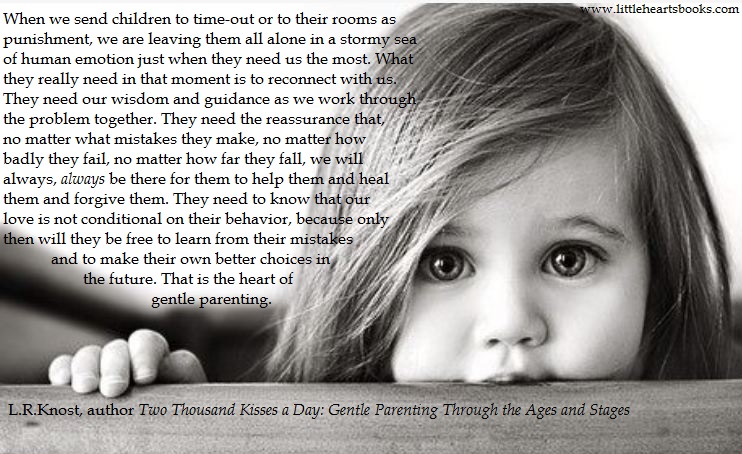 Even parents who use punishment-based parenting approaches other than physical punishment find that they must escalate and escalate to keep their children under ‘control.’ Behavior charts, time-outs, grounding, and removing privileges are some examples of non-physical punishment-based parenting. While these behavior modification techniques may be less painful to children physically, they still don’t address the underlying needs being communicated by the behavior and often are nearly as destructive to the parent/child relationship.
Using isolation such as time-outs or sending children to their room separates them from their source of guidance and comfort just when they need it the most and not only misses a golden opportunity to help the child learn coping mechanisms for dealing with their emotions, but also fractures the very connection that should provide the safety for expressing those emotions. Using behavior charts, removal of privileges, grounding, etc. separates children from their parents by creating an us-against-them mentality that inevitably leads to conflict instead of creating a teamwork mentality that leads to cooperation.
Here’s the thing, effective parenting and, more specifically, effective discipline, doesn’t require punishment. Equating discipline with punishment is an unfortunate, but common misconception. The root word in discipline is actually disciple which in the verb form means to guide, lead, teach, model, and encourage. In the noun form disciple means one who embraces the teaching of, follows the example of, and models their life after.
On the flip side, the root word in punishment is the Latin word punire which in verb form means to penalize, chastise, castigate, inflict harm, humiliate. There is no noun form of punire or its English equivalent, punishment.
Many of today’s most popular self-proclaimed parenting ‘experts’ equate physical punishment with discipline and go to great lengths to describe the best methods and tools for hitting children as well as instructing parents to maintain a calm, controlled, and even cheerful demeanor as they ‘lovingly’ hit their children.
It is interesting to note here that, when it comes to the law, crimes of passion are treated as less heinous than premeditated, planned, and purposefully executed crimes which are termed ‘in cold blood.’ And yet when physically punishing a child, a crime in many places across the globe, hitting in anger or frustration (i.e. passion) is deemed wrong by proponents of spanking, while hitting children with calm and deliberate intent (i.e. premeditation) is encouraged.
It is also interesting to note that, in the not-too-distant past, husbands hitting their wives was also viewed as not only a societal norm, but also a necessary part of maintaining a harmonious, successful marriage. In fact, a man who epitomizes the words calm and controlled, Sean Connery, shared his thoughts on the ’reasonable smacking’ of his wife in a 1987 interview with Barbara Walters in which he explained the necessity of using punitive methods to control women.
The core belief behind ‘reasonable smacking’ of wives was that there was no other effective way to control them. I agree. If controlling another human being is the goal, then force is necessary. Fear, intimidation, threats, power-plays, physical pain, those are the means of control.
But, if growing healthy humans is the goal, then building trust relationships, encouraging, guiding, leading, teaching, and communicating are the tools for success.
Many parents simply don’t know what else to do. They were raised with spanking and other punishment-based parenting methods as a means of control and “turned out okay” so they default to their own parents’ choices without researching alternatives to spanking or considering whether “okay” could be improved upon.
Consider this, more than 90% of American parents admit to spanking their children, and yet the common contention is that it’s a decline in spanking that is responsible for the purportedly escalating 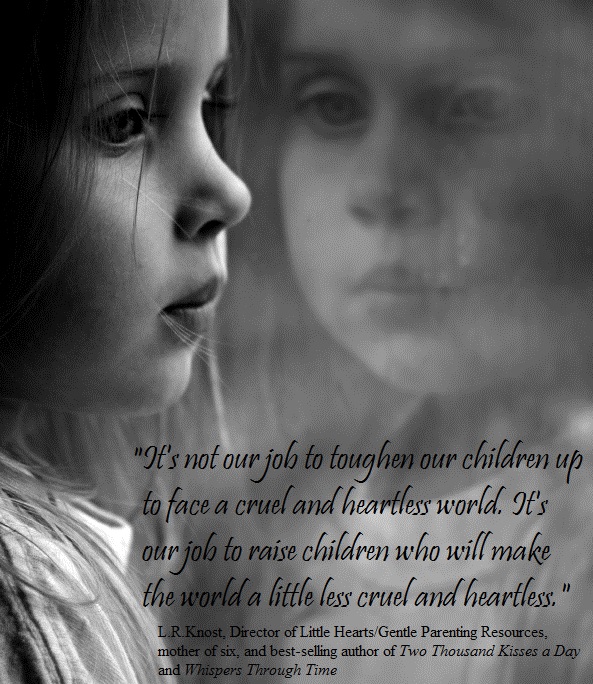 rates of youth violence and crime. Is it really the less than 10% of children who aren’t spanked who are responsible for all the problems of our society? Or could it be that the 90% of children who are subject to violence at home in the form of being slapped, paddled, smacked, yanked, whipped, popped, spanked, etc. are taking those lessons out into the world? Is it just possible that children who are hit learn to hit? That children who are hurt learn to hurt? Perhaps the lesson they are learning is that ‘might is right’ and violence is the answer to their problems, the outlet for their stress, the route to getting others to do what they want.
People throughout history have complained about ‘the trouble with kids today’ and they’ve pinned all the ills of their society on supposedly permissive parenting. They’ve ranted about out-of-control children, disrespectful youth, entitlement, spoiling, disobedience, violence, self-centeredness, etc:
“The children now love luxury. They have bad manners, contempt for authority, they show disrespect to their elders…. They no longer rise when elders enter the room. They contradict their parents, chatter before company, gobble up dainties at the table, cross their legs, and are tyrants over their teachers.” ~Socrates, 5th Century BC
“What is happening to our young people? They disrespect their elders, they disobey their parents. They ignore the law. They riot in the streets inflamed with wild notions. Their morals are decaying. What is to become of them?” ~Plato, 5th Century BC
“I see no hope for the future of our people if they are dependent on frivolous youth of today, for certainly all youth are reckless beyond words… When I was young, we were taught to be discreet and respectful of elders, but the present youth are exceedingly wise [disrespectful] and impatient of restraint” ~Hesiod, 8th Century BC
“The world is passing through troublous times. The young people of today think of nothing but themselves. They have no reverence for parents or old age. They are impatient of all restraint. They talk as if they knew everything, and what passes for wisdom with us is foolishness with them. As for the girls, they are forward, immodest and unladylike in speech, behavior and dress.” ~Peter the Hermit, 13th Century AD
Sounds familiar, doesn’t it? Maybe, though, there isn’t really any ‘trouble with kids today.’ Maybe the problem is with parents who repeat the patterns their own parents set or with societies who view normal stages of development as somehow abnormal.
Maybe ’kid’s today’ are just kids like they have been through the ages, full of exuberance and curiosity and learning their way in a great big world, and a listening ear, gentle guidance, and trusted arms to turn to when inevitable mistakes are made are really all children need to grow up into kind, helpful, responsible, productive members of our society.
The bottom line is that addressing our children’s underlying needs, the actual causes of their behavior instead of just the behavior itself, is a far more effective parental approach as well as being significantly better for a healthy, mutually respectful parent/child relationship. Sending our children out into the world as adults with their needs met, with coping mechanisms in place for those times when the stresses overwhelm them, and with the knowledge of a safe haven where comfort is always available when the world hurts them is a powerful way to change the world for the better.
Maybe, just maybe, sowing peace in our homes is the answer for our children, our families, and our world, after all.
*Also printed in The Natural Parent Magazine
Related posts:
Practical, Gentle, Effective Discipline
The Gift of a Strong-Willed Child
Backtalk is Communication…LISTEN
Bridge Over Troubled Waters~Parenting a ‘Problem’ Child
200 Ways to Bless Your Children with a Happy Childhood
12 Tips for Gently Parenting Your Adult Children (Hint: It starts when they’re newborns!)
The Measure of Success~Chinese Parents and French Parents Can’t BOTH Be Superior!
Award-winnning author, L.R.Knost, is the founder and director of the children's rights advocacy and family consulting group, Little Hearts/Gentle Parenting Resources, and Editor-in-Chief of Holistic Parenting Magazine. Books by L.R.Knost include Whispers Through Time: Communication Through the Ages and Stages of Childhood ; Two Thousand Kisses a Day: Gentle Parenting Through the Ages and Stages ; The Gentle Parent: Positive, Practical, Effective Discipline ; and Jesus, the Gentle Parent: Gentle Christian Parenting the first four books in the Little Hearts Handbook gentle parenting series, and children’s picture books Petey’s Listening Ears and the soon-to-be-released Grumpykins series.
Little Hearts Handbooks: Vote for Your Favorite Author Picture to Enter to Win a Pre-Release Copy!
 [Two Thousand Kisses a Day: Gentle Parenting Through the Ages and Stages by L.R.Knost now available. #14 on Amazon’s Top 100 New Releases in parenting!]
A winner has been chosen! For more opportunities to win a Little Hearts Handbook, follow Little Hearts/Gentle Parenting Resources by subscribing to receive updates from this website, on Face Book, Pinterest, and Twitter. Thank you to all who participated!
Exciting times ahead for Little Hearts! In the New Year, a series of handbooks based on the Little Hearts/Gentle Parenting Resources website will be released in paperback and for Kindle. The books will be approximately 120 pages and priced around $7.99 for paperback and $3.99 to $4.99 for Kindle. More details to come!
In celebration, we’re giving away a free, pre-release copy of the first handbook in the series, Two Thousand Kisses a Day~Gentle Parenting Through the Ages & Stages. Our official Little Hearts photographer from Melissa Lynsay Photography has outdone herself, and now we can’t decide on the best author picture for the back cover of the books.
We need your help deciding on a picture, so vote for your favorite author picture or comment on this post to register to win!
For voting purposes, we’ll call the picture above pic 1 and here is pic 2:
and pic 3:

Here are previews of the working copies of three of the book covers so you can see the pictures in ‘thumbnail’ form as they’ll be on the back cover. The actual handbooks are 6″ x 9″ so almost twice the size of these cover images which will make the pictures nearly double the size you see here:
Okay, there you go! Vote for your favorite picture or leave a comment to register to win a free copy. It’s that easy!
Award-winnning author, L.R.Knost, is the founder and director of the children's rights advocacy and family consulting group, Little Hearts/Gentle Parenting Resources, and Editor-in-Chief of Holistic Parenting Magazine. Books by L.R.Knost include Whispers Through Time: Communication Through the Ages and Stages of Childhood ; Two Thousand Kisses a Day: Gentle Parenting Through the Ages and Stages ; The Gentle Parent: Positive, Practical, Effective Discipline ; and Jesus, the Gentle Parent: Gentle Christian Parenting the first four books in the Little Hearts Handbook gentle parenting series, and children’s picture books Petey’s Listening Ears and the soon-to-be-released Grumpykins series.
Peaceful Parent, Happy Kids~An Interview with Dr. Laura Markham
 Dr. Laura Markham’s website, AhaParenting.com, is one of my favorite go-to resources to share with parents. With sound advice based on clinical and personal experience and supported by research, Dr. Markham offers excellent guidance for parents looking for help in their gentle parenting journeys.
Now, there’s a new resource from Dr. Markham that I’m delighted to share with you: her new parenting guide, Peaceful Parent, Happy Kids: How to Stop Yelling and Start Connecting! With a personable approach, clear explanations, and anecdotal illustrations, you’ll find Peaceful Parents, Happy Kids: How to Stop Yelling and Start Connecting an easy-to-read, helpful resource to keep on hand and to share with other parents in need of a little guidance. (Check back here on Monday for a chance to win a copy for free!)
Dr. Markham honored Little Hearts/Gentle Parenting Resources with the opportunity to be a part of her virtual book tour to launch her new book by engaging in an online interview with me. Here is the transcript from our surprisingly candid and insightful interview:
Welcome, Dr. Markham! Will you share your background/experience/education with my readers?
I’m trained as a clinical psychologist. When I got my PhD at Columbia University, my mentor was Dr. Larry Aber, an attachment theorist who ran the Barnard Toddler Center.
I was fascinated by the longitudinal studies that followed children over time and found that securely attached children are easier to raise, do better in school, are better liked by teachers and peers, are more professionally successful, are happier, are healthier, have better romantic relationships and marriages, enjoy parenting more, and are more likely to themselves raise securely attached children.
Unfortunately, only about 60% of children in the US (this varies a bit across cultures) are estimated to be securely attached, leaving the other 40% to struggle emotionally for their entire lives. And yet, this is something we can change – by working with parents! We can accurately project whether a child will be securely attached by interviewing the mom before the child is even born, and we can work with the parents to help them resolve their own attachment issues to raise a securely attached child. Every parent deserves that opportunity. That’s why I specialize in parenting.
So you advocate Attachment Parenting?
I’m an Attachment Theorist, but Attachment Parenting is not quite the same as Attachment Theory.
Attachment Parenting is a set of practices – for instance, wearing your baby, breastfeeding and co-sleeping – that are thought to promote a secure attachment. As an Attachment Theorist, I think it’s important to point out that while these practices may facilitate more responsive parenting—which does indeed contribute to a secure attachment—they are not the actual cause of ‘secure attachment.’
What creates a secure attachment is a parent who is warmly responsive to the needs of her unique child and able to accept the full range of his emotions. That means, for instance, that as a parent it’s important that we’re able to tolerate our child being angry at us, or clingy, or crying. To do that, we have to be able to stay calm and regulate our own feelings, and nurture our child through his emotions. That’s what creates attachment security.
Do you recommend babywearing, breastfeeding, and cosleeping?
I lived those practices with my own children, and they made my life easier and my babies happier. I personally believe they help us to be more responsive as parents, and research is emerging to back that up. So yes, I recommend them. But my point is that if it doesn’t work for you to use one or more of these practices, for whatever reason, it doesn’t mean you can’t be a responsive parent with a securely attached child.
How has your own parenting journey contributed to your work and to your new book?
When my son was born 21 years ago, my midwife told me before I left the hospital that I should begin right away to let my son cry at night so he would sleep better. My instincts, and my training, told me that was wrong. The more suggestions I heard, the more I realized that most parenting advice we take for granted in our culture was inherited from previous generations who did not have access to the longitudinal and brain research that we have now.
For instance, we now know that the advice during the last century to “Leave your baby to cry and he’ll learn to self-soothe” simply isn’t true – babies’ brains develop the wiring to soothe themselves by being soothed by their parents. Babies who are left to cry may stop crying because they’ve learned that no one comes, but their cortisol levels are still measurably high, indicating that they’re still stressed. That stress and fear has to come out somewhere, in the baby’s cranky moods or clingy behavior.
Another example is the pervasive practice of time-outs. Children act out because they’re in the grip of strong emotions, just as adults do. Sending them off alone to calm down gives them the message that having emotions is a bad thing, and that they’re all alone to learn to manage their overwhelming, scary feelings. And punishment actually hinders moral development—it doesn’t help the child behave better.
When my son was born, I saw so many parents around me struggling. Parenting is the hardest work we do, as I learned first hand, and parents don’t get the support we need and deserve. But I also saw parents unknowingly creating problems with their children by following well-intentioned, but misinformed, advice. These were wonderful people who loved their children without reservation and only wanted what was best for their children. They would have been horrified to learn that their own actions were making their kids act out more. So I wanted to support parents and help them get a better start with their children.
What influence did your own childhood experiences have on your parenting philosophy?
My parents both loved me, but they were divorced and had their own challenges. They couldn’t handle their own emotions, much less mine. I remember vividly how fast I had to grow up, how lonely I felt, how I was looking in all the wrong places for someone to love me as a teenager.
Now, I couldn’t have explained to you, even as a 16-year-old, what was wrong. But having that experience, I can say with total certainty that every child who is acting out is sending us an SOS for understanding, connection, and help with their emotions—no matter how incomprehensible their behavior may be to us.
How is it that you came out of those experiences okay?
Parents often ask me that when they hear about my childhood. I spent years in therapy and years meditating. I still have to work at taking care of myself; it doesn’t come naturally because I wasn’t taken care of. And I’m just lucky that I didn’t have additional risk factors – like ADHD, or a vulnerability to addiction – or I might not have made it to adulthood.
But there are two positive takeaways here:
1. No matter what your childhood was like, you can heal it and be the parent your child needs.
2. No parent is perfect, because we’re human. Luckily, children are pretty resilient. What we do right is more important in creating the solid foundation for our kids than those times we mess up.
What has most impacted your parenting philosophy?
My understanding of children includes my training in child development, especially Attachment theory, which I’ve already mentioned. What I see parents struggling with is always emotions – their own, and their child’s. We all need a loving “witness” so we can heal our emotional hurts, which I first learned from Virginia Axline and Carl Rogers, and then saw Aletha Solter put into practice with babies.
Of course, recent neurological findings have helped me flesh out and evolve my approach, so I’m a fan of Dan Siegel and Allan Schore. Finally, my specialty is practical solutions to the issues of everyday family life, so I’ve learned from countless leaders in the field –Adele Faber, Magda Gerber, Patty Wipfler, Larry Cohen, Jane Nelsen, and so many more.
How does the style of parenting you advocate build trust to set the stage for a peaceful, mutually respectful parent/child relationship throughout the childhood and adolescent years?
Every time we listen to our crying baby, tantruming toddler, or whining preschooler and respond to her needs, we build our child’s trust that we’re on her side, looking out for her best interests.
Every time we resist our impulse to lash out with punishment, and instead help our child with the feelings that are driving her behavior, we help her gain the emotional skills to manage her behavior.
Every time we seek first to connect, and only then to guide, we help our child want to follow our guidance.
That slow accretion of respectful interactions is what builds the strong relationship we all want with our children. Our children learn that’s how to live in relationship, so they’re naturally respectful, compassionate and considerate. They treasure their relationship with us, and would no more damage that relationship — by lying to us, or defying us — than they would set fire to the house, and for the same reasons.
I now have a 21-year-old and a 17-year-old. We never had the rocky teen years that scare parents. I think that tough teen stage is completely unnecessary; it’s created by a parenting style that doesn’t meet kids’ needs.
If you had to sum up your parenting philosophy in a single sentence, what would it be?
Choose love.
Or more specifically:
Manage your own emotions so that you can listen, empathize and stay connected with your child as you guide him. When you get upset, breathe through it and don’t take action until you’re centered again so you have access to your deeper wisdom.
Dr. Markham, thank you so much for including ‘Little Hearts/Gentle Parenting Resources’ in your virtual book tour, and good luck with the launch of ‘Peaceful Parent, Happy Kids: How To Stop Yelling and Start Connecting’!
~~~~~~~~~~~~~~
 Dr. Laura Markham trained as a clinical psychologist, but she’s also a mother, so she understands parents as well as kids. Her new book is Peaceful Parent, Happy Kids: How to Stop Yelling and Start Connecting. You can get Dr. Laura’s free daily or weekly emails online at AhaParenting.com, the home of Aha! Moments for parents of babies through teens.
Award-winnning author, L.R.Knost, is the founder and director of the children's rights advocacy and family consulting group, Little Hearts/Gentle Parenting Resources, and Editor-in-Chief of Holistic Parenting Magazine. Books by L.R.Knost include Whispers Through Time: Communication Through the Ages and Stages of Childhood ; Two Thousand Kisses a Day: Gentle Parenting Through the Ages and Stages ; The Gentle Parent: Positive, Practical, Effective Discipline ; and Jesus, the Gentle Parent: Gentle Christian Parenting the first four books in the Little Hearts Handbook gentle parenting series, and children’s picture books Petey’s Listening Ears and the soon-to-be-released Grumpykins series.
30 Days of Thankfulness~Day 21~Fruit!
I am thankful for fruit!
~By Their Fruit They Will Be Known~
 “The fruit of the Spirit is love, joy, peace, patience, kindness, goodness, faithfulness, gentleness and self-control” (Galatians 5:22-23)
Love ~ Many parents say they make their parenting choices out of love, and I believe that is so very true, but if God is love as He says He is (and He is!), then our love needs to reflect His in every way, including in our parenting. And how does God show His love? Sacrificially, “For God so loved the world that He gave His only Son, that whoever believes in Him will not perish, but have everlasting life.” (John 3:16). Modeling God’s sacrificial love in our parenting is reflected by making parenting choices based on our children’s needs, not our convenience. Responsive parenting is truly a picture of God’s sacrificial, unconditional love in that, as we respond to our children where they are, (“This is how God showed His great love for us, that Christ died for us while we were still sinners [emphasis added]” Romans 5:8) comforting their cries, guiding their choices, providing for their needs, encouraging their individuality, we are, moment by moment, day by day, sacrificing our lives for them.
Joy ~ Parenting can be a challenge (Ask God. He’s got a lot of children, and they don’t behave all that well!) but taking joy in the journey and in our children makes all the difference. “At that time Jesus, full of joy through the Holy Spirit, said, ‘I praise you, Father, Lord of heaven and earth, because you have hidden these things from the wise and learned, and revealed them to little children.’” (Luke 10:21) Take time out each day to enjoy your children, or, better yet, to tell them what joy they bring to your life and specifically what unique things you enjoy about them!
Peace ~ It’s so, so hard making parenting choices, knowing our actions (or inactions!) will have an incredibly profound effect on a precious little life. God knows and sees and cares about every detail of our lives and our children’s lives.  And, in the same way that we want our little ones to trust us with their needs and concerns and desires, God wants us to trust Him and to have peace in Him. “Do not be anxious about anything, but in every situation, by prayer and petition, with thanksgiving, present your requests to God. And the peace of God, which passes understanding, will guard your hearts and your minds in Christ Jesus.” (Philippians 4:6-7)
Patience ~ “Be completely humble and gentle; be patient, bearing with one another in love.” (Ephesians 4:2) Children come into our lives as small bundles with big needs who don’t speak or understand our language and then proceed to grow into little people with their own temperaments, plans, and desires. Having patience as a parent should qualify as an extreme sport! But having and modeling patience with our children not only helps us to guide and grow them gently, but also encourages them to exercise patience with themselves and others throughout life…a rare, but lovely gift we can give the world through our children.
Kindness ~ My grandmother’s favorite verse was “Love is patient, love is kind. It does not envy, it does not boast, it is not proud. It does not dishonor others, it is not self-seeking, it is not easily angered, it keeps no record of wrongs.”  (1Corinthians 13:4-5) This is a beautiful example of how the Bible encourages us to treat others…including our children! Taking time out on occasion to examine our parenting practices and evaluate them in terms of how loving and patient and kind we are to our little ones is a vital part of effective parenting. It’s also important to make sure we aren’t parenting ‘for the neighbors,’ in other words, we aren’t making parenting choices based on a ‘who has the best kid’ competition (envy, boastful) or out of embarrassment over our children’s behavior (pride). Are we easily angered by our children? Do we dredge up their mistakes time and time again? If so, consciously working to break those bad habits and replace them with love and patience and kindness will have a dramatically positive impact on our parenting.
Goodness ~ “Still other seed fell on good soil. It came up, grew and produced a crop, some multiplying thirty, some sixty, some a hundred times.” (Mark 4:8) Of all things, shouldn’t our very first desire in parenting our children be to till the soil of their little hearts so tenderly, so carefully, so intentionally that their hearts are “good soil,” ready, eager, and willing to receive the Good News of Jesus’ birth, death, and resurrection for their sins? Instead of focusing on punishing our children’s mistakes, their ‘sins,’ thus negating the Gospel and undermining the very purpose for Jesus’ suffering, shouldn’t we model the grace and mercy and forgiveness we ourselves have been given? So what, exactly, is “good soil”?  Agriculturally speaking, which is what the parable Jesus told was based on, “good soil” is well-drained (not bogged down by over-watering, i.e. over-indulgent parenting), fresh (not over-used or over-worked, i.e. over-bearing parenting), fertilized (filled with good nutrients, i.e. needs met), composted (mixed with rubbish, i.e. sinful!), and enriched (earthy minerals intact, i.e. connected to their source~their parents).
Faithfulness ~ “The living, the living—they praise you, as I am doing today; parents tell their children about your faithfulness.” (Isaiah 38:19) God is faithful in His promises, faithful in His love, faithful in His parenting. In all things we need to reflect His character to our children so that when we tell them about ‘His faithfulness’ it isn’t only in words, but also in deeds. And what is faithfulness, exactly? It is defined as constancy, dependability, care, trustworthiness, devotion, honor, attachment, commitment. So let us parents, as reflections of God, be faithful to exhibit constancy, dependability, care, trustworthiness, devotion, honor, attachment, and commitment in our parenting choices!
Gentleness ~ “Let your gentleness be evident to all”…except your children. No, of course the Bible doesn’t say that! God actually instructs us to “Let your gentleness be evident to ALL (emphasis added)” in Philippians 4:5. Tender, compassionate, merciful, warmhearted, sensitive, approachable, good-humored…these are all synonyms for gentleness, and gentle parenting reflects all of these qualities. Let’s take a look at the antonyms (opposites) of the word gentle in the thesaurus~harsh, tough, violent, sharp, rigid, severe, unrelenting, unforgiving, punitive, unpleasant, pitiless, stern. “Let your gentleness be evident to all” including (especially!) our littlest, most defenseless, and truly precious gifts from God~our children!
Self-control ~ “Like a city whose walls are broken through is a person who lacks self-control.” (Proverbs 25:28) City walls being broken through was a tragedy of great proportions in the Bible, whereas a city gladly throwing open its gates to welcome its King was a time of rejoicing. The ‘city walls’ were used metaphorically  in the Bible to refer to a person’s will. Many times the words ‘break a child’s will’ are thrown around and spoken as if directly from the mouth of God. But God, as our heavenly Parent, doesn’t seek to break our wills. Instead, He teaches us to trust Him by His own love, joy, peace, patience, kindness, goodness, faithfulness, gentleness and by His self-control in not stomping us out of existence as we deserve by our sinfulness. And, after building that trust-relationship with us, He gently calls us to joyfully and voluntarily lay down our wills out of trust and gratitude and to open our hearts and minds and lives to Him, welcoming in our King. This is the heart of trust-based obedience!
Related links:
Spare the Rod: The Heart of the Matter
Award-winnning author, L.R.Knost, is the founder and director of the children's rights advocacy and family consulting group, Little Hearts/Gentle Parenting Resources, and Editor-in-Chief of Holistic Parenting Magazine. Books by L.R.Knost include Whispers Through Time: Communication Through the Ages and Stages of Childhood ; Two Thousand Kisses a Day: Gentle Parenting Through the Ages and Stages ; The Gentle Parent: Positive, Practical, Effective Discipline ; and Jesus, the Gentle Parent: Gentle Christian Parenting the first four books in the Little Hearts Handbook gentle parenting series, and children’s picture books Petey’s Listening Ears and the soon-to-be-released Grumpykins series.
Gentle Discipline Resource Guide
[Portions reprinted from The Gentle Parent: Positive, Practical, Effective Discipline by L.R.Knost available November 2013; Two Thousand Kisses a Day: Gentle Parenting Through the Ages and Stages and Whispers Through Time: Communication Through the Ages and Stages of Childhood now available on Amazon.]
 Many people believe that gentle parenting is a form of unparenting, but nothing could be further from the truth. Gentle parenting is involved parenting ~interactive, engaged, active parenting. It takes focused attention, planning, participation, research, and so much more to be an empathetic, responsive parent who is in tune with their child’s needs and who is prepared to make whatever sacrifices are necessary to meet those needs. That said, in any home, like in any civilized society, boundaries are necessary for everyone’s safety and comfort. It is in the choosing and enforcing of those boundaries that gentle parenting distinguishes itself. In a gently parented home, boundaries are focused on guiding rather than controlling children and are enforced through empathetic and creative resolutions rather than harsh punitive consequences. If you’d like to transition to a more gentle mode of parenting, but don’t know where to start, below are links to alternatives to punishment, and here is a guide to help you set yourself up for success in your journey to gentle parenting…12 Steps to Gentle Parenting.

When Things Get Physical: Hitting, Throwing, Kicking, and Biting
The concept of using consequences, physical or otherwise, as a deterrent for hitting is based on the misconception that small children have the capacity for forethought (i.e. If I hit, I will get in trouble. Therefore I will not hit.) and that they are choosing to disobey. The fact is that the prefrontal cortex, where reasoning, logic, and forethought take place, is highly immature in toddlers and preschoolers and actually doesn’t develop fully until the mid-twenties! Small children act instinctively and impulsively even when not stressed simply because that is what they are developmentally capable of, but when they are stressed even the small amount of self-control they may have attained flies right out the window, and before they know it (literally!) they’ve reacted physically to their stress. Read more
 Testing the Boundaries~What’s a Parent to Do?
Typically, I advise parents to use Time-Ins instead of Time-Outs in order to connect-to-correct, but there is one area that I advise the use of Time-Outs…the ‘Time-Out Toy Box!’ When a toy is misused (i.e. thrown, used to hit, drawn on, fought over, etc) and a gentle redirection has been given, the next step for the toy is to be put in the ‘Time-Out Toy Box.’ Little ones generally find the concept of a toy being put in Time-Out rather humorous and go along with the removal without a fuss (the toy can be returned after an exaggeratedly stern warning to the toy letting it know what is expected of it and that it must listen to ‘the boss’ ~the child, lol. They love that!), but remember to communicate, listen, and be flexible. If the removal of a toy brings about a strong negative response, it may be that the inappropriate behavior was more than just…Read more

Few things ignite a parent’s temper like defiance. It feels like a slap in the face, a direct challenge to our authority. Power card…played. Gauntlet…thrown. Challenge…accepted?
Time out! No, not time-out as in punish your child, but time out as in hit the parental pause button, take a step back, assess the situation, and get some adult perspective.
There are three things to consider…Read more

Toddlers, Tantrums, and Time-In’s, Oh My!
Punishing them, yelling at them, sending them to their room, or putting them in time-out disconnects them even further from their source of security and not only delays a resolution of the issue, but misses an opportunity to equip them with the tools they need to handle future problems.
One effective tool for use in helping little ones cope with big emotions is a Calm-Me-Jar…Read more

Parenting a Strong-Willed Child
There are some children who are born into the world with the incredible life-gift of a strong will and an indomitable spirit. These children are often deeply misunderstood, and there are rows of books lining bookstore shelves with instructions about how to break their will, how to subdue their spirit, how to force their obedience. What an incredible loss of leadership, passion, and insight this world suffers when parents follow these punitive parenting practices. Not only can we parent these gifted children with gentleness and respect, but the gifts we get in return are priceless! …Read more
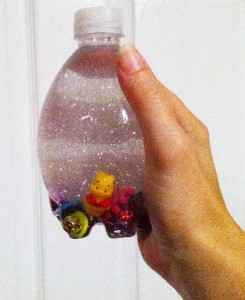 Easy Peasy DIY Parenting Tools
I-spy Water Jars, Quiet Bags, Calm-Me-Jars, Cozy Corners, Punch Bags, and more…Read more
 To a Toddler Sharing is a 4 Letter Word~MINE!
Almost from the moment a baby is born, parents teach them not to share. “No, no, sweetie. That’s mommy’s” and “That’s daddy’s, not yours” accompanied by the removal of whatever the forbidden item is are daily realities for little ones. This is unavoidable, of course, since bacteria-ridden keys don’t belong in little mouths and iphones don’t work well when soaked in drool.
But the challenge comes when our little ‘reflectors’ are expected to share their toys with anyone and everyone who takes a liking to them…Read more
 Spare the Rod: The Heart of the Matter
One of the hot-button issues when it comes to discipline and children is spanking, and the more Christian and conservative the audience, the more hot the debate becomes! There are no verses in the New Testament that support spanking, flogging, whipping, or otherwise hitting children. In the Old Testament there are…Read more
 Your Baby isn’t Trying to Annoy You; He’s Trying to Communicate! From the moment a child enters the world, they are trying to communicate. Crying, grunting, making eye contact, mirroring expressions, all of these things are the instinctive tools built into infants to reach out into a brand new world and make contact. They can do no more. It is entirely up to the parent to make the connection, to respond, to build those all-important ‘lines of communication’ that will be so vitally important to parents in later childhood. Communication is not something that just happens. It is not something that begins when a child becomes verbal, and it’s not a product of a child’s advancing maturity. Communication is a process, a relational building block, a result of intentional and responsive parenting. Read more
 Tots to Teens~Communication through the Ages and Stages
The evolution of children’s communication proceeds at a steady and relatively predictable pace, though the timing is influenced by factors such as individual personality, cognitive development, home environment, etc. Here’s what to expect through the ages and stages…
 Babes and Boundaries~A Gentle Parenting Perspective Gentle parenting doesn’t mean parenting without boundaries! Believe it or not, the foundation for discipline (guiding, leading, teaching…NOT punishment ) begins in the newborn and infancy stages. When parents respond quickly, consistently, and gently to their baby’s cries, the trust relationship that the parent is establishing becomes the cornerstone for later discipline. Boundaries need to be established for a child’s safety and growth into a successful citizen of our world. A child who is secure in the knowledge that he doesn’t have to fight to be heard or to have his needs met is more open and adaptable to limits. And when the ‘limit-setter’ is a person the child trusts, the enforcement of those boundaries becomes a matter of connection and communication instead of conflict and struggle. So, what might setting and enforcing boundaries using gentle parenting look like in real life? Read more
 Parenting in Public~What’s in Your Quiet Bag? More and more public places are becoming child un-friendly with snarky signs saying they’ll give your child an espresso and a pony if you don’t control him or charge you extra if you dare to enter their establishment and support their business with your hard-earned money or even flat out ban you altogether if you bring ‘the beast’ out in public with you! So what’s a parent to do? Read more
 Discipline & Behavior via Dr. Sears
You probably never thought of attachment tools, such as breastfeeding and babywearing, as being acts of discipline, but they are. Attachment parenting is like immunizing your child against emotional diseases later on. Your knowledge of your child becomes like a sixth sense enabling you to anticipate and control situations to keep your kids out of trouble. Discipline is based on building the right relationship with a child more than using the right techniques.
 Parenting toddlers made simple. via T.E.A.C.H. Through Love
Toddlers can be loud, boisterous, erratic, funny, messy, witty and smart all at the same time. They soak up everything they see and hear and that includes our reactions to their actions.
What Children Need Most When They Deserve It The Least via Happy Families
Parents prefer not to have their authority questioned. So rather than considering why a child may be resisting, they up the ante, doing their best puffer-fish impersonation, and make threats.
 Positive Parenting in Action: Exploration/Danger via Positive Parenting
Don’t mistake independence for defiance. Some toddlers are more strong-willed and independent than others. My first son was very mellow and content under my wing, while my second wanted independence early. He doesn’t want to hold my hand in parking lots (we’ll address that one!) because he says “I can walk by myself!”

With a healthy relationship based on open, honest communication, issues can be addressed as they arise and in a respectful and timely manner instead of a teen feeling the need to go ‘underground’ with their behavior or problems. Here are some practical tips for raising teens in a respectful and peaceful manner.
 Gentle Discipline: So what DO you do? via The Path Less Taken
Some people, for any number of reasons, do not know about alternatives. They don’t know that there’s another way. Some people want to do things differently, and want to break their cycle, but they honestly do not know where to start.
 Proactive Discipline and Well-behaved Children via Gentle Christian Mothers
Most people seem to think that physical punishment is the only way to elicit good behavior and assume that children who aren’t given prompt and regular spankings will be out of control “monsters”. Well, my kids are not perfect little robots. They have to be reminded to do things and they fight with each other. But my focus is not so much on obedience (do what I say right now!) as you might have expected. Instead my focus is on raising kids who are generally polite and content and care about how those around them feel. And that’s what I’ve got, kids who are noticeably considerate to adults and other children alike.
 6 Steps to Stop Yelling Dr. Laura Markham/Aha Parenting.com
We all know that our kids respond better if we don’t yell. Instead of escalating a difficult situation, if we can stay calm, it settles everyone else down. Our relationship with our child strengthens. They cooperate more. They start to control their own emotions more. Bottom line: How can you expect your child to control his own emotions if you don’t control yours?
 The One Thing You Can Do That Will Drastically Improve Your Interactions with Children via Real Child Development
If there was one thing you could do differently that would drastically improve your interactions with children would you want to know? Would you like to know the key that would increase cooperation, reduce tantrums, fighting and negative behavior?
 Gems via Mothering by Grace
This is a FAST way of making your child feel loved, valued and secure. GEMs help your kids feel affirmed and noticed, so their need to get your attention in negative ways decreases. Your energy levels will rise as you enjoy your child and remember what it’s all about. By focusing on your child and meeting their emotional needs for connection you are actually taking care of yourself at the same time. It takes only a few minutes to have a GEM, yet the positive effects last for ages.
 Why Spanking is Never Okay via Peaceful Parenting
Scientific research shows that physical punishment does not work in the long run, is associated with an increased risk for many behavioral and psychological problems, and is simply unnecessary given that we have non-violent discipline techniques that are very effective.
 Gentle Discipline Toolbox via Dulce de Leche
Gentle, effect tools for your parenting toolbox!
Related links:
Award-winnning author, L.R.Knost, is the founder and director of the children's rights advocacy and family consulting group, Little Hearts/Gentle Parenting Resources, and Editor-in-Chief of Holistic Parenting Magazine. Books by L.R.Knost include Whispers Through Time: Communication Through the Ages and Stages of Childhood ; Two Thousand Kisses a Day: Gentle Parenting Through the Ages and Stages ; The Gentle Parent: Positive, Practical, Effective Discipline ; and Jesus, the Gentle Parent: Gentle Christian Parenting the first four books in the Little Hearts Handbook gentle parenting series, and children’s picture books Petey’s Listening Ears and the soon-to-be-released Grumpykins series.
Babies Do Not Manipulate-They Communicate
[Portions reprinted from Whispers Through Time: Communication Through the Ages and Stages of Childhood by L.R.Knost. Two Thousand Kisses a Day: Gentle Parenting Through the Ages and Stages and The Gentle Parent: Positive, Practical, Effective Discipline also available on Amazon and through other major retailers.]
~~~~~~~~~~~~~~~~~~~~~
 On a recent trip to the park, I overheard a parent ranting and raving about a little one “being a brat and always pitching fits.” It took me less than two seconds of looking at the child to realize his mother had put him down on hot asphalt without shoes on, and his ‘fit’ was actually cries of pain as he danced around trying to keep his poor little feet off the asphalt while trying to push past his mommy to get back into the car. In a few years this mother will wonder why her ten-year-old is always so sullen and silent.
Later the same day in Wal-mart, a three-year-old asked her mommy what plastic wrap was for. The mother rolled her eyes and snapped, “For wrapping food in plastic, duh.” A few years from now, this mother will confess to a friend that she has no idea why her nine-year-old is so mouthy and rude.
Minutes later, a two-year-old riding past me in a shopping cart pointed at a toy and babbled in her cute baby language, looking at her daddy with a delighted smile. Her father ignored her first few attempts to get his attention, then finally barked, “Shut up!” without ever looking at her. In a few years this father will complain to his co-workers that his teenaged daughter never talks to him.
Communication in my son’s Tae Kwon Do classes is called, “The link between the world and me.” In the parent/child relationship, communication is entirely…hear this…entirely the responsibility of the parent. From the moment a child enters the world, they are trying to communicate. Crying, grunting, making eye contact, mirroring expressions, all of these things are the instinctive tools built into infants to reach out into a brand new world and make contact. They can do no more. It is entirely up to the parent to make the connection, to respond, to build those all-important ‘lines of communication’ that will be so vitally important to parents in later childhood. Communication is not something that just happens. It is not something that begins when a child becomes verbal, and it’s not a product of a child’s advancing maturity. Communication is a process, a relational building block, a result of intentional and responsive parenting.
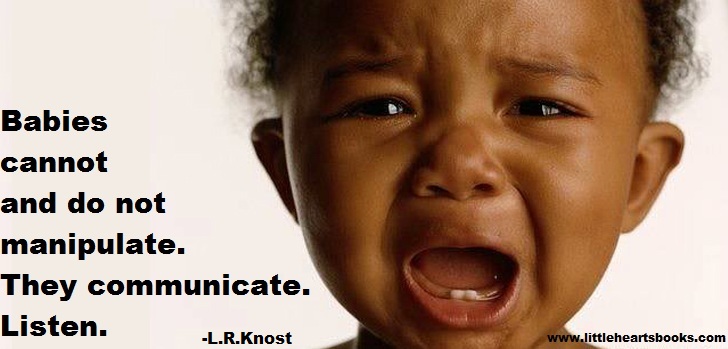 Crying is often mischaracterized as manipulation, and adults are certainly capable of using it that way. But to project such motivations on a baby is to grant them a level of skill and control far, far beyond their capabilities, and that is a potentially disastrous mistake. A parent’s perception of the motivation behind their child’s behavior is often the single most powerful determinant of the parent’s response. And the parental response or lack of response to a nonverbal child’s cries either builds or damages their communication and connection. There is no in between, no neutral.
Babies cannot and do not manipulate. They communicate. Listen. Respond. You aren’t being manipulated. You are being a parent.
And hear this well, parents, your relationship with your teenager is being established now, while your child is still a toddler. Your discipline issues with your nine-year-old are being minimized or intensified right now, while he is reaching out to you in infancy. Preschooler’s tantrums are being moderated or exacerbated at this moment by your response or lack of response to your baby’s cries.
 And the responsibility for building communication and connection with your child doesn’t end when your child becomes verbal. There is a reason children aren’t classified as adults until they are, in fact, adults. They simply do not have the judgment, experience, or maturity of an adult. Parents, you are the center of your child’s world for many years, and they will model themselves after the example you set.
If you listen to them, they will learn to listen. If you are rude to them, they will learn to be rude. If you treat them with respect, they will learn to be respectful. If you are angry, demanding, and harsh with them, they will learn to be angry, demanding, and harsh.
You decide every day by your parenting choices what kind of an adult you are going to raise. So live out how you want your children to turn out. That is the heart and soul of gentle, effective parenting.

Related posts:
The Taming of the Tantrum: A Toddler’s Perspective
When Children Act Out ~ Reflecting Our Emotions
Backtalk is Communication…LISTEN
Testing the Boundaries~What’s a Parent to Do?
Toddlers, Tantrums, and Time-Ins, Oh My!
Spare the Rod: The Heart of the Matter
Award-winnning author, L.R.Knost, is the founder and director of the children's rights advocacy and family consulting group, Little Hearts/Gentle Parenting Resources, and Editor-in-Chief of Holistic Parenting Magazine. Books by L.R.Knost include Whispers Through Time: Communication Through the Ages and Stages of Childhood ; Two Thousand Kisses a Day: Gentle Parenting Through the Ages and Stages ; The Gentle Parent: Positive, Practical, Effective Discipline ; and Jesus, the Gentle Parent: Gentle Christian Parenting the first four books in the Little Hearts Handbook gentle parenting series, and children’s picture books Petey’s Listening Ears and the soon-to-be-released Grumpykins series.