
Toxic Parenting: Spanking, Shaming, Threatening, Manipulating
[Excerpt from The Gentle Parent: Positive, Practical, Effective Discipline by L.R.Knost. Whispers Through Time: Communication Through the Ages and Stages of Childhood, Two Thousand Kisses a Day: Gentle Parenting Through the Ages and Stages, and Jesus, the Gentle Parent: Gentle Christian Parenting also available on Amazon and through other major retailers.]
~~~~~~~~~~~~~~~~~~~~~
 Want to help stop the bullying epidemic? Don’t act like a bully. Don’t hit, threaten, ignore, isolate, intimidate, ridicule, or manipulate your child. Children really do learn what they live…
I stood, frozen in shock, outside of the upscale bookstore where I would soon be signing my gentle parenting books and chatting with parents about alternatives to punishment-based parenting. A well-dressed young couple I’d spoken with just minutes before in a nearby pizzeria was getting into an expensive SUV several yards away from where I was standing, but the screams were crystal clear.
The young man was leaning over his wife who sat shrinking into her seat as he screamed in her face, “Get in the car! Get in the car!” over and over again. The woman was clearly confused, as was I. She was in the car, though not yet buckled up, so why in the world was the man screaming at his wife to get in? It suddenly dawned on me that what he wanted her to do was put her seatbelt on, but the man was too enraged to even realize that wasn’t what he was actually saying.
I glanced down at my little one who was shrinking back in fear and tried to organize my thoughts so I could cross the few yards separating me from the SUV and engage the man in conversation. If nothing else, I thought, reminding him that people were watching might help him to take a moment and compose himself.
But in the next second, the man suddenly yanked his wife out of her seat and landed several stinging blows on her bare skin before flinging her back into her seat, this time screaming at the sobbing woman, “You are not in charge! You are not in charge!” He then slammed her door shut, stomped around to his own seat, slammed his door, and pealed out of his parking space.
I quickly snapped a picture of the license plate with my iPhone and called the police to report the domestic violence I’d just witnessed. They immediately sent out an officer to track down the endangered woman and take the man into custody.
Now here’s the real story…
On a recent book tour I stood, frozen in shock, outside of the upscale bookstore where I would soon be signing my gentle parenting books and chatting with parents about alternatives to punishment-based parenting. A well-dressed woman and her two small children whom I’d chatted with just moments before in a nearby pizzeria were getting into an expensive SUV, but the screams were crystal clear.
The woman was leaning over her toddler and four-year-old who sat shrinking into their carseats as she screamed in their faces, “Get in the car! Get in the car!” at them over and over again. The children were clearly confused, as was I. They were in their carseats, though not yet buckled up, so why in the world was the woman screaming at her children to get in? It suddenly dawned on me that what she wanted was for the toddler to put her own arms in the straps, but the mother was too enraged to even realize that wasn’t what she was actually saying.
I glanced down at my little one who was shrinking back in fear and tried to organize my thoughts so I could cross the few yards separating me from the SUV and engage the woman in conversation. If nothing else, I thought, reminding the mother that people were watching might help her to take a moment and compose herself.
But in the next second, the woman suddenly yanked her toddler out of her carseat and landed several stinging blows to her chubby little legs before flinging her back into her carseat, this time screaming at the sobbing child, “You are not in charge! You are not in charge!” She then roughly buckled the little one in, stomped around to her own seat, slammed her door, and pealed out of her parking space.
As I stood there staring through tears at the tail lights speeding away, I realized that if I’d just witnessed a man doing that to his wife I could call the police who would intervene immediately because there are laws to protect adults from domestic violence, but there are no such laws protecting children in the US.
My opportunity was lost to touch those small children’s lives, and my heart aches for them. Was the mother just having a bad day? Was she angry at the snarky pizzeria cashier? Was she frustrated that dinner was pizza again because she’d been delayed at work? I don’t know, and, honestly, I don’t care. If a man was having a bad day, we wouldn’t accept that as an excuse for domestic violence.
Hitting any human being other than a child is against the law in the United States where it is legal for parents to hit their children whenever and wherever and with whatever they want to as long as it doesn’t leave lasting marks and, in nineteen states, for school officials to hit children with anything from rulers to two foot long boards. That is not acceptable. In fact, it is outrageous.
Though I know I can’t change the world for every child, I am determined to change the world for as many children as humanly possible. We don’t need new laws. We just need the domestic violence laws already in place to protect adults to be extended to protect our most vulnerable, voiceless, voteless citizens, our children.
Did you know that there is less evidence linking lead exposure to developmental delays in children and asbestos to cancer than there is of the short and long-term detrimental effects of spanking? Study after study has confirmed that spanking (not just physical abuse, but any physical act of correction – smacking, hitting, swatting, slapping, paddling, switching, etc.) is directly linked to greater aggression and other behavioral issues, impaired cognitive development, and increased risk of depression and anxiety in childhood as well as long-term mental issues in adulthood. And yet the American public is still reluctant to dismiss the physical punishment of children as an option for parents and school systems.
It is not unusual for public opinion to evolve slowly. Until recent years, husbands hitting their spouses in the US was considered “reasonable chastisement of wives” and “a private family matter” by the courts and by law enforcement even though it has technically been against the law in all fifty states for decades. Now domestic violence in the US is viewed with outrage and abusers with disdain.
While the tide is ever-so-slowly turning regarding public opinion of the physical punishment of children, in excess of eighty-percent of Americans still believe spanking is a necessary part of raising a child according to a survey cited by a UN report. And in the nineteen US states where corporal punishment is still legal in the public school system, wooden paddles are used on children as young as preschool, and parents’ permission or notification is often not even required. By contrast, in every branch of the US military and in the US penal system, physical punishment has long been outlawed as it was deemed ‘cruel and unusual’ and a ‘use of excessive force.’
Clearly there is a disconnect when it comes to physical punishment of the most vulnerable and defenseless of our citizens, our children. Even in the face of study after study detailing the detrimental effects of physical punishment on young children, more than ninety-percent of American parents still admit to spanking their toddlers and preschoolers, even if they don’t believe that it is a good alternative. The responses to a recently released study linking a significantly increased risk of mental illness in adulthood to being spanked as a child point to some possible reasons for that dichotomy:
1.”I was spanked, and I turned out okay.”
Not everyone who smokes gets lung cancer, but why take the risk?
2. “I don’t want to raise a rotten brat!”
Studies link spanking to increased aggression and other behavioral issues, not decreased.
3. “I spank my kids because the Bible commands me to.”
Not only is spanking not one of the Ten Commandments, but commanding or even suggesting that parents hit young children is not found anywhere in the Bible. The handful of Old Testament ‘rod’ and ‘training’ verses used to support this theory are misinterpreted to refer to physical punishment instead of guidance, and the word translated ‘child’ in those verses is translated ‘young man’ in every other instance.
4. “They’re my kids, and nobody has the right to tell me how to raise them!”
Our laws are civil agreements as to what is and is not acceptable in our society. We once agreed that slavery was acceptable. Now we know better, and our laws reflect that. As research continues to reveal the detrimental effects of spanking, public opinion will begin to shift and our laws will naturally follow suit. It is the way of a democratic society.
5. “Nothing else works!”
Thoughtful, compassionate, proactive parenting works.
Beyond even the issue of spanking, though, the mindset of controlling children through external forces rather than helping them learn how to and desire to control themselves is where the real changes need to happen. When humans, whether they are adults or children, are pushed, the inbuilt reaction is to push back. When humans are pulled, the inbuilt reaction is to pull back. When they are threatened, intimidated, or shamed, it is only the size and strength of their opponent that results in submission and that submission is temporary. As soon as the opponent is eliminated from the equation, humans will pursue their own course, often more angrily and rebelliously and single-mindedly.
Becoming our children’s opponent is not healthy parenting and it doesn’t create a healthy parent/child relationship. It creates a destructive dynamic primed for conflict, rebellion, and escalation. Even when parents choose non-violent means to control their children such as isolation (i.e. time-outs) and behavior charts and other punishment/reward tactics, the basic truth is that they are modelling manipulation and coercion and are focused on controlling a child’s behavior externally rather than working with them to help them learn to control their own behavior through an internal guidance system.
In parenting there will always be times when your child’s behavior doesn’t meet your expectations. Recognizing that you are two distinct individuals with differing opinions and plans and wants and needs will help you to work with your child instead of clashing with them and creating an unhealthy dynamic in your relationship. Be aware that unhealed hurts and unforgiveness, even of yourself, will get in the way of a healthy relationship and take the steps you need to take in order to heal your relationship and yourself (see Chapter Fifteen of The Gentle Parent: Positive, Practical, Effective Discipline).
Whenever things escalate to the point where you withhold affection and connection in order to punish or try to control behavior, and certainly if you are hitting or if you are hurting your child emotionally through threats, intimidation, and shaming, you can be sure you’ve stepped off the gentle discipline path. But there is always a way back, and that’s through reconnection, owning our mistakes, and starting again. The bottom line is that we cannot control another human being. We can force external obedience temporarily, but only by constantly escalating the threats, emotional manipulations, and punishments which accomplish nothing in the long run and do far greater damage than they are worth.
There is no doubt that the vast majority of parents not only deeply love their children, but, based on the information and experiences they have to work with, are also making the best parenting decisions they know how to make. Working with our children instead of against them is a foreign concept to most parents, but therein lies the secret to a peaceful, happy home and the healthy parent/child trust relationship that the Three C’s of gentle discipline—Connection, Communication, and Cooperation—are built upon.
Related posts:
Backtalk is Communication…LISTEN
The Gift of a Strong-Willed Child
Bridge Over Troubled Waters~Parenting a ‘Problem’ Child
Fear Doesn’t Lead to Faith: Becoming Your Child’s Safe Place
Spare the Rod: The Heart of the Matter
 Award-winnning author, L.R.Knost, is the founder and director of the children's rights advocacy and family consulting group, Little Hearts/Gentle Parenting Resources, and Editor-in-Chief of Holistic Parenting Magazine. Books by L.R.Knost include Whispers Through Time: Communication Through the Ages and Stages of Childhood ; Two Thousand Kisses a Day: Gentle Parenting Through the Ages and Stages ; The Gentle Parent: Positive, Practical, Effective Discipline ; and Jesus, the Gentle Parent: Gentle Christian Parenting the first four books in the Little Hearts Handbook gentle parenting series, and children’s picture books Petey’s Listening Ears and the soon-to-be-released Grumpykins series.

Stealing God’s Gift: Free Will is a Gift to be Nurtured, Not a Curse to be Broken
[Excerpt reprinted from Jesus, the Gentle Parent: Gentle Christian Parenting by L.R.Knost. Two Thousand Kisses a Day: Gentle Parenting Through the Ages and Stages; Whispers Through Time: Communication Through the Ages and Stages of Childhood; and The Gentle Parent: Positive, Practical, Effective Discipline by L.R.Knost also available on Amazon and through other major retailers.]
~~~~~~~~~~~~~~~~~~~~~
“Let us then approach God’s throne of grace with confidence, so that we may receive mercy and find grace to help us in our time of need.”
Hebrews 4:16
“Many parents in using the rod of correction on their child do so with an obvious lack of vigor and often stop short of the child’s will being completely broken … Both my wife and I have often remarked that it is good that one of our children was not our firstborn. This particular child who came along later in our family was extremely willful and rebellious toward our authority and would often require sessions of correction lasting from one to two hours in length before the will would finally be broken … Even though you may think these methods of correction that God has ordered parents to carry out are bestial, abusive, and unloving, you are the one who is bestial, abusive, and unloving if you don’t obey God in this matter. Moreover, if you do not obey God your child likely will not be saved unless the Lord supernaturally in His mercy does so despite your disobedience.” (Ronald E. Williams, The Correction and Salvation of Children)
“She then administers about ten slow, patient licks on his bare legs. He cries in pain. If he continues to show defiance by jerking around and defending himself, or by expressing anger, then she will wait a moment and again lecture him and again spank him. When it is obvious he is totally broken, she will hand him the rag and very calmly say, “Johnny, clean up your mess.” He should very contritely wipe up the water [about spanking a 3-year-old]” (Pearl, p. 62) …“Never reward delayed obedience by reversing the sentence. And, unless all else fails, don’t drag him to the place of cleansing. Part of his training is to come submissively. However, if you are just beginning to institute training on an already rebellious child, who runs from discipline and is too incoherent to listen, then use whatever force is necessary to bring him to bay. If you have to sit on him to spank him then do not hesitate. And hold him there until he is surrendered. Prove that you are bigger, tougher, more patiently enduring and are unmoved by his wailing. Defeat him totally. Accept no conditions for surrender. No compromise. You are to rule over him as a benevolent sovereign. Your word is final (p. 49)” (Michael Pearl, To Train Up a Child)
Where, exactly, did the pseudo-Biblical idea that a parent must break a child’s will originate? How did a person’s God-given will, their freedom of choice, their strength and individuality, come to be seen as the root of all sin  that must be purged? At what point did “defeating” a child so that they are “totally broken” become the goal of Christian parenting?
Let’s go back to the model of servant leadership set by Jesus who said, “I stand at the door and knock…” (Revelations 3:20) Knock what? Knock humans on their backsides and pin them down while pummelling them until they are utterly defeated? Knock small children around until they are totally broken?
No, of course not. Jesus says, “I stand at the door and knock. If anyone hears my voice and opens the door, I will come in and eat with that person, and they with me.” Jesus doesn’t barge in making demands to prove how big and tough he is. Jesus invites us to open the door of our lives and to invite him in as an honored guest, in return.
Look also at Deuteronomy 30:19 where God shares that it is from him that our ability to choose originates, “I have set before you life and death, blessing and curse; therefore choose life, that you and your descendants may live.” Note that God doesn’t demand that we submit our free, God-given will, our ability to choose, to him. He simply invites us to align our will with his.
And look at James 4:8, “Draw near to God and He will draw near to you.” God doesn’t chase us down, “sit on” us, or “use whatever force is necessary” (see Pearl quote above) to strong-arm us into submission. He reaches out to us and inspires us and opens his arms to us, inviting us into the safety and comfort and wholeness of a relationship with Love Himself.
Our will is a gift, an opportunity to choose right from wrong, and the vehicle through which God calls us to choose his Son. Without this amazing and wonderful gift, without the freedom to use our free will, Jesus’ suffering and death on the Cross would be pointless.
Sin is a moot point in light of the grace we’ve been given. Grace is the point. The whole point. Everything leading up to the Cross pointed to the Cross, everything was settled on the Cross, and on the Cross in the outstretched  arms of Jesus grace was born. Sin only matters in the sense that when we voluntarily choose to stay within the boundaries God has given us, we are closer to him, more in-tune with him, and more aligned with his will. He does not stray from us, not ever. But we do stray from him. We are human, and as humans we learn by doing, by experiencing, by exercising our free will as we stretch and grow and discover and make mistakes and overcome life and are overcome by life, each trial and failure and success a learning experience. God doesn’t chase us down and crash through the walls we’ve put up and drag us back to repentance. He waits for us, always available, always forgiving, always loving us unconditionally, but never giving up as he calls out to us, inviting us gently to himself.
When it comes to parenting, we all know that some of God’s children are created with a remarkable strength of will, a powerful drive to explore and discover, an insatiable thirst for knowledge, an incredible need to know and be known, and with more energy than can be contained in a small body. Their frequent challenges to ‘the way things are’ can feel overwhelming to the most patient of parents, and their sometimes epic meltdowns when all of that extreme energy explodes out of their small frames can act like a tidal wave of emotion that gets everyone swept up in the maelstrom. These children who are given the gift of an indomitable spirit have all of the amazing characteristics of future world leaders, but their gifts need to be grown and nurtured and developed, not contained, stunted, and crushed.
A popular child-training book by Dr. James Dobson, The New Strong-Willed Child, has a markedly different approach to parenting strong-willed children, however: “Some strong-willed children absolutely demand to be spanked, and their wishes should be granted. . . two or three stinging strokes on the legs or buttocks with a switch are usually sufficient to emphasize the point, ‘You must obey me.’” In addition to the disputable Biblical interpretations of the ‘rod’ verses and the misuse of the word ‘obey’ in translating from the original language of the Bible, there is a fundamental difference in philosophies revealed here. In the positive parenting approach, children are born perfect and need only to be guided through the normal stages and behaviors of childhood. In the punitive parenting approach, children are born sinful and must be forced to submit to superior authority.
On a purely logical level, why would we fight a child for control when what we really want is for them to be in control of themselves? Why not, instead, help them to process those big emotions and learn how to direct their own energy and develop their own ability to control themselves? Why not follow Jesus’ example and invite our strong little future leaders to walk alongside us in tandem to learn and grow and discover together for the oh-so-brief season of their childhood?
On a practical level, though, the question is, “How can we partner with our children in positive and peaceful ways to guide them gently and effectively?”
Here is a chapter from The Gentle Parent: Positive, Practical, Effective Discipline to get you started on your gentle journey with your own little future leaders:
‘The Gift of a Strong-Willed Child’
There are some children who are born into the world with the incredible life-gift of a strong will and an indomitable spirit. These children are often deeply misunderstood, and there are rows of books lining bookstore shelves with instructions about how to break their will, how to subdue their spirit, how to force their obedience. What an incredible loss of leadership, passion, and insight this world suffers when parents follow these punitive parenting practices. Not only can we parent these gifted children with gentleness and respect, but the gifts we get in return are priceless!
Take a look at some of the common descriptions used when referring to the characteristics of a strong-willed child:
Demanding, Insistent, Stubborn, Bossy, Cocky, Difficult, Challenging, Fixated, Contrary, Rebellious, Defiant
Now look at some of the common characteristics of adults who are world leaders, CEO’s, entrepreneurs, innovators, world-class athletes, and the like:
Decisive, Determined, Persistent, Authoritative, Confident, Valiant, Gutsy, Committed, Resourceful, Nonconforming,Bold
Note that the characteristics are the same, but the characterizations are negative when applied to a child and positive when applied to an adult.
Other characteristics of strong-willed children that coincide with the characteristics of adult leaders in their fields are:
- They are typically highly creative and intelligent.
- They are usually passionate and intense in their interests and beliefs.
- They often have an insatiable need to know ‘why.’
- They typically learn by doing.
- They tend to have an intense need to test the status quo.
- They are typically highly perfection-oriented, but often that is focused on their expectations of themselves instead of others.
- They tend to need high levels of validation.
- They usually have an intense need to be heard.
- They often have a strong need for emotional safety.
- They tend to be resistant to change unless they feel like they have some control over the change.
- They are often highly sensitive.
- They are typically intensely focused on their latest project or interest.
- They tend to be conscientious and highly committed.
- They are usually intensely independent.
While there’s no doubt that it’s a challenge having a child who seems to challenge everything, there are ways to work with them rather than against them to preserve and nurture their unique gifts. Maintaining a healthy parent/child relationship is vital as you work to find a balance between setting limits with your richly spirited child while not limiting their freedom to stretch and grow and develop into the person they were created to be.
The key to preserving your trust relationship with your child is remaining calm and present and supportive, even while setting and maintaining reasonable boundaries. It is helpful to remember that the most strong-willed children tend to be the ones who identify the most strongly with their parents. So instead of viewing their seemingly constant challenges as defiance or attempts to thwart authority, work to parent from a place of understanding that your strong-willed child is actually on a discovery mission and is doing endless ‘research’ on you by testing and retesting and digging and chiseling to discover all of your quirks and foibles and ups and downs and strengths and weaknesses. This kind of testing isn’t negative unless you make it into a battle of wills instead of responding with gentle, respectful guidance. Taking this stance will help you to keep from seeing the challenges as personal insults and, instead, see the challenges as attempts to learn and grow and understand.
There is no doubt, though, that parenting a child with the gift of a strong will is a constant exercise in patience and self-regulation. The personal growth you will experience is invaluable as you seek to parent with empathy and wisdom and compassion, but it can be draining and will often stretch you far, far out of your comfort zone. Knowing that and being prepared for it will help you cope with the inevitable stresses, and being ready ahead of time with some specific strategies for handling the challenges will help you to respond calmly and effectively.
This is a good place to revisit the Three C’s of gentle discipline—Connection, Communication, and Cooperation.
Connection ~ Maintaining a secure connection with your spirited child is vital. It is the springboard from which all of your interactions with your child will originate, and it is the touchstone to which you will both return, again and again and again, when your relationship gets strained and stained and stretched.
- Play word games, board games, rough-and-tumble outdoor games, silly face in the mirror games. Play is the language of childhood, so make sure to speak your child’s language every day.
- Laugh together. Humor is an undervalued parenting tool. But it lowers defenses, inspires smiles, brings people together, and reconnects hearts.
- Read storybooks, chapter books, travel brochures, encyclopedias, anything that will inspire you to dream together, talk, plan, get excited, share interests.
- Focus more on who your child is than on what your child does. Remember, you’re growing a person, not fixing a problem. So make sure to spend time getting to know the person, not just the child. It doesn’t have to cost anything. Just walk together, talk together, share ice cream cones, spot shapes in the clouds, and enjoy each other.
Communication ~ Children have their own ‘inner world’ of thoughts and plans and problems and worries and hopes and dreams that are occupying their time and attention, so a lack of cooperation is often simply the result of having a different agenda than we do. Getting some insight into that ‘inner world’ is key in guiding and growing them respectfully.
- Listen with your heart. Listen ‘between the lines’ to what your child is communicating through their behavior. Listen and listen and listen some more. That is always, always the first step in communicating with your child.
- Reflect, connect, and redirect. Reflect what you hear, whether it’s communicated by your child’s behavior or their words. This not only validates their emotions and lets them know that you hear and understand them, but it also helps them to understand their own emotions. For instance, if your child is upset that he can’t have a cookie after brushing his teeth for bedtime, try saying, “I hear you. You’re upset because you want a cookie.” Then reestablish your connection, “I like cookies, too!” and offer a solution, “How about we go pick out the two best cookies and put them in a special container that we can take to the park in the morning?”
- Don’t take non-compliance as a personal insult. A strong-willed child is very much their own person with their own agenda. Focus on inviting cooperation instead of demanding obedience. Whether it’s staying in bed or cleaning up or whatever the issue, make it a team effort and come up with a game plan ahead of time. For example, you could say, “You seem to be having trouble staying in bed at night. What do you think would help you to be more ready to go to sleep when it’s time for bed?” or “It’s important to pick up our things so they don’t get broken, let’s put on the timer and work together for ten minutes and see who gets the most picked up.”
- Make a firm commitment not to resort to punishments to control behavior. The resentment that comes from being punished absolves children in their own minds of responsibility. It doesn’t teach them responsibility, and resentment can actually cause a lot of the behaviors you are trying to avoid.
- Communicate daily, outwardly to your child and inwardly to yourself, the positive aspects of your child’s personality. When the focus is on ‘fixing’ a child, they get the message that they are somehow broken, and that is not a healthy self-image to take into adulthood.
- ‘No’ is not a complete thought. It is an imperative, a command. It doesn’t teach. It tells. If you want your child to learn to think like an adult, take the time to explain your adult thinking.
- Remember that children, especially when they are upset, open ‘conversations’ through their behavior, and it’s up to us, the only adults in the relationship, to gently guide them toward continuing those conversations verbally as well as equipping them with the resources to be able to do so.
- Also keep in mind that the social mores of rudeness simply aren’t inborn and don’t apply to early interactions with our children. They are learned by imitating how we as parents behave. Politeness is a heart issue that cannot be imposed by the will of another unless we want it to only be an external façade instead of a heartfelt courtesy. Helping your strong-willed child learn to speak kindly means speaking kindly to your child as well as offering guidance when they’ve been rude such as saying, “That is not a nice tone of voice” or “That isn’t a kind thing to say” and then offering a do-over “Can you try saying that to me again more nicely? I’ll always try my best to be nice to you, and I would like you to try to do the same for me.”
Cooperation ~ Always keep at the forefront of your parenting goals that you are seeking thoughtful cooperation, not mindless compliance. That way you will remember to treat your child as a thoughtful individual with ideas and needs and feelings of their own instead of a mindless drone there to do your bidding.
- Set clear limits and explain them in age-appropriate terms. Remember, if you want to invite cooperation, you have to actually issue the invitation to cooperate!
- Limit the number of limits. Spirited children are often stressed children simply because of their own intense emotions and reactions to things, so set them up for success by keeping your limits few and clear and by maintaining them consistently.
- Make sure to let your child have a voice in determining the limits so they feel like they have some control over their lives and so they feel some ownership over the limits.
- Brainstorm together ways of helping everyone to work together. Some ideas are to come up with hand signals or words that remain your little secret codes to indicate when it’s time to leave the park or to do homework or to dial the activity level or noise volume down a few notches.
- Invite cooperation by creating daily routines together. Don’t be surprised if your child ends up being the one who is a stickler for following the routine, even to the point of nagging you to follow it. These gifted children tend to be all-in, fully focused and committed, and they’ll expect you to be the same!
- Cooperate with your child’s needs and personality by working with them rather than against them. For instance, if you know that your child has a hard time leaving a project, give them plenty of time to find a good stopping point when you need them to leave it for a while. Or if you know that your child has a hard time following directions at bedtime, try writing or drawing the tasks that need to be done (i.e. toothbrushing, pajamas, etc.) on ping-pong balls and put them in a small ‘bedtime jar’ so your child can feel some control over their routine as they independently pick out the balls one by one for a ‘surprise’ nighttime order of tasks or take them all out and decide what order to do them in themselves.
- If you are already locked in a head-to-head power struggle, put away your boxing gloves so your child will (eventually!) feel safe putting away theirs. When you battle with your child, you may win a skirmish or two, but you will lose the treasure…your trust relationship. Putting away the gloves means slowing down, breathing through your own emotions, and finding a way to work through the issue together. Remember, you’re the adult in the relationship, but that doesn’t give you the right to overpower your child; it gives you the responsibility to empower your child. That involves modeling the tools of diplomacy—communication, cooperation, compromise—that you want your child to stock in their own emotional toolkit.
Remember, the children who come into the world with their ‘boxing gloves on’ so to speak are often the ones who become the biggest world changers. It’s not easy raising these little world-changers, I know (Believe me, I know. Two of my six are world-changers-in-the-making!), but the rewards are phenomenal!
“The Lord’s loving-kindnesses indeed never cease, for his compassions never fail.”
Lamentations 3:22
Related posts:
Spare the Rod: The Heart of the Matter
Jesus, the Gentle Parent: Gentle Christian Parenting
Tattered Tapestries: Weaving Trust Through the Chaos
Fear Doesn’t Lead to Faith: Becoming Your Child’s Safe Place
Where Did You Learn Love, Child?
Gentle Journeys: A Book Club for a New Generation
Practical, Gentle, Effective Discipline
Award-winnning author, L.R.Knost, is the founder and director of the children's rights advocacy and family consulting group, Little Hearts/Gentle Parenting Resources, and Editor-in-Chief of Holistic Parenting Magazine. Books by L.R.Knost include Whispers Through Time: Communication Through the Ages and Stages of Childhood ; Two Thousand Kisses a Day: Gentle Parenting Through the Ages and Stages ; The Gentle Parent: Positive, Practical, Effective Discipline ; and Jesus, the Gentle Parent: Gentle Christian Parenting the first four books in the Little Hearts Handbook gentle parenting series, and children’s picture books Petey’s Listening Ears and the soon-to-be-released Grumpykins series.
Hurting People Hurt People: Does Bullying Begin at Home?
[Excerpt from Whispers Through Time: Communication Through the Ages and Stages of Childhood by L.R.Knost. Two Thousand Kisses a Day: Gentle Parenting Through the Ages and Stages, The Gentle Parent: Positive, Practical, Effective Discipline, and Jesus, the Gentle Parent: Gentle Christian Parenting also available on Amazon and through other major retailers.]
~~~~~~~~~~~~~~~~~~~~~
“By words we learn thoughts, and by thoughts we learn life.”
Jean Baptiste Girard
I love words. I love language. I love playing with old, staid quotes and classic literature titles, stories and  legends, clichés and adages, and weaving them into unique or humorous settings.
But along with loving word play, I’m very aware of the power of language. Words can bring life, “It’s a boy!” and love, “I do!” and words can bring death, “I’m sorry. There’s nothing more we can do.”
When it comes to raising children, the power of words cannot be overestimated. From how the labels we use influence our own perceptions of our children and their perceptions of themselves to how children’s immature grasp of language limits their understanding and responses, words exercise immense power over the life of a child.
Just as important as being careful of the labels we use and having an understanding of language development in young children, though, or even more so, is being aware of the propensity for stressed and angry adults to ‘power-up’ on children and use language as a weapon. The lash of the tongue on the heart of a child can have devastating and lasting consequences.
“You stupid little idiot!”
“Can’t you do anything right?”
“Why did I ever have you?”
“I hate my life!”
“You are totally useless!”
Words live and breathe and grow in our hearts until they either bear life-giving fruit ~ comfort, security, confidence…or fester into infectious, oozing wounds ~ despondency, anxiety, rage.
There is great truth to the belief that bullying begins at home. Children learn what they live. Just as violence begets violence, so angry parents tend to result in angry children, and parents who ridicule tend to produce sarcastic children, and critical parents tend to generate negative children, and on and on.
Whether the children end up the bully or the bullied, aggressive with their peers or with themselves, cutting down others or cutting themselves, the fact is that hurting people hurt people, and children raised with violence or condemnation in whatever form they take are hurting people.
Words matter. They matter desperately…as desperate as a five-year-old is to hear she’s good, as desperate as a ten-year-old is to hear he’s smart, as desperate as a fifteen-year-old is to hear she’s valuable.
The truth is that we all make mistakes. We all say the wrong thing sometimes. We get angry and frustrated and overwhelmed and verbally lash out at these tiny, impetuous, energetic, often incomprehensible, but always vulnerable little people we’ve been entrusted with the care and raising of. And often we don’t apologize because we don’t want to appear weak or to admit we’ve made a mistake or we’d rather just let it be or it doesn’t even occur to us that we should apologize to a child. But words can heal, too, and an apology is a necessary step in the healing process.
But when verbal blows go untended, souls become scarred. When lashing out becomes the norm, damages begin to mount. And when children with battered souls grow into adults, the vicious cycle often continues in the form of domestic violence, substance abuse, or other destructive behaviors.
Parents, choose your words wisely, carefully, thoughtfully. In the same way that violence begets violence and anger begets anger, kindness begets kindness and peace begets peace. Sow words of peace, words that build, words that show respect and belief and support. Those are the seeds of a future filled with goodness and hope and compassion, and aren’t those the things we really want for our children, after all? [end excerpt]
Related posts:
Backtalk is Communication…LISTEN
The Gift of a Strong-Willed Child
Bridge Over Troubled Waters~Parenting a ‘Problem’ Child
Fear Doesn’t Lead to Faith: Becoming Your Child’s Safe Place
Spare the Rod: The Heart of the Matter
Award-winnning author, L.R.Knost, is the founder and director of the children's rights advocacy and family consulting group, Little Hearts/Gentle Parenting Resources, and Editor-in-Chief of Holistic Parenting Magazine. Books by L.R.Knost include Whispers Through Time: Communication Through the Ages and Stages of Childhood ; Two Thousand Kisses a Day: Gentle Parenting Through the Ages and Stages ; The Gentle Parent: Positive, Practical, Effective Discipline ; and Jesus, the Gentle Parent: Gentle Christian Parenting the first four books in the Little Hearts Handbook gentle parenting series, and children’s picture books Petey’s Listening Ears and the soon-to-be-released Grumpykins series.
Sexting: Irresponsible at Seventeen Magazine
[By L.R.Knost, author of Two Thousand Kisses a Day: Gentle Parenting Through the Ages and Stages, Whispers Through Time: Communication Through the Ages and Stages of Childhood, and The Gentle Parent: Positive, Practical, Effective Discipline available on Amazon and through other major retailers.]
~~~~~~~~~~~~~~~~~~~~~
 In this digital era not only is the world available literally at our fingertips, but a whole new world has opened for predators, pedophiles, perverts, and porn purveyors to assault our children. From predators posing as children to draw children into online relationships and then lure them into real-life danger to pedophiles using the power and anonymity of the internet to traffic in child pornography, our children are at risk in ways that are increasingly difficult to monitor, filter, and protect them from. We are advised to supervise their online activities, but how are we to know that little twelve-year-old Patsy from piano class is actually fifty-year-old Patrick from prison or that fourteen-year-old Joey from the local gym is actually forty-eight-year-old Jimmy from the local jail?
Talking with our children about the dangers, staying in-tune with them so we recognize when they are stressed or feeling pressured or guilty, working on intentional connection and two-way communication so that our children feel safe and comfortable with us, and maintaining an open, non-judgmental relationship throughout their childhood so that they know they can come to us for help with anything, anytime, anywhere are all vital elements in keeping our children safe from adults who would do them harm.
But what about when it’s other children who are the danger? What about when they are violated by an in-real-life friend? Most of us have had the conversations about stranger-danger and friend-danger and good-touches and bad-touches and our children know what constitutes a personal violation in the physical sense, but do they know what constitutes a violation online and via text and Instagram and other digital media?
Children are increasingly becoming victims of virtual and visual sexual harassment by their own peers and are being bullied either into reciprocating and/or into silence. One such sexual victimization is called ‘sexting’ and has become a huge problem across cultural, ethnic, and gender boundaries. Sexting involves one party taking a graphically nude picture of themselves or of just specific body parts, and texting them to another party. These pictures sometimes get shared from one young person to the next, resulting in ruined reputations and often intense bullying. Children like thirteen-year-old Hope Witsell have been so viciously bullied and horribly humiliated that they have taken their young lives to escape the torture.
Released into this environment by Seventeen Magazine, whose target market is from tweens to teens (ages 12 to 19), is a recent article entitled “What’s with the Pics, Dude?” This incredibly irresponsible article about sexting portrays young males as hapless victims of their own sexual and approval needs and young females as those responsible for redirecting the young men into more appropriate behaviors. The young males are characterized as “needing reassurance that they are desirable” and “fishing for a compliment” and as “figuring you’ll be excited” and “hoping to start a game.” While the young females victimized by the sexting are warned that they may be in danger of “trouble from the law” and that in order to “protect” themselves they should conceal the incident from their parents and from school officials. The damage done to a vulnerable girl who may be humiliated and frightened and looking for guidance as to how to handle the situation, but is told to hide it and to respond with a flirty response and a “cute selfie” instead of cutting off communications with the young man and seeking adult support is incalculable. And the danger the young lady is placed in, whether she may be intimidated into silence or pressured into reciprocation which may then put her in the situation faced by the young victims who committed suicide after their sexting pictures were shared, is very real.
I can only hope that parents are paying attention not only to their children’s online activities and digital interactions, but also to what they are reading so that they can filter the dangers and counteract the misinformation that abounds. Parents, your children have access to the internet, at home or the library or at school or at a friend’s house. And they have access to iPhones and other devices that can take, send, and receive pictures. Be aware. Be in-tune. Be intentional. Focus on maintaining your connection and keeping the lines of communication open. And don’t wait until your child brings these dangers to your attention. Bring them to theirs and let them know you are watching, and you’re available, and you are their safe place.
Related posts:
Backtalk is Communication…LISTEN
Parenting a Strong-Willed Child
Practical, Gentle, Effective Discipline
Award-winnning author, L.R.Knost, is the founder and director of the children's rights advocacy and family consulting group, Little Hearts/Gentle Parenting Resources, and Editor-in-Chief of Holistic Parenting Magazine. Books by L.R.Knost include Whispers Through Time: Communication Through the Ages and Stages of Childhood ; Two Thousand Kisses a Day: Gentle Parenting Through the Ages and Stages ; The Gentle Parent: Positive, Practical, Effective Discipline ; and Jesus, the Gentle Parent: Gentle Christian Parenting the first four books in the Little Hearts Handbook gentle parenting series, and children’s picture books Petey’s Listening Ears and the soon-to-be-released Grumpykins series.
The Trouble With Kids Today
[Portions reprinted from Two Thousand Kisses a Day: Gentle Parenting Through the Ages and Stages by L.R.Knost available on Amazon]
 “People are telling parents like me that we are failing our children because we practice controlled discipline in our homes. I say: the children that are raised without it are the ones being abused and robbed of the chance of success in adulthood.” Controlled discipline in the eyes of this author of I Don’t Like Spanking My Kids, But I Do It Anyway is physical punishment. Equating discipline with punishment is a common misconception, but she is, unfortunately, not alone in her stance.
Many of today’s most popular self-proclaimed parenting ‘experts’ also equate physical punishment with discipline and go to great lengths to describe the best methods and tools for hitting children along with instructing parents to maintain a calm, controlled, and even cheerful demeanor as they ‘lovingly’ hit their children.
It is interesting to note here that, when it comes to the law, crimes of passion are treated as less heinous than premeditated, planned, and purposefully executed crimes which are termed ‘in cold blood.’ And yet when physically punishing a child, a crime in many places across the globe, hitting in anger or frustration (i.e. passion) is deemed wrong by proponents of spanking, while hitting children with calm and deliberate intent (i.e. premeditation) is encouraged.
It is also interesting to note that, in the not-too-distant past, husbands hitting their wives was also viewed as not only a societal norm, but a necessary part of maintaining a harmonious, successful marriage. In fact, a man who epitomizes the words calm and controlled, Sean Connery, shared his thoughts on the ‘reasonable smacking’ of his wife in a 1987 interview with Barbara Walters:
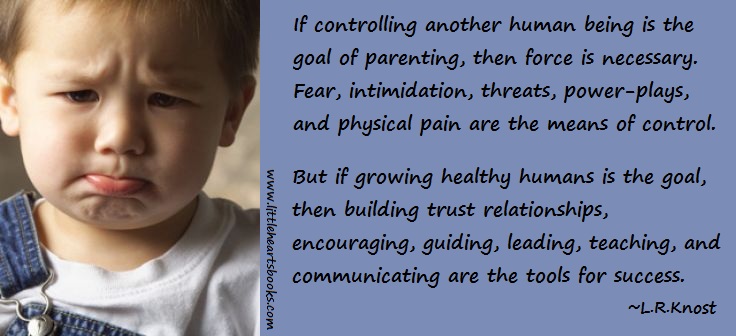
The core belief behind ‘reasonable smacking’ of wives was that there was no other effective way to control them. I have to agree. If controlling another human being is the goal, then force is necessary. Fear, intimidation, threats, power-plays, physical pain, those are the means of control.
But if growing healthy humans is the goal, then building trust relationships, encouraging, guiding, leading, teaching, communicating, those are the tools for success.
Many parents simply don’t know what else to do. They were raised with spanking as a means of control and “turned out okay” so they default to their own parents’ parenting choices without researching alternatives to spanking or considering whether “okay” could be improved upon.
As to the I Don’t Like Spanking My Kids, But I Do It Anyway author’s contention that “We are raising a generation of children who are over-sensitive because they eventually find out that they aren’t as good at baseball or ballet as some other kid and their parents promised them that everyone is equal. They feel entitled because we teach them that they should. They throw tantrums when life doesn’t go their way because their parents have tiptoed around them to make sure that it does,” that reasoning sounds strangely familiar.
People throughout history have complained about ‘the trouble with kids these days.’ They’ve pinned all the ills of their society on permissive parenting. They’ve ranted about out-of-control children, disrespectful youth, entitlement, spoiling, disobedience, violence, self-centeredness, etc:
“The children now love luxury. They have bad manners, contempt for authority, they show disrespect to their elders…. They no longer rise when elders enter the room. They contradict their parents, chatter before company, gobble up dainties at the table, cross their legs, and are tyrants over their teachers.”
~Socrates, 5th Century BC“What is happening to our young people? They disrespect their elders, they disobey their parents. They ignore the law. They riot in the streets inflamed with wild notions.
Their morals are decaying. What is to become of them?”
~Plato, 5th Century BC“I see no hope for the future of our people if they are dependent on frivolous youth of today, for certainly all youth are reckless beyond words… When I was young, we were taught to be discreet and
respectful of elders, but the present youth are exceedingly wise [disrespectful] and impatient of restraint”
~Hesiod, 8th Century BC“The world is passing through troublous times. The young people of today think of nothing but themselves. They have no reverence for parents or old age. They are impatient of all restraint. They talk as if they knew everything, and what passes for wisdom with us is foolishness with them. As for the girls, they are forward, immodest and unladylike in speech, behavior and dress.”
~Peter the Hermit, 13th Century ADMy grandpa notes the world’s worn cogs
And says we’re going to the dogs.
His grandpa in his house of logs
Said things were going to the dogs.
His grandpa in the Flemish bogs
Said things were going to the dogs.
His grandpa in his hairy togs
Said things were going to the dogs.
But this is what I wish to state:
The dogs have had an awful wait.
~Unknown, circa 1936Small children disturb your sleep, big children your life.
~Yiddish Proverb
Perhaps, just perhaps, there isn’t any ‘trouble with kids today.’ Maybe the trouble is with societies who view normal stages of development as somehow abnormal. Maybe the problem is with parents who repeat the patterns their own parents set and don’t delve into the belief system they are now passing along to their children. Or maybe the problem is simply the rose-colored glasses older generations tend to have about their own youth when they share idealized versions of ‘the good old days.’
Could it be that ‘kid’s today’ are just kids like they have been through the ages, full of exuberance and curiosity and learning their way in a great big world? Could it be that a listening ear, gentle guidance, and trusted arms to turn to when inevitable mistakes are made are really all children need to grow up into kind, helpful, responsible, productive members of our society?
Consider this, “Since more than 90% of American parents admit to spanking their children, it’s hard to accept that a decline in spanking is responsible for the purportedly escalating rates of youth violence and crime. Could it be that the 90% of children who are subject to violence at home in the form of being slapped, paddled, smacked, yanked, whipped, popped, spanked, etc. are taking those lessons out into the world? Is it just possible that children who are hit learn to hit? That children who are hurt learn to hurt? Perhaps the lesson they are learning is that ‘might is right’ and violence is the answer to their problems, the outlet for their stress, the route to getting others to do what they want.” Better Children, Better World
Could it be that sowing peace in our homes is the answer after all?
Related posts:
Practical, Gentle, Effective Discipline
Spare the Rod: The Heart of the Matter
Tots to Teens~Communication Through the Ages and Stages
Testing the Boundaries~What’s A Parent To Do?
One Slippery Sock & Other Silly Tools for your Parenting Toolbox!
The Measure of Success~Chinese Parents and French Parents Can’t BOTH Be Superior!
Award-winnning author, L.R.Knost, is the founder and director of the children's rights advocacy and family consulting group, Little Hearts/Gentle Parenting Resources, and Editor-in-Chief of Holistic Parenting Magazine. Books by L.R.Knost include Whispers Through Time: Communication Through the Ages and Stages of Childhood ; Two Thousand Kisses a Day: Gentle Parenting Through the Ages and Stages ; The Gentle Parent: Positive, Practical, Effective Discipline ; and Jesus, the Gentle Parent: Gentle Christian Parenting the first four books in the Little Hearts Handbook gentle parenting series, and children’s picture books Petey’s Listening Ears and the soon-to-be-released Grumpykins series.