
A Sea Change: Obedience is Not the Goal
[Excerpt reprinted from Jesus, the Gentle Parent: Gentle Christian Parenting by L.R.Knost. Two Thousand Kisses a Day: Gentle Parenting Through the Ages and Stages; Whispers Through Time: Communication Through the Ages and Stages of Childhood; and The Gentle Parent: Positive, Practical, Effective Discipline by L.R.Knost also available on Amazon and through other major retailers.]
“Look also at ships: although they are so large and are driven by fierce winds, they are turned by a very small rudder wherever the pilot desires.”
James 3:4
 Oh, the toddler years, those delightful days when little ones begin to discover that they are, indeed, separate individuals from their parents and begin to test the waters to see how far out to sea their little boats can take them when they’ve got a full head of steam. This is the age when parents begin to wonder how in the world to tether their little steamboats to the docks or scuttle them in shallow waters to slow them down.
Obedience becomes a hot topic at moms’ groups and men’s breakfasts, at playdates and on park benches as parents wrestle with this new developmental stage that often shows up, unwelcome and unannounced, and the desperate, bewildered question being debated is always the same:
“How can I get my child to obey?”
Take a moment and examine what that question really means, though. Does it mean, “How can I control my child?” or does it mean, “How can I help my child learn self-control?” It’s an important distinction because the first meaning is external and temporary (i.e. only effective as long as the controlling factors are ever-present and escalate as the child grows) and the second meaning is internal and intrinsic. In the first, the rudder of a child’s ship is firmly removed from the child’s hands again and again as the parent and child struggle for control of the ship. In the second, the rudder remains in the child’s hands as the parent guides, instructs, and leads the way with their little steamboat sheltered alee of the parent ship.
Parents often feel lost at sea, themselves, when it comes to the best course for guiding and growing their children in the storm-tossed waves and murky waters of childhood behaviors, and many churches try to meet parent’s needs by offering parenting books and classes. A vast number of those resources are, unfortunately, based on a punitive, authoritarian model. These books, and the classes based on the books, claim to be Biblical, but miss the heart of the Father entirely and mislead and even intimidate parents into believing that they must train their children into instant, unquestioning obedience in order to raise their children ‘God’s way.’
Consider, though, that Jesus said, “You will know them by their fruit.” (Matthew 7:16) referring to how we will recognize his children. And what is the fruit of the Spirit? Love. Joy. Peace. Patience. Kindness. Goodness. Gentleness. Faithfulness. Self-control. What’s missing? Nothing. God’s Word is perfect. And yet obedience is not included as a fruit of the Spirit. It is not mentioned as a measure of love for God or evidence of a relationship with God. That certainly doesn’t mean that God doesn’t want us to listen to his wise counsel and remain within the safe boundaries he’s shared with us. What it does mean is that it’s a heart issue, not an obedience issue, and he wants our trust and thoughtful, considered cooperation, not our fear-driven, mindless obedience.
Did you know, in fact, that the word obey doesn’t even appear in the original texts of the Bible? When the English translators of the King James version of the Bible encountered the Hebrew words hupakouo/hupakoe and shema/lishmoa they discovered that there wasn’t an exact English equivalent, so they chose the word hearken in their translations which subsequently became an archaic term and was later changed to obey.24 So, what exactly do the original words in the Bible mean?
Hupakouo/hupakoe – to hear from above; to listen for; to lend an ear to1,2,3
Shema/lishmoa – to understand, to internalize, to ponder, to reflect upon1,2,3
And, in the negative form, rather than the word disobedience in the original texts, there is…
Parakouo – to close one’s ears to; to ignore1,2,3
The same mistranslation also occurs from the original Greek texts of the New Testament where peitho and peitharcheo are translated into, respectively, obey and disobey but actually mean…
Peitho – to be persuaded; to be moved; to respond25
Peitharcheo – to remain unpersuaded; to be unmoved by; to be unresponsive to25
Also translated into obey in English are the Greek words phulasso and teron and their various conjugations, all of which mean to watch, to observe carefully, to give consideration to25.
Taken together, the meaning of what is now translated obey in the original text of the Bible is more accurately read ‘listen to, thoughtfully consider, and respond to.’ That is a far, far different meaning than the ‘instant obedience’ often held up as the epitome of Christian faith and evidence of love for God and, by extension, the goal of so-called ‘Biblical parenting.’
Before we address the parenting conundrum of instant obedience versus thoughtful consideration, let’s look at several verses in the Bible with the original meanings restored:
He replied, “Blessed rather are those who hear the Word of God and obey listen to, thoughtfully consider, and respond to it.” (Luke 11:28)
Jesus replied, “Anyone who loves me will obey listen to, thoughtfully consider, and respond to my teaching. My Father will love them, and we will come to them and make our home with them. (John 14:23)
Children, obey listen to, thoughtfully consider, and respond to your parents in the Lord, for this is right. (Ephesians 6:1)
One other interesting note is that the word translated punish in the English versions of the Bible is from the Hebrew word avon and from the Greek kolasis/kolazo. Look at the contrast in meanings:
Punish (English) – to inflict a penalty upon; to exact retribution; to make suffer26
Avon (Hebrew) – to carry guilt; to bear one’s own iniquity1,2,3
Kolasis/kolazo (Greek) – removed; separated25
The word used in English translations of the Bible, punish, conveys an external infliction of negative consequences, while the original words, avon (Hebrew) and kolasis/kolazo (Greek) convey internal, self-imposed consequences (i.e. carrying the weight of guilt/shame) and natural consequences (i.e. being estranged).
There is no fear in love. But perfect love drives out fear, because fear has to do with punishment bearing one’s own iniquity, carrying guilt, feeling shame, being estranged. (1 John 4:18)
Jesus came to take our place, to bear our iniquities, to carry our guilt, to free us from shame, and to reunite us with our Father, and the literal translation conveys that truth perfectly.
The thing is, instant obedience and thoughtless compliance based on fear of punishment will always be an external and temporary ‘fix’ for behavior issues, as evidenced by the increasingly defiant and disconnected Israelite nation in the Old Testament, while thoughtful consideration and cooperation are internal, a heart-deep and soul-to-soul connection inspired by compassion, respect, and communication. Consider this passage from The Gentle Parent: Positive, Practical, Effective Discipline:
Someone once wrote, “Obedience is doing what you’re told, no matter what’s right. Morality is doing what’s right, no matter what you’re told.” History preserved the quote, but not the source with any credibility, but it’s a wise statement nonetheless.
Growing children with an inner compass that guides their steps toward kindness and compassion and generosity of spirit is far, far and away superior to training children to operate on automatic pilot. Parents often focus so much time and energy on trying to make their children obey in the small moments of life that they forget to step back and take a panoramic view of how their parenting choices may affect their children’s life course.
‘Instant obedience’ is the new catch-phrase in many popular parenting articles and books, but the reality is that, while instant obedience may be convenient for parents in the moment, it can have powerful negative impacts on the adults their children will become.
Training children into instant obedience is the equivalent of disabling their inner guidance system and strapping on a remote-controlled rocket. The end result may be adults who are easily controlled by others or adults who are deeply divided, constantly fighting the external controls, but hampered by an erratic, immature inner compass that never had the chance to develop properly.
Equipping children with a healthy, well-functioning internal guidance system, an inner compass, takes time, patience, and self-control on the part of the parents. Certainly not a convenient alternative! While it may not be convenient to slow down our hectic life pace and really connect with our children, it’s that connection that enables their internal guidance system to come online. While taking the time to really communicate may be a sacrifice, it’s in that communication that the directions on their inner guidance system are set. And, while working cooperatively with our children may take more time and effort, the fact is that inviting cooperation rather than forcing compliance raises leaders instead of reaping followers.
Clearly, teaching our children to control themselves is far more effective in the long-term than trying to control our children, but how, specifically, can we go about equipping them with those all-important internal controls?
- Model instead of manipulate.
- Invite instead of intimidate.
- Support instead of shame.
- Encourage instead of enrage.
- Teach instead of threaten.
- Listen instead of lecture.
- Help instead of hurt.
- Parent instead of punish.
Instant obedience and mindless compliance are poor goals, indeed, when raising children. A thoughtfully questioning, passionately curious, and humorously resourceful child who delights in inventing ‘compromises’ and who endlessly pushes the boundaries tends to become a thoughtful, passionate, resourceful adult who will change the world rather than being changed by the world.These are simple truths, and yet their effects are profound when we embrace them and incorporate them into our parenting. Connection, Communication, and Cooperation, the Three C’s of gentle parenting, are powerful and effective tools in guiding our children toward self-control to help them learn to steer their own ships, and, if we are to be fishers of men, then isn’t a ship headed out to sea exactly what each of us should be, anyway? Instead of mooring our children to the shore, let’s sail alongside them in the sometimes calm, sometimes stormy, but always glorious sea of life, keeping them sheltered on our leeward side until they are ready to sail alone.
“For I am the Lord your God who takes hold of your right hand and says to you, Do not fear; I will help you.”
Isaiah 41:13
Related posts:
Stealing God’s Gift: Free Will is a Gift to be Nurtured, Not a Curse to be Broken
Spare the Rod: The Heart of the Matter
Did Jesus Have a Temper Tantrum?
Jesus, the Gentle Parent: Gentle Christian Parenting
Tattered Tapestries: Weaving Trust Through the Chaos
Fear Doesn’t Lead to Faith: Becoming Your Child’s Safe Place
Where Did You Learn Love, Child?
Practical, Gentle, Effective Discipline
 Award-winnning author, L.R.Knost, is the founder and director of the children's rights advocacy and family consulting group, Little Hearts/Gentle Parenting Resources, and Editor-in-Chief of Holistic Parenting Magazine. Books by L.R.Knost include Whispers Through Time: Communication Through the Ages and Stages of Childhood ; Two Thousand Kisses a Day: Gentle Parenting Through the Ages and Stages ; The Gentle Parent: Positive, Practical, Effective Discipline ; and Jesus, the Gentle Parent: Gentle Christian Parenting the first four books in the Little Hearts Handbook gentle parenting series, and children’s picture books Petey’s Listening Ears and the soon-to-be-released Grumpykins series.

Parenting Through Cancer: Coping with Emotions
 “Bedtime. Go grab your toothbrush from the suitcase, okay?”
“Why?” my eight-year-old asks.
“It’s late, and we all need to sleep. Please go brush your teeth and get ready for bed,” I reply, distracted as I pack the last few things for my extended hospital stay after my surgery in the morning.
“Why?” her determined voice questions.
“We need to get ready for bed, sweetie,” I answer, still not glancing in her direction as I mentally go through my checklist to make sure I’ve packed everything I’ll need.
“Why?” she persists, her volume rising.
My attention is finally caught by her challenging tone, and I turn to look at her.
Belligerent eyes stare me down.
I take a deep breath to get through my first knee-jerk, stress reaction, then consciously slow my breathing, quiet my thoughts, and focus fully on my strong-spirited little girl who is clearly in contrary mode.
I wait.
She shifts, uncomfortable, then shoots, “Why?”
I soften my gaze and offer a slight smile.
I wait.
“Why?” she snaps again, a bit more quietly.
I hold her gaze calmly, knowing she needs space and time to work through her feelings before she’ll be able to share them.
I wait.
She turns away, her small shoulders stiff as she sits on the side of the bed, her back to me.
I wait.
A minute passes, then two. Then, in a soft voice, “I don’t want you to go.”
“I know,” I say quietly.
I wait again.
Moments pass in silence, then she whispers, “I’m scared.”
“I know, baby. I am, too,” I reply, struggling to hold back my own tears as I hear hers start.
And I wait.
Soon a small body crashes into me and my girl wraps her arms around me tightly. I hold her close, my heart breaking at the pain and fear I wish she never had to feel. After a few moments she slips away and brushes her teeth, then settles quietly into bed.
I lay awake throughout the night, listening to the even breathing of my sleeping eight-year-old nearby and cuddling my tiny cosleeper close and praying desperately for all of my children as I head into the unknown.
Hours later, I slip out of bed and kiss each sleeping child, then leave for an early hospital check-in. My heart stays behind with my feisty sweet girl and my little cosleeper and each one of my six incredibly unique and wonderfully kind-hearted children. This is so hard. Cancer sucks.
Related posts:
My Cancer Story, Part 1: The Diagnosis
The Gift of a Strong-Willed Child
Backtalk is Communication…LISTEN
Bridge Over Troubled Waters~Parenting a ‘Problem’ Child
Spare the Rod: The Heart of the Matter
Toxic Parenting: Spanking, Shaming, Threatening, Manipulating
Award-winnning author, L.R.Knost, is the founder and director of the children's rights advocacy and family consulting group, Little Hearts/Gentle Parenting Resources, and Editor-in-Chief of Holistic Parenting Magazine. Books by L.R.Knost include Whispers Through Time: Communication Through the Ages and Stages of Childhood ; Two Thousand Kisses a Day: Gentle Parenting Through the Ages and Stages ; The Gentle Parent: Positive, Practical, Effective Discipline ; and Jesus, the Gentle Parent: Gentle Christian Parenting the first four books in the Little Hearts Handbook gentle parenting series, and children’s picture books Petey’s Listening Ears and the soon-to-be-released Grumpykins series.
‘Patience Doesn’t Feel Patient’ by Sarah Sprague – Friends of L.R.Knost Rock the Guest Posts while She Battles Cancer
 They say that bravery doesn’t feel brave or fearless because if you’re not afraid it is something other than bravery. I guess that patience is one of those things, as well.
From the outside it looks like calm and peace but from the inside it can feel more like the tested limits of self control.
Learning to be patient is learning how to separate what we feel from how we act. It is learning to accept our feelings while choosing to not act on them. It is learning to say to ourselves:
I can be angry without acting angry.
I can be impatient without acting impatient.
I can be upset without acting upset.
I can be hurt without acting hurt.
I can feel without acting on my feelings.
I can feel without reacting to what I feel.
When I choose to act patient I slow down. I speak more slowly than I normally would. I lower my volume and I pace my words so that they won’t rush together in an explosion of words that no one will understand and that will act as a precursor to yelling. There’s a rhythm to this patience that doesn’t feel patient. A slow rhythm. A careful spacing of words. A slowness to how my body moves as I make sure that no part of me will gain a momentum that will feel like hitting or grabbing or being anything other than soft and gentle.
- When my toddler hits again.
- When my seven year old is upset that he doesn’t understand his homework and is avoiding doing it instead of asking questions.
- When my four year old has snuck his safety scissors into the other room so that he can cut apart a travel pillow to see what is inside, and the entire world feels like it’s covered with tiny Styrofoam pellets.
- When the two-and-a-half gallon water dispenser has been opened by someone curious and it has flooded the kitchen.
- When my three year old fed the fish every container of fish food all at once and the twenty nine gallon aquarium needed to have all of its water cleaned and replaced at bedtime.
I slow down to try and run in quicksand. I go slow-motion like walking through an empty room with a strobe light. I try and move my body through a thickened air. And I try to slow every word down so that it comes with a peace and gentleness that doesn’t show any of the frustration that I feel.
I grasp at all of the excuses that my child doesn’t yet have the words to offer. I try and see what positive or curious motivations they might have, or what stresses may be driving them to this place. I try to wrap every part of my heart and brain around empathy and love.
He sits at the table fiddling with his pencil. Nothing has been done on his worksheet, not even his name. He has gotten up to do half a dozen things. I have to make dinner. I have to sweep the floors. I have to do all the things on my to-do list.
“Issac.. Can you please do your homework?” I ask.
“Okay.” He says. And he picks up his pencil and stares off into space.
I am feeling anything but patient. My daughter has not napped today and she claws at my knees to be picked up, asks to draw on his homework with his pencil, and wants no substitutes for this thing that she cannot have. So now I’m being screamed at. I tap at his worksheet and he tells me to help Keenie calm down. So I walk away to find her some playdoh so that we can work on his homework together.
I come back. Nothing’s been done.
Breathe. Slow down. Find the reasons. Seven hour days at school with fifteen minute recesses. Not nearly enough time to decompress after school. He’s having a hard time reconnecting to what he’s trying to do.
I move slowly, lay my hand on his shoulder as softly and gently as I can. On contact my own tense muscles relax. This is my child. My son. He is seven and I love him dearly.
I plant a kiss on his head, and sniff his hair the way I used to when he was tiny, when he was a toddler. It smells just like him.
My other hand comes down to his worksheet. I’m standing behind him, my body enveloping his. Supporting and soft and patient, not angry and looming. My finger pointing to where he needs to write his name. Slow voice. Quiet voice. “Isaac, what does this say?” I ask. Trying to get him to look at the worksheet long enough to begin writing.
He writes his name.
“Now what’s the next question?” I ask. Soft. Slow. Clear. Strong.
He doesn’t answer. He doesn’t move.
I tap the paper. His eyes move to where I’m pointing.
“Can you read this for me?” I ask. He reads the question out loud.
“Do you understand what the question is asking?” I ask.
The dam breaks. He doesn’t understand. He screeches frustration and tells me that he didn’t understand in class.
My frustration is gone. I understand now. We go over what he can do if he doesn’t understand something in class. I ask him if he wants me to help him figure out how he can answer the questions or if he wants me to write a note on the top so that his teachers will know he needs more help with this topic. He chooses to have me try and show him how to work out the answers.
I sit down next to him. He’s fully engaged now.
Patience did not feel patient at first. But then. At the end of it, when I’ve responded well? When the crisis is past. When the messes have been cleaned up? When I’ve helped my seven year old slow down to re-focus and understand what he refuses to understand? When I’ve had self control and when I have acted patient?
That is when patience feels patient. When we’re past the thing that has me pulling my hair out. When we’re past the thing that has me wanting to move faster and raise my voice. When we’re past the thing that has me wanting to throw a tantrum all of my own.
That.. Is when I feel patient. Radiant. Powerful.
And it takes my breath away.
Sarah Sprague, creator of the ‘Wait-It-Out’ gentle sleep learning method (WIO), writes at Nurshable: Joy in Gentle Parenting and can be found on Facebook at Nurshable.
Related posts:
My Cancer Story, Part 1: The Diagnosis
Award-winnning author, L.R.Knost, is the founder and director of the children's rights advocacy and family consulting group, Little Hearts/Gentle Parenting Resources, and Editor-in-Chief of Holistic Parenting Magazine. Books by L.R.Knost include Whispers Through Time: Communication Through the Ages and Stages of Childhood ; Two Thousand Kisses a Day: Gentle Parenting Through the Ages and Stages ; The Gentle Parent: Positive, Practical, Effective Discipline ; and Jesus, the Gentle Parent: Gentle Christian Parenting the first four books in the Little Hearts Handbook gentle parenting series, and children’s picture books Petey’s Listening Ears and the soon-to-be-released Grumpykins series.
‘The Myth of Baby Sleep Regressions: What’s Really Happening to Your Baby’s Sleep?’ by Pinky McKay – Friends of L.R.Knost Rock the Guest Posts While She Battles Cancer
 The 4 month sleep regression, the 12 month sleep regression, the 18 month sleep regression – what is happening?
Of course, any time your baby’s sleep suddenly seems to go pear shaped , you wonder what am I doing wrong? Having a neat little term like ‘sleep regression’ gets you off the hook – it’s not you, it’s your baby. It’s a sleep regression. It’s normal and common and it will pass.
The term ‘sleep regression’ sounds more helpful than the patronising label ‘accidental parenting’ which implies you have done something to create your wakeful baby but you are such a half-wit you didn’t even realize you were doing something ‘wrong’. It sounds much smarter too and even a little bit intellectual, as though you have done your homework about infant sleep.
But here’s the thing: your baby isn’t having a ‘regression’. Sleep isn’t a milestone – even though it certainly feels like an achievement when your baby starts snoozing for several hours at a stretch. By the way, ‘all night’ in infant sleep studies means five hours sleep in a row –not eight hours like an adult or twelve hours like some baby books will tell you. The real, measurable, important milestones that signal your baby’s actual development can influence your baby’s sleep, or lack of it. So, when your baby, who has been sleeping in peaceful blocks, suddenly starts waking more frequently, it usually means he is approaching a real developmental milestone – he is not ‘regressing’, he is ‘progressing.’
Developmental milestones can be physical (rolling, crawling, cruising, walking), emotional (separation anxiety) and neurological. Neurological milestones are outlined in ‘The Wonder Weeks’ , a book by Dutch researchers, psychologists Franz Plooij and Hetty Van Der Rit , who observed many children in their homes over a number of years. They describe the ‘wonder weeks’ as critical periods of development that change the baby’s perception of his world. For instance, at 26 weeks, babies start to perceive distance. This means that as you walk away, your baby is now more aware of the distance that separates you and he will yell at you because the increasing distance between you and him is confusing and a bit scary.
As babies approach any new developmental phase, their perception of the world changes so, although this can be just a blip on the radar for some babies, more sensitive babies will need extra reassurance and can become quite clingy or generally unsettled at these times.
Because babies process information during their sleep – circulation to the brain almost doubles during REM sleep – it’s perfectly normal for them to wake more often as they are approaching new milestones. For instance, at around four months (the four month sleep ‘regression’ that everyone is talking about), babies are becoming much more aware of the world – they are babbling (this is the beginning of language acquisition), exploring things with their mouth (soon that will include their feet too as they suck their toes), they are recognizing familiar people (and becoming anxious around strangers – separation anxiety is kicking in), many babies are starting to roll over so they wake because they have unintentionally rolled onto their belly and this has woken them. They are confused and upset because they really wanted to be sleeping but that tiny brain processing information has resulted in some extra ‘practice’ of their new skill. All of this adds up to a very busy little brain that finds it difficult to switch off. And, as well as often having difficulty getting to sleep in the first place or resettling after being woken by their busy brains and bodies, when he wakes, confused, your baby will call for help from the most important person in his world – you.
Of course at any time if your baby suddenly becomes unsettled or wakeful, it’s important to check that there isn’t a medical reason for this or an impending illness such as sore ears or a urinary tract infection (babies generally wake when they wee if they have a UTI because it hurts), or if your baby has recently started family foods she isn’t upset by food sensitivities.
Once you have ruled out illness as a reason for sudden changes in your baby’s sleep patterns, consider your baby’s development: what new skills is your baby learning? Is she a bit more clingy during her awake times? Does she seem more sensitive right now? And try to see her wakefulness as a positive – she is not regressing, she is progressing. She is learning and developing in leaps and bounds. She isn’t waking because you have done anything wrong. You aren’t encouraging ‘bad habits’ you are helping your baby feel secure as she grows through these intense developmental stages. You don’t have to justify your baby’s behavior with fancy labels or reasons for her waking (except perhaps, to yourself if it makes you feel better).
The good news is that, as your baby masters each new milestone, there will be spells of sound sleep again – until the next developmental leap!
Pinky McKay is an International Board Certified Lactation Consultant and best selling author of Sleeping Like a Baby, 100 Ways to Calm the Crying, Parenting By Heart and Toddler Tactics. For more baby sleep tips, check out her bundle – Sleeping Like a Baby plus the recording package of interviews by leading international sleep researchers ‘The Truth About Infant Sleep – Science, Wisdom and Gentle Solutions’
Related posts:
My Cancer Story, Part 1: The Diagnosis
Award-winnning author, L.R.Knost, is the founder and director of the children's rights advocacy and family consulting group, Little Hearts/Gentle Parenting Resources, and Editor-in-Chief of Holistic Parenting Magazine. Books by L.R.Knost include Whispers Through Time: Communication Through the Ages and Stages of Childhood ; Two Thousand Kisses a Day: Gentle Parenting Through the Ages and Stages ; The Gentle Parent: Positive, Practical, Effective Discipline ; and Jesus, the Gentle Parent: Gentle Christian Parenting the first four books in the Little Hearts Handbook gentle parenting series, and children’s picture books Petey’s Listening Ears and the soon-to-be-released Grumpykins series.
Sandbox Soapbox: Toddler Insights
[Excerpt from The Gentle Parent: Positive, Practical, Effective Discipline by L.R.Knost. Whispers Through Time: Communication Through the Ages and Stages of Childhood, Two Thousand Kisses a Day: Gentle Parenting Through the Ages and Stages, and Jesus, the Gentle Parent: Gentle Christian Parenting also available on Amazon and through other major retailers.]
~~~~~~~~~~~~~~~~~~~~~
 As we step into the toddler zone, let’s start where we should always start…with observing and understanding so that we can not only grow happy, well-rounded children, but also grow as parents and as humans ourselves. So to begin to implement the Three C’s of gentle discipline – Connection, Communication, and Cooperation – let’s take a peek inside the mind of the toddler by listening in on a sandbox conversation at the park:
 Toddler 1: You look a little frazzled, Dude. Hard day?
 Toddler 2: Hard doesn’t even begin to describe my day! I love my mommy to pieces, but seriously, she does NOT know how to share. I took one little thing out of her purse, and she freaked! Snatching and saying, “Mine!” and everything. And right in the middle of the store, too! So embarrassing. Everybody was looking at me, rolling their eyes. I felt like a total failure.
Toddler 1: I hear you! I have the same problem. And mine has been getting into EVERYTHING, too! Like, I stashed my cracker under the couch so I could have a little snack later, and she totally threw it in the trash! Who does that?
Toddler 2: You think that’s bad? Check this. I’m minding my own business, just chillin’ with my toys, and she just snatches me up and carts me off and straps me in the highchair, no warning at all. And I’m not even hungry! Then she gets all upset when I do a little physics with my food. Btw, so cool how sometimes it falls straight down and sometimes it splats against the wall. I think it has something to do with the consistency of the food and the angle of my trajectory. Just a working theory atm, though.
Toddler 1: Cool! Let me know what you figure out. How about this. I can’t get anything done! No joke! I spent all morning building this stellar block tower. Dude, you should have seen this thing. It was epic! So, I walk away for like one second, and she dumps the whole thing in the toy box! An entire morning’s work, gone. I don’t know why I bother sometimes.
Toddler 2: Same! And what’s with this new ‘time-out’ thing mine’s into all of a sudden? I get the slightest bit upset about something, and, just when I need a cuddle, she sticks me in this chair and won’t let me get up! Like a chair is a good hugger? Really?
Toddler 1: That is just wrong. Hey, how about this whole potty training dealio? She wants me to do my business in a little plastic bowl. We eat out of those things! Seriously, you gotta wonder what goes on in their brains sometimes.
Toddler 2: You’re lucky. Mine keeps propping me up on that big white contraption with water in it. I could drown! And you should see what happens when she pushes down that handle in the back. Can you say vortex of DOOM?!?
Toddler 1: Not cool, Dude, not cool at all! Are you dealing with tantrums yet? Mine has got a temper like you wouldn’t believe! Anytime she doesn’t get her way, watch out for the fireworks! She yells and flaps her arms and stomps around, and, I hate to say it, but she’s starting to hit. Like that’s going to solve anything. I have no idea how to handle these aggression issues! Why can’t they just be reasonable like us?
Toddler 2: I think it’s a communication issue, myself. I mean, they’re just barely starting to understand us when we talk to them, so I try to cut mine a little slack when she starts getting frustrated. I just stay close, maybe pat her arm or offer her a toy. Sometimes she settles down a bit and starts smiling again, but sometimes she just needs a little time to calm down. I stay present, though, so she knows I’m always there for her.
Toddler 1: I think you’re messing up there, Dude. You need to walk away, just walk away and let her deal. If you comfort her, she’ll expect you to help her process her emotions, and that’ll lead to dependency issues, mark my words! When she freaks, you’ve got to force her to control herself! When she’s ready to be reasonable and listen, then you can be friends again.
Toddler 2: I don’t know. Mine flat out won’t listen. I can’t tell you how many times I have to ask her to play with me before she finally looks up from her toy. What is it with parents and electronics, anyway? And then all she does is say, “Just a minute, hon.” What exactly is a minute, btw?
Toddler 1: ‘Just a minute’ means ‘This is more important than you,’ Dude. Come on, get with the program. You have to make them pay attention! Yell. Throw something. Bite the cat. Whatever it takes! Don’t let them get away with disrespecting you like that or they’ll never pay attention.
Toddler 2: Word. Talk about getting with the program, how do you handle the sleep issues? I just cannot take another sleepless night! She keeps me up for hours every. single. night. It starts out great, bath-time, a book and cuddles, but then she just clocks out like I’m some kind of a toy she can switch off when it gets dark! And, man, is it dark. I don’t know what’s living in my closet, but it is ginormous!
Toddler 1: Sleep training, Dude! It’s the only way. They turn that light out and shut the door, you follow them! Every. Time. Or, if you’re too scared (totally get that, btw) then just start hollering and don’t stop. If you can’t sleep, make sure they can’t, either! And don’t give in. Not even once. You let them get away with that stuff one time, and you’ll never get any sleep, ever! They have to learn that it’s their job to take care of you day and night, even if all you need is a hug!
Toddler 2: Got it. Oh, man, here she comes. Seriously, do you have this problem, too? We’re at the park. Everybody’s having a good time. And she just up and decides to leave. I think she’s got some anti-social tendencies. I’m thinking of having her tested.
Toddler 1: Same here! But I’m working on it. They’ve got to learn it’s not all about them, and it’s our job to teach them. Look, here comes mine, too. Watch and learn, Dude. I’m using the arched-back, flail and wail today. Deep breath and, “No! No! Noooooo…”
Seeing our own actions from another perspective is uncomfortable, no doubt, but the understanding we can achieve is well worth the discomfort if we can learn and grow from it as parents. As Maya Angelou, American author, poet, and self-described Renaissance Woman, wrote, “Do the best you can until you know better. Then when you know better, do better.”
Related posts:
Toddlers, Tantrums, and Time-in’s, Oh my!
The Gift of a Strong-Willed Child
Backtalk is Communication…LISTEN
When Children Act Out ~ Reflecting Our Emotions
Bridge Over Troubled Waters~Parenting a ‘Problem’ Child
The Taming of the Tantrum: A Toddler’s Perspective
Practical, Gentle, Effective Discipline
200 Ways to Bless Your Children with a Happy Childhood
When Things Get Physical: Hitting, Throwing, Kicking, and Biting
Award-winnning author, L.R.Knost, is the founder and director of the children's rights advocacy and family consulting group, Little Hearts/Gentle Parenting Resources, and Editor-in-Chief of Holistic Parenting Magazine. Books by L.R.Knost include Whispers Through Time: Communication Through the Ages and Stages of Childhood ; Two Thousand Kisses a Day: Gentle Parenting Through the Ages and Stages ; The Gentle Parent: Positive, Practical, Effective Discipline ; and Jesus, the Gentle Parent: Gentle Christian Parenting the first four books in the Little Hearts Handbook gentle parenting series, and children’s picture books Petey’s Listening Ears and the soon-to-be-released Grumpykins series.
Jesus, the Gentle Parent: Gentle Christian Parenting
Jesus, the Gentle Parent: Gentle Christian Parenting
by
L.R.Knost
Intelligent, Well-Researched, Compassionate ~ L.R.Knost has done it again. With her compassionate tone, relational style, and intelligent, well-researched writing, Jesus, the Gentle Parent is like a refreshing, peaceful  walk through the scriptures with a friendly and knowledgeable tour guide. This book differs from Two Thousand Kisses a Day, Whispers Through Time, and The Gentle Parent: Positive, Practical, Effective Discipline in that it takes a Christian approach to parenting as L.R. takes on big names in the Christian child-training sect such as Dr. James Dobson, Tedd Tripp, Gary Ezzo, and Michael Pearl, breaking down their doctrine and reexamining such issues as spanking, instant obedience, submission, free will, and more in light of the original Hebrew and Greek texts of the scriptures. As always, L.R. offers gentle parenting alternatives along with real-life examples of their applications, but in Jesus, the Gentle Parent she goes even further and shares parenting insights based on the life of Jesus that will turn the mainstream Christian world on its head. This is truly a grace-based parenting book which shows parents how to be “their children’s first taste of God” by following in the gentle, wise, grace-filled footsteps of Jesus. ~ The Parenting Review
Back cover: In this examination of mainstream Christian parenting practices and the doctrinal beliefs behind them, best-selling author, L.R.Knost, debunks common cultural and theological beliefs about spanking, original sin, sin nature, submission, authority, obedience, breaking a child’s will, and more, along with providing grace-filled, gentle solutions to behavior issues.
Here’s a bit from the foreword by Samuel S. Martin (Biblical scholar and author residing in Israel):
“Jesus, the Gentle Parent is a book to read, reread, and internalize.
In these pages, you will find keen insights and powerful Scriptural truths which I am only beginning to grasp the significance of, myself. Before agreeing to write the foreword for Jesus, The Gentle Parent, I carefully read and examined how L.R. had engaged the subject, and I can say without hesitation that I am a better person, a better father, a better human being, and a better Christian for doing so.
I come from a background of high academic achievement in the area of Biblical studies. My late father, Dr. Ernest L. Martin (1932-2002) was one of the founding members of the Foundation for Biblical Research and an internationally recognized Biblical scholar with multiple books and academic credits to his name.
Growing up, I lived in Israel (my permanent adult residence since 2001) for five summers, living in the Bible lands while my father was involved in the largest excavation taking place in the Middle East at that time. For my summer vacations, I toured Biblical sites in Israel as well visiting Greece and seeing where St. Paul journeyed.
I grew up in a house with a room dedicated to my father’s library which numbered over 10,000 volumes when he passed away. These are the tools that I was taught to use. I’ve been exercising these tools now for some twenty years as I have studied and written exhaustively about doctrinal issues, including publishing a book on corporal punishment (spanking) in the Bible in the hope of shedding new light on that issue.”
Check out Samuel Martin’s book: Thy Rod and Thy Staff, They Comfort Me: Christians and the Spanking Controversy
Other gentle parenting resources you may find helpful:
 Two Thousand Kisses a Day: Gentle Parenting Through the Ages and Stages Calm, Reassuring, Likable ~ Written in L.R.Knost’s signature easy-to-read and conversational style, ‘Two Thousand Kisses a Day’ offers an overview of gentle parenting from birth through young adulthood along with concrete suggestions and insights into how to implement gentle parenting in each stage of childhood. Her seasoned and practical approach based on extensive child development research and years of parent mentoring as well as over twenty-five years of parenting her six children is as likable as it is reassuring. Parents with children of any age will find this information-packed book with its bite-sized chapters and practical approach to parenting a helpful and encouraging addition to their home library, as well as a welcome gift for new or struggling parents. ~The Parenting Review
 Whispers Through Time: Communication Through the Ages and Stages of Childhood Sweet, Funny, Insightful ~ Award-winning ‘Whispers Through Time’ by L.R. Knost is destined to be a dog-eared favorite, passed down from generation to generation. L.R. Knost shows parents how to find their own answers for their own children and their own families in this guidebook as she challenges conventional thinking with a wisdom born of experience and a healthy dose of research to back it up. Written with the same unique blend of sweetness and humor, grit and honesty, reassurance and insight that made L.R. Knost’s first book, ‘Two Thousand Kisses a Day: Gentle Parenting Through the Ages and Stages,’ a best-seller, ‘Whispers Through Time’ has become a runaway hit in its own right. ~The Parenting Review
 The Gentle Parent: Positive, Practical, Effective Discipline Relaxed, Reassuring, Practical ~ Written by L.R.Knost, best-selling, award-winning author of ‘Two Thousand Kisses a Day’ and ‘Whispers Through Time,’ ‘The Gentle Parent: Positive, Practical, Effective Discipline’ shares the simple secrets of a peaceful, happy home in the Three C’s of gentle discipline–Connection, Communication, and Cooperation. In her signature relaxed and poetic style, L.R.Knost gently guides parents through the steps of applying the Three C’s in real-life scenarios from tantrums to defiance to parenting a strong-willed child to healing a broken parent/child relationship. Practical and proven, this newest installment in the Little Hearts Handbook parenting series will be tucked into diaper bags, kept handy on nightstands, and shared with good friends for its research-backed, experience-based, and humor-rich insights, ideas, and inspiration. ~The Parenting Review
 Gentle Parenting Workshop 1: Getting Started on Your Gentle Journey The Gentle Parenting Workshop series from award-winning author, L.R.Knost, is a companion series to her best-selling parenting books, ‘Two Thousand Kisses a Day,’ ‘Whispers Through Time,’ and the newest release, ’The Gentle Parent.’ This first workshop in the series, ‘Gentle Parenting Workshop 1: Getting Started on Your Gentle Journey,’ will help you set your gentle parenting goals, identify specific parenting problems, and target practical solutions to help you along on your journey to gentle parenting.
 Gentle Parenting Workshop 2: Healing from Your Past so You Don’t Pass it Along to Your Children, will help you walk through the steps of recovery from a painful past, leading you on a journey of healing and forgiveness, of unloading negative emotional baggage into the past where it belongs instead of unloading it onto your children and passing it along to the next generation, and of renewal to open the pathway to a more peaceful and gentle approach to parenting.
“Forgiving someone doesn’t mean telling them that hurting us was okay. It means telling ourselves that it’s okay to stop hurting. It doesn’t mean we have to trust them again. It means we can learn to trust ourselves again because we deserve it. It doesn’t mean we have to give them a free pass back into our lives. It means we are free to take our lives back again. Forgiving is letting the hurts of the past go so that we can move freely into the future.”
The Gentle Parenting Workshop 2 walks you through five stages of healing and emotional freedom, including multiple action steps for you to take along the way from making the decision to change to identifying your triggers to forgiving your own mistakes of the past to coping when life hits hard.
“When a tragedy strikes in the form of a death or a life-changing illness or an accident, or when our lives are suddenly turned upside-down due to a divorce or other major life event, we need to grieve the loss of our old lives, our old ‘normal,’ our younger, more carefree, and unwounded selves, so that we can embrace our new normal and learn to live fully and joyfully again. Just as if a person had hurt us, we are hurting humans and we need to take the time and make the investment in self-care to work through the hurt and emerge a wiser, more mature, and more compassionate human.”
Award-winnning author, L.R.Knost, is the founder and director of the children's rights advocacy and family consulting group, Little Hearts/Gentle Parenting Resources, and Editor-in-Chief of Holistic Parenting Magazine. Books by L.R.Knost include Whispers Through Time: Communication Through the Ages and Stages of Childhood ; Two Thousand Kisses a Day: Gentle Parenting Through the Ages and Stages ; The Gentle Parent: Positive, Practical, Effective Discipline ; and Jesus, the Gentle Parent: Gentle Christian Parenting the first four books in the Little Hearts Handbook gentle parenting series, and children’s picture books Petey’s Listening Ears and the soon-to-be-released Grumpykins series.
Healing Your Hurts So You Don’t Hurt Your Children
Gentle Parenting Workshop 2: Healing from Your Past so You Don’t Pass it Along to Your Children will help you work through the steps of recovery from a painful past, leading you on a journey of healing and forgiveness, of unloading negative emotional baggage into the past where it belongs instead of unloading it onto your children and passing it along to the next generation, and of renewal to open the pathway to a more peaceful and gentle approach to parenting.
“The key to freedom is forgiveness. Forgiveness drains the past of its power to drain the present of its peace. Keep in mind, though, that it’s a journey, an ongoing life-process, a day-by-day decision, not a destination.
Forgiving someone doesn’t mean telling them that hurting us was okay. It means telling ourselves that it’s okay to stop hurting. It doesn’t mean we have to trust them again. It means we can learn to trust ourselves again because we deserve it. It doesn’t mean we have to give them a free pass back into our lives. It means we are free to take our lives back again. Forgiving is letting the hurts of the past go so that we can move freely into the future.”
The Gentle Parenting Workshop 2 walks you through five stages of healing and emotional freedom, including multiple action steps for you to take along the way from making the decision to change to identifying your triggers to forgiving your own mistakes of the past to coping when life hits hard.
“When a tragedy strikes in the form of a death or a life-changing illness or an accident, or when our lives are suddenly turned upside-down due to a divorce or other major life event, we need to grieve the loss of our old lives, our old ‘normal,’ our younger, more carefree, and unwounded selves, so that we can embrace our new normal and learn to live fully and joyfully again. Just as if a person had hurt us, we are hurting humans and we need to take the time and make the investment in self-care to work through the hurt and emerge a wiser, more mature, and more compassionate human.”
Remember, it’s easier to grow heart-whole children than it is to repair broken-hearted adults. Continuing to pass pain from one generation to the next is costly, but giving your children the gift of a happy childhood is truly priceless.
Gentle Parenting Workshop 2: Healing from Your Past so You Don’t Pass it Along to Your Children ~ .99 cents on Amazon for Kindle, to download onto your computer, iPhone or other smart phone, or iPad
Other gentle parenting resources you may find helpful:
Gentle Parenting Workshop 1: Getting Started on Your Gentle Journey
The Gentle Parenting Workshop series from award-winning author, L.R.Knost, is a companion series to her best-selling parenting books, ‘Two Thousand Kisses a Day,’ ‘Whispers Through Time,’ and the newest release, ‘The Gentle Parent.’ This first workshop in the series, ‘Gentle Parenting Workshop 1: Getting Started on Your Gentle Journey,’ will help you set your gentle parenting goals, identify specific parenting problems, and target practical solutions to help you along on your journey to gentle parenting.
Two Thousand Kisses a Day: Gentle Parenting Through the Ages and Stages
Calm, Reassuring, Likable ~ Written in L.R.Knost’s signature easy-to-read and conversational style, ‘Two Thousand Kisses a Day’ offers an overview of gentle parenting from birth through young adulthood along with concrete suggestions and insights into how to implement gentle parenting in each stage of childhood. Her seasoned and practical approach based on extensive child development research and years of parent mentoring as well as over twenty-five years of parenting her six children is as likable as it is reassuring. Parents with children of any age will find this information-packed book with its bite-sized chapters and practical approach to parenting a helpful and encouraging addition to their home library, as well as a welcome gift for new or struggling parents. ~The Parenting Review
Whispers Through Time: Communication Through the Ages and Stages of Childhood
Sweet, Funny, Insightful ~ Award-winning ‘Whispers Through Time’ by L.R. Knost is destined to be a dog-eared favorite, passed down from generation to generation. L.R. Knost shows parents how to find their own answers for their own children and their own families in this guidebook as she challenges conventional thinking with a wisdom born of experience and a healthy dose of research to back it up. Written with the same unique blend of sweetness and humor, grit and honesty, reassurance and insight that made L.R. Knost’s first book, ‘Two Thousand Kisses a Day: Gentle Parenting Through the Ages and Stages,’ a best-seller, ‘Whispers Through Time’ has become a runaway hit in its own right. ~The Parenting Review
The Gentle Parent: Positive, Practical, Effective Discipline
Relaxed, Reassuring, Practical ~ Written by L.R.Knost, best-selling, award-winning author of ‘Two Thousand Kisses a Day’ and ‘Whispers Through Time,’ ‘The Gentle Parent: Positive, Practical, Effective Discipline’ shares the simple secrets of a peaceful, happy home in the Three C’s of gentle discipline–Connection, Communication, and Cooperation. In her signature relaxed and poetic style, L.R.Knost gently guides parents through the steps of applying the Three C’s in real-life scenarios from tantrums to defiance to parenting a strong-willed child to healing a broken parent/child relationship. Practical and proven, this newest installment in the Little Hearts Handbook parenting series will be tucked into diaper bags, kept handy on nightstands, and shared with good friends for its research-backed, experience-based, and humor-rich insights, ideas, and inspiration. ~The Parenting Review
Award-winnning author, L.R.Knost, is the founder and director of the children's rights advocacy and family consulting group, Little Hearts/Gentle Parenting Resources, and Editor-in-Chief of Holistic Parenting Magazine. Books by L.R.Knost include Whispers Through Time: Communication Through the Ages and Stages of Childhood ; Two Thousand Kisses a Day: Gentle Parenting Through the Ages and Stages ; The Gentle Parent: Positive, Practical, Effective Discipline ; and Jesus, the Gentle Parent: Gentle Christian Parenting the first four books in the Little Hearts Handbook gentle parenting series, and children’s picture books Petey’s Listening Ears and the soon-to-be-released Grumpykins series.
Two Thousand Connection Points a Day: Attachment Parenting Beyond Infancy
[Reprinted from Two Thousand Kisses a Day: Gentle Parenting Through the Ages and Stages by L.R.Knost. Whispers Through Time: Communication Through the Ages and Stages of Childhood and The Gentle Parent: Positive, Practical, Effective Discipline also now available on Amazon and through other major retailers.]
~~~~~~~~~~~~~~~~~~~~~
From kicking and rolling and stretching to being lulled to sleep by the rhythmic cadence of a mama’s heartbeat, little ones spend the first months of their existence wrapped in a warm, dark, gently swaying cocoon, a life-giving embrace, the ultimate hug, readying themselves for their grand entrance to the world.
Then, in those first moments of life beyond the womb, when the muffled sounds of the outside world become clear and the muted lights become glaringly bright, a warm chest with the scent of life-sustaining milk and the sweet sound of a familiar heartbeat welcome the little one to the comfort and safety of a mama’s arms.
In the days, weeks, and months following, little fingers and toes are counted and kissed again and again and again. Soft cheeks are snuzzled and a fuzzy little head is nuzzled, and two thousand kisses a day seems a reasonable number to a mama’s heart overflowing with tenderness for this tiny new member of the family.
Then comes the rolling and sitting and crawling and walking, and soon the two thousand kisses dwindle to brief morning cuddles before a toddler is off to explore the world, healing kisses on boo-boos, and goodnight snuggles with a bedtime book.
Time passes and the little one grows in independence, getting up and dressed and ready on their own, grabbing their own band-aid for a scrape, and reading themselves to sleep. Gone are the snuzzles and nuzzles of infancy, and the two thousand kisses a day are simply sweet memories.
Growing independence, though, doesn’t have to mean growing separation. Humans were created to be relational beings. We may outgrow our dependency, but we never outgrow the need for community, interaction, appreciation, reassurance, and support.
Infants, children, and adults alike all share this life-long need for connection. While over time that need will also be met through friendships, business engagements, social interactions, and the like, family relationships are the steady and sure bedrock of secure connection and belonging that ground us and assure us that our needs will not go unmet even in the darkest of times.
Attachment parenting is often misconstrued to be simply about breastfeeding, babywearing, cosleeping, etc. But, while those are possible choices for creating and maintaining a secure parent/child connection in the early years, they are just a small sampling of the relationship-building choices that parents can make throughout their children’s lives.
As little ones outgrow the ‘two thousand kisses a day’ stage, parents can begin consciously creating ‘two thousand connection points a day’ to replace those tender expressions of love with age-appropriate expressions of appreciation and approval, love and support.
From responding empathetically to a preschooler’s whine, to paying attention to a seven-year-old when they tell their endless stories, to listening ‘between the lines’ to the angst of a teen, maintaining a secure parent/child connection beyond infancy is simply about meeting emotional needs consistently, intentionally, and relationally.
Creating two thousand connection points a day isn’t about quality time, and it isn’t even about the quantity of time spent with our children. It is, instead, about being there in the small moments, the moments that matter to our children, and consciously meeting with them right where they are. It is about…
- Simply smiling and letting our eyes light up with welcome when our children walk in the room
- Maintaining eye contact when our children talk to us instead of letting our eyes constantly stray back to our laptop/iPhone
- Voicing our sincere appreciation for their latest ‘masterpiece’ or victory or achievement
- Expressing our affection physically in whatever way our children are comfortable with, whether it’s a wrestling match, a knuckle pound, or a hug
- Giving our children our undivided, wholehearted attention when they share their latest treasure or sing a never-ending song they make up as they go or just want to sit and be close for awhile
- Listening to what our children need to say without the threat of repercussion
- Inferring what they aren’t able to express verbally
- Welcoming our children into our daily lives, whether we are discussing politics or cooking dinner or fixing the toilet
- Allowing our children to express their emotions, even when they aren’t pretty
- Validating their anger, hurt, frustration, or embarrassment instead of minimizing or dismissing their feelings
- Helping them to process those emotions by listening and reflecting back what we hear
- Guiding them toward understanding of their own feelings and empathetically equipping them with coping mechanisms for the future
- Sharing our own hurts, disappointments, and mistakes in age-appropriate terms so they’ll know it’s okay to be human
- Honoring our children’s intense need to avoid embarrassment by offering guidance privately and respectfully, even if their behavior issue is public and/or disrespectful
- Sharing their interests even if the life-cycle of a snail wouldn’t be our first choice of dinner conversation
- Offering choices so they can grow in independence and confidence
- Supporting them even when their choices lead to disappointment or failure
- Being gently and kindly and completely honest about our own disappointment or hurt when their behavior negatively affects us so they’ll know they can trust us to be truthful, even in the hard things
- Helping them whenever and wherever they express a need for assistance so they’ll know they never have to go life alone
These connection points are all about maintaining and enriching a strong parent/child relationship through all of the ages and stages of childhood so that, through a foundation of trust and mutual respect, parenting takes the form of guiding instead of punishing, encouraging natural growth instead of forcing independence, and creating a strong, intimate, interwoven family fabric that will stand the test of time.
Award-winnning author, L.R.Knost, is the founder and director of the children's rights advocacy and family consulting group, Little Hearts/Gentle Parenting Resources, and Editor-in-Chief of Holistic Parenting Magazine. Books by L.R.Knost include Whispers Through Time: Communication Through the Ages and Stages of Childhood ; Two Thousand Kisses a Day: Gentle Parenting Through the Ages and Stages ; The Gentle Parent: Positive, Practical, Effective Discipline ; and Jesus, the Gentle Parent: Gentle Christian Parenting the first four books in the Little Hearts Handbook gentle parenting series, and children’s picture books Petey’s Listening Ears and the soon-to-be-released Grumpykins series.
The Color of Change
[Portions reprinted from The Gentle Parent: Positive, Practical, Effective Discipline by L.R.Knost. Whispers Through Time: Communication Through the Ages and Stages of Childhood and Two Thousand Kisses a Day: Gentle Parenting Through the Ages and Stages also available on Amazon and through other major retailers.]
~~~~~~~~~~~~~~~~~~~~~

So few parents today were raised peacefully and respectfully by their own parents that it’s no surprise that a big issue in the gentle parenting community is how to overcome the stumbling blocks of change. Moving from a control-based parenting style, whether you’re used to spanking or time-outs or reward charts or some combination of the three, to a connection-based parenting style is a heart and mindset change as much as it is a lifestyle change. The undeniable fact is that change is hard work. Whether you’re trying to overcome your own childhood or your own already-established parenting habits, you can expect it to get harder before it gets easier. Just like with any lifestyle change, you will hit walls along the way, and they might even knock you back a step or two. Here are five tips to help you keep calm and carry on to achieve your parenting goals:
1) Commit to no hitting or other physical expressions of anger or frustration, and let that be your starting point, the line in the sand that you absolutely won’t cross. Just like in marriage, if you don’t make a commitment, there’s nothing to keep you from straying back into old patterns.
2) Rethink your parenting role and move from trying to force or manipulate or plead or coerce or use any other tactic to try to control your child’s behavior and instead build a desire in your child to cooperate because they trust you to make good decisions and to want them to be happy and safe. Do that by taking all of that energy that’s been going into trying to control their behavior (external controls) and focusing it on trying to build your connection and modeling the behavior you want to encourage (building internal controls).
3) Examine what you’re modeling. If right now you are insisting on your own way and reacting emotionally with anger and power-plays to your child’s lack of cooperation, what are you modeling? Stubbornness and lack of emotional regulation (i.e. adult-style tantrums). If, instead, you connect with your child, engage them in creative problem-solving, and work together with them toward a resolution to whatever issue you’re having, what are you modeling? Compromise, resourcefulness, and cooperation. Definitely worthwhile life lessons!
4) Keep working on you. Remind yourself that it’s your emotions and experiences and expectations that are causing your outbursts, not your little one’s behavior. Ask yourself why you’re so upset. Let yourself explore your inner triggers. Work through that internally instead of reacting to it externally.
5) Choose a touchstone in a color that will help to keep you grounded, something to look at or hold on to when you feel yourself slipping back into old thinking and behavior patterns. It could be a necklace or bracelet or key chain in a color that captures the essence of the parent you want to be to help you stay focused as you work your way toward becoming that parent. Colors have psychological implications, so some good choices might be blue which is the color of peace and trust; turquoise which is the color of communication; pink which is the color of unconditional love; or magenta which is the color of harmony. You can also place the color around your house as a reminder of the peaceful home you’re trying to create and as a symbol of change and renewal to help you remember to stop and breathe and think before responding to your child.
Remember, it’s a huge change to go from demanding obedience to inviting cooperation, and if you are already in an adversarial pattern with your child, that process will take extra time and patience. And keep in mind that no parenting ‘works’ to change a child into an adult or into a perfect little puppet. Children are imperfect humans being raised by imperfect humans in an imperfect world, after all! But shifting your thinking from expecting, or demanding, obedience to working with your child, understanding them, connecting with them, and inviting them to cooperate (i.e. Instead of “If you don’t put your dinner dishes in the sink, you won’t get ice cream for dessert” try “Let me know when your dishes are in the sink so I can get your ice cream for you.”) is the first and most important step toward a gentler style of parenting and a more peaceful home.
*Having gentle parenting tools ready and available in your ‘toolbox’ will go a long way toward helping you to stick to your commitment to be a more gentle parent. Here are some links to practical alternatives to punishment:
Practical, Gentle, Effective Discipline
Testing the Boundaries~What’s a Parent to Do?
*Also published in The Natural Parent Magazine
Related posts:
When Children Act Out ~ Reflecting Our Emotions
Backtalk is Communication…LISTEN
Bridge Over Troubled Waters~Parenting a ‘Problem’ Child
The Taming of the Tantrum: A Toddler’s Perspective
The Thoughtful Parent’s Guide to Positive Parenting Guides
Award-winnning author, L.R.Knost, is the founder and director of the children's rights advocacy and family consulting group, Little Hearts/Gentle Parenting Resources, and Editor-in-Chief of Holistic Parenting Magazine. Books by L.R.Knost include Whispers Through Time: Communication Through the Ages and Stages of Childhood ; Two Thousand Kisses a Day: Gentle Parenting Through the Ages and Stages ; The Gentle Parent: Positive, Practical, Effective Discipline ; and Jesus, the Gentle Parent: Gentle Christian Parenting the first four books in the Little Hearts Handbook gentle parenting series, and children’s picture books Petey’s Listening Ears and the soon-to-be-released Grumpykins series.
Imagination is the Language of Childhood

If “play is the work of childhood,” as Fred Rogers so aptly put it, then imagination is truly the language of childhood.
Little Hearts/Gentle Parenting Resources is focused on helping parents to see things from their children’s perspective in order to connect and communicate, guide and inspire, and support and encourage their children throughout childhood and beyond.
Children’s books are a wonderful avenue for parents to connect with their children through that lovely language of childhood…imagination. Little Hearts Books LLC is excited to announce the July 2013 release of L.R.Knost’s newest children’s book, A Walk in the Clouds. Written in a playful, rhythmic cadence…
Little toes high in the air
Waving round without a care
Walking cross the sunlit sky
Spotting cloudy shapes go by
A duck floats in a crystal sea
Look! A bird’s nest in a tree
A dancing hippo takes a bow
And there’s a tiny little cow
Laughing penguins all lined up…
and illustrated with whimsical cloud shapes of dancing hippos, laughing penguins, and more, A Walk in the Clouds captures that magical childhood experience of laying in the cool grass while spotting shapes in the clouds drifting overhead and celebrates the pure and simple joy of ‘doing nothing’ that makes childhood such a beautiful season of life. For some ideas about connecting with your children through play, check out this Bucket List for a Happy Childhood!
 Other children’s books by L.R.Knost include Petey’s Listening Ears the first in the Wisdom for Little Hearts picture book series focused on equipping parents with gentle parenting tools while entertaining and gently guiding children, and Grumpykins, a soon-to-be-released series by L.R.Knost, that develops children’s emotional health and intelligence as little Grumpykins’ bad attitude and grumpiness brings giggles as well as understanding about emotions, perceptions, and self-regulation.
L.R.Knost is the author of the Little Hearts Handbook series of parenting guides. Two Thousand Kisses a Day: Gentle Parenting Through the Ages and Stages and Whispers Through Time: Communication Through the Ages and Stages of Childhood are the first two books in the series. The next book in the series, due to be released in November of 2013, is The Gentle Parent: Positive, Practical, Effective Discipline.
Other books in the Little Hearts Handbook series due to be released in 2014 are
- Gentle Christian Parenting: Reflecting the Heart of Jesus
- Raising Bookworms: Sharing a Love of Reading with Children.
- Gentle Beginnings: The First Year
To find out more about the Little Hearts Handbooks, click here for reviews, sample chapters, author interviews, contact and media information, and giveaways!
Award-winnning author, L.R.Knost, is the founder and director of the children's rights advocacy and family consulting group, Little Hearts/Gentle Parenting Resources, and Editor-in-Chief of Holistic Parenting Magazine. Books by L.R.Knost include Whispers Through Time: Communication Through the Ages and Stages of Childhood ; Two Thousand Kisses a Day: Gentle Parenting Through the Ages and Stages ; The Gentle Parent: Positive, Practical, Effective Discipline ; and Jesus, the Gentle Parent: Gentle Christian Parenting the first four books in the Little Hearts Handbook gentle parenting series, and children’s picture books Petey’s Listening Ears and the soon-to-be-released Grumpykins series.
Five Gentle Tools for Handling Lying
 [Reprinted from Whispers Through Time: Communication Through the Ages and Stages of Childhood by L.R.Knost. Two Thousand Kisses a Day: Gentle Parenting Through the Ages and Stages and The Gentle Parent: Positive, Practical, Effective Discipline also available through Amazon and other major retailers.]
The line between fantasy and reality is very blurry for small children. They still believe in Santa Claus and the Tooth Fairy. They are convinced that they can talk to animals and can fly if they wear a cape and are faster runners if they wear their ‘fast shoes.’ They think the moon follows them home and that if they stretch as tall as they can, they can touch the stars. It’s one of the most beautiful and celebrated facets of the innocence of childhood, but also one of the most misunderstood.
When a little boy puts a bowl on his head and makes up a fantastic story about rocketing to the moon in a cardboard spaceship, adults smile nostalgically and applaud his imagination. When that same little boy finds himself stuck in the uncomfortable position of being caught sneaking cookies from the pantry and makes up a story about the cookies accidentally falling off of the shelf into his mouth, those same adults often shame the child.
When a little girl perches on the arm of the sofa and tells a tall tale about pirates and stormy seas and walking the plank, her parents will laugh and join in the fun, but then she will often be punished if she spins a tale to cover her tracks after she stuffs a towel down the toilet to see if it will flush and finds out that stuffed up toilets overflow instead.
Communication is a complex skill, full of hidden nuances and subtle connotations and social mores that are far, far beyond the capacity of young children to understand. And yet they are often held to an impossible standard of perfection by the adults in their life. Interestingly, those adults holding them to such a high standard rarely hold themselves to the same standard, though. What adult, when faced with a traffic fine for speeding, hasn’t protested that they didn’t know they were going over the speed limit? How often do adults say “I love your new haircut” or “You haven’t aged a day” when the opposite is true? How many adults call out of work sick when they aren’t actually sick or return something to the store after using it and say it’s unused or tell their spouse to say they aren’t home when a phone call comes in they don’t want to answer?
How, then, when adults are the ones modeling how communication should be used, can they expect children to somehow know instinctively when it is and isn’t acceptable to lie? How can parents expect children to have the fortitude and maturity to simply accept the discomfort of telling the truth when they, themselves, so easily and often lie to avoid their own discomfort?
And yet parents are often horrified and embarrassed when their child lies. So much so, in fact, that they react to their own emotions instead of responding appropriately to the child and the situation, and they end up shaming and/or punishing their child.
Think about it realistically for a moment, though. If children lie because they’ve seen the adults in their life lie, is shaming or punishing them fair? If they lie because they are uncomfortable and fearful, will making them more uncomfortable and fearful solve the problem? If they lie because it’s normal for their developmental stage, does it seem reasonable to hold them accountable for it?
Having a few tools ready and available in your parenting ‘toolbox’ helps to avoid these ineffective and rather hypocritical adult reactions to children lying:
First, be aware that the safer your children feel with you, the less likely they will be to lie. Removing the motivation of fear and discomfort will go a long way toward making your children trust you with the truth, no matter what it is.
Second, even when children feel safe they may lie simply because small children often say how they wish things were and really believe they can make it happen just by saying it! Bearing this in mind can help you to see that innocent imagination at work that you enjoy so much in other settings and help you to exercise more patience and understanding.
Third, when confronted with a lie, the best response is to calmly state the truth yourself, assure the child that they can always tell you the truth, and then move on without punishing the lie or giving the lie any more power or attention.
Fourth, all behavior, including lying, is communication. Focusing on the need behind the behavior instead of the behavior itself (or the lie it prompted) will actually solve the problem rather than simply address the symptom of the problem.
Fifth, keeping in mind that, over time, your children will mature enough to verbalize their needs instead of acting them out if their needs are met consistently and with understanding and respect while they are younger will help you to stay calm and focused. The end result will be healthy communication and trust with no need to lie.
Imagination truly is the language of childhood. It only makes sense to try to understand their language instead of insisting they perfect ours. We are, after all, the only adults in the relationship!
Related posts:
Practical, Gentle, Effective Discipline
200 Ways to Bless Your Children with a Happy Childhood
10 Ways to Play with your Children when Play is the Last Thing on your Mind
12 Tips for Gently Parenting Your Adult Children (Hint: It starts when they’re newborns!)
Tots to Teens~Communication Through the Ages and Stages
Award-winnning author, L.R.Knost, is the founder and director of the children's rights advocacy and family consulting group, Little Hearts/Gentle Parenting Resources, and Editor-in-Chief of Holistic Parenting Magazine. Books by L.R.Knost include Whispers Through Time: Communication Through the Ages and Stages of Childhood ; Two Thousand Kisses a Day: Gentle Parenting Through the Ages and Stages ; The Gentle Parent: Positive, Practical, Effective Discipline ; and Jesus, the Gentle Parent: Gentle Christian Parenting the first four books in the Little Hearts Handbook gentle parenting series, and children’s picture books Petey’s Listening Ears and the soon-to-be-released Grumpykins series.
Two Thousand Kisses a Day: Gentle Parenting Through the Ages and Stages
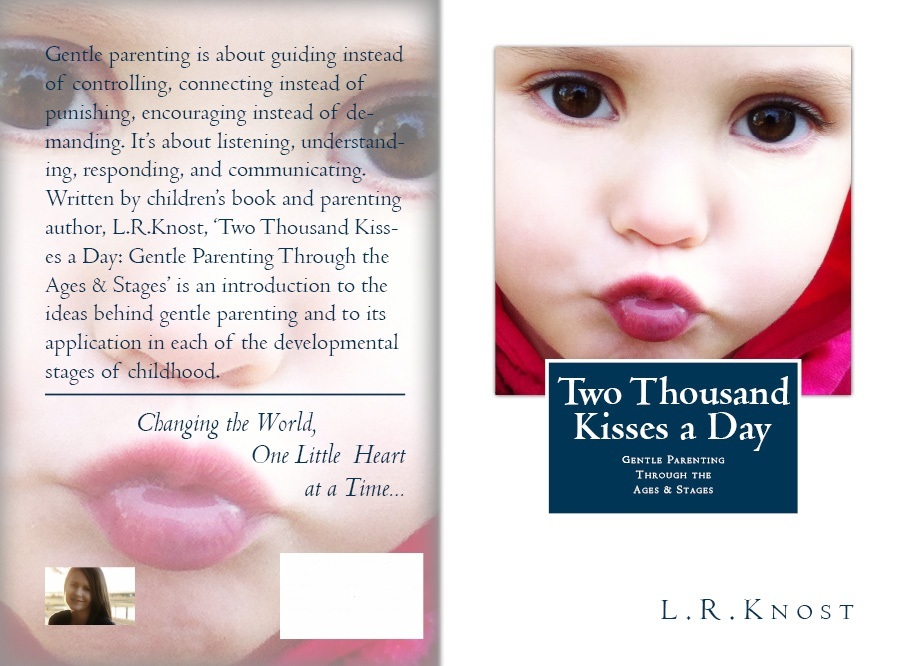 Two Thousand Kisses a Day: Gentle Parenting Through the Ages and Stages now available on Amazon:
~The birth story of a book~
A mother is born…
Many years ago (26 to be exact!), a small, scared, pregnant, teenage girl walked down the aisle to her tall, scared, clueless, young man and they said their “I do’s.”
But what were they going to do? No earthly idea! They didn’t have the internet to surf for blogs about parenting and marriage, couldn’t afford the few paltry magazines available on those subjects at the time, and weren’t convinced that the way their parents had raised them was exactly how they wanted to raise their unexpected little blessing. So, they simply joined hands and hearts and figured it out the old-fashioned way…through trial and error.
The young girl gave birth prematurely and, after a terrifying NICU stay, brought home her barely 5 lb baby boy. Since the young couple were living on one income and were barely able to feed themselves, it made sense to them to breastfeed their little one. Neither one had ever even seen a mother breastfeeding her baby or even heard of a lactation consultant and no one at the hospital had mentioned breastfeeding at all, so the two young people just kept working through the cracked, bleeding nipples, engorgement, over-supply, and other issues until they got it figured out…and then they were breastfeeders!
Neither one of the young couple had ever read a parenting book or had ever even heard the words ‘cry-it-out,’ and the young girl discovered their first night home how much easier it was to clear away all of the pillows and blankets to keep her baby safe and then simply take her little guy into bed with her and breastfeed him when he was hungry…and then they were co-sleepers!
‘Self-soothing’ was another term the two young people had never heard, so the two of them just did what came naturally and picked up their baby when he fussed or grunted or just looked cute and finally found it easier to just snuggle their little preemie into a baby carrier and tote him around with them wherever they went…and then they were babywearers!
As their precious little guy got bigger and began to explore his new world, the young couple delighted in everything he did and simply moved him or distracted him with songs and toys if he got into things. They couldn’t bear the thought of hurting their son, so punitive parenting just wasn’t an option. They decided to treat their little guy like a person instead of a possession and communicate with him instead of punishing him…and then they were gentle discipliners!
Now, this journey might sound like an easy one when summed up this way, but I can assure you it wasn’t. The young couple, my amazing husband and I, encountered strong criticism of our parenting choices through the years:
- We were warned that our marriage would suffer at the very least, and our babies would suffocate at the worst, if we slept with them in our bed instead of putting them in isolation to sleep.
- We were informed that my breasts would look like deflated balloons and reach my knees by my thirties if I breastfed more than a few weeks.
- We were admonished that our children would grow into spoiled brats if we responded to their needs instead of teaching them to ‘deal with it’ and ‘self-soothe’ their own, and would end up as social outcasts or criminals if we encouraged and guided them instead of spanking them.
These challenges to our parenting style were difficult at the time, and they sometimes even resulted in people choosing to de-friend us (not Facebook de-friending, in real life!), but that had the powerful positive effect of making us really examine what our beliefs were and, as a result, strengthening and solidifying our values, our marriage, and our family.
As for the dire warnings listed above:
- Our beautiful, strong, loving marriage is in its 27th year.
- Our children all survived and thrived on co-sleeping (our littlest is still safely and contentedly sleeping in our bed) and have, in their own time, moved happily to their own rooms.
- Except for being a couple of cup sizes larger at the moment since I’m breastfeeding a toddler, lol, my breasts are normal despite the fact that I’ve breastfed little ones for a cumulative 10+ years of my adult life!
- Our children are, in order, a 25-year-old Pastor (our firstborn son mentioned in the story above who is now a husband and father of two!), a 23-year-old Family Therapist, an 18-year-old pre-med university student on scholarship, 13- and 7-year-old beautiful and well-behaved homeschooled girls with lots of friends (soooo not social outcasts!), and a sweet and happy 2-year-old baby girl. Not a spoiled brat or criminal in the bunch!
Our journey to gentle parenting has had another, somewhat unexpected, effect. While we may not agree with others’ parenting choices, we have been on the receiving end of criticism far too long not to have learned this lesson: Gentle parenting is for parents, too! We have learned to respond gently to our friends who don’t agree with us, even when they don’t respond gently to us. Responding with harshness and criticism doesn’t work with adults any better than it does with children! Responding gently to those who disagree with us may or may not affect their parenting choices, but what it does do is model respectful behavior and conflict resolution to our children and, most of the time, preserve dear friendships.
A gentle parenting advocate is born…
This journey also resulted in a passion for children and family harmony that launched me many years ago into the world of parent coaching and child advocacy and later initiated the creation of Little Hearts/Gentle Parenting Resources as a consulting and educational resource for parents, caregivers, and educators. The culmination of this work led to the development of a series of gentle parenting handbooks designed to equip parents with the information and tools they need to gently guide their children from infancy through toddlerhood and the preschool years and on through middle childhood, the teen years, and beyond.
A book is born…
Two Thousand Kisses a Day: Gentle Parenting Through the Ages and Stages is the first in the series. It is an introduction to the ideas behind gentle parenting and provides practical examples of its application in each of the developmental stages of childhood such as the transition from diapers to potty, problems with sharing, coping with picky eaters, guiding children gently through behavioral issues, and more!
*also published in The Natural Parent Magazine
Award-winnning author, L.R.Knost, is the founder and director of the children's rights advocacy and family consulting group, Little Hearts/Gentle Parenting Resources, and Editor-in-Chief of Holistic Parenting Magazine. Books by L.R.Knost include Whispers Through Time: Communication Through the Ages and Stages of Childhood ; Two Thousand Kisses a Day: Gentle Parenting Through the Ages and Stages ; The Gentle Parent: Positive, Practical, Effective Discipline ; and Jesus, the Gentle Parent: Gentle Christian Parenting the first four books in the Little Hearts Handbook gentle parenting series, and children’s picture books Petey’s Listening Ears and the soon-to-be-released Grumpykins series.
Little Hearts Handbooks: Vote for Your Favorite Author Picture to Enter to Win a Pre-Release Copy!
 [Two Thousand Kisses a Day: Gentle Parenting Through the Ages and Stages by L.R.Knost now available. #14 on Amazon’s Top 100 New Releases in parenting!]
A winner has been chosen! For more opportunities to win a Little Hearts Handbook, follow Little Hearts/Gentle Parenting Resources by subscribing to receive updates from this website, on Face Book, Pinterest, and Twitter. Thank you to all who participated!
Exciting times ahead for Little Hearts! In the New Year, a series of handbooks based on the Little Hearts/Gentle Parenting Resources website will be released in paperback and for Kindle. The books will be approximately 120 pages and priced around $7.99 for paperback and $3.99 to $4.99 for Kindle. More details to come!
In celebration, we’re giving away a free, pre-release copy of the first handbook in the series, Two Thousand Kisses a Day~Gentle Parenting Through the Ages & Stages. Our official Little Hearts photographer from Melissa Lynsay Photography has outdone herself, and now we can’t decide on the best author picture for the back cover of the books.
We need your help deciding on a picture, so vote for your favorite author picture or comment on this post to register to win!
For voting purposes, we’ll call the picture above pic 1 and here is pic 2:

and pic 3:

Here are previews of the working copies of three of the book covers so you can see the pictures in ‘thumbnail’ form as they’ll be on the back cover. The actual handbooks are 6″ x 9″ so almost twice the size of these cover images which will make the pictures nearly double the size you see here:
Okay, there you go! Vote for your favorite picture or leave a comment to register to win a free copy. It’s that easy!
Award-winnning author, L.R.Knost, is the founder and director of the children's rights advocacy and family consulting group, Little Hearts/Gentle Parenting Resources, and Editor-in-Chief of Holistic Parenting Magazine. Books by L.R.Knost include Whispers Through Time: Communication Through the Ages and Stages of Childhood ; Two Thousand Kisses a Day: Gentle Parenting Through the Ages and Stages ; The Gentle Parent: Positive, Practical, Effective Discipline ; and Jesus, the Gentle Parent: Gentle Christian Parenting the first four books in the Little Hearts Handbook gentle parenting series, and children’s picture books Petey’s Listening Ears and the soon-to-be-released Grumpykins series.
Helping Unique Learners Find Their Genius
[From Raising Bookworms: Life, Learning, and Literacy by L.R.Knost available 2014; Two Thousand Kisses a Day: Gentle Parenting Through the Ages and Stages, Whispers Through Time: Communication Through the Ages and Stages of Childhood, and The Gentle Parent: Positive, Practical, Effective Discipline now available on Amazon and through other major retailers.]
 Homeschooling a unique learner can be challenging simply because they don’t get the benefit of access to testing and professional support without a lot of initiative, research, phone calls, and door-knocking on your part. But the trade-off is the freedom to tailor your teaching and learning environment to your child’s needs, and that is of incredible value when educating a unique learner.
Albert Einstein said, “Everybody is a genius. But if you judge a fish on its ability to climb a tree, it will live its whole life believing that it is stupid.” Unique learners have beautiful minds just waiting to find their genius. We just need to look outside of the box to help them find it!
Here are some of the tips, tools, and techniques I’ve learned through years of homeschooling my unique learners to help them work through the challenges they face on a daily basis:
1.) Lighten up…Everything in life is easier if you take it with a grain of salt and learn to laugh. Our unique learners will have more struggles and challenges than the average person throughout life, not just during their school years. That is an unavoidable fact. But who wants to be ‘average’ anyway? Help them to celebrate their uniqueness and embrace the future with grace and humor by sharing your own struggles, modeling coping techniques, and being able to laugh at your own mistakes. Make ‘even missteps are valuable steps on the road to success’ your homeschool motto!
2.) Play…Children learn best through play, and that applies to therapy, as well. Experience is the only true path to learning, so let their imaginations soar as they do the hard work of learning to cope with their unique challenges. (See some play-based, brain-enriching, and eye-tracking activities below)
3.) Jazz it up…Music truly is medicine for the soul. Buy a good set of headphones (not earbuds) and play classic instrumentals softly while your unique learner is trying to concentrate, whether it be on reading or writing or drawing, etc. Filtering out the cacophony of life and soothing their stress levels with the gentle strains of Mozart are only some of the benefits of music. Another benefit is that the rhythms, cadence, and timing of music actually have an organizing effect on the brain!
4.) Exercise…Invest in an exercise bicycle (We got ours for $15 from a yard sale!) that lets your unique learner sit in a comfortable seat while pedaling. The cross-over action of pedaling also has an organizing effect on the brain, and, if used while reading or playing video games (Video games can be great exercises for eye-tracking if you choose the right ones!) can actually increase the speed and effectiveness of learning.
5.) Get crunchy…Believe it or not, another ‘brain organizing’ activity is chewing, particularly crunchy foods, while reading, etc. Some good choices are pretzels, carrot sticks, celery, granola, and nuts. (If you’ve got a sensory sweetie like I do, be careful to let them choose something that won’t send their senses into overdrive.) Sugarless chewing gum can be substituted when you go places where foods aren’t appropriate, but still would like to offer your child a calming, organizing aid.
6.) Listen, listen, listen…Your unique learner will have more than their share of stress and possibly a harder time articulating it than others might. Slow down and really focus on what they are communicating. Listen ‘between the lines’ to their heart, their hurts, their fears, their needs. Be their safe place, their source of comfort and renewal.
7.) Hug it out…Physical closeness is healing, and so make sure that along with the extra struggles and challenges your unique learner faces, they get lots of extra cuddles, snuggles, and hugs. When they get older, a gentle touch on their shoulder or a light hand on their arm will be instantly calming and comforting because it will tap into those feelings of comfort and closeness from earlier childhood.
8.) Watch and learn…Just as every child is different, every child with challenges is unique in how they manifest those challenges and how they handle them. Paying careful attention to your own unique learner’s personality, struggles, aversions, triggers, etc. will give you clues as to how to help them learn to cope. With SPD (Sensory Processing Disorder), for example, avoiding unpleasant stimulus and providing needed stimulus is the name of the game. Typically, you’ll want to provide a quiet learning area at home, lots of freedom to move, permission to step away and de-stress when they feel overwhelmed, etc. and, when going out, avoid buffet-style restaurants and loud, crowded shopping and entertainment venues.
9.) Guide them gently…Discipline (guiding, modeling, teaching, etc.) invites communication and strengthens your parent/child connection. Punishment stifles communication and strains parent/child connections. Keep those vital lines of communication open and your parent/child connection healthy by providing consistent boundaries and gentle guidance, being open to discussion, and modeling the desired behavior.
10.) Read, read, read…Successful readers are not simply those who understand the mechanics of reading any more than successful biking is understanding the mechanics of a bicycle. Readers are born when a love for reading is fostered. Let them see you reading often. Cuddle up and read to them when they are young. Co-read (you read a sentence, they read a sentence, etc) when they are new readers or when they are tired or struggling. Let them read comics (The relation of pictures to words is a huge aid in reading comprehension.). For more reading tips, see Raising Bookworms.
Here are some exercises and activities that have helped my Renaissance Girl with her challenges with SPD, dyslexia, ADD, visual/auditory processing disorders, dyscalculia, etc:
Gross motor and fine motor cross-over exercises to get the two sides of the brain communicating more efficiently…
~Bouncing a brightly colored ball back and forth between us using alternate hands (left, right, left, right, etc.)
~Skipping, marching, swinging while singing 
~Climbing
~Balance beam
~Bicycling
~Piano
~Sorting 
Brain-organizing activities…
~Memory matching
~Tonal music
~Free-style building with blocks, tinkertoys, legos, etc.
~Design-matching building
~Sensory bins
Eye-tracking activities…
~Laser pointer games-following a laser pointer light in a darkened room, pointing to moving targets (i.e. bubbles), etc.
~Ceiling tracing-following the seam of the wall and ceiling from corner to corner moving only the eyes
~Video games-Flash Focus and Brain Age are good choices for the Gameboy. Wii Fit, Carnival Games, and Sports Games are good for the Wii. There are also great games for improving eye-tracking for the X-box, Playstation, and online. If you do the research to find what best fits your child’s interests, you’ll have much better participation!
Visual-motor learning…
~Clay letters-tactile learning by forming letters and words on a template with clay or dough 
~Contextual learning-Children with dyslexia tend to learn better in context than by breaking things down to their parts, so phonics-based learning is often mind-boggling for them. Flashcards are a no-go because speed and movement impede their attempts to focus rather than help them. Writing-based learning such as copying and illustrating short poems, copying a short sentence from a wall-mounted chalkboard or large paper taped to the wall and illustrating it, writing and illustrating their own stories, and writing stories on the computer are great ways to help them learn to read.
~Once they are beginning to read, graphic novels, large-print chapter books on topics that interest them, and continued creative writing are excellent practice.
~Online reading games can be helpful, but only if they are untimed (Timed anything is a huge stressor and sets them up for frustration and failure.) and your child feels comfortable with the level of activity and brightness on the screen as otherwise these can cause headaches and their eyes to tire quickly.
These tips are not, of course, exhaustive or a replacement for professional therapies. But as you work your way through what can often be a labyrinth of paperwork, meetings, appointments, etc. on your way to finding the services your child needs, these may help to ease the wait a bit. 🙂
Related posts:
Children who love to read…READ! Engaging children’s hearts in the wonder of reading instead of just training their minds in its mechanics. Raising Bookworms
It’s time for a return to childhood, to simplicity, to running and climbing and laughing in the sunshine, to experiencing happiness instead of being trained for a lifetime of pursuing happiness…it’s time to let children be children again. A Return to Childhood
Think homeschooled children are unsocialized, over-controlled, locked-away-from-the-world misfits? Think again! My Renaissance Girl
Successful reading means far more than possessing the ability to read. Engaging the hearts of students moves reading success beyond a life skill and turns it into a life style. And graphic novels are too powerful of a tool in our arsenal to be disregarded because of pride or prejudice. Raising Super Readers~The MARVELous Power of Comic Books!
In the world of a child wonders are as simple as sticks and sheets, leaves and books, boxes and giggles, and the promise in a rainy day. The Seven Wonders of the World of Childhood
Parenting choices strongly impact the level and type of attachment a child develops and, by extension, the development of a love of learning. A love of learning grows when it isn’t stifled by fear or stress or regimented by over-structuring or a focus on achievement or competition. Parents fostering a healthy attachment are thus also fostering a life-long love of learning in their children. Live to Play~Play to Learn~Learn to Live!
If you give a toddler a book
He’ll climb into your lap
While he’s in your lap
He might lay his head on your chest
When he lays his head on your chest
He’ll hear your heartbeat
When he hears your heartbeat
He’ll probably ask if you can hear… If You Give A Toddler A Book…
Einstein recognized his unique lens and often commented about it and about how organized education systems didn’t accommodate individuality and creativity. Here is a look into this ‘unique learner’s’ mind in his own words…Beautiful Minds
Award-winnning author, L.R.Knost, is the founder and director of the children's rights advocacy and family consulting group, Little Hearts/Gentle Parenting Resources, and Editor-in-Chief of Holistic Parenting Magazine. Books by L.R.Knost include Whispers Through Time: Communication Through the Ages and Stages of Childhood ; Two Thousand Kisses a Day: Gentle Parenting Through the Ages and Stages ; The Gentle Parent: Positive, Practical, Effective Discipline ; and Jesus, the Gentle Parent: Gentle Christian Parenting the first four books in the Little Hearts Handbook gentle parenting series, and children’s picture books Petey’s Listening Ears and the soon-to-be-released Grumpykins series.
When Children Hit~10 Tips for Parents
[Portions reprinted from The Gentle Parent: Positive, Practical, Effective Discipline by L.R.Knost. Two Thousand Kisses a Day: Gentle Parenting Through the Ages and Stages and Whispers Through Time: Communication Through the Ages and Stages of Childhood also available on Amazon and through other major retailers.]
 Toddlers and preschoolers are still in the early stages of learning to communicate verbally. Add to that the fact that they have little-to-no impulse control and very immature social skills, and you’ve got a recipe for an instinctive physical response (i.e. hitting, kicking, biting, hair pulling, throwing things, etc.) to situations in which they are frustrated, angry, scared, or just tired and out-of-sorts.
Many parents who practice gentle discipline wonder where their little one picked up the behavior, not realizing that it is a normal and age-appropriate reaction, albeit an unacceptable one. Very often parents are advised to spank their child to train them not to hit others, especially those who are smaller and weaker than they are. (more…)
Award-winnning author, L.R.Knost, is the founder and director of the children's rights advocacy and family consulting group, Little Hearts/Gentle Parenting Resources, and Editor-in-Chief of Holistic Parenting Magazine. Books by L.R.Knost include Whispers Through Time: Communication Through the Ages and Stages of Childhood ; Two Thousand Kisses a Day: Gentle Parenting Through the Ages and Stages ; The Gentle Parent: Positive, Practical, Effective Discipline ; and Jesus, the Gentle Parent: Gentle Christian Parenting the first four books in the Little Hearts Handbook gentle parenting series, and children’s picture books Petey’s Listening Ears and the soon-to-be-released Grumpykins series.
Picky Eater? Here’s Help!
[Reprinted from Two Thousand Kisses a Day: Gentle Parenting Through the Ages and Stages by L.R.Knost. Whispers Through Time: Communication Through the Ages and Stages of Childhood and The Gentle Parent: Positive, Practical, Effective Discipline also now available on Amazon and through other major retailers.]
~~~~~~~~~~~~~~~~~~~~~
 I was one of those children who was incredibly picky when it came to food and, despite my mom’s gently enforced ‘one bite rule,’ I went on to become an incredibly picky eater as an adult, as well. I vividly remember as a young child gagging as I tried to force down a bite, my throat feeling like it was closing up, and like there was no way food was going to fit through there. As a very compliant child, it bothered me immensely to disappoint my mom, and, being the logical person that I was even at that young age, I remember feeling that her expectations were very reasonable and being frustrated at my own inability to comply.
Fast forward a few years to when I began having children of my own and needed to make parenting decisions about everything from breastfeeding to cosleeping to discipline. On my journey to gentle parenting I revisited my childhood memories often, finding myself appreciating my mom’s gentleness and her way of using silliness to help me see the ‘silver lining’ in life when things were hard. In some things, I chose to follow the parenting path my mom took, and in others I took a different course and blazed my own trail.
When I was at university, I worked as a certified nutrition consultant with a focus on natural approaches to nutrition, health, and fitness. I took that knowledge, along with my studies in developmental psychology, human behavior, and communication, and incorporated all of it into my parenting decisions.
As I muddled through the toddler years with my firstborn, I decided to take an approach to nutrition that was unheard of, as far as I knew. I would offer to nurse, offer the food on my plate, and offer food I’d made specifically for him, and then let my little man decide. That was the beginning of our baby led weaning, though I didn’t know that term at the time.
What I discovered then and have seen proven time and again through the years with my own six very different children as well as with the families I’ve worked with is that, given the freedom to choose, children will generally experiment with more textures and tastes than if they are forced to eat their parents’ choice of food for them. It’s simply human nature that, if a child (or an adult, for that matter!) knows that they don’t have to try a new food and that they can run to the trashbin and spit it out if they do try it and don’t like it, then they are far, far more likely to give it a chance. And if they don’t try it the first time it’s offered, or if they do try it and don’t like it, making it available again off and on in the future will give them more opportunities to try the food and perhaps end up liking it when their tastes mature a bit more.
In our home, my children know that if they don’t like what’s being served for a meal there is always an alternative in the form of a PB&J or a reheat later if they just aren’t hungry at mealtime, though if we’re sitting down together I do expect them to sit with the family and chat with us while we eat. Even if they like the food being served, they may not feel hungry for a heavy meal just then or perhaps the last time they ate that meal their tummy got upset or maybe there are other reasons they don’t want the meal that they simply can’t articulate. As the adult, I can choose to make an issue out of it and end up in an unnecessary power struggle, or I can choose to offer my children the same respect I offer myself, because you can bet your bottom dollar that if I don’t want to eat something, I’m not eating it!
Among the many benefits of this approach, beyond the greater propensity for a child to experiment with tastes and textures and beyond the elimination of mealtime battles, I also saved myself a ton of mommy guilt through the years. I had no way of knowing early on that my renaissance girl had Sensory Processing Disorder which was strongly affecting her ability to eat or that my little caboose was missing an enzyme and couldn’t eat meat. Had I spent their toddler years forcing foods on them and engaging in coercive or punitive mealtime parenting, the damage to our relationship, not to mention their health, could have been disastrous. Additionally, children who feel powerless over their lives can begin trying to recapture a sense of power by exercising excessive control over their eating with the danger of a resulting eating disorder when they get into their teen years.
So, on a practical level how do you get a toddler or preschooler to eat? Well, first and foremost, rigidly scheduling mealtimes creates a battleground in and of itself. Toddlers’ and preschoolers’ ever-shifting growth patterns cause them to go through slow-growth periods where they simply aren’t hungry and other periods where they’re hungry 24/7! Grazing, or eating multiple small meals and snacks throughout the day, not only fits these growth patterns better, but is actually a much healthier way for all of us to eat because it stabilizes blood sugar which, when low, leads to overeating as does simply eating because ‘it’s time.’ Teaching our little ones to listen to their bodies’ hunger cues is a hugely positive step toward avoiding obesity later in life, as well!
Secondly, a combination of keeping little ones active so they work up a good appetite (which also sets them on the path toward an active physical lifestyle!) and offering a variety of healthy foods throughout the day will typically be all it takes to meet their nutrition requirements. As a general guideline, toddlers and preschoolers need:
- Two to three servings of dairy (i.e. 1 oz. cheese, ½ cup milk, ½ cup yogurt);
- Four to six servings of grains (i.e. ½ slice bread, ½ cup non-sugared cereal, ¼ cup pasta, 2 crackers);
- Two servings of protein (i.e. two 1” squares of chicken, fish, or beef);
- Two to three servings of veggies (i.e. 2 tbs peas, corn, cauliflower, etc);
- And two to three servings of fruit (i.e. ½ banana, apple, orange, etc., ¼ cup raisins, blueberries, raspberries, 3-4 strawberries or grapes, etc)
Here are some fun ways to invite your little ones to make healthy eating choices:
~Breakfast ideas~

- Need an easy and healthy breakfast for little ones? Try an ice cream cone filled with almonds & bite sized chunks of fruit & cheese!
- Start little people’s day healthy & happy. Make a smiley face clock on their plate with almonds, cheese & fruit with yogurt to dip them in!
- Try making ‘apple cookies’ (apples sliced into round discs) into faces with almonds, raisins & cheese!
- Sundae breakfast! Yogurt sprinkled with granola & raisins & nuts & drizzled with local honey (helps control seasonal allergies, too), yummy! *Note: Never feed honey to a baby under a year old.

- Here comes the sun! Make frozen pancakes more healthy by surrounding them with fruit & topping with berries & almonds & drizzling with local honey!
~Lunch ideas~

- Banana Boats~Slice of whole wheat bread spread with peanut butter & local honey & wrapped around a banana. Top with just a sprinkle of brown sugar for a treat!
- Double Trouble~Celery, carrot & pretzel sticks with a scoop of cottage cheese & a scoop of peanut butter for double dipping!
- Picasso PB&J’s~Round whole wheat flat bread with small dollops of peanut butter, fruit preserves & yogurt around the edge in a colorful palate with pretzel sticks for paint brushes!
~Dinner ideas~
- Boil some cauliflower, carrots, zucchini & yellow squash until a bit mushy & puree.
1) Mix with your favorite meatloaf recipe for a hidden veggie serving!
2) Mix with spaghetti sauce & freeze in single serving containers.

- Spaghetti Twisters~Make rotini noodles instead of spaghetti noodles for a cute ‘twist’ and add your special spaghetti sauce for a tornado of veggie goodness!
- Pizza Racers~Use rectangular flatbread & lightly coat with olive oil and broil for a couple of minutes to crisp it up, then add your souped-up spaghetti sauce & let your little ones top with mozzarella ‘racing stripes’ & pepperoni ‘racing tires’ for a super-charged dinner!

- Pureed cauliflower also works great mixed with mac & cheese, stuffing, and mashed potatoes for a hidden veggie to round out any meal!
Related posts:
Toddlers, Tantrums, and Time-Ins, Oh My!
Practical Gentle Discipline Guide
Tots to Teens~Communication Through the Ages and Stages
A Place to Rest~Becoming Your Child’s Safe Harbor
Love in the Time of Cosleeping
Your Baby isn’t Trying to Annoy You; He’s Trying to Communicate!
Award-winnning author, L.R.Knost, is the founder and director of the children's rights advocacy and family consulting group, Little Hearts/Gentle Parenting Resources, and Editor-in-Chief of Holistic Parenting Magazine. Books by L.R.Knost include Whispers Through Time: Communication Through the Ages and Stages of Childhood ; Two Thousand Kisses a Day: Gentle Parenting Through the Ages and Stages ; The Gentle Parent: Positive, Practical, Effective Discipline ; and Jesus, the Gentle Parent: Gentle Christian Parenting the first four books in the Little Hearts Handbook gentle parenting series, and children’s picture books Petey’s Listening Ears and the soon-to-be-released Grumpykins series.
You’re Not the Boss of Me!
 [Portions reprinted from The Gentle Parent: Positive, Practical, Effective Discipline by L.R.Knost. Two Thousand Kisses a Day: Gentle Parenting Through the Ages and Stages and Whispers Through Time: Communication Through the Ages and Stages of Childhood also available on Amazon and through other major retailers.]
Few things ignite a parent’s temper like defiance. It feels like a slap in the face, a direct challenge to our authority. Power card…played. Gauntlet…thrown. Challenge…accepted?
Time out! No, not time-out as in punish your child, but time out as in hit the parental pause button, take a step back, assess the situation, and get some adult perspective.
There are three things to consider:
- Behaviors are communication. What is your child trying to communicate?
- Is the behavior really defiance, or did your child’s action hit a nerve in you for some reason?
- If the behavior is, in fact, defiance, what circumstances preceded it?
Once you’ve assessed the situation, you can more effectively address it. If your child is communicating an unmet need such as a need for more interaction from you, a need to be heard, or if they simply need an outlet for their energy, you can first meet those needs and then offer your child ideas about how to better communicate their needs to you in the future.
The same process applies if your child’s behavior is communicating stress, anger, fear, or insecurity. Taking a step back allows you to not only see the emotion behind the action, but also gives you a moment to consider if there have been any big transitions in your child’s life such as a move or change in childcare or a recent illness (or, possibly, a breach in trust if you have ‘lost it’ and yelled, threatened, or spanked) that they may have big feelings about but are not able to articulate. First you can meet those emotional needs with empathic listening, offering words to help them articulate their feelings, apologizing if you have broken trust with them, and providing an outlet for their pent up emotions. Then you can address their behavior by giving them options for expressing their needs in more acceptable ways.
Meeting their needs before addressing their behavior is vital because it lowers their defenses, clears whatever is cluttering up your parent/child connection, and opens the pathways to communication, in effect turning on their listening ears!
*On a side note, be aware that it is possible, especially with very young children, that what you are interpreting as defiance is actually age-appropriate curiosity and exploration. A twelve month old who repeatedly pulls the cat’s tail may be experimenting with the interesting sound the cat makes, the soft texture of the fur, her own feeling of power, or just trying to find out if pulling the tail is as ‘not-okay’ after her nap as it was before. Little ones too young to grasp the concept of permanence (typically those less than twenty-four to thirty months) live very much in the moment and cannot be expected to understand the permanent nature of rules and limits. Removing temptations (commonly referred to as baby-proofing) is not only for their safety, but is also a visual form of limit setting. A common misconception is that removing temptations is passive or indulgent parenting, but it is actually proactive parenting (whereas passive/indulgent parenting would be simply allowing the behavior) and is an effective and gentle beginning to the process of boundary setting.
If in taking a step back to assess the situation you discover that your child’s behavior isn’t really defiance, but a nerve was hit in you that caused you to perceive it that way, you can first address your child’s need and then their behavior, if necessary, but then take the time to address your own needs. Perhaps you have an unmet need to be heard by your spouse, boss, or even your own parents, or maybe there is a wound from your past that needs to be healed or a source of stress in your life that is causing you to feel overwhelmed. Taking an honest look at your own needs and hurts and stressors and dealing with those issues will not only benefit your parenting, but your life in general!
If your ‘time out’ assessment reveals that the circumstances preceding your child’s defiance contributed to it, you can learn from that and find ways to avoid those circumstances in the future. For instance, you may realize that hunger or tiredness or over-scheduling are triggers for your child’s behavior. Or you may see that your wording is provoking a negative response. (The word ‘no’ can be a trigger for a power struggle. Try rephrasing your no’s into yes’s. For instance, instead of “No, you can’t have ice cream until after dinner” you could try “I know you love ice cream. I do, too! We’re getting ready to eat right now, but what flavor would you like after dinner?” The objective is to set the same limit, but phrase it in a way that invites cooperation instead of triggering opposition.) You might realize you are inadvertently communicating your own stress to your child or even taking it out on them. Or you may have slipped into a negative parenting pattern and be ‘powering up’ on your child, in effect throwing down the gauntlet yourself, and they are merely reflecting your behavior. Whatever the case may be, learn from it, make the necessary adjustments, repair your relationship with an apology if needed, reconnect with your child, and then share ideas about better ways both of you can handle things in the future.
Keep in mind, though, that sometimes what parents perceive as defiance is really just a child testing their boundaries to make sure that they are secure. Children need to know they’re safe, and a parent who is confident and comfortable enough in their leadership to calmly and gently guide their child to stay within their boundaries is very reassuring. The goal of gentle parenting, however, is not controlling children, but equipping them to control themselves (in other words, we want to teach them to be ‘the boss’ of themselves!) So if your child is testing their boundaries, be careful to respond with guidance, not punishment.
Finally, remember, you are raising a little human with thoughts, needs, ideas, and a personality all their own. They aren’t perfect any more than you are, and expecting perfection will lead to conflict, not connection. When they make mistakes, choose understanding, not anger. When they make poor choices, choose guidance, not punishment. And when they challenge your authority and throw down that gauntlet of defiance, choose peace, not warfare. Remember, you don’t have to attend every fight you’re invited to!
~~~~~~~~~~~~~~
Related posts:
Toddlers, Tantrums, and Time-In’s, Oh My!
The Gift of a Strong-Willed Child
Backtalk is Communication…LISTEN
When Children Act Out ~ Reflecting Our Emotions
Bridge Over Troubled Waters~Parenting a ‘Problem’ Child
The Taming of the Tantrum: A Toddler’s Perspective
Practical, Gentle, Effective Discipline
200 Ways to Bless Your Children with a Happy Childhood
Award-winnning author, L.R.Knost, is the founder and director of the children's rights advocacy and family consulting group, Little Hearts/Gentle Parenting Resources, and Editor-in-Chief of Holistic Parenting Magazine. Books by L.R.Knost include Whispers Through Time: Communication Through the Ages and Stages of Childhood ; Two Thousand Kisses a Day: Gentle Parenting Through the Ages and Stages ; The Gentle Parent: Positive, Practical, Effective Discipline ; and Jesus, the Gentle Parent: Gentle Christian Parenting the first four books in the Little Hearts Handbook gentle parenting series, and children’s picture books Petey’s Listening Ears and the soon-to-be-released Grumpykins series.
The Trouble With Kids Today
[Portions reprinted from Two Thousand Kisses a Day: Gentle Parenting Through the Ages and Stages by L.R.Knost available on Amazon]
 “People are telling parents like me that we are failing our children because we practice controlled discipline in our homes. I say: the children that are raised without it are the ones being abused and robbed of the chance of success in adulthood.” Controlled discipline in the eyes of this author of I Don’t Like Spanking My Kids, But I Do It Anyway is physical punishment. Equating discipline with punishment is a common misconception, but she is, unfortunately, not alone in her stance.
Many of today’s most popular self-proclaimed parenting ‘experts’ also equate physical punishment with discipline and go to great lengths to describe the best methods and tools for hitting children along with instructing parents to maintain a calm, controlled, and even cheerful demeanor as they ‘lovingly’ hit their children.
It is interesting to note here that, when it comes to the law, crimes of passion are treated as less heinous than premeditated, planned, and purposefully executed crimes which are termed ‘in cold blood.’ And yet when physically punishing a child, a crime in many places across the globe, hitting in anger or frustration (i.e. passion) is deemed wrong by proponents of spanking, while hitting children with calm and deliberate intent (i.e. premeditation) is encouraged.
It is also interesting to note that, in the not-too-distant past, husbands hitting their wives was also viewed as not only a societal norm, but a necessary part of maintaining a harmonious, successful marriage. In fact, a man who epitomizes the words calm and controlled, Sean Connery, shared his thoughts on the ‘reasonable smacking’ of his wife in a 1987 interview with Barbara Walters:
The core belief behind ‘reasonable smacking’ of wives was that there was no other effective way to control them. I have to agree. If controlling another human being is the goal, then force is necessary. Fear, intimidation, threats, power-plays, physical pain, those are the means of control.
But if growing healthy humans is the goal, then building trust relationships, encouraging, guiding, leading, teaching, communicating, those are the tools for success.
Many parents simply don’t know what else to do. They were raised with spanking as a means of control and “turned out okay” so they default to their own parents’ parenting choices without researching alternatives to spanking or considering whether “okay” could be improved upon.
As to the I Don’t Like Spanking My Kids, But I Do It Anyway author’s contention that “We are raising a generation of children who are over-sensitive because they eventually find out that they aren’t as good at baseball or ballet as some other kid and their parents promised them that everyone is equal. They feel entitled because we teach them that they should. They throw tantrums when life doesn’t go their way because their parents have tiptoed around them to make sure that it does,” that reasoning sounds strangely familiar.
People throughout history have complained about ‘the trouble with kids these days.’ They’ve pinned all the ills of their society on permissive parenting. They’ve ranted about out-of-control children, disrespectful youth, entitlement, spoiling, disobedience, violence, self-centeredness, etc:
“The children now love luxury. They have bad manners, contempt for authority, they show disrespect to their elders…. They no longer rise when elders enter the room. They contradict their parents, chatter before company, gobble up dainties at the table, cross their legs, and are tyrants over their teachers.”
~Socrates, 5th Century BC“What is happening to our young people? They disrespect their elders, they disobey their parents. They ignore the law. They riot in the streets inflamed with wild notions.
Their morals are decaying. What is to become of them?”
~Plato, 5th Century BC“I see no hope for the future of our people if they are dependent on frivolous youth of today, for certainly all youth are reckless beyond words… When I was young, we were taught to be discreet and
respectful of elders, but the present youth are exceedingly wise [disrespectful] and impatient of restraint”
~Hesiod, 8th Century BC“The world is passing through troublous times. The young people of today think of nothing but themselves. They have no reverence for parents or old age. They are impatient of all restraint. They talk as if they knew everything, and what passes for wisdom with us is foolishness with them. As for the girls, they are forward, immodest and unladylike in speech, behavior and dress.”
~Peter the Hermit, 13th Century ADMy grandpa notes the world’s worn cogs
And says we’re going to the dogs.
His grandpa in his house of logs
Said things were going to the dogs.
His grandpa in the Flemish bogs
Said things were going to the dogs.
His grandpa in his hairy togs
Said things were going to the dogs.
But this is what I wish to state:
The dogs have had an awful wait.
~Unknown, circa 1936Small children disturb your sleep, big children your life.
~Yiddish Proverb
Perhaps, just perhaps, there isn’t any ‘trouble with kids today.’ Maybe the trouble is with societies who view normal stages of development as somehow abnormal. Maybe the problem is with parents who repeat the patterns their own parents set and don’t delve into the belief system they are now passing along to their children. Or maybe the problem is simply the rose-colored glasses older generations tend to have about their own youth when they share idealized versions of ‘the good old days.’
Could it be that ‘kid’s today’ are just kids like they have been through the ages, full of exuberance and curiosity and learning their way in a great big world? Could it be that a listening ear, gentle guidance, and trusted arms to turn to when inevitable mistakes are made are really all children need to grow up into kind, helpful, responsible, productive members of our society?
Consider this, “Since more than 90% of American parents admit to spanking their children, it’s hard to accept that a decline in spanking is responsible for the purportedly escalating rates of youth violence and crime. Could it be that the 90% of children who are subject to violence at home in the form of being slapped, paddled, smacked, yanked, whipped, popped, spanked, etc. are taking those lessons out into the world? Is it just possible that children who are hit learn to hit? That children who are hurt learn to hurt? Perhaps the lesson they are learning is that ‘might is right’ and violence is the answer to their problems, the outlet for their stress, the route to getting others to do what they want.” Better Children, Better World
Could it be that sowing peace in our homes is the answer after all?
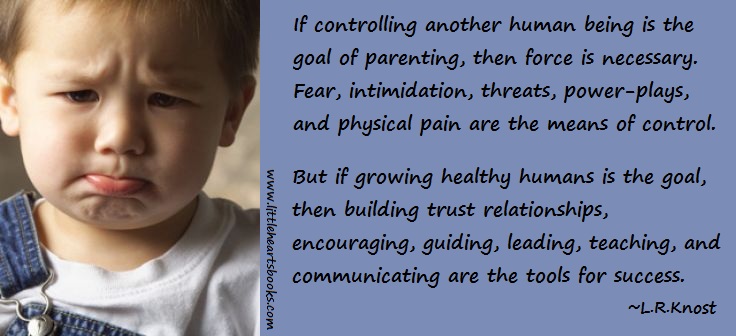
Related posts:
Practical, Gentle, Effective Discipline
Spare the Rod: The Heart of the Matter
Tots to Teens~Communication Through the Ages and Stages
Testing the Boundaries~What’s A Parent To Do?
One Slippery Sock & Other Silly Tools for your Parenting Toolbox!
The Measure of Success~Chinese Parents and French Parents Can’t BOTH Be Superior!
Award-winnning author, L.R.Knost, is the founder and director of the children's rights advocacy and family consulting group, Little Hearts/Gentle Parenting Resources, and Editor-in-Chief of Holistic Parenting Magazine. Books by L.R.Knost include Whispers Through Time: Communication Through the Ages and Stages of Childhood ; Two Thousand Kisses a Day: Gentle Parenting Through the Ages and Stages ; The Gentle Parent: Positive, Practical, Effective Discipline ; and Jesus, the Gentle Parent: Gentle Christian Parenting the first four books in the Little Hearts Handbook gentle parenting series, and children’s picture books Petey’s Listening Ears and the soon-to-be-released Grumpykins series.
Death of a Butterfly: Helping Children Cope with Loss

[Reprinted from Two Thousand Kisses a Day: Gentle Parenting Through the Ages and Stages by L.R.Knost. Whispers Through Time: Communication Through the Ages and Stages of Childhood and The Gentle Parent: Positive, Practical, Effective Discipline also now available on Amazon and through other major retailers.]
 My little Funny Face accidentally killed a butterfly today. Her sweet little heart is broken, poor thing. We’re walking through the stages of mourning together as I use these small (to us adults) losses to equip her with healthy tools for handling the difficult things life will surely bring through the years, as it does to all of us. Whether it’s the death of a butterfly, the loss of a favorite stuffed animal, or another loss that matters to them deeply, guiding children through their uncomfortable and often overwhelming emotions is something parents are often unprepared to handle. Here are the steps we take together when life gets hard and loss becomes a reality to my children:
1.) Feeling~The first step is simply allowing my children to feel their emotions. If they’re crying, I listen to their cues to know when to offer hugs or if they need some time alone or just someone to sit quietly next to them. If they’re angry, I watch closely to see if they need some directions for a safe outlet such as punching a pillow or going outside to kick a ball or if they are able to just stomp around and get it out that way. If they are unnaturally quiet, I let them know I’m there if they need me and then I leave them alone to sort through their emotions in their own time.
2.) Expressing~The second step is guiding my children to express their feelings in some tangible form. This step begins either when they initiate a conversation about the loss or when I see that their emotions are getting the best of them, indicating that they need some assistance in moving forward. This step may take the form of simply talking through what they are feeling, but typically it includes drawing a picture, making up a song or dictating a poem for me to write down for them, making a memory box, or some combination of each of them.
3.) Refocusing~The third and last step is giving my children ideas about how to move on. It’s often hard for them to figure out how to redirect their thoughts from constantly swirling around their loss. It takes a measure of mental maturity to be able to focus elsewhere when emotions are running high. This is not to say that they should never think about their loss again. I am always open to listening to their feelings and sharing their memories with them. This last step is just gently helping them to consciously shift their attention from what they have lost to what they still have, moving their thoughts from loss to life. This step often takes the form of encouraging them to head outside and play in the mud or climb a tree, or it might be offering to read them a favorite book or play a board game with them or maybe inviting a friend over to play.
While these three steps are in no way exhaustive, the idea behind this process is to simplify the stages of grief in a way that is accessible to parents and understandable to children. And then, when life hits hard and big losses occur such as the loss of a loved one, divorcing parents, etc. having walked through these small losses with our children sets the stage for helping them to work through the harder things while preserving a healthy parent/child connection.
When big life losses do occur, staying in tune with our children and letting them ask questions freely while we work to temper our answers in age appropriate terms is vital. Watching for changes in their behavior helps to give us clues as to what they’re feeling. If they start having trouble sleeping or resisting going to school or having meltdowns, etc. it might be helpful to seek out professional counseling for a brief time. We also need to keep in mind that small children have active imaginations and the line between fantasy and reality is very blurry for them. Death may not impact them much at all if the reality of it doesn’t sink in, or, on the flip side it could have a significant impact and they could begin to imagine all sorts of awful things happening to them or their family or friends. It’s important to let our children lead the way as to how we need to help them cope. Our local library or online at Goodreads or Amazon’s Listopia can also be good resources for age appropriate books on death and grief to share with our children. We do need to be sure to read through them ourselves first to make sure we’re comfortable with how things are presented, though.
Here is a brief, generic ‘script’ that can be used as a starting point for sharing difficult news about a loss with our children:
“I have something to tell you, and it’s a very hard thing. I want you to know that you are safe, and I’m safe, and I’m right here to help you, okay?”
(Give them time to respond.)
“Your (grandpa, aunt, friend, etc.), *name,* died. Do you know what ‘died’ means?”
(Give them time to respond.)
“It means they’re gone to (fill in your belief), and they won’t be coming back.”
(Give them time to respond.)
“It’s okay to be sad or even angry or scared. Those are normal emotions when people die. We are all very sad because we’re going to miss *name.*”
(Give them time to respond.)
“You’ll probably need some time to think about what happened, and you’ll probably have questions. That’s okay. And it’s okay to talk about *name,* too. We all are going to miss *name* and talking about them can help us to remember happy times with them.”
(Give them time to respond.)
“Would you like to make a goodbye card or a memory box? That might help you to feel better.”
Obviously this is a generic script that will need to be adapted based on a child’s responses, but it provides a starting point to open the conversation and begin to walk them through the grieving and healing process. Time does heal, but often it isn’t simply the passage of time that heals, but rather the support and comfort from those with whom we spend that time.
Related posts:
Children in the three to six-year-old age range are beginning to realize that their parents aren’t the all-powerful beings that they once believed them to be. This realization can be very uncomfortable for them, causing them a great deal of unease as they are concurrently beginning to realize that there is a whole, big, wide world beyond their safe, little home, a that the world is full of potential dangers, hazards unknown, and just a lot of really big, scary things. So what is a parent to do with their newly timid little house-mouse? The Age of Fear~Young Children and Anxiety
Award-winnning author, L.R.Knost, is the founder and director of the children's rights advocacy and family consulting group, Little Hearts/Gentle Parenting Resources, and Editor-in-Chief of Holistic Parenting Magazine. Books by L.R.Knost include Whispers Through Time: Communication Through the Ages and Stages of Childhood ; Two Thousand Kisses a Day: Gentle Parenting Through the Ages and Stages ; The Gentle Parent: Positive, Practical, Effective Discipline ; and Jesus, the Gentle Parent: Gentle Christian Parenting the first four books in the Little Hearts Handbook gentle parenting series, and children’s picture books Petey’s Listening Ears and the soon-to-be-released Grumpykins series.
The Age of Fear: 8 Tips to Help Young Children Cope with Anxiety
[Reprinted from Two Thousand Kisses a Day: Gentle Parenting Through the Ages and Stages by L.R.Knost. Whispers Through Time: Communication Through the Ages and Stages of Childhood and The Gentle Parent: Positive, Practical, Effective Discipline also now available on Amazon and through other major retailers.]
Your once fearless five-year-old suddenly refuses to leave your side at the park saying, “I’m afraid the birds will eat me,” while eyeing the tiny swallows hopping on the ground as if they’re evil geniuses plotting his demise.
Your three-year-old, whom you once found proudly grinning while sitting atop the refrigerator, has abruptly decided the swings are objects of abject terror that will, “Fly me to the ground.” (Translation: I’ll fall off!)
Your six-year-old who has slept like a log in his own bed for years is suddenly resisting bedtime and climbing into your bed with you at 3 am every. single. night.
Your happy little four-year-old suddenly becomes withdrawn and clingy, refusing to play with her playdate friends and wanting to sit in your lap. And, even worse, she’s started sucking her thumb again!
The preschool and early elementary school years are sometimes marred with exaggerated fears, odd anxieties, nightmares, night terrors, and other evidences of insecurity that can make the most confident of parents feel a combination of dismay, frustration, worry, and failure. Regression is a common accompaniment, from pottying accidents to night-waking to thumb-sucking. Often, acting-out behaviors also increase in this time period.
So, what in the world is going on?
No, it’s not an environmental-toxin-induced, super-early-onset of adolescent-hormone-overload. And, normally, it’s not a trauma-reaction to life changes such as moving or starting preschool or school, though those events can exacerbate the issue. (Be aware that these behaviors can, rarely, indicate an anxiety disorder, stress-overload, or abuse. If you suspect any of these things may be causing your child’s behavior, seek a professional evaluation.)
Typically, though, sudden anxiety behaviors in preschool/early elementary aged children are simply another normal stage of development, an indication of cognitive growth. In other words, as odd as it sounds, fear can be a sign of maturity!
Children in the three to six-year-old age range (Keep in mind that this is a rough age estimate. Children are individuals, not pre-programmed robots!) are beginning to realize that their parents aren’t the all-powerful beings that they once believed them to be. This realization can be very uncomfortable for them, causing them a great deal of unease as they are concurrently beginning to realize that there is a whole, big, wide world beyond their safe, little home, and that that world is full of potential dangers, hazards unknown, and just a lot of really big, scary things.
So what is a parent to do with their newly timid little house-mouse?
First, be aware that there is no one-size-fits-all miracle ‘cure.’ You know your child better than anyone else, and being responsive to her unique needs means taking your cues from her as to what may help or hinder her journey through this uncomfortable stage.
That said, here are some ideas that may help:
- Before forcing your child to ‘face his fears,’ consider whether someone throwing a spider on you if you are deathly afraid of spiders or locking you in a closet if you’re claustrophobic would be helpful to you in overcoming your fears. If the answer is ‘NO!’ then honor your child’s feelings and move on to another solution.
- When your child voices her concerns, resist the urge to minimize them. If she says, “I’m afraid of monsters coming in my window,” try not to say, “There’s no such thing as monsters.” Remember, she’s realizing you aren’t all-powerful, and that means you aren’t all-knowing, either! Rather than be reassured by your words, she’ll simply think you don’t know about the monsters and can’t help her and keep her safe. Instead, you can brainstorm ideas together to keep the monsters at bay. While you don’t want to say that monsters actually do exist, you can say something like, “Let’s think of ways to keep you safe. What if daddy throws the monsters away in the trashcans outside and the trashman takes them away?” Don’t be afraid to be seriously silly. In other words, take her fears seriously, but offer silly solutions that offer visuals of the monsters (or whatever the fear is) going away forever.
- Help your child to make a ‘nightmare safe’ out of a shoe box. At night
 before he goes to bed, sit with him and encourage him to put all his scary thoughts in the box for you to take and keep safely away from him while he sleeps. Let him know that if he does have a bad dream, he can come to you even if it’s the middle of the night, and you’ll help him to put the scary dream in the box so he’ll be able to go back to sleep.
- Avoid phrases such as “You’re a big boy now” and “Only babies do that.” Focus instead on encouraging your child to do the things you know he can do. For instance, if he’s usually able to climb the ladder on the slide but gets ‘stuck’ halfway up and asks for help, start by moving near so he knows you are close and willing to help him if needed. Then verbally encourage him, “I know you can do it. I’m here if you need me.” But don’t pressure him. If he gets upset or insists he can’t do it, help him down. Remember, it isn’t really about the slide at all. It’s about seeking reassurance that you can still be trusted to take care of him, that he’s still safe with you.
-
 If the occasional monster in the closet or under the bed needs to be evicted, try reading a book like Go Away, Big Green Monster! and make your own ‘Monster-Away Spray,’ to send all the scary monsters packing. The ones we made didn’t match the colors in the book perfectly because we just used foam stickers and googlie eyes from our craft box and blue spray bottles from the bargain bin at the fabric store, but my girls were thrilled with them. We filled them with water (and added a little spritz of febreeze in my six-year-old’s bottle because, “Monsters can’t STAND flowers!”) and then Daddy and Big Brother took turns pretending to be monsters and ran away squealing from the girls when they got sprayed. Role-playing with children (and just playing with them, period!) is a powerful tool in helping them learn coping skills. Now, a bit of bedtime spritzing in closets and under beds is all it takes to make my girls feel confident that they’ve rousted the beasties so they can sleep in peace!
- If regression is an issue, keep in mind that your child is self-comforting by returning to a time she felt safe. Rather than punishing, ridiculing, bribing, or in other ways trying to ‘control’ the behavior, offer comfort in appropriate ways to demonstrate that she can trust you to meet her comfort/safety needs. This applies to acting-out behaviors, as well. Set boundaries, certainly, and provide plenty of guidance, but remember that punishment tends to push children farther away rather than connecting with them. Since your child is reacting to a feeling of disconnection from you in her new understanding of your non-superhero status, pushing her further away will merely exacerbate the issue, not solve it.
- Just listen. This is the simplest solution to a rather complex problem. Slow down and make time to just take a walk with your child. Sit with him in the evening and watch him color or play a quiet board game with him. Lay with him in his bed for a few minutes before he sleeps and chat about the day. Just the fact of you taking the time to focus on him, to be quiet with him, to enjoy his company, and to reconnect with him will go a long way towards soothing his fears.
- Even if your child isn’t introverted by nature, the following table offers some wonderful tips that translate well into this brief anxiety stage:
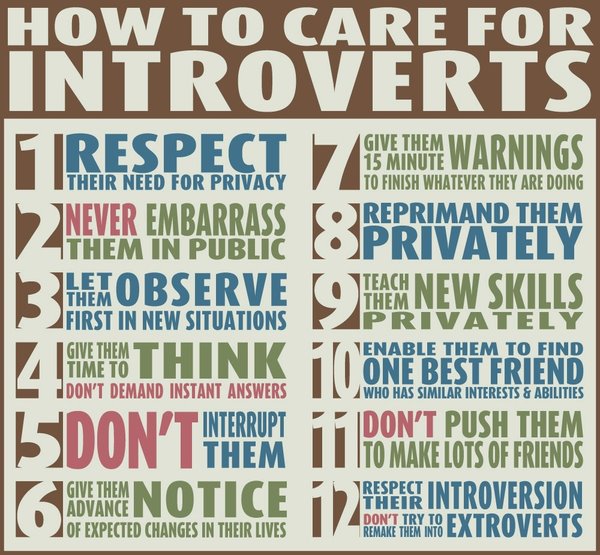
Remember, just like all the other stages of development, this ‘age of fear’ won’t last forever. Staying connected with your child and keeping the communication lines open through the ages and stages of development will help to ease their way as well as keeping your relationship strong and healthy.
Related posts:
Toddlers, Tantrums, and Time-Ins, Oh My!
Testing the Boundaries~What’s A Parent To Do?
To a Toddler Sharing is a 4 Letter Word~MINE!
Babes and Boundaries~A Gentle Parenting Perspective
Your Baby isn’t Trying to Annoy You; He’s Trying to Communicate!
Award-winnning author, L.R.Knost, is the founder and director of the children's rights advocacy and family consulting group, Little Hearts/Gentle Parenting Resources, and Editor-in-Chief of Holistic Parenting Magazine. Books by L.R.Knost include Whispers Through Time: Communication Through the Ages and Stages of Childhood ; Two Thousand Kisses a Day: Gentle Parenting Through the Ages and Stages ; The Gentle Parent: Positive, Practical, Effective Discipline ; and Jesus, the Gentle Parent: Gentle Christian Parenting the first four books in the Little Hearts Handbook gentle parenting series, and children’s picture books Petey’s Listening Ears and the soon-to-be-released Grumpykins series.
Bubble-Wrapped Kids? You bet!
[By L.R.Knost, author of Two Thousand Kisses a Day: Gentle Parenting Through the Ages and Stages now available on Amazon and through other major retailers.]
There is a lot of debate in the blogosphere about Helicopter Parenting and Bubble-Wrapped or Cotton-Wool Kids. I make no apologies for protecting my children. They say crime is down. Maybe per capita it is overall down. Maybe there are less arrests or convictions or whatever. Or maybe there is less shoplifting and littering and other non-violent crimes. Or maybe ‘they’ are wrong. I don’t know, and I don’t care.
Walk into a Wal-Mart and look at the wall of missing children, and you’ll see new faces nearly every day. Turn on the news, and you’re almost guaranteed to hear about a new heinous crime against a child. Misspell something on Google, and the sites that will appear in your search results will sicken you.
But if none of that were true, I’d still be the protective parent that I am. I’d still be that parent because of one sweet little local girl who was lost forever to a fiend. When I hear the name Jessica Lunsford, my heart shivers to a blood-curdling stop for a brief moment, and I have to catch my breath.
I remember the days after she went missing. I remember praying for her safety, praying for her family, praying for the rescuers and volunteers who were searching day and night for her. I remember checking for news updates multiple times a day, a silent prayer in my heart, begging, “Please, God, please.”
And the whole time I was praying, the whole time rescuers, family, friends, volunteers were searching, she was mere yards from her home being kept in a closet by a depraved monster who abused her and then buried her alive.
So, yes, I do guard my children closely. Outside play is free, muddy, messy, regular…and supervised. Bike riding is a family activity. Public bathroom trips are on the buddy-system. Sleepovers are almost exclusively at our house.
My children are homeschooled, but the oldest two started out in public school. For those few years, I drove them to and from school. I chaperoned field trips. I volunteered as a teacher’s aid.
There is more history to my journey, of course. There are happenings in my childhood I won’t share. There are people in my past who did what they should not.
 And there are other things that led me here, to this place of mama lioness guarding her young fiercely, to this 5’1” person who could and would take on the most ferocious of threats to protect her children, to this gentle mother who will face the vileness of the world fearlessly and boldly to guard her little ones’ hearts, minds, and bodies. There is more, so much more I have seen and heard and experienced, but that will remain unsaid.
I will not apologize for protecting my children, no matter what the newest label or theory or study shows. My children are free to climb trees, hang from monkey bars, and play king-of-the-mountain on huge dirt mounds. But they aren’t free to hang out at the mall alone. They can scavenge their daddy’s workshop for scrap wood and other ‘treasures’ and use his tools to build…well, whatever their incredible imaginations come up with! But they can’t walk to the store by themselves. They can troll the beach for shells and explore the rocky inlet for sand dollars and sea urchin. But they aren’t allowed to surf the internet without supervision.
Freedom to explore. Freedom to grow. Freedom to discover. Freedom to become who they are meant to be. All within the boundaries of parental guidance and protection. That is how it is in our home. And our home is truly a happy and safe place to be.
Related posts:
The Measure of Success~Chinese Parents and French Parents Can’t BOTH Be Superior!
Tots to Teens~Communication Through the Ages and Stages
Babes and Boundaries~A Gentle Parenting Perspective
Into the Looking Glass~Teens and Self-Esteem
Award-winnning author, L.R.Knost, is the founder and director of the children's rights advocacy and family consulting group, Little Hearts/Gentle Parenting Resources, and Editor-in-Chief of Holistic Parenting Magazine. Books by L.R.Knost include Whispers Through Time: Communication Through the Ages and Stages of Childhood ; Two Thousand Kisses a Day: Gentle Parenting Through the Ages and Stages ; The Gentle Parent: Positive, Practical, Effective Discipline ; and Jesus, the Gentle Parent: Gentle Christian Parenting the first four books in the Little Hearts Handbook gentle parenting series, and children’s picture books Petey’s Listening Ears and the soon-to-be-released Grumpykins series.
To a Toddler Sharing is a 4 Letter Word~MINE!
[Reprinted from Two Thousand Kisses a Day: Gentle Parenting Through the Ages and Stages by L.R.Knost. Whispers Through Time: Communication Through the Ages and Stages of Childhood and The Gentle Parent: Positive, Practical, Effective Discipline also now available on Amazon and through other major retailers.]
 Almost from the moment a baby is born, parents teach them not to share. “No, no, sweetie. That’s mommy’s” and “That’s daddy’s, not yours” accompanied by the removal of whatever the forbidden item is are daily realities for little ones. This is unavoidable, of course, since bacteria-ridden keys don’t belong in little mouths and iphones don’t work well when soaked in drool.
But the challenge comes when our little ‘reflectors’ are expected to share their toys with anyone and everyone who takes a liking to them. (Keep in mind that “their toys” as defined by a toddler are anything they own, are playing with, want to play with, don’t want to play with but want to remain available, etc.) It’s fully acceptable for us adults to not share our ‘toys’ with others, though. How often do we invite friends over and hand them the keys to our car? And yet we get to choose our own friends, do the inviting, and we have adult reasoning skills and judgment in place…things small children don’t have control over or access to!
The primary learning mode for little ones is imitation, but still we expect them to somehow have the cognitive maturity to learn to share despite their parents not sharing their ‘toys’ with them and despite seeing their parents not sharing their ‘toys’ with their own friends.
On top of that, we’re expecting them to grasp some pretty intricate and tricky relational nuances. What does ‘being a good friend’ entail? Why is someone taking something I want an acceptable part of friendship? If they can take what I want, why can’t I take what they want?
And, to round off the difficulty, ownership is an advanced, abstract concept and sharing is even more so. The difference between sharing and giving away forever or between someone borrowing your things and someone stealing from you is rather nebulous in the mind of a child. Now add in a complete inability to grasp time concepts (They get my toy for a minute? How long is a minute? When mommy tells me ‘just a minute’ when she’s on the phone it seems like forever before she’s done!) and to understand other abstract concepts such as permanence, and you can see the murky waters tiny people are expected to navigate when it comes to understanding sharing!
Obviously, little ones need help overcoming all of these obstacles. Punishing them, calling them selfish brats, forcing them to share, etc. are all counterproductive, not to mention damaging to the very relationship that is pivotal to eventual understanding of the concept of sharing. Going back to that primary learning mode of imitation, the key to teaching a child to share lies in the trust relationship being built by gentle, responsive parenting:
1.) When a child is secure in their relationship with their parents, when they know they will be heard, when they trust that their needs will be met quickly and consistently, much of the impetus behind the refusal to share is removed simply because the child isn’t living in a constant state of ‘fight or flight’ response. (This is not to say they will share freely, no matter how gentle the parenting. The afore mentioned obstacles are still in play, and your little ones are still human. What it does mean is that some of the impediments to sharing are removed and the stage is set for learning.)
2.) Within the context of the parent/child relationship, be mindful of how often you say ‘no’ or ‘mine’ and try to offer alternatives in the moment to model sharing.
3.) Be aware of the fact that your child isn’t choosing their own friends at this point and neither they nor their little playmates are skilled socially yet. Stay nearby and in tune with your little one so you can step in and help them deal with any sharing difficulties such as snatching or tug-o-war with a toy before they escalate.
4.) Use concrete words to guide your little one in social situations. For example, try “Use your gentle hands” instead of “Don’t snatch/hit/push.”
5.) Resist the embarrassed-adult-knee-jerk-reaction of scolding your child, snatching toys from them to give to another child, and punishing your child for a normal developmental stage. That kind of reaction not only doesn’t model self-control, but it also doesn’t model acceptable social behavior, which is exactly what you’re upset about your child not displaying!
6.) Prepare for playdates by putting away any treasured toys such as special lovies or new toys that you know your little one will have trouble sharing. Honoring their feelings about these few special things will help them to feel more comfortable sharing their other toys because you are showing them in a concrete manner that you will help them to protect and preserve the things that matter to them.
7.) Play sharing games with your child daily to practice this advanced skill. When she says “Mine!” respond by smiling, picking up something of yours you don’t mind her playing with, and saying, “This is mine. I’ll share!” and hand it to her. Often little ones will start running around picking up their toys and bringing them to you to ‘share’ and wait for it to be reciprocated, resulting in a back and forth, back and forth sharing game that taps into another excellent learning mode for children…play!
Above all, keep in mind that sharing is a learned skill and it will take time for your  small one to grow into a socially skilled little butterfly. Creating an atmosphere of trust, modeling sharing, and honoring their feelings will surround them with a safe environment in which they can develop the skills needed to become the most treasured of friends!
Related posts:
Toddlers, Tantrums, and Time-Ins, Oh My!
Testing the Boundaries~What’s A Parent To Do?
Babes and Boundaries~A Gentle Parenting Perspective
Your Baby isn’t Trying to Annoy You; He’s Trying to Communicate!
Award-winnning author, L.R.Knost, is the founder and director of the children's rights advocacy and family consulting group, Little Hearts/Gentle Parenting Resources, and Editor-in-Chief of Holistic Parenting Magazine. Books by L.R.Knost include Whispers Through Time: Communication Through the Ages and Stages of Childhood ; Two Thousand Kisses a Day: Gentle Parenting Through the Ages and Stages ; The Gentle Parent: Positive, Practical, Effective Discipline ; and Jesus, the Gentle Parent: Gentle Christian Parenting the first four books in the Little Hearts Handbook gentle parenting series, and children’s picture books Petey’s Listening Ears and the soon-to-be-released Grumpykins series.
Easter Eggs, an Empty Tomb, and an Exploding Dishwasher

Chocolate? What chocolate?
Life with kids is messy. Just ask God. He’s got a whole planet of them, and the scrapes they get themselves into are the stuff of legends, literally! Luckily for us, He’s the best. parent. ever.
That’s one of the things I like best about Easter, celebrating the Original Gentle Parent, the Author of Intentional Parenting, Unconditional Love in Person, and I love sharing and implementing what I learn from His example.
I had a perfect opportunity to implement some of that gentle, intentional, unconditional parenting last night when I headed into the kitchen to color Easter eggs with a clingy, tired baby on one hip and an over-excited six-year-old dancing around my legs, only to find a tidal wave of sudsy bubbles exploding from every crevice of my dishwasher and covering my newly cleaned floor. My Renaissance Girl had used dishwashING liquid instead of dishwashER liquid…sigh.
Now, just to set the stage, we have a home church and, in anticipation of the extra family and friends we were expecting for the Easter service, I had spent the entire day cleaning and scrubbing and organizing and still had more cleaning and setting up to do as well as coloring eggs and settling little ones in bed for the night before filling Easter baskets.
So I stood there, staring at the billowing disaster and adding a slew of new tasks to my already too-long list, and winged a quick prayer up to my Role Model. Then I threw down a towel levee, plopped my little people down for a good old bubble romp, and grabbed my camera. Disaster-misaster, what we had was a fun Easter memory in the making!
That Old Rugged Cross on a lonely hill is a testimony to triumph…life conquering death, good conquering evil, hope conquering fear…justice served and grace given. And that Empty Tomb we celebrate isn’t about death. It’s about life…messy, muddled, mysterious, mistake-ridden life, the kind we live every day…even Easter!

Happy Easter!
Related posts:
Communication vs. Miscommunication
Playground Confessions~Look Who’s Talking!
The Measure of Success~Chinese Parents and French Parents Can’t BOTH Be Superior!
Award-winnning author, L.R.Knost, is the founder and director of the children's rights advocacy and family consulting group, Little Hearts/Gentle Parenting Resources, and Editor-in-Chief of Holistic Parenting Magazine. Books by L.R.Knost include Whispers Through Time: Communication Through the Ages and Stages of Childhood ; Two Thousand Kisses a Day: Gentle Parenting Through the Ages and Stages ; The Gentle Parent: Positive, Practical, Effective Discipline ; and Jesus, the Gentle Parent: Gentle Christian Parenting the first four books in the Little Hearts Handbook gentle parenting series, and children’s picture books Petey’s Listening Ears and the soon-to-be-released Grumpykins series.
Avenging Childhood~The Change Makers
As I drove out of my driveway this afternoon, I glanced up and saw The Avengers racing around my neighbor’s yard, intent on fighting crime (or each other or the dog or some dragonflies, lol). It made my heart so happy to see childhood…just real, everyday, the-way-children-through-the-ages-have-played kind of childhood at its most honest and robust and carefree. I jumped out of my van and proceeded to confirm my neighbor’s suspicions that I’m a little off my rocker by wildly waving my camera in the air and pointing at her adorable boys roughhousing, silently asking for permission to play paparazzi. She nodded, and the boys hammed it up for me for a few minutes, posing and posturing in their wonderful world of make-believe.
I climbed back into my van amidst my little girls’ giggles (pretty sure they were laughing more at me for taking pictures of the neighbors rather than laughing at the boys’ antics). As we headed off on our afternoon errands, I thought about how the world has changed, but children haven’t. Yes, over time the world will do its share of influencing or corrupting, as the case may be, but children are born children just like they have been since the beginning of time.
Every child is born a fresh, new, open book with pages and pages waiting to be filled.  Everything is new. Every day is an adventure. Every experience is an opportunity for discovery. Whether they’re boys or girls, whether they have average or advanced or impaired cognitive or motor abilities, whether they’re Asian or Caucasian, Black or Middle Eastern, Hispanic or (as a growing number are worldwide) a unique blend of races and ethnicities, they all start out the same…brand-new, innocent, precious beyond compare.
I am passionate about helping parents fill the first pages of their children’s lives with messages of gentle welcome, of needs met, of trust. I’m equally passionate about helping parents transition into later stages where they are simply there to offer guidance, support, and encouragement as their children begin filling the pages of their lives with their own choices, interests, and gifts.
I’ve heard it said that only those crazy enough to think they can change the world actually do change it. I honestly believe that changing the world starts at home with how we parent our children. Maybe my neighbor is right about me, after all. 🙂
*Book art via Anagram Bookshop*
Related posts:
Communication vs. Miscommunication
Playground Confessions~Look Who’s Talking!
The Measure of Success~Chinese Parents and French Parents Can’t BOTH Be Superior!
Award-winnning author, L.R.Knost, is the founder and director of the children's rights advocacy and family consulting group, Little Hearts/Gentle Parenting Resources, and Editor-in-Chief of Holistic Parenting Magazine. Books by L.R.Knost include Whispers Through Time: Communication Through the Ages and Stages of Childhood ; Two Thousand Kisses a Day: Gentle Parenting Through the Ages and Stages ; The Gentle Parent: Positive, Practical, Effective Discipline ; and Jesus, the Gentle Parent: Gentle Christian Parenting the first four books in the Little Hearts Handbook gentle parenting series, and children’s picture books Petey’s Listening Ears and the soon-to-be-released Grumpykins series.