
‘Myths and Facts About Night Wakings’ by Tracy Cassels, Ph.D. Candidate in Developmental Psychology – Friends of L.R.Knost Rock the Guest Posts while She Battles Cancer
When you hear of most people talk of night-wakings in infancy, there seems to be a fear that somehow if they aren’t stopped (usually by a parent), one will be looking at long-term problems that will follow your infant into childhood and beyond. It’s really rather dramatic, especially for something that is so biologically normal for infants. After all, they biologically expect to breastfeed and the fat content of our human milk is much lower than in other mammals, meaning our babies need to feed frequently to simply stay alive and grow. (This is why scheduled feeds with hours between are linked with a ‘failure to thrive’ condition in the short-term[1] and lower intelligence in the long-term[2].)
But what is the situation with respect to night wakings across infancy, toddlerhood, and childhood? At what point do frequent night wakings pose a problem that will follow a child long-term? Or is it simply a state like any other state?
 Myth: Your baby should be sleeping through by 3 months of age.
Fact: Night waking is normal for babies and toddlers.
I think we first need to be clear that night waking itself isn’t really the “problem”. The “problem” is that when younger children wake, they often require parental help to fall back asleep, and so parents view night wakings as a problem[3] despite them being biologically normal and not contrary to healthy development. We must also be clear that when people believe their baby or child “sleeps through the night”, they can only refer to the fact that they do not wake when or if their child wakes. Babies and children can wake and fall asleep on their own again (though not all will) and so parents simply have no idea how often (if at all) these babies are rousing during the night.
How normal is night waking? Well, in a longitudinal study looking at night wakings between birth and 3 years of age, the percentage of infants/children who did not signal their parents at night from 6 months to 3 years only rose from 29.58% to 37.94%[4]. At 3 years of age, 25.6% of toddlers were waking and signaling their parents 3 or more nights per week. And notably, none of these children suffered any clinical problems or sleep disorders.
Myth: If your baby wakes regularly into the night, they will continue to wake in the night until you stop it.
Fact: Early night waking does not predict later night wakings.
 What do I mean? Well, I mean that night waking in infancy does not predict night waking at later ages, at least based on a very comprehensive, longitudinal study out of Switzerland[5] and there are no studies I have found that counter this finding. In this particular study, which examined 493 children and their families, night wakings from 3 months of age onward actually rose consistently until age 4, when over half of the children were waking at least once per week and 22% were waking every night. These numbers then declined slightly until age 10, but even at age 10, over 20% of children were waking at least once per week and around 4% were waking nightly. Notably, night waking in infancy (< 1-2 years) was not predictive of night waking later, but later (> 1-2 years) night waking was associated with further night wakings. Now, what the authors do not measure, and acknowledge as a limitation, is how long the child wakes, the reason for waking, does the child require parental help, breastfeeding, etc.
Notably, night wakings were not associated with other sleep disturbances, such as bedtime resistance and sleep-onset problems (i.e., the ability to fall asleep relatively efficiently). This implies that they are distinct from other sleep behaviours that parents find problematic. Though only my opinion, my take is that these other behaviours reflect social or emotional issues (e.g., anxiety around sleep, stress) while night wakings are more physiological or biological in nature.
[Somewhat off topic but fascinatingly, they found that increases in bedsharing in the toddler years was associated with less bedtime resistance or sleep-onset problems, suggesting that children are yearning for contact and experiencing separation anxiety which bedsharing provides a “fix” to. The authors propose this as well as cohort effects found that children raised in an earlier time did not have the bedsharing rates later groups did and had much greater reported problems associated with bedtime resistance and sleep-onset problems.]
Myth: Night waking is a sign that something is wrong and you have to do something to fix it.
Fact: Night waking often reflects developmentally appropriate behaviour across all ages.
One of the highlights of the Swiss research mentioned above was the acknowledgement that night wakings may not be negative at all, but rather reflect the individual developmental stage of any child. As they so wonderfully put it,
[N]ight wakings must be understood in the context of cognitive, emotional, and physical changes that occur at different developmental stages. Some children may need parental proximity during the night as during the day depending on their developmental level, individual characteristics, and attachment behavior.[5]
In the toddler years, night wakings are often associated with children coming into bed with the parents as many toddlers are first put to sleep in their own room or bed. The degree of separation anxiety that toddlers feel can be great and they require the proximity to parents to help feel safe again[6], leading to night wakings and moving sleep locations. This same feeling of anxiety or security can come at all ages throughout childhood, though, and a child that still demonstrates this at 8 or 9 years of age is still in the developmentally normal range. There is also the issue of nighttime fears and nightmares which increase with age through childhood until a peak (often early childhood) then start to decrease again; these fears are considered cognitively, socially, and emotionally normal[7], but do result in night wakings that often require parental involvement. Then of course there are the reasons we all tend to wake at night (adults included): Going to the bathroom, too much on our mind, stress, etc. These things can affect children as well, especially school-age children who have to cope with school, evolving relationships with friends, possible stress in the household, and more.
***
Lots of people today worry that night wakings reflect a “problem” and that they need to deal with it or else they will face long-term sleep problems. Well, first let’s be clear that night wakings in infancy have no predictive power over later night wakings. So you can put that little myth to rest. Second, you can be sure that night wakings are entirely normal through toddlerhood and are not associated with any ill effects for your child. Not all children will experience them, but those that do are not experiencing anything problematic. And finally, many of the children who continue to wake do so for very normal, developmentally appropriate reasons; just as adults often wake at night too. There may be times when parents need to seek help about their child’s sleep, but these will often be due to more than just night wakings. Clusters of problems are what parents should be concerned with, not night wakings alone.
So the next time someone – anyone – tells you that you need to stop your child from waking in the night, you can – at the very least – smile, nod, and go ahead and do absolutely nothing. Without worry.
Tracy Cassels is the founder and primary writer for Evolutionary Parenting. She obtained her B.A. in Cognitive Science from the University of California, Berkeley and an M.A. in Clinical Psychology from the University of British Columbia. She is currently a Ph.D. Candidate in Developmental Psychology, also at the University of British Columbia, where she is studying how certain evolutionary factors affect children’s empathic behavior. She can also be found on Facebook here.
Related posts:
Parenting Through Cancer: Coping with Emotions
My Cancer Story, Part 1: The Diagnosis
 Award-winnning author, L.R.Knost, is the founder and director of the children's rights advocacy and family consulting group, Little Hearts/Gentle Parenting Resources, and Editor-in-Chief of Holistic Parenting Magazine. Books by L.R.Knost include Whispers Through Time: Communication Through the Ages and Stages of Childhood ; Two Thousand Kisses a Day: Gentle Parenting Through the Ages and Stages ; The Gentle Parent: Positive, Practical, Effective Discipline ; and Jesus, the Gentle Parent: Gentle Christian Parenting the first four books in the Little Hearts Handbook gentle parenting series, and children’s picture books Petey’s Listening Ears and the soon-to-be-released Grumpykins series.

‘Patience Doesn’t Feel Patient’ by Sarah Sprague – Friends of L.R.Knost Rock the Guest Posts while She Battles Cancer
 They say that bravery doesn’t feel brave or fearless because if you’re not afraid it is something other than bravery. I guess that patience is one of those things, as well.
From the outside it looks like calm and peace but from the inside it can feel more like the tested limits of self control.
Learning to be patient is learning how to separate what we feel from how we act. It is learning to accept our feelings while choosing to not act on them. It is learning to say to ourselves:
I can be angry without acting angry.
I can be impatient without acting impatient.
I can be upset without acting upset.
I can be hurt without acting hurt.
I can feel without acting on my feelings.
I can feel without reacting to what I feel.
When I choose to act patient I slow down. I speak more slowly than I normally would. I lower my volume and I pace my words so that they won’t rush together in an explosion of words that no one will understand and that will act as a precursor to yelling. There’s a rhythm to this patience that doesn’t feel patient. A slow rhythm. A careful spacing of words. A slowness to how my body moves as I make sure that no part of me will gain a momentum that will feel like hitting or grabbing or being anything other than soft and gentle.
- When my toddler hits again.
- When my seven year old is upset that he doesn’t understand his homework and is avoiding doing it instead of asking questions.
- When my four year old has snuck his safety scissors into the other room so that he can cut apart a travel pillow to see what is inside, and the entire world feels like it’s covered with tiny Styrofoam pellets.
- When the two-and-a-half gallon water dispenser has been opened by someone curious and it has flooded the kitchen.
- When my three year old fed the fish every container of fish food all at once and the twenty nine gallon aquarium needed to have all of its water cleaned and replaced at bedtime.
I slow down to try and run in quicksand. I go slow-motion like walking through an empty room with a strobe light. I try and move my body through a thickened air. And I try to slow every word down so that it comes with a peace and gentleness that doesn’t show any of the frustration that I feel.
I grasp at all of the excuses that my child doesn’t yet have the words to offer. I try and see what positive or curious motivations they might have, or what stresses may be driving them to this place. I try to wrap every part of my heart and brain around empathy and love.
He sits at the table fiddling with his pencil. Nothing has been done on his worksheet, not even his name. He has gotten up to do half a dozen things. I have to make dinner. I have to sweep the floors. I have to do all the things on my to-do list.
“Issac.. Can you please do your homework?” I ask.
“Okay.” He says. And he picks up his pencil and stares off into space.
I am feeling anything but patient. My daughter has not napped today and she claws at my knees to be picked up, asks to draw on his homework with his pencil, and wants no substitutes for this thing that she cannot have. So now I’m being screamed at. I tap at his worksheet and he tells me to help Keenie calm down. So I walk away to find her some playdoh so that we can work on his homework together.
I come back. Nothing’s been done.
Breathe. Slow down. Find the reasons. Seven hour days at school with fifteen minute recesses. Not nearly enough time to decompress after school. He’s having a hard time reconnecting to what he’s trying to do.
I move slowly, lay my hand on his shoulder as softly and gently as I can. On contact my own tense muscles relax. This is my child. My son. He is seven and I love him dearly.
I plant a kiss on his head, and sniff his hair the way I used to when he was tiny, when he was a toddler. It smells just like him.
My other hand comes down to his worksheet. I’m standing behind him, my body enveloping his. Supporting and soft and patient, not angry and looming. My finger pointing to where he needs to write his name. Slow voice. Quiet voice. “Isaac, what does this say?” I ask. Trying to get him to look at the worksheet long enough to begin writing.
He writes his name.
“Now what’s the next question?” I ask. Soft. Slow. Clear. Strong.
He doesn’t answer. He doesn’t move.
I tap the paper. His eyes move to where I’m pointing.
“Can you read this for me?” I ask. He reads the question out loud.
“Do you understand what the question is asking?” I ask.
The dam breaks. He doesn’t understand. He screeches frustration and tells me that he didn’t understand in class.
My frustration is gone. I understand now. We go over what he can do if he doesn’t understand something in class. I ask him if he wants me to help him figure out how he can answer the questions or if he wants me to write a note on the top so that his teachers will know he needs more help with this topic. He chooses to have me try and show him how to work out the answers.
I sit down next to him. He’s fully engaged now.
Patience did not feel patient at first. But then. At the end of it, when I’ve responded well? When the crisis is past. When the messes have been cleaned up? When I’ve helped my seven year old slow down to re-focus and understand what he refuses to understand? When I’ve had self control and when I have acted patient?
That is when patience feels patient. When we’re past the thing that has me pulling my hair out. When we’re past the thing that has me wanting to move faster and raise my voice. When we’re past the thing that has me wanting to throw a tantrum all of my own.
That.. Is when I feel patient. Radiant. Powerful.
And it takes my breath away.
Sarah Sprague, creator of the ‘Wait-It-Out’ gentle sleep learning method (WIO), writes at Nurshable: Joy in Gentle Parenting and can be found on Facebook at Nurshable.
Related posts:
My Cancer Story, Part 1: The Diagnosis
Award-winnning author, L.R.Knost, is the founder and director of the children's rights advocacy and family consulting group, Little Hearts/Gentle Parenting Resources, and Editor-in-Chief of Holistic Parenting Magazine. Books by L.R.Knost include Whispers Through Time: Communication Through the Ages and Stages of Childhood ; Two Thousand Kisses a Day: Gentle Parenting Through the Ages and Stages ; The Gentle Parent: Positive, Practical, Effective Discipline ; and Jesus, the Gentle Parent: Gentle Christian Parenting the first four books in the Little Hearts Handbook gentle parenting series, and children’s picture books Petey’s Listening Ears and the soon-to-be-released Grumpykins series.
‘The Myth of Baby Sleep Regressions: What’s Really Happening to Your Baby’s Sleep?’ by Pinky McKay – Friends of L.R.Knost Rock the Guest Posts While She Battles Cancer
 The 4 month sleep regression, the 12 month sleep regression, the 18 month sleep regression – what is happening?
Of course, any time your baby’s sleep suddenly seems to go pear shaped , you wonder what am I doing wrong? Having a neat little term like ‘sleep regression’ gets you off the hook – it’s not you, it’s your baby. It’s a sleep regression. It’s normal and common and it will pass.
The term ‘sleep regression’ sounds more helpful than the patronising label ‘accidental parenting’ which implies you have done something to create your wakeful baby but you are such a half-wit you didn’t even realize you were doing something ‘wrong’. It sounds much smarter too and even a little bit intellectual, as though you have done your homework about infant sleep.
But here’s the thing: your baby isn’t having a ‘regression’. Sleep isn’t a milestone – even though it certainly feels like an achievement when your baby starts snoozing for several hours at a stretch. By the way, ‘all night’ in infant sleep studies means five hours sleep in a row –not eight hours like an adult or twelve hours like some baby books will tell you. The real, measurable, important milestones that signal your baby’s actual development can influence your baby’s sleep, or lack of it. So, when your baby, who has been sleeping in peaceful blocks, suddenly starts waking more frequently, it usually means he is approaching a real developmental milestone – he is not ‘regressing’, he is ‘progressing.’
Developmental milestones can be physical (rolling, crawling, cruising, walking), emotional (separation anxiety) and neurological. Neurological milestones are outlined in ‘The Wonder Weeks’ , a book by Dutch researchers, psychologists Franz Plooij and Hetty Van Der Rit , who observed many children in their homes over a number of years. They describe the ‘wonder weeks’ as critical periods of development that change the baby’s perception of his world. For instance, at 26 weeks, babies start to perceive distance. This means that as you walk away, your baby is now more aware of the distance that separates you and he will yell at you because the increasing distance between you and him is confusing and a bit scary.
As babies approach any new developmental phase, their perception of the world changes so, although this can be just a blip on the radar for some babies, more sensitive babies will need extra reassurance and can become quite clingy or generally unsettled at these times.
Because babies process information during their sleep – circulation to the brain almost doubles during REM sleep – it’s perfectly normal for them to wake more often as they are approaching new milestones. For instance, at around four months (the four month sleep ‘regression’ that everyone is talking about), babies are becoming much more aware of the world – they are babbling (this is the beginning of language acquisition), exploring things with their mouth (soon that will include their feet too as they suck their toes), they are recognizing familiar people (and becoming anxious around strangers – separation anxiety is kicking in), many babies are starting to roll over so they wake because they have unintentionally rolled onto their belly and this has woken them. They are confused and upset because they really wanted to be sleeping but that tiny brain processing information has resulted in some extra ‘practice’ of their new skill. All of this adds up to a very busy little brain that finds it difficult to switch off. And, as well as often having difficulty getting to sleep in the first place or resettling after being woken by their busy brains and bodies, when he wakes, confused, your baby will call for help from the most important person in his world – you.
Of course at any time if your baby suddenly becomes unsettled or wakeful, it’s important to check that there isn’t a medical reason for this or an impending illness such as sore ears or a urinary tract infection (babies generally wake when they wee if they have a UTI because it hurts), or if your baby has recently started family foods she isn’t upset by food sensitivities.
Once you have ruled out illness as a reason for sudden changes in your baby’s sleep patterns, consider your baby’s development: what new skills is your baby learning? Is she a bit more clingy during her awake times? Does she seem more sensitive right now? And try to see her wakefulness as a positive – she is not regressing, she is progressing. She is learning and developing in leaps and bounds. She isn’t waking because you have done anything wrong. You aren’t encouraging ‘bad habits’ you are helping your baby feel secure as she grows through these intense developmental stages. You don’t have to justify your baby’s behavior with fancy labels or reasons for her waking (except perhaps, to yourself if it makes you feel better).
The good news is that, as your baby masters each new milestone, there will be spells of sound sleep again – until the next developmental leap!
Pinky McKay is an International Board Certified Lactation Consultant and best selling author of Sleeping Like a Baby, 100 Ways to Calm the Crying, Parenting By Heart and Toddler Tactics. For more baby sleep tips, check out her bundle – Sleeping Like a Baby plus the recording package of interviews by leading international sleep researchers ‘The Truth About Infant Sleep – Science, Wisdom and Gentle Solutions’
Related posts:
My Cancer Story, Part 1: The Diagnosis
Award-winnning author, L.R.Knost, is the founder and director of the children's rights advocacy and family consulting group, Little Hearts/Gentle Parenting Resources, and Editor-in-Chief of Holistic Parenting Magazine. Books by L.R.Knost include Whispers Through Time: Communication Through the Ages and Stages of Childhood ; Two Thousand Kisses a Day: Gentle Parenting Through the Ages and Stages ; The Gentle Parent: Positive, Practical, Effective Discipline ; and Jesus, the Gentle Parent: Gentle Christian Parenting the first four books in the Little Hearts Handbook gentle parenting series, and children’s picture books Petey’s Listening Ears and the soon-to-be-released Grumpykins series.
Did Jesus have a Temper Tantrum?
[Excerpt reprinted from Jesus, the Gentle Parent: Gentle Christian Parenting by L.R.Knost. Two Thousand Kisses a Day: Gentle Parenting Through the Ages and Stages; Whispers Through Time: Communication Through the Ages and Stages of Childhood; and The Gentle Parent: Positive, Practical, Effective Discipline by L.R.Knost also available on Amazon and through other major retailers.]
~~~~~~~~~~~~~~~~~~~~~
 “Jesus entered the temple courts and drove out all who were buying and selling there. He overturned the tables of the money changers and the benches of those selling doves. “It is written,” he said to them, “‘My house will be called a house of prayer but you are making it a den of robbers.’”
Matthew 21:12-13
Temper tantrum: (n.) a loss of mental balance or composure, esp. an outburst of anger or irritation
It may seem a bit disrespectful to label Jesus’ takedown in the temple courtyard as a temper tantrum, but according to the dictionary definition of a tantrum, that would be an accurate designation. He acted out his overwhelming emotions by flipping over tables and throwing chairs and chasing people away in a God-sized, epic tantrum that must have shocked the religious to their core and rocked the pharisaical back on their heels.
So what’s the deal? Are temper tantrums signs of a child’s sinful, selfish nature, as the child-training set are so quick to accuse, or are they normal expressions of overwhelming emotions? Let’s see what the child-trainers have to say:
“A temper tantrum is an absolute rejection of parental authority. Parents should isolate the child (with a promise of consequences), then follow through with chastisement [spanking] after the child settles down.” (Gary Ezzo, Growing Kid’s God’s Way)
“…tantrums are a form of challenging behavior that can be eliminated by one or more appropriate spankings.(p. 108)” (Dr. James Dobson, The New Dare to Discipline)
“A seven-month-old boy had, upon failing to get his way, stiffened, clenched his fists, bared his toothless gums and called down damnation on the whole place. At a time like that, the angry expression on a baby’s face can resemble that of one instigating a riot. The young mother, wanting to do the right thing, stood there in helpless consternation, apologetically shrugged her shoulders and said, “What can I do?” My incredulous nine-year-old whipped back, “Switch him.” The mother responded, “I can’t, he’s too little.” With the wisdom of a veteran who had been on the little end of the switch, my daughter answered, “If he is old enough to pitch a fit, he is old enough to be spanked.(p. 79)” (Michael Pearl, To Train Up a Child)
“If your child is still angry, it’s time for another round. ‘Daddy has spanked you, but you are not sweet enough yet. We are going to have to go back upstairs for another spanking.’”(Tedd Tripp, Shepherding a Child’s Heart)
So, what do you think, parents? Is acting out of overwhelming emotions a sin that must be punished as the child-trainers claim or is it normal human behavior? Is there even such a thing as normal human behavior, or is human behavior itself sinful by its very nature? Is having overwhelming emotions, in and of itself, a sin?
Sin, Biblically speaking, is acting outside of God’s nature. Since Jesus is God in the flesh, he was clearly acting within God’s nature at all times, even though he was also fully human. So, Jesus’ actions and his human behaviors, his normal human behaviors, all fell within the boundaries of God’s nature and therefore were and are not sinful.
Let’s go back to Jesus and breakdown the takedown in the temple. He was angry. He toppled tables. He threw things. He chased people away. But Jesus was and is sinless, so clearly being angry, being overwhelmed by big emotions, and acting on those emotions are not sins, in and of themselves.
When does acting on emotions become sinful, then? The answer lies in Ephesians 4:26-27, “In your anger do not sin: Do not let the sun go down while you are still angry, and do not give the devil a foothold.” Note that it doesn’t say, “Getting angry is a sin.”
Emotions can lead to sin when they remain unsettled, are left to burrow deeply into our hearts and take root, and when we subsequently respond with spite, bitterness, vengeance, or rage.
As parents, then, how can we help our children when they are overwhelmed by their emotions, when they tantrum and cry and act out their big feelings? Does it make sense to expect them to cope with their big emotions alone or to suppress their emotions so they remain unsettled?
Of course not. Our children need us to parent them, not punish them.
“God is our refuge and strength, an ever-present help in times of trouble.”
(Psalm 46:1b)
Just as God is “our refuge and strength” and “an ever-present help” that is what we need to be for our children, to reflect the heart of our Father to our own little ones. We can help them to process their emotions. We can work with them to resolve their problems. And we can equip them with the life skills they’ll need to handle their emotions on their own when they grow into adulthood.
As you read on, remind yourself that having emotions is not a sin and needing help processing those emotions is a normal part of childhood:
When a little person feels frustrated, overwhelmed, or just plain old out-of-sorts (read: tantrum time!), it’s tempting for parents to focus on correction rather than connection. But when children are intensely stressed, the prefrontal cortex of the brain, which in early childhood is an underdeveloped, mushy grey sponge waiting to be formed, is flooded with cortisol, the ‘stress hormone.’ The result is what is known as the fight-freeze-or-flight syndrome in which higher brain functions (learning, reason, self-control) are markedly hampered and lower brain functions (instinct, physical reactions) take over. This is an in-built survival mechanism that gradually comes under conscious control through years of growth in a safe and supportive environment. Interestingly, it is theorized that this underdeveloped ‘sponginess’ is why small children are able to learn new languages more quickly than older children and adults. They are, in a very literal way, absorbing information raw, unhampered by the processing and reason of a more mature brain.
Expecting young children to have the maturity and self-control to overcome this God-given survival instinct is unrealistic. Threatening, punishing, or even reasoning with them while their higher brain functions are suppressed is futile and actually just adds more stress to the situation (more stress = fuel on the tantrum-fire!).
What they really need is help…
- First, help coping with their big emotions
- Then, help reconnecting with their source of safety and security (you!)
- And last, help processing the problem that sent them into a maelstrom of emotion in the first place.
Punishing them, yelling at them, sending them to their room, or putting them in time-out disconnects them even further from their source of security and not only delays a resolution of the issue, but misses an opportunity to equip them with the tools they need to handle future problems.
This is where the Three C’s of gentle discipline come into play:
Connection:
- Remaining present and supportive until they are able to calm down enough to accept your help
- Drawing them close when they’re ready (time-in)
Communication:
- Validating their emotions by labeling them and empathizing (i.e. “You’re sad because we have to leave the park. I’m sad, too. The park is fun!”)
- Offering words to help them express their frustrations using reflective language (i.e. “It’s hard to do things we don’t like, isn’t it?”)
Cooperation:
- Helping them move on by redirecting their attention to the future (i.e. “When we get home we’re going to make a snack. Would you like grapes or bananas today?”)
- Modeling coping skills and self-control by calming your own reaction to their meltdown and helping them process their big emotions
These are all ways of reconnecting with your toddler or preschooler to help them successfully navigate their present difficulty as well as to cope with difficulties they’re confronted with in the future.
One effective tool for use in helping little ones cope with big emotions is a Calm-Me-Jar made from small, round, plastic bottles such as Aquapod water bottles. They are perfect for small hands to shake and manhandle to their heart’s content.
To make your own Calm-Me-Jar, fill up a plastic water bottle with warm water and basic craft glitter glue in whatever color you like. You can add some extra glitter and a drop of food coloring to customize your glitter jar to your child’s tastes, and then when you have the look you want, be sure to hot glue the top on to prevent spills.
When my little ones have meltdowns, or, if I can catch it, before they reach that point, I pull out one of the Calm-Me-Jars and shake it up and just let them hold it while I hold them (when they are ready to be held) and talk or sing quietly. When I feel their body relaxing and their breathing slow down, I might say something like, “It’s sad when we can’t have a toy, isn’t it?” or whatever else will reflect what they seem to be unable to express.
When an older preschooler or early elementary-aged child has a meltdown, or, again, before if I can catch it, I first connect, “I’m here. I can see you’re upset. How can I help?” and listen as they try to verbalize their feelings. If they’re having trouble with the words, instead of immediately supplying the words for them, I’ll offer them a Calm-Me-Jar and ask if they’d like to show me how they’re feeling. They will often shake the Calm-Me-Jar vigorously while jumping up and down and twisting all around, which is a great physical outlet for their intense feelings. I watch until I see their movements slowing and their breathing evening out, and when they’ve calmed just enough to hear me, I quietly talk them through the calming process, “Look at all that fairy dust bouncing around like crazy! I bet that’s how it feels inside when you’re so upset. Look at how it’s starting to slow down and settle to the bottom. If we breathe really slowly, we can feel ourselves settling like the fairy dust. Want to try it with me?” Then, if there are any behavior issues we need to address, we’ll work through those afterward when they’re calm, connected, and capable of interacting and understanding.
Here’s an example of how Calm-Me-Jars are helpful in ‘listening between the lines’ to my children’s behavior so I can meet them where they are and help them process their big feelings:
My five-year-old is a tiny girl with BIG emotions, and she really likes using Calm-Me-Jars to work through her feelings. We’ve put several together such as a silvery one she named Goodnight Moon, a light blue one she named Nemo Under the Sea, a pink one she named Hello Kitty Princess Ballerina, and a dark blue one she named Starry, Starry Night. When she is mad at one of her siblings, she’ll often bring me one of her Calm-Me-Jars (Goodnight Moon is a favorite in the evening!) and work out some of her upset physically by shaking the jar like crazy while she jumps up and down and tells me how mad she is. When she’s a bit calmer, we’ll have a little cuddle and watch the glitter settle while saying goodnight to the moon, all the furniture, and whatever other silliness we come up with until she’s calm. If there’s a discipline issue or she needs some help working things out with a sibling, we’ll work through it at that point because I know that’s when she can hear me and really process what I’m saying. If she chooses Starry, Starry Night we might sing Twinkle, Twinkle Little Star or step outside and see if there are any stars out yet. If she decides on Hello Kitty Princess Ballerina she’ll often dance her frustrations away while shaking her Calm-Me-Jar. And if she picks out Nemo Under the Sea we’ll ‘speak whale’ like Dory from Finding Nemo or we’ll make fishy faces at each other until we’re both giggling.
As you can see, my feisty little girl’s choice of Calm-Me-Jar shows me what she needs to do to work through her emotions of the moment, whether it’s to act things out physically in acceptable ways or to connect through song or through silliness.
The key is being in tune with your little one enough to understand their personality and work with it instead of against it. My five-year-old is spunky and silly, so having a long, serious talk would drive her crazy and accomplish nothing. We quickly decide together how she’ll approach whatever the problem was the next time she encounters it, and then she’s ready to move on, whereas when some of my older ones were little they really liked to talk things through (and still do!). My toddler, on the other hand, doesn’t have tantrums because that simply isn’t part of her own unique personality, but she’s still fascinated by her Calm-Me-Jar and loves to sit with me and watch the “pintess faywe dut” (“princess fairy dust”) glitter settle when she’s feeling a bit cranky or out-of-sorts.
Remember, there is no cure for tantrums because they are simply a normal result of a normal developmental stage of childhood. Trying to avoid tantrum triggers (tiredness, hunger, overstimulation, etc.) is always a good first step, along with remaining in-tune, responsive, and available, but when all else fails and a tantrum does occur, reacting with an adult tantrum is tantamount to throwing fuel on a toddler-tantrum-fire. So instead of losing it when your little one loses it, take an adult time-out, breathe deeply to gain control of your own emotions, and then grab the Three C’s of gentle discipline from your parenting toolbox and work with your child, not against them. (Two Thousand Kisses a Day: Gentle Parenting Through the Ages and Stages)
Reactors react to a crisis with a meltdown. Responders respond to a crisis with help. To raise a mature, stable adult, be a first responder, not a nuclear reactor!
“God is our refuge and our strength,
an ever-present help in times of trouble”
Psalm 46:1b
Related posts:
Stealing God’s Gift: Free Will is a Gift to be Nurtured, Not a Curse to be Broken
Spare the Rod: The Heart of the Matter
Jesus, the Gentle Parent: Gentle Christian Parenting
Tattered Tapestries: Weaving Trust Through the Chaos
Fear Doesn’t Lead to Faith: Becoming Your Child’s Safe Place
Where Did You Learn Love, Child?
Practical, Gentle, Effective Discipline
Award-winnning author, L.R.Knost, is the founder and director of the children's rights advocacy and family consulting group, Little Hearts/Gentle Parenting Resources, and Editor-in-Chief of Holistic Parenting Magazine. Books by L.R.Knost include Whispers Through Time: Communication Through the Ages and Stages of Childhood ; Two Thousand Kisses a Day: Gentle Parenting Through the Ages and Stages ; The Gentle Parent: Positive, Practical, Effective Discipline ; and Jesus, the Gentle Parent: Gentle Christian Parenting the first four books in the Little Hearts Handbook gentle parenting series, and children’s picture books Petey’s Listening Ears and the soon-to-be-released Grumpykins series.
Breastfeeding: Manna from God
[Excerpt reprinted from Jesus, the Gentle Parent: Gentle Christian Parenting by L.R.Knost. Two Thousand Kisses a Day: Gentle Parenting Through the Ages and Stages; Whispers Through Time: Communication Through the Ages and Stages of Childhood; and The Gentle Parent: Positive, Practical, Effective Discipline by L.R.Knost also available on Amazon and through other major retailers.]
~~~~~~~~~~~~~~
“But we proved to be gentle among you, as a nursing mother tenderly cares for her own children.”
1 Thessalonians 2:7
 Jesus’ mother, Mary, didn’t practice attachment parenting when raising little Jesus. The Bible does tell us that she breastfed Jesus, “Blessed is the mother who gave you birth and nursed you.” (Luke 11:27). The culture of the time tells us that she likely coslept with him in the small, one or two room house typical of that period and that she wore him close to her heart in the daylight hours in a wrap to keep him safe from the snakes and scorpions and other dangers that populated the region. So it is certain that she was a breastfeeding mama and almost certain that she was a cosleeping and babywearing mama.
But Mary didn’t practice attachment parenting as she was growing a tiny Savior. She simply parented Jesus in the naturally instinctive way that mothers have mothered their little ones since time began. Attachment parenting is merely a term coined much later to tie these natural parenting choices and others in with the modern research of psychologists like John Bowlby who found that the healthiest emotional and relational adults tended to have strong early attachments with a parent or primary caregiver.
The Bible reinforces those research findings by not just referring to breastfeeding as providing life-sustaining nutrition, but also as a source of comfort and connection, “For you will nurse and be satisfied at her comforting breasts.” (Isaiah 66:11)
God’s biological design for breastfeeding weaves a developing infant’s needs with a mother’s needs into a delicately synchronized dance, and even daddies get in on the dance! There is an inbuilt, biochemical response to the birth of a baby that affects both sexes in similar, though somewhat different ways. As the birth of a new baby nears, a mother’s oxytocin level, known as the ‘love hormone’ because of its ability to create warm feelings of safety and attachment, increases as part of the preparation for bringing a new life into the world and sustaining that life at her breast. Daddies also experience a rise in oxytocin, as well as an increase in estrogen, which results in their brains being pre-wired to love and protect their mate and offspring. Then, after birth and throughout the breastfeeding relationship, oxytocin levels in mamas and daddies remain elevated, rising and falling in rhythmic peaks and valleys in response to a baby’s ever-changing needs. This is no accident of nature. This is a beautiful biological design.
This lovely and perfect design also reveals itself in the balance of nutrients present in breastmilk. Breastmilk has the perfect composition of calories, nutrients, fats, and other components to ensure the optimal development of a growing infant. The composition of breastmilk shifts to accommodate growth spurts, sicknesses, and other needs throughout a mother and child’s nursing relationship. Interestingly, the ratios of each of the components change throughout the day to offer the most energy during the daylight hours and the highest concentrations of sleep-inducing nucleotides during nighttime feeding, so if a mama is pumping and storing breastmilk, it’s important to label the time of day the milk was pumped to avoid giving the more stimulating daytime milk at night!
Beyond the nutritional and bonding benefits of breastfeeding, there are also amazing health benefits to both mama and baby:
A reduction in the risk of SIDS, asthma, childhood leukemia, diabetes, gastroenteritis, otitis media (ear infections), LRTIs (pneumonia, bronchitis, etc), necrotizing enterocolitis, and obesity are just some of the protective benefits for babies. For mothers, breastfeeding has been correlated with a significant decrease in the risk of diseases such as breast cancer, ovarian cancer, diabetes, and heart disease to name just a few.
Additionally, the Journal of the American Academy of Pediatrics released a study in April of 2010 that concluded, “The United States incurs $13 billion in excess costs annually and suffers 911 preventable deaths per year because our breastfeeding rates fall far below medical recommendations.” Those numbers are only based on breastfeeding benefits for the first six months of life. The World Health Organization, American Academy of Pediatrics, Centers for Disease Control, and others recommend breastfeeding for the first two years of a child’s life. Imagine the tally if the researchers had looked at the lives lost and billions of dollars spent unnecessarily in a two year breastfeeding scenario instead of a six month scenario. (Two Thousand Kisses a Day: Gentle Parenting Through the Ages and Stages)
Some stumbling blocks in the breastfeeding relationship that mamas may encounter include the modern societal view of breasts as solely sexual objects which often leads those in public places, including many churches, to shame mothers into hiding in restrooms or vehicles or at the very least using covers that make breastfeeding far more difficult and clumsy than it needs to be. Biblically speaking, breasts are referred to half as often in reference to sexual relationships as they are in reference to the God-designed breastfeeding relationship between mothers and their little ones. Again, that is no accident!
Breastfeeding is not shameful and should not be hidden. As one of our current world leaders, Pope Francis, said during a 2014 baptism ceremony at the historic Sistine Chapel,
“Today the choir will sing, but the most beautiful choir of all is the choir of the infants who will make a noise. Some will cry because they are not comfortable or because they are hungry,” Francis said, according to Reuters. “If they are hungry, mothers, feed them, without thinking twice. Because they are the most important people here.”
He didn’t tell them to leave or to cover up or to make their babies wait. He tenderly told the young mothers to feed their babies when they’re hungry. End of story.
Another stumbling block to a healthy, full-term breastfeeding relationship is the increasingly prevalent diagnosis of low milk supply:
Even though mothers’ bodies are capable of miraculously growing a human being for nine months and bringing that precious new life into the world, those same life-giving bodies seem to be failing in ever-increasing numbers to provide life-giving nutrition to those precious babies because of issues with low milk supply.
Why is this happening? For some, it is certainly just pediatricians using formula-fed babies’ growth charts instead of breastfed babies’ charts or family and friends who believe that all babies should be chubby and content that lead new mothers to believe they have low supply, but there does appear to be an increasing number of babies legitimately labeled as failure-to-thrive with low milk supply determined to be the cause. (Two Thousand Kisses a Day: Gentle Parenting Through the Ages and Stages)
Often the low milk supply is caused by forcing babies to sleep alone and training them to sleep through the night. The fact is that babies aren’t biologically designed to sleep through the night. They are, though, biologically programmed to crave closeness with their mothers, and their proximity to and access to the breast throughout the night stimulates ongoing production of breastmilk, keeping up the mother’s supply naturally.As a simple matter of survival, it makes biological sense that God would build into babies a need to be near their primary source of safety, nutrition, and comfort:
Babies biologically should not sleep through the night. Not only is the deep sleep required to sleep through the night actually a recognized factor in SIDS (Sudden Infant Death Syndrome), but babies who sleep through the night are also not nursing to stimulate breastmilk production, thus their mother’s milk may begin to dry up. Clearly, that’s not a healthy biological design. (Two Thousand Kisses a Day: Gentle Parenting Through the Ages and Stages)
The bottom line is that breastfeeding is a biological norm created by God to meet a baby’s needs in the healthiest and most convenient way. That said, there are certainly times when a mother can’t breastfeed due to a medical condition, life circumstances, adoption, or other factors. In those cases mamas can still achieve a healthy attachment and strong, loving relationship and even boost their oxytocin ‘love hormone’ levels by holding their little ones close to their hearts during feeding, making eye contact and exchanging smiles and coos and giggles, kissing and nuzzling their babies’ fuzzy little heads, keeping their little ones close during the day in a baby wrap or sling, taking time out for a few periods of ‘kangaroo care’ each day, and meeting nighttime needs quickly, gently, and consistently. (end excerpt)
Related posts:
Ten Steps to Surviving the First Three Months with a Newborn
Love in the Time of Cosleeping
300+ Nicknames for Your Babykins…Doodlebug…Snugglebunny…
Babywearing Basics Resource Guide
Breastfeeding, Babywearing, and Bouncing Back into Shape after Baby
Jesus, the Gentle Parent: Gentle Christian Parenting
Tattered Tapestries: Weaving Trust Through the Chaos
Fear Doesn’t Lead to Faith: Becoming Your Child’s Safe Place
Where Did You Learn Love, Child?
Spare the Rod: The Heart of the Matter
Gentle Journeys: A Book Club for a New Generation
Award-winnning author, L.R.Knost, is the founder and director of the children's rights advocacy and family consulting group, Little Hearts/Gentle Parenting Resources, and Editor-in-Chief of Holistic Parenting Magazine. Books by L.R.Knost include Whispers Through Time: Communication Through the Ages and Stages of Childhood ; Two Thousand Kisses a Day: Gentle Parenting Through the Ages and Stages ; The Gentle Parent: Positive, Practical, Effective Discipline ; and Jesus, the Gentle Parent: Gentle Christian Parenting the first four books in the Little Hearts Handbook gentle parenting series, and children’s picture books Petey’s Listening Ears and the soon-to-be-released Grumpykins series.
Toddlers, Tantrums, and Time-in’s, Oh my!
[Reprinted from The Gentle Parent: Positive, Practical, Effective Discipline by L.R.Knost. Whispers Through Time: Communication Through the Ages and Stages of Childhood and Two Thousand Kisses a Day: Gentle Parenting Through the Ages and Stages also available on Amazon and through other major retailers.]
~~~~~~~~~~~~~~~~~~~~~
 When a little person feels frustrated, overwhelmed, or just plain old out-of-sorts (read: tantrum time!) it’s tempting for parents to focus on correction rather than connection. But when children are intensely stressed, the prefrontal cortex of the brain, which in early childhood is an underdeveloped, mushy grey sponge waiting to be formed, is flooded with cortisol, the ‘stress hormone.’ The result is what is known as the fight-freeze-or-flight syndrome in which higher brain functions (learning, reason, self-control) are markedly hampered and lower brain functions (instinct, physical reactions) take over. This is an in-built survival mechanism that gradually comes under conscious control through years of growth in a safe and supportive environment. Interestingly, it is theorized that this underdeveloped ‘sponginess’ is why small children are able to learn new languages more quickly than older children and adults. They are, in a very literal way, absorbing information raw, unhampered by the processing and reason of a more mature brain.
Expecting young children to have the maturity and self-control to overcome this God-given survival instinct is unrealistic. Threatening, punishing, or even reasoning with them while their higher brain functions are suppressed is futile and actually just adds more stress to the situation (more stress = fuel on the tantrum-fire!).
What they really need is help…
- First, help coping with their big emotions
- Then, help reconnecting with their source of safety and security (you!)
- And last, help processing the problem that sent them into a maelstrom of emotion in the first place.
Punishing them, yelling at them, sending them to their room, or putting them in time-out disconnects them even further from their source of security and not only delays a resolution of the issue, but misses an opportunity to equip them with the tools they need to handle future problems.
This is where the Three C’s of gentle discipline come into play.
Connection:
- Remaining present and supportive until they are able to calm down enough to accept your help
- Drawing them close when they’re ready (time-in)
Communication:
- Validating their emotions by labeling them and empathizing (i.e. “You’re sad because we have to leave the park. I’m sad, too. The park is fun!”)
- Offering words to help them express their frustrations using reflective language (i.e. “It’s hard to do things we don’t like, isn’t it?”)
Cooperation:
- Helping them move on by redirecting their attention to the future (i.e. “When we get home we’re going to make a snack. Would you like grapes or bananas today?”)
- Modeling coping skills and self-control by calming your own reaction to their meltdown and helping them process their big emotions
These are all ways of reconnecting with your toddler or preschooler to help them successfully navigate their present difficulty as well as to cope with difficulties they’re confronted with in the future.
One effective tool for use in helping little ones cope with big emotions is a Calm-Me-Jar made from small, round, plastic bottles such as AquapodTM water bottles. They are perfect for small hands to shake and manhandle to their heart’s content.
To make your own Calm-Me-Jar, fill up a plastic water bottle with warm water and basic craft glitter glue in whatever color you like. You can add some extra glitter and a drop of food coloring to customize your glitter jar to your child’s tastes, and then when you have the look you want, be sure to hot glue the top on to prevent spills.
When my little ones have meltdowns, or, if I can catch it, before they reach that point, I pull out one of the Calm-Me-Jars and shake it up and just let them hold it while I hold them (when they are ready to be held) and talk or sing quietly. When I feel their body relaxing and their breathing slow down, I might say something like, “It’s sad when we can’t have a toy, isn’t it?” or whatever else will reflect what they seem to be unable to express.
When an older preschooler or early elementary-aged child has a meltdown, or, again, before if I can catch it, I first connect, “I’m here. I can see you’re upset. How can I help?” and listen as they try to verbalize their feelings. If they’re having trouble with the words, instead of immediately supplying the words for them, I’ll offer them a Calm-Me-Jar and ask if they’d like to show me how they’re feeling. They will often shake the Calm-Me-Jar vigorously while jumping up and down and twisting all around, which is a great physical outlet for their intense feelings. I watch until I see their movements slowing and their breathing evening out, and when they’ve calmed just enough to hear me, I quietly talk them through the calming process, “Look at all that fairy dust bouncing around like crazy! I bet that’s how it feels inside when you’re so upset. Look at how it’s starting to slow down and settle to the bottom. If we breathe really slowly, we can feel ourselves settling like the fairy dust. Want to try it with me?” Then, if there are any behavior issues we need to address, we’ll work through those afterward when they’re calm, connected, and capable of interacting and understanding.
Here’s an example of how Calm-Me-Jars are helpful in ‘listening between the lines’ to my children’s behavior so I can meet them where they are and help them process their big feelings:
My five-year-old is a tiny girl with BIG emotions, and she really likes using Calm-Me-Jars to work through her feelings. We’ve put several together such as a silvery one she named Goodnight Moon, a light blue one she named Nemo Under the Sea, a pink one she named Hello Kitty Princess Ballerina, and a dark blue one she named Starry, Starry Night. When she is mad at one of her siblings, she’ll often bring me one of her Calm-Me-Jars (Goodnight Moon is a favorite in the evening!) and work out some of her upset physically by shaking the jar like crazy while she jumps up and down and tells me how mad she is. When she’s a bit calmer, we’ll have a little cuddle and watch the glitter settle while saying goodnight to the moon, all the furniture, and whatever other silliness we come up with until she’s calm. If there’s a discipline issue or she needs some help working things out with a sibling, we’ll work through it at that point because I know that’s when she can hear me and really process what I’m saying. If she chooses Starry, Starry Night we might sing Twinkle, Twinkle Little Star or step outside and see if there are any stars out yet. If she decides on Hello Kitty Princess Ballerina she’ll often dance her frustrations away while shaking her Calm-Me-Jar. And if she picks out Nemo Under the Sea we’ll ‘speak whale’ like Dory from Finding Nemo or we’ll make fishy faces at each other until we’re both giggling.
As you can see, my feisty little girl’s choice of Calm-Me-Jar shows me what she needs to do to work through her emotions of the moment, whether it’s to act things out physically in acceptable ways or to connect through song or through silliness.
The key is being in tune with your little one enough to understand their personality and work with it instead of against it. My five-year-old is spunky and silly, so having a long, serious talk would drive her crazy and accomplish nothing. We quickly decide together how she’ll approach whatever the problem was the next time she encounters it, and then she’s ready to move on, whereas when some of my older ones were little they really liked to talk things through (and still do!). My toddler, on the other hand, doesn’t have tantrums because that simply isn’t part of her own unique personality, but she’s still fascinated by her Calm-Me-Jar and loves to sit with me and watch the “pintess faywe dut” (“princess fairy dust”) glitter settle when she’s feeling a bit cranky or out-of-sorts.
Remember, there is no cure for tantrums because they are simply a normal result of a normal developmental stage of childhood. Trying to avoid tantrum triggers (tiredness, hunger, overstimulation, etc.) is always a good first step, along with remaining in-tune, responsive, and available, but when all else fails and a tantrum does occur, reacting with an adult tantrum is tantamount to throwing fuel on a toddler-tantrum-fire. So instead of losing it when your little one loses it, take an adult time-out, breathe deeply to gain control of your own emotions, and then grab the Three C’s of gentle discipline from your parenting toolbox and work with your child, not against them.
“Reactors react to a crisis with a meltdown. Responders respond to a crisis with help. To raise a mature, stable adult, be a first responder, not a nuclear reactor!” ~ L.R.Knost
Related posts:
The Gift of a Strong-Willed Child
Backtalk is Communication…LISTEN
When Children Act Out ~ Reflecting Our Emotions
Bridge Over Troubled Waters~Parenting a ‘Problem’ Child
The Taming of the Tantrum: A Toddler’s Perspective
Practical, Gentle, Effective Discipline
200 Ways to Bless Your Children with a Happy Childhood
When Children Hit~10 Tips for Parents
Award-winnning author, L.R.Knost, is the founder and director of the children's rights advocacy and family consulting group, Little Hearts/Gentle Parenting Resources, and Editor-in-Chief of Holistic Parenting Magazine. Books by L.R.Knost include Whispers Through Time: Communication Through the Ages and Stages of Childhood ; Two Thousand Kisses a Day: Gentle Parenting Through the Ages and Stages ; The Gentle Parent: Positive, Practical, Effective Discipline ; and Jesus, the Gentle Parent: Gentle Christian Parenting the first four books in the Little Hearts Handbook gentle parenting series, and children’s picture books Petey’s Listening Ears and the soon-to-be-released Grumpykins series.
Two Thousand Connection Points a Day: Attachment Parenting Beyond Infancy
[Reprinted from Two Thousand Kisses a Day: Gentle Parenting Through the Ages and Stages by L.R.Knost. Whispers Through Time: Communication Through the Ages and Stages of Childhood and The Gentle Parent: Positive, Practical, Effective Discipline also now available on Amazon and through other major retailers.]
~~~~~~~~~~~~~~~~~~~~~
From kicking and rolling and stretching to being lulled to sleep by the rhythmic cadence of a mama’s heartbeat, little ones spend the first months of their existence wrapped in a warm, dark, gently swaying cocoon, a life-giving embrace, the ultimate hug, readying themselves for their grand entrance to the world.
Then, in those first moments of life beyond the womb, when the muffled sounds of the outside world become clear and the muted lights become glaringly bright, a warm chest with the scent of life-sustaining milk and the sweet sound of a familiar heartbeat welcome the little one to the comfort and safety of a mama’s arms.
In the days, weeks, and months following, little fingers and toes are counted and kissed again and again and again. Soft cheeks are snuzzled and a fuzzy little head is nuzzled, and two thousand kisses a day seems a reasonable number to a mama’s heart overflowing with tenderness for this tiny new member of the family.
Then comes the rolling and sitting and crawling and walking, and soon the two thousand kisses dwindle to brief morning cuddles before a toddler is off to explore the world, healing kisses on boo-boos, and goodnight snuggles with a bedtime book.
Time passes and the little one grows in independence, getting up and dressed and ready on their own, grabbing their own band-aid for a scrape, and reading themselves to sleep. Gone are the snuzzles and nuzzles of infancy, and the two thousand kisses a day are simply sweet memories.
Growing independence, though, doesn’t have to mean growing separation. Humans were created to be relational beings. We may outgrow our dependency, but we never outgrow the need for community, interaction, appreciation, reassurance, and support.
Infants, children, and adults alike all share this life-long need for connection. While over time that need will also be met through friendships, business engagements, social interactions, and the like, family relationships are the steady and sure bedrock of secure connection and belonging that ground us and assure us that our needs will not go unmet even in the darkest of times.
Attachment parenting is often misconstrued to be simply about breastfeeding, babywearing, cosleeping, etc. But, while those are possible choices for creating and maintaining a secure parent/child connection in the early years, they are just a small sampling of the relationship-building choices that parents can make throughout their children’s lives.
As little ones outgrow the ‘two thousand kisses a day’ stage, parents can begin consciously creating ‘two thousand connection points a day’ to replace those tender expressions of love with age-appropriate expressions of appreciation and approval, love and support.
From responding empathetically to a preschooler’s whine, to paying attention to a seven-year-old when they tell their endless stories, to listening ‘between the lines’ to the angst of a teen, maintaining a secure parent/child connection beyond infancy is simply about meeting emotional needs consistently, intentionally, and relationally.
Creating two thousand connection points a day isn’t about quality time, and it isn’t even about the quantity of time spent with our children. It is, instead, about being there in the small moments, the moments that matter to our children, and consciously meeting with them right where they are. It is about…
- Simply smiling and letting our eyes light up with welcome when our children walk in the room
- Maintaining eye contact when our children talk to us instead of letting our eyes constantly stray back to our laptop/iPhone
- Voicing our sincere appreciation for their latest ‘masterpiece’ or victory or achievement
- Expressing our affection physically in whatever way our children are comfortable with, whether it’s a wrestling match, a knuckle pound, or a hug
- Giving our children our undivided, wholehearted attention when they share their latest treasure or sing a never-ending song they make up as they go or just want to sit and be close for awhile
- Listening to what our children need to say without the threat of repercussion
- Inferring what they aren’t able to express verbally
- Welcoming our children into our daily lives, whether we are discussing politics or cooking dinner or fixing the toilet
- Allowing our children to express their emotions, even when they aren’t pretty
- Validating their anger, hurt, frustration, or embarrassment instead of minimizing or dismissing their feelings
- Helping them to process those emotions by listening and reflecting back what we hear
- Guiding them toward understanding of their own feelings and empathetically equipping them with coping mechanisms for the future
- Sharing our own hurts, disappointments, and mistakes in age-appropriate terms so they’ll know it’s okay to be human
- Honoring our children’s intense need to avoid embarrassment by offering guidance privately and respectfully, even if their behavior issue is public and/or disrespectful
- Sharing their interests even if the life-cycle of a snail wouldn’t be our first choice of dinner conversation
- Offering choices so they can grow in independence and confidence
- Supporting them even when their choices lead to disappointment or failure
- Being gently and kindly and completely honest about our own disappointment or hurt when their behavior negatively affects us so they’ll know they can trust us to be truthful, even in the hard things
- Helping them whenever and wherever they express a need for assistance so they’ll know they never have to go life alone
These connection points are all about maintaining and enriching a strong parent/child relationship through all of the ages and stages of childhood so that, through a foundation of trust and mutual respect, parenting takes the form of guiding instead of punishing, encouraging natural growth instead of forcing independence, and creating a strong, intimate, interwoven family fabric that will stand the test of time.
Award-winnning author, L.R.Knost, is the founder and director of the children's rights advocacy and family consulting group, Little Hearts/Gentle Parenting Resources, and Editor-in-Chief of Holistic Parenting Magazine. Books by L.R.Knost include Whispers Through Time: Communication Through the Ages and Stages of Childhood ; Two Thousand Kisses a Day: Gentle Parenting Through the Ages and Stages ; The Gentle Parent: Positive, Practical, Effective Discipline ; and Jesus, the Gentle Parent: Gentle Christian Parenting the first four books in the Little Hearts Handbook gentle parenting series, and children’s picture books Petey’s Listening Ears and the soon-to-be-released Grumpykins series.
Toddler Fighting Sleep? 20 Peaceful Sleepy-Time Tips
[By L.R.Knost, author of Two Thousand Kisses a Day: Gentle Parenting Through the Ages and Stages, Whispers Through Time: Communication Through the Ages and Stages of Childhood, and The Gentle Parent: Positive, Practical, Effective Discipline available on Amazon and through other major retailers.]
Toddlers are infinitely curious little dynamos that may seem like clones of the Energizer Bunny…they keep going and going and going and…well, you get the idea! Even little ones who were supposedly ‘good’ sleepers in infancy often seem to lose the ability and/or the desire to sleep once they reach toddlerhood. Add a baby sibling (or one on the way!) to the mix, and you can find yourself right back to that zombie-mama state you thought you’d left behind after those first few exhausting newborn months. So what’s a zombie-mama to do? Here are a few tips to try and recapture some precious zzz’s for both yourself and your little one(s) and to turn those dreaded bedtime battles into peaceful bedtime snuggles:
- Stop stressing. Sometimes we get so focused on the latest study or research that tells us that the average child needs ‘x’ amount of sleep for optimal brain development, or how many naps the average child needs, or what time the average child should go to bed or wake up that we forget we aren’t growing an ‘average’ child. We’re growing a unique individual who may need more sleep or less sleep, or may be an early bird or a night owl, or may naturally sleep in long stretches or may sleep in shorter spurts. There is a wide range of normal, so try to stop focusing on the latest research and start focusing on discovering the normal sleep rhythms and needs of your own perfect little person!
- Speaking of sleep rhythms, start keeping a log of your little one’s sleep patterns. You may be surprised to find that they are getting more sleep than you think they are! For two weeks, write down what time your child falls asleep for naps and bedtimes, what time your child gets up, what activities precede nap and bedtimes (play, tv, bathtimes, books, etc.), how long before falling asleep those activities take place, how long the bedtime routine takes each night, how long it takes your child to fall asleep, etc. Keep in mind, the more detailed you make the log, the more information you’ll have to work with in addressing any sleep issues you’re having.
- Once you have a good idea of where you are, you can decide where you want to go. If your sleep log reveals that your little one is getting enough sleep (which, believe it or not, is normally the case since children are typically quite adept at knowing what they need and following their body’s cues!), you can relax and go with their own unique flow. Sometimes, though, when you have other children or need your child’s sleep patterns to fit your work schedule better or if your little one has adopted some sleep habits that are making life a bit difficult, you might want to tweak your little one’s sleep rhythms to fit more easily into your lifestyle. If that is the case, remember that tiny changes make for an easier transition than big ones.
- If you do need to tweak you little one’s sleep patterns, start by making a list of priorities. Do you want them to go to sleep earlier? Do you want them to sleep for longer stretches? Do you want to shift their naps to a different time of day? Write down the changes you want to make in order of importance, then write a specific plan to work with your child’s rhythms and personality to try to implement those changes.
- If your little one is taking forever to fall asleep at night, look at your sleep log and see if there is anything that could be contributing to the problem. For instance, if they’re watching tv in the evenings it may seem like they’re settling down in preparation for going to bed, but in actuality all that stillness combined with the stimulation of the lights and sounds are building up a kinetic energy in their little body that’s likely to come out in a burst of activity just when you’re ready for them to go to sleep! Other things that may be contributing to bedtime battles are hunger, a too-short or too-stimulating bedtime routine, a too-late nap, over-tiredness, or even just not being tired that early in the evening.
- To eliminate hunger as a contributor to bedtime battles, and also to help your toddler sleep for longer stretches, try adding a late snack with sleep-inducing foods rich in tryptophan and calming magnesium such as almonds, sunflower seeds, milk, yogurt, bananas, apples and peanut butter.
- A consistent bedtime routine isn’t just about performing the same rituals in the same order every night. It’s far more about starting bedtime consistently at around the same time each evening. Look at the log you created to find clues as to whether you’ve got a night owl or an early bird on your hands, and take your little one’s natural rhythms into consideration along with your own needs (i.e. getting up early for work, needing time with your spouse, etc.) when establishing their routine.
- A slow nighttime routine is always better than a speedy one, and toddlers tend to respond better when they have some semblance of control over their lives, so slow down in the evenings and give your toddler some control over their bedtime by cutting out colorful pictures of each element of the routine and pasting them on magnets or ping-pong balls, then let your toddler arrange the magnets in the order they want to do bedtime or pick the ping-pong balls out of a jar for a fun element of surprise.
- If there’s a particular element of the bedtime routine that your toddler resists, such as tooth-brushing, move that element entirely out of the routine so your toddler doesn’t relate it with bedtime. Try some of these toddler tooth-brushing tips and brush your little one’s teeth at least half an hour before starting your bedtime routine.
- Too little outside time and not enough rough-and-tumble play is a big contributor to sleep issues, so make sure that your little one is getting a daily dose of sunshine along with plenty of free play time to run and climb and jump and explore. Don’t forget to join them with some tickles and giggles to get those delightful belly laughs going and to fill their little lungs with healthy doses of oxygen and their little hearts with healthy doses of love.
- Another thing your sleep log may reveal is that your toddler just isn’t tired at the time you are trying to get them to sleep. If your log shows a consistent, quiet bedtime routine that your toddler enjoys and participates in, but they still don’t fall asleep within 15 to 20 minutes of laying down, try shifting bedtime later in 15 minute increments to see if that helps.
- If naptime is a problem, first check your daily routine to see if it’s just too busy for your little one to have enough time to relax and go to sleep easily. Remember that, while we may be able to work with our little ones to help their sleep patterns to fit our lifestyles a bit better, we can’t expect these tiny people who are so new to the world and have so many needs that may conflict with our plans to be the ones to do all the compromising!
- To shift the timing of your toddler’s nap, first look at your log and see if it’s reasonable to expect them to go to sleep earlier or later based on their current bedtime and wake time. It may be that you need to gradually shift their bedtime and/or wake time before you begin to try to shift their naptime. Any changes you want to make should be done in no more than 15 minute increments, and you should wait a several days between each shift for your child time to adjust.
- If you are making adjustments to your child’s sleep routine and they start resisting, slow down. You may even need to take a step or two back and wait a bit before moving forward again. Remember, the objective is to work with your child’s natural sleep rhythms and personality. If they resist, they are communicating their needs to you, and, as the adult, it’s up to you to ‘read’ your little one’s behavior and respond to the needs they don’t know how to articulate any other way so that you can make sleeping a peaceful part of each day instead of a daily battleground.
- Don’t discount the value of darkness to lull little ones to sleep and white noise to block out ambient noises. Also, make sure to use dim reddish or orangish lights for nightlights. Blue lights have been shown to suppress the release of the sleep-inducing hormone, melatonin.
- If you have an infant whose sleep rhythms you’re juggling as well as a toddler with sleep issues, start by creating a log for each of them. Follow the same suggestions above for your toddler as needed while letting your spouse have some one-on-one time with your infant. If you don’t have help, try wearing your baby in a wrap while going through your nighttime routine with your toddler or putting your baby to sleep before your toddler’s bedtime, if possible.
- If you have issues with getting your infant to sleep because of your toddler’s noisy interruptions, try putting together a basket of quiet time toys that only comes out when it’s your baby’s bedtime to keep their novelty value for your toddler.
- Remember, often what parents interpret as a toddler (or an infant) fighting sleep is actually them fighting separation from their primary attachment figures. Nighttime can be a dark and scary time for a little person, and being forcibly separated from the people they count on all day to take care of their needs and comfort them when they’re afraid merely compounds the issue. Laying down with your little one and softly humming or telling a quiet story or simply being near can allay those fears and help them to drift off to sleep more quickly and peacefully.
- If you’ve been cosleeping and are ready to transition your toddler to their own space, try these gentle transitioning tips.
- Last, but certainly not least, keep in mind that these early days of childhood will pass quickly and your little one will mature in their sleep rhythms as surely as they will grow in stature and independence, and soon they won’t need the same time-intensive parenting they need now, though they’ll always need the same intense love, just in different ways.
Related posts:
25 Tips to Prepare Children for a New Sibling
Love in the Time of Cosleeping
Transitioning from Cosleeping: A Toddler’s Own Space
Babywearing Basics Resource Guide
The Terrible Trouble with Toothbrushing: A Toddler’s Perspective
The Thoughtful Parent’s Guide to Positive Parenting Guides
The Taming of the Tantrum: A Toddler’s Perspective
Practical, Gentle, Effective Discipline
10 Ways to Play with your Children when Play is the Last Thing on your Mind
200 Ways to Bless Your Children with a Happy Childhood
Award-winnning author, L.R.Knost, is the founder and director of the children's rights advocacy and family consulting group, Little Hearts/Gentle Parenting Resources, and Editor-in-Chief of Holistic Parenting Magazine. Books by L.R.Knost include Whispers Through Time: Communication Through the Ages and Stages of Childhood ; Two Thousand Kisses a Day: Gentle Parenting Through the Ages and Stages ; The Gentle Parent: Positive, Practical, Effective Discipline ; and Jesus, the Gentle Parent: Gentle Christian Parenting the first four books in the Little Hearts Handbook gentle parenting series, and children’s picture books Petey’s Listening Ears and the soon-to-be-released Grumpykins series.
11 Reasons Breastfeeding my Toddler ROCKS!
[Portions reprinted from Two Thousand Kisses a Day: Gentle Parenting Through the Ages and Stages by L.R.Knost available on Amazon and other major retailers. Whispers Through Time: Communication Through the Ages and Stages of Childhood and The Gentle Parent: Positive, Practical, Effective Discipline now also available.]
~~~~~~~~~~~~~~~~~~~~~
 As a mother of six, I’ve been breastfeeding babies and toddlers for a cumulative 10+ years of my adult life (and counting!). That’s more than 3,650 days and nights I’ve spent nursing! For someone to spend that much of their lives committed to something, clearly they must believe it is worth the time, effort, and personal sacrifices involved. I do, and it is!
Here are just some of the reasons I’m still happily and willingly breastfeeding my toddler:
1) Breastmilk doesn’t suddenly ‘expire’ when a baby reaches 12 months. In fact, studies show that breastmilk actually changes composition to meet a child’s changing needs as they grow!
2) We all know how picky toddlers can be, so knowing that my toddler is getting a super-charged, nutrition-packed, power-snack several times a day sets my mind at ease and eliminates meal-time battles.
3) The all-important immune system enhancement that breastmilk gives our little ones keeps right on providing protection into the toddler years.
4) Not only does breastfeeding offer health benefits while a child is actively being nursed, but studies show that it also provides long-term health benefits such as reduced chances of asthma, childhood leukemia, diabetes, gastroenteritis, otitis media (ear infections), LRTIs (pneumonia, bronchitis, etc), necrotizing enterocolitis, obesity, and other potentially life-altering or fatal conditions.
5) Nursing gives me a chance to slow down several times a day and focus on my toddler. While I play with her fingers, nuzzle her little head, and smile into her big, brown eyes, I’m savoring these moments that I know will be gone all too soon.
6) Research shows that breastfeeding enhances brain development and may help little ones to reach their full intellectual potential.
7) The health benefits of breastfeeding aren’t just for children, either. For breastfeeding mothers the benefits include a statistically significant decrease in the risk of diseases such as breast cancer, ovarian cancer, diabetes, and heart disease to name just a few!
8) As a source of comfort and connection, nursing my toddler is a miracle ‘cure’ for all sorts of boo-boos, frustrations, sleeping issues, and potential meltdowns. In fact, it’s one of the best tools I’ve got in my parenting toolbox during the toddler years!
9) When faced with a serious illness recently, breastfeeding for comfort was credited for keeping my toddler out of the hospital because it kept her from getting dehydrated when she was too sick to eat or drink anything else.
10) Breastfeeding a toddler can burn from 300 to 700 calories, depending on how often they are nursing. Dieting without even trying…win!
11) Economically and environmentally speaking, I don’t have to buy bottles and formula during the infant years; I don’t buy sugary juiceboxes or plastic water bottles to bring to the park and add more trash to the landfills; I don’t have to let my little one drink from germ-ridden water fountains; and I always, day or night, anytime, anywhere, have a healthy, environmentally friendly source of hydration and nutrition for my toddler.
To check out the studies mentioned here or to find a supportive community for your breastfeeding journey, visit KellyMom.com
Related posts:
Love in the Time of Cosleeping
And Baby Makes Three~Surviving the first three months with a newborn!
Breastfeeding, Babywearing, and Bouncing Back into Shape after Baby
A Boy, A Girl, and A Baby~Journey to Gentle Parenting
Babywearing Basics Resource Guide
Practical Gentle Discipline Guide
Award-winnning author, L.R.Knost, is the founder and director of the children's rights advocacy and family consulting group, Little Hearts/Gentle Parenting Resources, and Editor-in-Chief of Holistic Parenting Magazine. Books by L.R.Knost include Whispers Through Time: Communication Through the Ages and Stages of Childhood ; Two Thousand Kisses a Day: Gentle Parenting Through the Ages and Stages ; The Gentle Parent: Positive, Practical, Effective Discipline ; and Jesus, the Gentle Parent: Gentle Christian Parenting the first four books in the Little Hearts Handbook gentle parenting series, and children’s picture books Petey’s Listening Ears and the soon-to-be-released Grumpykins series.
Two Thousand Kisses a Day: Gentle Parenting Through the Ages and Stages
 Two Thousand Kisses a Day: Gentle Parenting Through the Ages and Stages now available on Amazon:
~The birth story of a book~
A mother is born…
Many years ago (26 to be exact!), a small, scared, pregnant, teenage girl walked down the aisle to her tall, scared, clueless, young man and they said their “I do’s.”
But what were they going to do? No earthly idea! They didn’t have the internet to surf for blogs about parenting and marriage, couldn’t afford the few paltry magazines available on those subjects at the time, and weren’t convinced that the way their parents had raised them was exactly how they wanted to raise their unexpected little blessing. So, they simply joined hands and hearts and figured it out the old-fashioned way…through trial and error.
The young girl gave birth prematurely and, after a terrifying NICU stay, brought home her barely 5 lb baby boy. Since the young couple were living on one income and were barely able to feed themselves, it made sense to them to breastfeed their little one. Neither one had ever even seen a mother breastfeeding her baby or even heard of a lactation consultant and no one at the hospital had mentioned breastfeeding at all, so the two young people just kept working through the cracked, bleeding nipples, engorgement, over-supply, and other issues until they got it figured out…and then they were breastfeeders!
Neither one of the young couple had ever read a parenting book or had ever even heard the words ‘cry-it-out,’ and the young girl discovered their first night home how much easier it was to clear away all of the pillows and blankets to keep her baby safe and then simply take her little guy into bed with her and breastfeed him when he was hungry…and then they were co-sleepers!
‘Self-soothing’ was another term the two young people had never heard, so the two of them just did what came naturally and picked up their baby when he fussed or grunted or just looked cute and finally found it easier to just snuggle their little preemie into a baby carrier and tote him around with them wherever they went…and then they were babywearers!
As their precious little guy got bigger and began to explore his new world, the young couple delighted in everything he did and simply moved him or distracted him with songs and toys if he got into things. They couldn’t bear the thought of hurting their son, so punitive parenting just wasn’t an option. They decided to treat their little guy like a person instead of a possession and communicate with him instead of punishing him…and then they were gentle discipliners!
Now, this journey might sound like an easy one when summed up this way, but I can assure you it wasn’t. The young couple, my amazing husband and I, encountered strong criticism of our parenting choices through the years:
- We were warned that our marriage would suffer at the very least, and our babies would suffocate at the worst, if we slept with them in our bed instead of putting them in isolation to sleep.
- We were informed that my breasts would look like deflated balloons and reach my knees by my thirties if I breastfed more than a few weeks.
- We were admonished that our children would grow into spoiled brats if we responded to their needs instead of teaching them to ‘deal with it’ and ‘self-soothe’ their own, and would end up as social outcasts or criminals if we encouraged and guided them instead of spanking them.
These challenges to our parenting style were difficult at the time, and they sometimes even resulted in people choosing to de-friend us (not Facebook de-friending, in real life!), but that had the powerful positive effect of making us really examine what our beliefs were and, as a result, strengthening and solidifying our values, our marriage, and our family.
As for the dire warnings listed above:
- Our beautiful, strong, loving marriage is in its 27th year.
- Our children all survived and thrived on co-sleeping (our littlest is still safely and contentedly sleeping in our bed) and have, in their own time, moved happily to their own rooms.
- Except for being a couple of cup sizes larger at the moment since I’m breastfeeding a toddler, lol, my breasts are normal despite the fact that I’ve breastfed little ones for a cumulative 10+ years of my adult life!
- Our children are, in order, a 25-year-old Pastor (our firstborn son mentioned in the story above who is now a husband and father of two!), a 23-year-old Family Therapist, an 18-year-old pre-med university student on scholarship, 13- and 7-year-old beautiful and well-behaved homeschooled girls with lots of friends (soooo not social outcasts!), and a sweet and happy 2-year-old baby girl. Not a spoiled brat or criminal in the bunch!
Our journey to gentle parenting has had another, somewhat unexpected, effect. While we may not agree with others’ parenting choices, we have been on the receiving end of criticism far too long not to have learned this lesson: Gentle parenting is for parents, too! We have learned to respond gently to our friends who don’t agree with us, even when they don’t respond gently to us. Responding with harshness and criticism doesn’t work with adults any better than it does with children! Responding gently to those who disagree with us may or may not affect their parenting choices, but what it does do is model respectful behavior and conflict resolution to our children and, most of the time, preserve dear friendships.
A gentle parenting advocate is born…
This journey also resulted in a passion for children and family harmony that launched me many years ago into the world of parent coaching and child advocacy and later initiated the creation of Little Hearts/Gentle Parenting Resources as a consulting and educational resource for parents, caregivers, and educators. The culmination of this work led to the development of a series of gentle parenting handbooks designed to equip parents with the information and tools they need to gently guide their children from infancy through toddlerhood and the preschool years and on through middle childhood, the teen years, and beyond.
A book is born…
Two Thousand Kisses a Day: Gentle Parenting Through the Ages and Stages is the first in the series. It is an introduction to the ideas behind gentle parenting and provides practical examples of its application in each of the developmental stages of childhood such as the transition from diapers to potty, problems with sharing, coping with picky eaters, guiding children gently through behavioral issues, and more!
*also published in The Natural Parent Magazine
Award-winnning author, L.R.Knost, is the founder and director of the children's rights advocacy and family consulting group, Little Hearts/Gentle Parenting Resources, and Editor-in-Chief of Holistic Parenting Magazine. Books by L.R.Knost include Whispers Through Time: Communication Through the Ages and Stages of Childhood ; Two Thousand Kisses a Day: Gentle Parenting Through the Ages and Stages ; The Gentle Parent: Positive, Practical, Effective Discipline ; and Jesus, the Gentle Parent: Gentle Christian Parenting the first four books in the Little Hearts Handbook gentle parenting series, and children’s picture books Petey’s Listening Ears and the soon-to-be-released Grumpykins series.
Breastfeeding, Babywearing & Bouncing Back into Shape after Baby
[By L.R.Knost, author of Two Thousand Kisses a Day: Gentle Parenting Through the Ages and Stages, Whispers Through Time: Communication Through the Ages and Stages of Childhood, and The Gentle Parent: Positive, Practical, Effective Discipline available on Amazon and through other major retailers.]
~~~~~~~~~~~~~~~~~~~~~
 There is no such thing as a ‘miracle’ weight-loss plan, but living a healthy, active life and eating nutritious meals doesn’t have to be all about sweat, sacrifice, and self-discipline, either. It can be about having fun, eating foods you love, and, best of all, it can fit right in with your lifestyle! By following a few basic nutritional guidelines and finding ways to fit exercise into your daily life, you can create your own ‘life plan’ and start moving toward your weight-loss and health goals.
1.) Practice the 3 B’s
Breastfeeding~Did you know that one of the best ways to lose weight after giving birth is to breastfeed? Breastfeeding uses about 300-500 of the calories you eat each day. That means if you eat the full amount of daily recommended calories for your weight, you’re actually dieting! I don’t recommend calorie-counting as a means of weight loss, but that’s a pretty cool fact, anyway! And when you add the fact that breastfeeding significantly reduces your risk of breast cancer and is super healthy for baby…win-win-win!
Babywearing ~Did you know that in addition to all of the amazing benefits to your baby, babywearing also offers you an excellent opportunity for a daily workout? Wearing your baby works your core and glutes specifically and gives you a full body workout, as well! Who needs a gym when housecleaning, walks on the beach, strolls through the mall, and just daily life in general are an excellent workout, all while keeping baby next to your heart and close enough for kisses?!?
Bouncing~Did you know that kegels can actually do more harm than good? Shallow knee bends like the ones mommies use instinctively when they bounce to soothe a fussy baby are the preferred method of improving the pelvic girdle! So say goodbye to the sneezing/laughing ‘leakies’ and hello to buns and thighs of steel!
2.) Healthy Eating, It Does a Body Good
Did you know that a low fat diet can actually make you fat? A diet of full-fat milk, real butter, real cane sugar, extra virgin olive oil, coconut oil, fat-marbled meat, eggs, nuts of all kinds, cheeses, fruits, veggies, and whole grain pastas and breads is far more likely to help you lose weight and maintain a healthy weight for life.
Along with enjoying these yummy foods, you’ll lose weight faster and be overall healthier by avoiding High Fructose Corn Syrup (HFCS – it’s in practically everything…breads, juices, jellies, etc…so you’ll have to read labels carefully!) and other corn-derived syrups and sugars, along with food dyes, margarine, vegetable/canola/safflower oils, and artificial sweeteners.
If you’ve got a sweet-tooth, denying yourself a treat can lead to overeating as you try to satisfy that urge with other foods. One way to combat that is to indulge in a small amount of ice cream (without HFCS or other corn syrups!) or dark chocolate, preferably in the evening because raising your blood sugar earlier in the day tends to increase your appetite for the rest of the day.
Keep in mind, letting yourself become hungry is one of the surest paths to overeating! It’s far better to eat multiple, small, snack-type meals throughout the day than to wait for meals when you’ll be hungrier and more likely to eat too much. Other benefits to ‘snacking’ instead of eating three full-on meals are 1.) Maintaining a consistent blood sugar, which aids in appetite control and helps your body escape the ‘survival’ instinct to store fat; 2.) Reducing your appetite naturally by eating smaller amounts at a time which helps your stomach to shrink; and 3.) Increasing your metabolism by consistently keeping your digestive system heated up in ‘burn mode.’
Sample meal plan:
1st Breakfast~
¼ cup almonds & ¼ cup raisins
2nd Breakfast~
1 whole egg (Yes, eat the yolk, too! That’s where most of the healthy nutrients are.)
1 Whole wheat English muffin with real butter and ¼ cup natural fruit preserves
8 oz. cottage cheese
Elevensees~
½ cup pretzels & 2 oz. whole-fat cheese
Lunch~
Spinach salad with ¼ cup shredded carrots, ¼ cup dried apricots or cranberries, 2 oz. whole-fat shredded cheese, 4 oz. shredded pork, 2 tbs. minced almonds or sunflower seeds , and 2-4 tbs. Balsamic Vinaigrette (Read the label and watch out for HFCS!)
Tea~
8 oz. yogurt & ¼ cup granola & ¼ cup berries
Supper~
Fettucini Alfredo, Meatball Sub, Pizza, whatever you want! Just fill up your plate as you normally would, then put back half. After you eat, wait 20 minutes and, if you’re still hungry, eat ¼ of what you put back. (Supper is where most people ‘fail’ because that’s the time most social eating occurs. Rather than denying yourself and setting yourself up for failure, this plan allows you to enjoy the foods and social life you’re accustomed to, while still cutting out ¼ to ½ of the calories you’d normally eat at this meal.)
Dessert~
For those with a sweet tooth, after supper is the best time for a few ounces of dark chocolate or ice cream! Pastries and cakes aren’t good choices for a treat, but if you indulge occasionally, no worries 🙂
Bedtime snack~
¼ cup almonds & ¼ cup dried pomegranates or cranberries
You can take this sample plan and switch out items from the same food group so it fits your tastes. For instance, if you don’t like salads, you could switch out the lunch salad with a baked whole grain pork burrito and top it with lettuce, tomato, cheese, etc. Just try to make sure that for every protein/fruit/veggie/dairy you take out, you put the same amount back in. (Sorry about The Hobbit reference. I couldn’t resist!)
3.) A Grateful Heart is a Healthy Heart
Science has proven that a good outlook on life improves not only the quality of a person’s life, but also the length and health aspects of their life. Taking time to intentionally focus on the good things in your life will improve your health, satisfaction, and overall happiness. Here are some ideas:
A.) Get outdoors! Heading out into the sunshine has been shown to improve a person’s mood as well as their health. There’s something about standing in the midst of towering trees or watching butterflies flutter by in the garden that makes stress just melt away. (And a daily dose of sunshine-induced Vitamin D is good for your bones!)
B.) Walka-Walka-Walka! Walking improves circulation and deepens breathing, both of which will make you feel more alive and ready to take on the world!
C.) Count your blessings! Taking time each day to list and be thankful for the good things in your life helps to create balance, making life feel more manageable when it begins to feel overwhelming.
D.) Volunteer! Reaching out to help your fellow humans in need is a great way to make your life feel a lot more purposeful and to help you get a healthy perspective on the stresses in your life.
E.) Laugh out loud! We all type that little ‘lol’ all the time when we’re online, but did you know that actually doing it, really and truly laughing out loud, releases stress-relieving, feel-good endorphins in our bodies? So watch a comedy routine, catch a funny old sit-com rerun, or just sit and enjoy a child playing for ten minutes, and you’ll be sure to laugh away the blues!
*Obligatory disclaimer: I am not a doctor, nor do I play one on TV. This is a guide (not a diet) that I created to return to my pre-pregnancy (Well, pre-pregnancies, actually, since I have six children!) shape and weight in a healthy and swift fashion and that I continue to follow for weight maintenance and healthy nutrition. This guideline is not designed for special health needs. Be sure to check with your doctor or other health professional if you have any health concerns.
Related posts:
Babywearing Basics Resource Guide
10 Ways to Play with your Children when Play is the Last Thing on your Mind
Parenting, Trickery & The Great Obesity Lie
Award-winnning author, L.R.Knost, is the founder and director of the children's rights advocacy and family consulting group, Little Hearts/Gentle Parenting Resources, and Editor-in-Chief of Holistic Parenting Magazine. Books by L.R.Knost include Whispers Through Time: Communication Through the Ages and Stages of Childhood ; Two Thousand Kisses a Day: Gentle Parenting Through the Ages and Stages ; The Gentle Parent: Positive, Practical, Effective Discipline ; and Jesus, the Gentle Parent: Gentle Christian Parenting the first four books in the Little Hearts Handbook gentle parenting series, and children’s picture books Petey’s Listening Ears and the soon-to-be-released Grumpykins series.
A Mile In Their Shoes
Before you judge someone, walk a mile in their shoes. ~Unknown
My mother always taught me to think about things from other people’s perspective before reacting to them, a life lesson that has translated into the empathetic, gentle style of parenting I teach, write about, and follow with my own children. Discerning what other people feel isn’t always easy, of course, and our own experiences, attitudes, and emotions can get in the way. But seeking to not just understand, but to really feel what another person feels is vital to true communication and connection. To that end, I try to always ask myself, whether interacting with my children, my husband, or any other person who crosses my path, “How would I feel if…”
So come, take a walk with me~
 How would I feel if I was suddenly thrust from my safe, familiar world into a startlingly new and uncomfortable world where I couldn’t function on my own, where my very survival depended entirely on beings who I didn’t know, didn’t understand, and who didn’t understand me? Would I learn to feel safe in this new world if they left me for hours on end in dark places with no way to communicate, no way to meet my own needs? Or would I learn to trust these new beings if my needs were met day and night, if they were always available, always responsive, always gentle?
 How would I feel if I was a small person in a big world, a world where large beings were constantly jabbering at me in a language I barely understood, a world where everything was a challenge, from climbing out of a chair to learning to control my bodily functions, a world where every day, all day long, I was confronted with new things to taste, new things to explore, new things to discover. If I tried to communicate and no one slowed down to listen, would I learn to listen? If I got overwhelmed by all the new challenges and was punished, would I learn how to cope with my emotions? If I was snatched away from my explorations with no warning, no explanation, would I learn to respect other people’s spaces and paces? Or would I learn to listen if I was heard, cope if I was helped, and respect if I was respected?
 How would I feel if I was an adult-sized person, my body flooded with a consistently inconsistent rush of mind-altering hormones, in a world of adults who demanded adult maturity from me, but treated me like a child? Would I learn to cope with the huge life changes taking place if my awkwardness incited conflict instead of compassion? Would I be willing to share my struggles if my still-growing communication skills were taken at face value instead of my heart being heard? Would I desire to make good choices if the most important people in my life didn’t trust me enough to let me make them? Or would I learn confidence by being understood, trust by being truly heard, responsibility by being trusted to be responsible?
 How would I feel if I was a new parent, struggling with exhaustion, overwhelmed by newness, desperate to make the right decisions for my precious new baby, but was surrounded by conflicting advice and head-shakers and nay-sayers? Would I learn to trust my instincts if every choice I made was the subject of commentary and unsolicited advice? Would I grow into my new role if I was pushed and shamed and coerced into following other people’s parenting choices? Would I learn to share my fears and concerns if they were met with negativity, ridicule, and debate? Or would I find my own path in the world of parenting if I was allowed to listen to my heart? Would I discover my parenting niche if I was trusted to make my own choices? Would I be open to new ideas and find support if my struggles were met with reassurance and compassion and acceptance?
 How would I feel if I was a strong, wise, gifted person in a body that was beginning to fail me with age? Would I feel valued if others only saw my frailty and not my strength? Would I offer wisdom if my life experiences were ridiculed? Would I share my gifts if no one bothered to slow down and recognize them? Or would I still feel I had life to live, something to give if my stories were heard, if my wisdom was received, if someone, anyone, took the time to sit with me and talk for awhile.
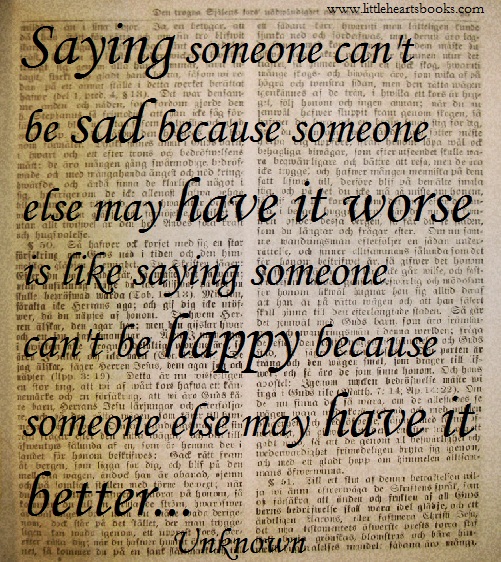 Related posts:
The Seven Wonders of the World of Childhood
Playground Confessions~Look Who’s Talking!
The Measure of Success~Chinese Parents and French Parents Can’t BOTH Be Superior!
Award-winnning author, L.R.Knost, is the founder and director of the children's rights advocacy and family consulting group, Little Hearts/Gentle Parenting Resources, and Editor-in-Chief of Holistic Parenting Magazine. Books by L.R.Knost include Whispers Through Time: Communication Through the Ages and Stages of Childhood ; Two Thousand Kisses a Day: Gentle Parenting Through the Ages and Stages ; The Gentle Parent: Positive, Practical, Effective Discipline ; and Jesus, the Gentle Parent: Gentle Christian Parenting the first four books in the Little Hearts Handbook gentle parenting series, and children’s picture books Petey’s Listening Ears and the soon-to-be-released Grumpykins series.
A Return to Childhood
[By L.R.Knost, author of Two Thousand Kisses a Day: Gentle Parenting Through the Ages and Stages, Whispers Through Time: Communication Through the Ages and Stages of Childhood, and The Gentle Parent: Positive, Practical, Effective Discipline available on Amazon and through other major retailers.]
 There is such a rush these days to get children sleeping through the night, weaned off the breast, eating solid foods, potty trained, reading independently, and on and on, that we seem to have lost the ability to simply enjoy life as it happens and let our children do the same. Gone are the days of making mud-pies and playing in piles of leaves. They’ve been replaced with flashcards, language immersion (even in the womb!), educational dvd’s, and the like. Preschool has become the new kindergarten, with parents rushing to get on waiting lists for the ‘best of the best’ preschools, often even before their first prenatal appointment!
Therapists in New York have reported an increase in parents seeking psychiatric services for stress related to the intensely “cutthroat” admissions process for top-rated private preschools and kindergartens. “Parenting is a competitive sport,” says Dr. Lisa Spiegel. And that competition is leading parents to ask if their three-year-old should wear suits to preschool interviews, which designer purses are best to carry on school tours, and even if they should be induced into early delivery so their child “could be considered for kindergarten before the Sept. 1 cutoff date.” (New York Post, see link below)
One would assume, with all of this emphasis on independence and education, that we would be moving forward as a society to a more self-sufficient, competent, and well-educated populace which, by extension, might reasonably be assumed to have less need of welfare programs and prisons. One would assume wrong, unfortunately.
By way of comparison, in 1960, welfare spending in the United States was $48.20 per capita with 1.7% of the population receiving federal assistance. (infoplease.com) By 2010 it had increased to $2256.40 per capita (usgovernmentspending.com) with 8.0% of the population receiving assistance. (wiki.answers.com) In 1960, 0.18% of the US population was imprisoned, whereas in 2010 that number had climbed to 0.74% (businessinsider.com) with drug use, rape, and assault rates skyrocketing.
So what happened? Obviously, there are many contributing factors, but one often overlooked, powerful contributor is how we parent our children. Study after study has confirmed that early childhood experiences have a profound impact on adult behavior, achievement, and satisfaction with life. The modern emphasis on ever-earlier independence and academics seems to inadvertently be sacrificing the very things they are designed to accomplish, and the modern view of parenting as a “competition” is setting the stage for stress, conflict, and failure.
Perhaps it is time for parents to reevaluate their priorities and realize their children are blessings to be cherished and nurtured, not pawns in a cut-throat game of strategy and intrigue. Perhaps it is time for a return to childhood, to simplicity, to running and climbing and laughing in the sunshine, to experiencing happiness instead of being trained for a lifetime of pursuing happiness…perhaps it is time to let children be children again:
1) Let babies be babies~in other words, baby them! Babies are completely and totally helpless in every way. Medical experts agree that it isn’t possible to spoil a newborn, so responding promptly to cries will simply help them learn to trust that their needs will be met. Babies left to cry-it-out often do end up sleeping through the night earlier than babies whose needs are responded to because they have learned to give up on their needs being met. But that gain of sleeping through the night is accomplished at the loss of trust, and the resultant stress and long-term consequences simply aren’t worth it. (Surviving the First Three Months with a Newborn) Stress causes our bodies to release a hormone called cortisol which, when present for prolonged periods, can dramatically undermine brain development in babies and permanently impair brain function for life. Some causes of stress in babies are extended illnesses, detached parenting, and separation from their mothers, which has been linked to long-term anxiety and anti-social behavior. (News, Science and Environment)
2) Let human babies drink human milk~in other words, nurse them! Breastfeeding beyond the typical 6-12 month period has been shown to improve not only overall IQ’s in children, but also improve health and social outcomes. Children who are breastfed for 24+ months are less likely to have allergies and more likely to have healthy immune systems. (kellymom.com) Also, according to the World Health Organization, “a modest increase in breastfeeding rates could prevent up to 10% of all deaths of children under five,” due, in part, to tainted water supplies, but also due to the immunity factors. And, socially, studies have shown repeatedly that, “Meeting a child’s dependency needs is the key to helping that child achieve independence.” (Elizabeth N. Baldwin, Esq. ‘Extended Breastfeeding and the Law.’)
3) Let children know they matter~in other words, listen and respond to them! Strong, healthy attachment in parent/child relationships has been linked to increased success rates in future marriage, greater career satisfaction, and overall stability and emotional health in adulthood. Children raised with detached parents tend to be forced into premature independence through sleep training, rigid discipline, and too early and/or prolonged separation from parents, often resulting in long-term dependency, attachment, and satisfaction issues. “Decades of research, including longitudinal studies, have shown that as securely attached babies get older, they form better relationships with others, have higher self-esteem, are more flexible and resilient under stress, and perform better in every aspect of life, from schoolwork to peer interactions.” (Dr. Laura Markham)
4) Let children see you being ‘good’~in other words, model the behavior you desire! Children are born observers and the first people they observe, with an almost scientific intensity, are their parents. Modeling appropriate and desirable behavior to children such as self-control, compassion, helpfulness, listening, respect, etc is a powerful tool in passing along these qualities to the next generation. “Discipline is everything you put into children that influences how they turn out…Whatever your ultimate objectives, they must be rooted in helping your child develop inner controls that last a lifetime. You want the guidance system that keeps the child in check at age four to keep his behavior on track at age forty, and you want this system to be integrated into the child’s whole personality, a part of him or her.” (Dr. William Sears)
5) Let children play~in other words, don’t rush them into growing up! Study after study has shown that children learn more, retain knowledge better, and maintain their natural curiosity and love of learning when they are allowed to learn through a combination of unstructured and guided play. The trend these days is to start children in academic-centered preschools as early as two years old and then move them into academically rigorous kindergarten programs, often while still four years of age. “While many children do fine in kindergarten and first grade, by the time they reach second grade, ‘they can’t hold it together — they fall apart and really struggle.’” (Colvin) “Newspapers and magazines across the country are reporting that kindergarten is the new first grade—full of pressure and short on play.”(What to Expect in Kindergarten) “As the parent of a child entering kindergarten, you’re sure to be shocked and amazed by what’s changed since your days on the story rug. Kindergarten isn’t what it used to be…many of the changes you observe make kindergarten a more challenging and potentially pressuring stage, it’s all in the name of teaching your child more effectively.”(Kindergarten Assessment) However, effective teaching is a subjective subject. Is teaching effective if it results in children who are capable of rote memorization and passing standardized tests, but lack imagination, curiosity, and a love of reading? Or is teaching more effective if it results in children who are innovative, pioneering, and life-long learners?
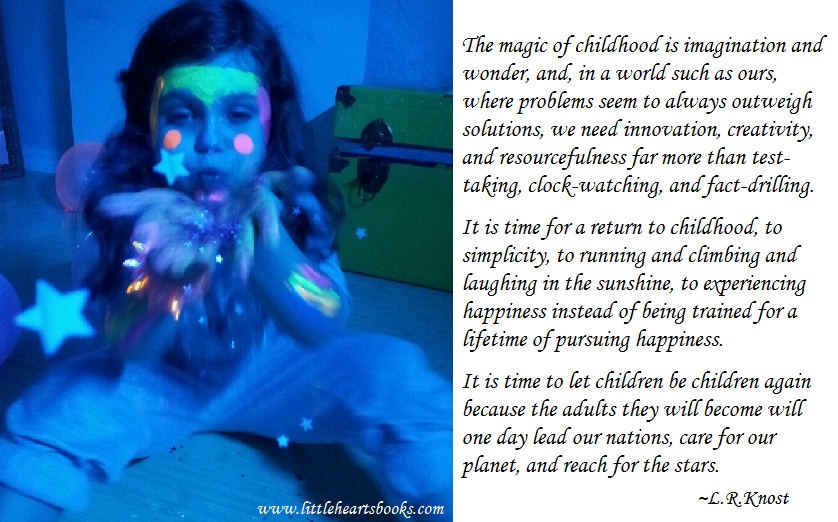

Do you think my little dirt magnet enjoyed her homeschool day?
Related posts:
The Seven Wonders of the World of Childhood
Raising Super Readers~The MARVELous Power of Comic Books!
The Measure of Success~Chinese Parents and French Parents Can’t BOTH Be Superior!
Alphabet Fun~Imagination From A to Z!
Live to Play~Play to Learn~Learn to Live!
One Slippery Sock & Other Silly Tools for your Parenting Toolbox!
Award-winnning author, L.R.Knost, is the founder and director of the children's rights advocacy and family consulting group, Little Hearts/Gentle Parenting Resources, and Editor-in-Chief of Holistic Parenting Magazine. Books by L.R.Knost include Whispers Through Time: Communication Through the Ages and Stages of Childhood ; Two Thousand Kisses a Day: Gentle Parenting Through the Ages and Stages ; The Gentle Parent: Positive, Practical, Effective Discipline ; and Jesus, the Gentle Parent: Gentle Christian Parenting the first four books in the Little Hearts Handbook gentle parenting series, and children’s picture books Petey’s Listening Ears and the soon-to-be-released Grumpykins series.
A Place for Me
[By L.R.Knost, author of Two Thousand Kisses a Day: Gentle Parenting Through the Ages and Stages, Whispers Through Time: Communication Through the Ages and Stages of Childhood, and The Gentle Parent: Positive, Practical, Effective Discipline available on Amazon and through other major retailers.]
 As a child, I loved to find a little ‘hidey-hole’ and tuck myself away from the big, big world for awhile. Somehow, sitting in a closet quietly singing to a much-loved babydoll, hiding in the leafy bower of an old grandfather oak with my nose in a book, or throwing a blanket over an end-table and crawling under it with a flashlight just made the world a little smaller, a little friendlier, a little less overwhelming. I remember feeling safe. I remember listening to the sound of my breathing, just listening. I remember closing my eyes and daydreaming, the cadence of my breath the only sound in the stillness.
It was there in the stillness, in the wanderings of my imagination, that I processed the brokenness of a broken home, adapted to the subsequent juggling of two homes, coped with the eventual abandonment by a father, and, over time, unlocked my guarded heart to a new father. It was in the smallness, in the microcosm of my own creation, that the big world shrunk down and the chaos receded and life’s mountains became surmountable molehills.
With my own children, I’ve fallen in love anew with the ‘hidey-hole.’ Whether it’s a fort of sofa cushions,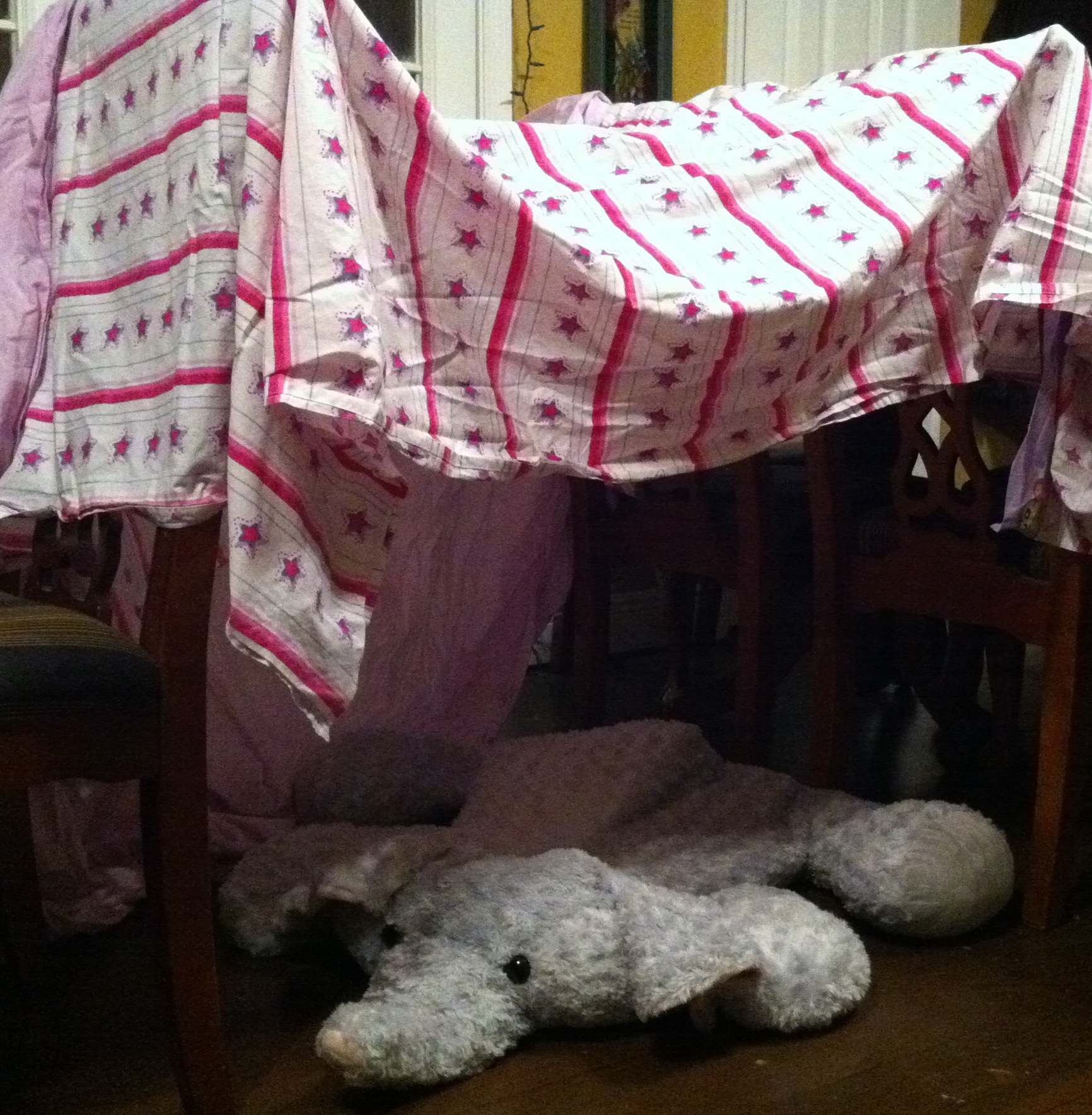 a sheet with the ends tied to dining room chairs, a blanket hung over a coffee table, or the tree house built by my amazing hubby, my children’s imaginations take flight. And, as they make clubhouse signs and set about ‘nesting’ in their little corner of the world, their muffled giggles and busy chatter make my heart sing.
I pray that the big, big world out there is kind to my children, that they never know sadness, never taste bitterness, never experience disillusionment. But I know better. I know life can and will challenge and even hurt them. I know people will disappoint and hearts will be broken and dreams will be shattered.
But I also know that in the quiet places God’s still, small voice can be heard whispering comfort. I know that in the simplicity of play the complexity of life can be sorted like puzzle pieces joined to reveal a picture. And I know that in the nooks and niches we carve out for ourselves even as adults, the world seems a little smaller, a little friendlier, and a little less overwhelming.
 Related posts:
200 Ways to Bless your Children with a Happy Childhood
Playground Confessions~Look Who’s Talking!
Live to Play~Play to Learn~Learn to Live!
One Slippery Sock & Other Silly Tools for your Parenting Toolbox!
Parenting in Public: Toddler Time
Testing the Boundaries~What’s A Parent To Do?
Award-winnning author, L.R.Knost, is the founder and director of the children's rights advocacy and family consulting group, Little Hearts/Gentle Parenting Resources, and Editor-in-Chief of Holistic Parenting Magazine. Books by L.R.Knost include Whispers Through Time: Communication Through the Ages and Stages of Childhood ; Two Thousand Kisses a Day: Gentle Parenting Through the Ages and Stages ; The Gentle Parent: Positive, Practical, Effective Discipline ; and Jesus, the Gentle Parent: Gentle Christian Parenting the first four books in the Little Hearts Handbook gentle parenting series, and children’s picture books Petey’s Listening Ears and the soon-to-be-released Grumpykins series.
Sandbox Soapbox: Toddler Insights
[Portions reprinted from The Gentle Parent: Positive, Practical, Effective Discipline by L.R.Knost. Whispers Through Time: Communication Through the Ages and Stages of Childhood and Two Thousand Kisses a Day: Gentle Parenting Through the Ages and Stages also available on Amazon and through other major retailers.]
~~~~~~~~~~~~~~~~~~~~~

You look a little frazzled, Dude. Hard day?
 Man, I love my mommy to pieces, but seriously, she does NOT know how to share. I took one little thing out of her purse, and she freaked! Snatching and saying, “Mine!” and everything. And right in the middle of the store, too! So embarrassing. Everybody was looking at me, rolling their eyes. I felt like a total failure.
I hear you! I have the same problem. And mine has been getting into EVERYTHING, too! Like, I stashed my cracker under the couch so I could have a little snack later, and she totally threw it in the trash! Who does that?
You think that’s bad? Check this. I’m minding my own business, just chillin’ with my toys, and she just snatches me up and carts me off and straps me in the highchair, no warning at all. And I’m not even hungry! Then she gets all upset when I do a little physics with my food. Btw, so cool how sometimes it falls straight down and sometimes it splats against the wall. I think it has something to do with the consistency of the food and the angle of my trajectory. Just a working theory atm, though.
Cool! Let me know what you figure out. How about this. I can’t get anything done! No joke! I spent all morning building this stellar block tower. Dude, you should have seen this thing. It was epic! So, I walk away for like one second, and she dumps the whole thing in the toy box! An entire morning’s work, gone. I don’t know why I bother sometimes.
Same! And what’s with this new ‘time-out’ thing mine’s into all of a sudden? I get the slightest bit upset about something, and, just when I need a cuddle, she sticks me in this chair and won’t let me get up! Like a chair is a good hugger? Really?
That is just wrong. Hey, how about this whole potty training dealio? She wants me to do my business in a little plastic bowl. We eat out of those things! Seriously, you gotta wonder what goes on in their brains sometimes.
You’re lucky. Mine keeps propping me up on that big white contraption with water in it. I could drown! And you should see what happens when she pushes down that handle in the back. Can you say vortex of DOOM?!?
Not cool, Dude, not cool at all! Are you dealing with tantrums yet? Mine has got a temper like you wouldn’t believe! Anytime she doesn’t get her way, watch out for the fireworks! She yells and flaps her arms and stomps around, and, I hate to say it, but she’s starting to hit. Like that’s going to solve anything. I have no idea how to handle these aggression issues! Why can’t they just be reasonable like us?
I think it’s a communication issue, myself. I mean, they’re just barely starting to understand us when we talk to them, so I try to cut mine a little slack when she starts getting frustrated. I just stay close, maybe pat her arm or offer her a toy. Sometimes she settles down a bit and starts smiling again, but sometimes she just needs a little time to calm down. I stay present, though, so she knows I’m always there for her.
I think you’re messing up there, Dude. You need to walk away, just walk away and let her deal. If you comfort her, she’ll expect you to help her process her emotions, and that’ll lead to dependency issues, mark my words! When she freaks, you’ve got to force her to control herself! When she’s ready to be reasonable and listen, then you can be friends again.
I don’t know. Mine flat out won’t listen. I can’t tell you how many times I have to ask her to play with me before she finally looks up from her toy. What is it with parents and electronics, anyway? And then all she does is say, “Just a minute, hon.” What exactly is a minute, btw?
‘Just a minute’ means ‘This is more important than you,’ Dude. Come on, get with the program. You have to make them pay attention! Yell. Throw something. Bite the cat. Whatever it takes! Don’t let them get away with disrespecting you like that or they’ll never pay attention.
Word. Talk about getting with the program, how do you handle the sleep issues? I just cannot take another sleepless night! She keeps me up for hours every. single. night. It starts out great, bath-time, a book and cuddles, but then she just clocks out like I’m some kind of a toy she can switch off when it gets dark! And, man, is it dark. I don’t know what’s living in my closet, but it is ginormous!
Sleep training, Dude! It’s the only way. They turn that light out and shut the door, you follow them! Every time. Or, if you’re too scared (totally get that, btw) then just start hollering and don’t stop. If you can’t sleep, make sure they can’t, either! And don’t give in. Not even once. You let them get away with that stuff one time, and you’ll never get any sleep, ever! They have to learn that it’s their job to take care of you day and night, even if all you need is a hug!
Got it. Oh, man, here she comes. Seriously, do you have this problem, too? We’re at the park. Everybody’s having a good time. And she just up and decides to leave. I think she’s got some anti-social tendencies. I’m thinking of having her tested.
Same here! But I’m working on it. They’ve got to learn it’s not all about them, and it’s our job to teach them. Look, here comes mine, too. Watch and learn, Dude. I’m using the arched-back, flail and wail today. Deep breath and, “No! No! Noooooo…”
Related posts:
Backtalk is Communication…LISTEN
When Children Act Out ~ Reflecting Our Emotions
Bridge Over Troubled Waters~Parenting a ‘Problem’ Child
The Incredible Power of the Whisper
The Taming of the Tantrum: A Toddler’s Perspective
The Thoughtful Parent’s Guide to Positive Parenting Guides
Award-winnning author, L.R.Knost, is the founder and director of the children's rights advocacy and family consulting group, Little Hearts/Gentle Parenting Resources, and Editor-in-Chief of Holistic Parenting Magazine. Books by L.R.Knost include Whispers Through Time: Communication Through the Ages and Stages of Childhood ; Two Thousand Kisses a Day: Gentle Parenting Through the Ages and Stages ; The Gentle Parent: Positive, Practical, Effective Discipline ; and Jesus, the Gentle Parent: Gentle Christian Parenting the first four books in the Little Hearts Handbook gentle parenting series, and children’s picture books Petey’s Listening Ears and the soon-to-be-released Grumpykins series.
Babes and Boundaries~A Gentle Parenting Perspective
[Reprinted from Two Thousand Kisses a Day: Gentle Parenting Through the Ages and Stages by L.R.Knost. Whispers Through Time: Communication Through the Ages and Stages of Childhood also now available on Amazon]
 Parenting is soooo tiring and frustrating at times. Sometimes you just want to sit a small child down and say, “Do you know how much easier your life (and mine!) would be if you’d just be REASONABLE?!?” But we know that wouldn’t do any good because the words ‘reasonable’ and ‘toddler/preschooler’ just don’t play well together. The thing to remember is that gentle parenting doesn’t mean parenting without boundaries.
Believe it or not, the foundation for discipline (guiding, leading, teaching…NOT punishment ) begins in the newborn and infancy stages. When parents respond quickly, consistently, and gently to their baby’s cries, the trust relationship that the parent is establishing becomes the cornerstone for later discipline. Boundaries need to be established for a child’s safety and growth into a successful citizen of our world. A child who is secure in the knowledge that he doesn’t have to fight to be heard or to have his needs met is more open and adaptable to limits. And when the ‘limit-setter’ is a person the child trusts, the enforcement of those boundaries becomes a matter of connection and communication instead of conflict and struggle.
So, what might setting and enforcing boundaries using gentle parenting look like in real life? Here are a few examples:
- Your 18 month old has begun hitting you whenever you try the ‘remove and distract’ method of keeping her from sticking things into power outlets. In addition to covering the outlets with safety covers, a gentle parenting approach to hitting at this age would be to gently hold your child’s hand when she tries to hit, look her in the eye, and say quietly and firmly, “Gentle” or “Gentle hands,” while stroking your cheek with her hand. This sets a boundary that hitting is not okay while demonstrating what behavior is acceptable. Don’t expect this to be a one-time deal, though. Little ones learn through consistent and patient repetition.
- Your 2 year old drops to the ground in limp protest every time you try to leave ANYWHERE! First, giving a toddler some warning that a change is about to occur respects their often intense interest in and focus on their own activities. A gentle parenting approach might be to utilize the ‘countdown to leaving’ method to give them a time context (i.e. “Five more minutes! That means you have enough time for five more horsey rides on grandpa’s back!”… “Four more minutes! That means you can have four more jumps into the ballpit!”… “Three more minutes! That means you have enough time to build three more towers and knock them down!”… “Two minutes left! That means you have enough time to go down the slide two more times!”… “One more minute! That means you can look at one more book!”). Remember, children aren’t little robots we can just upload the right program into and expect it to work perfectly every time, so when your little human still impersonates a limp noodle despite your best efforts, quietly acknowledge his distress, “It’s hard to leave when you’re having fun, isn’t it?” and then gently pick him up and move him to the car/stroller, etc.
- Your 3 year old flat out refuses to wear shoes, period. In addition to giving choices, “Do you want to wear the red boots or the blue sneakers today?” and offering her the opportunity to assert her independence, “Would you like to put your shoes on yourself or do you want mommy to help?” sometimes all that is needed is a simple question, “Why don’t you want to wear shoes?” Three year olds are typically becoming articulate enough that, if they aren’t already stressed, they can do a pretty good job of explaining themselves. You might be surprised to hear something like, “Tomowow my boos hut my toes,” which when translated means, “The last time I wore my boots they hurt my feet, and now I think all shoes will hurt me.” Moving on to a more verbal communication stage of your relationship with your child when they’re ready might seem a no-brainer, but parents often get caught up in patterns of parenting from previous stages and it just doesn’t occur to them to simply ask their child what’s wrong. Again, this won’t always work, so when your little bohemian still rejects all things soled, calmly let her know that she will remain in the stroller/sling/cart and not do any walking until she decides she’s ready to put on her shoes.
One other note about parental boundaries is that it’s not just your children who will challenge them! Everyone and their mother (or especially their mother!) will take every ‘misbehavior’ by your child as an opportunity to give you unsolicited and often unwanted advice. Remember, when it comes down to it, it’s you, the parent, who determines what limits to set. Mrs. In-My-Day, Cousin Know-It-All, Mr. My-Way-Is-The-Only-Way, and Neighbor Nose-In-Everyone-Else’s-Business all have their own ideas that make sense to them, and that’s fine, but you are not them! You the unique parent of a unique individual, and you have the sole responsibility to raise that individual as you see fit (with reasonable limits set by your community as to what constitutes abuse, neglect, etc).
In practical application, boundaries do reflect the culture and environment in which a child lives. In a small, rural community in Spain, doors may be left open day and night and the neighbors may all be related. Small children might have the freedom to wander in and out of houses, play ball in the middle of the road, and plop down for an afternoon nap on a neighbor’s sofa. In a busy, urban city such as New York, doors may be kept locked, people may never have even met their neighbors, and playing in the street might be tantamount to a child endangerment charge.
The point is that boundaries aren’t a one-size-fits-all list that you can buy from Barnes & Noble, put on the fridge, and slap a sticker on every time a child complies. Boundaries are personal limits determined by the parent’s values and priorities and culture as well as reflecting the age and maturity of their child and the unique attributes of their community.
It may ‘take a village’ to raise a child, but remember, it’s you, the parent, who’s the leader of your tribe!
Related posts:
Testing the Boundaries~What’s A Parent To Do?
Toddlers, Tantrums, and Time-Ins, Oh My!
The Taming of the Tantrum: A Toddler’s Perspective
Award-winnning author, L.R.Knost, is the founder and director of the children's rights advocacy and family consulting group, Little Hearts/Gentle Parenting Resources, and Editor-in-Chief of Holistic Parenting Magazine. Books by L.R.Knost include Whispers Through Time: Communication Through the Ages and Stages of Childhood ; Two Thousand Kisses a Day: Gentle Parenting Through the Ages and Stages ; The Gentle Parent: Positive, Practical, Effective Discipline ; and Jesus, the Gentle Parent: Gentle Christian Parenting the first four books in the Little Hearts Handbook gentle parenting series, and children’s picture books Petey’s Listening Ears and the soon-to-be-released Grumpykins series.
Testing the Boundaries~What’s A Parent To Do?
 [Portions reprinted from The Gentle Parent: Positive, Practical, Effective Discipline by L.R.Knost. Two Thousand Kisses a Day: Gentle Parenting Through the Ages and Stages and Whispers Through Time: Communication Through the Ages and Stages of Childhood now available on Amazon and through other major retailers.]
Challenging behavior in our children can be really…well, challenging! How do you ‘handle’ a child who suddenly refuses to wear shoes or sit in her carseat/seatbelt or eat, period? Here are some tips to help you regain that snuggly, loving relationship you used to enjoy before your baby became a…gulp…PERSON!
1.) Remove the word ‘handle’ from your parenting vocabulary entirely. Your child isn’t a lion to be tamed or a dog to be trained! He’s a person, an individual with thoughts, interests, concerns, wants, and needs that are totally separate from yours. Respecting him as a separate individual not only models the value we need to place on others in our homes and communities, but also sets the stage for a mutually respectful relationship in his teen years and beyond.
2.) Slow down! Often simplifying our lives is the key to simplifying our parenting issues. Rushing a child from one activity to the next doesn’t expand her horizons; it stunts her creativity and inherent zest for life, which are the building blocks of a life-long love of learning. When she digs her heels in, pay attention! She’s trying to communicate a very deep need for time and space to learn about the world, to play and grow, and to just ‘be.’
3.) Small children have very little control over their lives, and the more powerless they feel, the more likely they are to make eating, getting dressed, going to the potty, etc. a battle of wills. Giving choices, engaging your child in making plans, and being flexible and responsive on a daily basis are good ‘proactive’ parenting, but little people are notorious for their awkward timing in deciding to suddenly assert their independence! Be prepared for those challenging moments by deciding ahead of time how you will respond. (See below for some ideas!)
4.) Listen, listen, listen! The first question parents ask me is almost always, “How do I get my child to listen?” And my first response is usually, “How well do you listen?” As Ralph Waldo Emerson so aptly put it, “What you do speaks so loud that I cannot hear what you say.” In other words, our children learn best by imitation. If every time our little ones ask for our attention we say, “Just a minute,” then we cannot expect instant attention from them. If when they speak to us our eyes constantly stray back to our computers and iPhones, we should not be surprised if they have a hard time looking at us when we ask them to. Listening is a two-way street that starts and ends with us, the adults.
5.) Boundaries are our friends! Many people believe that Gentle Parenting is a form of un-parenting, but nothing could be further from the truth. Gentle Parenting is involved parenting~interactive, engaged, active parenting. It takes focused attention, planning, participation, research, and so much more to be an empathetic, responsive parent who is in tune with their child’s needs and who is prepared to make whatever sacrifices are necessary to meet those needs. That said, in any home, like in any civilized society, boundaries are necessary for everyone’s safety and comfort. It is in the choosing and maintaining of those boundaries that Gentle Parenting distinguishes itself. In a gently parented home, boundaries are focused on guiding rather than controlling children and are maintained through empathetic and creative resolutions rather than harsh punitive consequences. (See below for some ideas!)
6.) Watch your attitude! Do you have angry eyes? A sharp tone? Do you issue commands and demand compliance? Do you sigh and roll your eyes when frustrated with your little one? All of these things contribute to creating resistance in children. Really, who wants to cooperate with someone who is demanding, impatient, sarcastic, angry, etc? Does feeling like a burden or a failure ever motivate anyone? Is a desire to please rooted in correction or connection? Think about how you like to be treated by authority figures (supervisors, law enforcement, etc.) and then treat your children the way you want to be treated! This not only reduces challenging behavior, but also models The Golden Rule~Do to others as you want them to do to you…an excellent life lesson!
Here are some ideas for your Gentle Parenting toolbox:
- Little one refusing to put on shoes before leaving the house? First, ask him why he doesn’t want to wear them. A toddler most likely won’t be able to/want to explain, but you’re modeling courtesy and opening up a dialogue, both good connection points. A three-year-old, though, might just surprise you with a very logical, in their own mind at least, response! Second, don’t react; just scoop the shoes up, and take them with you. If the refusal to wear shoes continues at the park/in the library/at the doctor’s office, etc. calmly tell him he can sit in your lap or in the stroller and hang out with you until he’s ready to wear his shoes.
- If a tantrum results, remember to stay calm (deep breathing, counting silently, and saying a quick prayer for guidance are all helpful!) and remain present. Some children respond well to a parent quietly talking, offering words to express what the child may be experiencing (i.e. “It’s frustrating when we have to do things we don’t like. I can see that you’re angry, and that’s okay. Let’s just sit here together for a while.”), while other children become more upset when a parent attempts to interact with them during a tantrum and are comforted simply by your quiet presence, a gentle back rub, or playing with a Calm-Me-Jar . Getting to know your child is an important part of Gentle Parenting and will help you to ‘read’ these situations so you can be responsive to their unique needs.
- A place for Time-Outs. Typically, I advise parents to use Time-Ins instead of Time-Outs in order to connect-to-correct, but there is one area that I advise the use of Time-Outs…the ‘Time-Out Toy Box!’ When a toy is misused (i.e. thrown, used to
 hit, drawn on, fought over, etc) and a gentle redirection has been given, the next step for the toy is to be put in the ‘Time-Out Toy Box.’ Little ones generally find the concept of a toy being put in Time-Out rather humorous and go along with the removal without a fuss (the toy can be returned after an exaggeratedly stern warning to the toy letting it know what is expected of it and that it must listen to ‘the boss’ ~the child, lol. They love that!), but remember to communicate, listen, and be flexible. If the removal of a toy brings about a strong negative response, it may be that the inappropriate behavior was more than just over-exuberance, in which case a Time-In might be needed. Again, being in tune with your child will help you to ‘read’ the situation and respond appropriately.
- The most challenging, independent children tend to be the ones who need the most intentional parental reconnection. Strong will=Strong need! It is often the strongest-willed children who identify most closely with their parents, oddly enough. While there is no denying how difficult it can be to raise a strong-willed child, seeing the purpose behind the behavior can make the journey much more manageable. Try to view their seemingly constant testing as them doing ‘research’ on you, seeing where your strengths and weaknesses are, and discovering all the ins and outs of being you. Also, taking the time to explain why you make the decisions you do, why you said this, why you didn’t say that, answering the endless questions patiently and openly, can alleviate some of the challenging behavior by offering them insights into who you are without them having to ‘dig’ it out of you!
Related posts:
Practical, Gentle, Effective Discipline
The Taming of the Tantrum: A Toddler’s Perspective
When Children Hit~10 Tips for Parents
Easy Peasy DIY Parenting Tools
To a Toddler Sharing is a 4 Letter Word~MINE!
Tots to Teens~Communication through the Ages and Stages
Parenting in Public: Toddler Time
Award-winnning author, L.R.Knost, is the founder and director of the children's rights advocacy and family consulting group, Little Hearts/Gentle Parenting Resources, and Editor-in-Chief of Holistic Parenting Magazine. Books by L.R.Knost include Whispers Through Time: Communication Through the Ages and Stages of Childhood ; Two Thousand Kisses a Day: Gentle Parenting Through the Ages and Stages ; The Gentle Parent: Positive, Practical, Effective Discipline ; and Jesus, the Gentle Parent: Gentle Christian Parenting the first four books in the Little Hearts Handbook gentle parenting series, and children’s picture books Petey’s Listening Ears and the soon-to-be-released Grumpykins series.
Toddlers, Tantrums, and Time-Ins, Oh My!
[Portions reprinted from The Gentle Parent: Positive, Practical, Effective Discipline by L.R.Knost. Whispers Through Time: Communication Through the Ages and Stages of Childhood and Two Thousand Kisses a Day: Gentle Parenting Through the Ages and Stages also available on Amazon and through other major retailers.]
 When a little person feels frustrated, overwhelmed, or just plain old out-of-sorts (read: tantrum time!) it’s tempting for parents to focus on correction rather than connection. But when children are intensely stressed, the prefrontal cortex of the brain (which in early childhood is an under-developed, mushy ‘ball of playdoh’ waiting to be formed) is flooded with cortisol, aka the ‘stress hormone.’ The result is what is known as the fight-freeze-or-flight syndrome in which higher brain functions (learning, reason, self-control) are markedly hampered and lower brain functions (instinct, physical reactions) take over. This is an in-built survival mechanism that gradually comes under conscious control through years of growth in a safe and supportive environment.
Expecting young children to have the maturity and self-control to overcome this God-given survival instinct is unrealistic. Threatening, punishing, or even reasoning with them while their higher brain functions are suppressed is futile and actually just adds more stress to the situation (more stress=fuel on the tantrum-fire!).
What they really need is help…first, help coping with their big emotions…then, help reconnecting with their source of safety and security (you!)…and last, help processing the problem that sent them into a maelstrom of emotion in the first place. Punishing them, yelling at them, sending them to their room, or putting them in time-out disconnects them even further from their source of security and not only delays a resolution of the issue, but misses an opportunity to equip them with the tools they need to handle future problems.
Drawing them close (time-in), offering words to help them express their frustrations (reflective language), and modeling coping skills and self-control for them are all ways of reconnecting with them to help them successfully navigate their present difficulty as well as cope with those they’re confronted with in the future.
One effective tool for use in helping little ones cope with big emotions is a Calm-Me-Jar.
Here are our Calm-Me-Jars~

They are made from the little round plastic Coke bottles sold around Christmas time. (Other times of the year you can get Aquapod water bottles which are similar.) I like them because, first, they aren’t glass (who really wants to hand an upset toddler or preschooler a glass anything?!?) and, second, they are perfect for small hands to shake and manhandle to their heart’s content.
Glitter glue gel didn’t work at all because it stayed all clumped up. Just basic craft glitter glue from the Dollar Tree worked really well, though. Cold water kept the glue clumpy, too, so lukewarm tap water is the best bet. I used colored glitter glue with a tiny drop of food coloring in the colored Calm-Me-Jars, and just silver glitter glue with the clear one. I also added actual glitter to each jar because the glitter in the glue was itsy bitsy. The combination of the two types of glitter really turned out pretty. Add about one ounce of glitter glue in each bottle and then as much glitter as you like and a tiny bit of food coloring if you want to make the colors deeper.
When each of the bottles had the look we wanted, we glued the tops down with hot glue, then added ribbons for decorations. Our original Calm-Me-Jars are approaching a year old, and they haven’t become cloudy or clumpy, etc, so it seems that as long as you keep the lids on, they’ll last indefinitely! Here’s a closer view:


The Cat in the Hat Can Help You with That!


(If you’re really into Dr Seuss, here’s some Seussical fun for your little one!)
When my littler ones have meltdowns (or, if I can catch it, before they reach that point), I pull out one of the Calm-Me-Jars and shake it up and just let them hold it while I hold them or, if they aren’t ready to be touched, I stay close by and talk or sing quietly. When I feel their body relaxing and their breathing slow down, I might say something like, “It’s sad when we can’t have a toy, isn’t it?” or whatever else will reflect what they seem to be unable to express.
If they’ve hit someone or thrown something, I first reflect what my little person is feeling (after tending to the other child if they are hurt or upset), then, when they’re a bit calmer, I go on to reflect what the other person might be feeling, “It hurts Sissy when you hit her.” Then I offer a suggestion about the next step. “Why don’t we go ask Sissy if she’s okay? If she has a boo-boo, we might need to get a bandage for her.” It’s very intriguing for little ones to feel like they can ‘fix’ something, and often the idea that they have that kind of power makes all the difference in the frequency and intensity of meltdowns, not to mention the positive impact of learning to think and care about the feelings of others.
When an older preschooler/early elementary-aged child is about to have a meltdown, I first try to help them begin to recognize those feelings by verbalizing for them, “I see you’re feeling upset. It’s hard not getting things we want, isn’t it?” (Or “having to do things we don’t want to” etc). Then, depending on how much they seem to need connection vs. simply calming down, I either ask if they want to use their Cozy Corner (see below) to help them calm down, “Do you want to head over to your Cozy Corner for a few minutes and grab one of your Calm-Me-Jars so you can have a break for a bit?”
Or if they need to connect, I scoop them against my side into a big hug and head into the Cozy Corner with them (or just my rocking chair) for a cuddle (aka a time-in). While we’re cuddling, or before if they’re feeling too angry to be touched, I let them shake the Calm-Me-Jar as hard and often as they want right at first as a physical outlet for their intense feelings, watching to see when their breathing begins to even out and their body to relax. When they’ve calmed just enough to hear me, I quietly talk them through the calming process, “Look at all that fairy dust bouncing around like crazy! I bet that’s how it feels inside when you’re so upset. Look at how it’s starting to slow down and settle to the bottom. If we breathe really slowly, we can feel ourselves settling like the fairy dust.” Sometimes we sing a quiet song or I offer to read a book or pray with or for them, depending on the circumstances.
When my five-year-old is mad at one of her siblings, she’ll often bring one of her Calm-Me-Jars (Goodnight Moon is a favorite at night!) and work out some of the upset physically by shaking the jar like crazy and telling me how angry she is. When she’s a bit calmer, we’ll have a little cuddle and watch the glitter settle while saying goodnight to the moon, all the furniture, and whatever other silliness we come up with until she’s calm. If there’s a discipline issue, we’ll work through it at that point because I know that’s when she can hear me and really process what I’m saying. (With Starry, Starry Night we sometimes sing Twinkle, Twinkle Little Star; with Hello Kitty Princess Ballerina she likes to dance her frustrations away while the glitter dances with her; and with Nemo Under the Sea we speak ‘whale’ like Dorry or make fishy faces at each other.)
The key to all of this is being in tune with your little one enough to understand their personality and work with it instead of against it. My five-year-old is spunky and silly, so having a long, serious talk would drive her nuts and accomplish nothing, whereas when some of my older ones were little they really liked to talk things through (and still do!).
Here are some Cozy Corner ideas for when your little people need a little space to cope with this great big world:
 Set aside a small corner of the family room so they can still be close to you and let them help decorate it and choose a favorite blanket, some comfy pillows, and a few special books and stuffed friends to keep there. Here’s a cool tutorial for how to make this tent for under $25!
Let them help name their special place so they’ll know it’s theirs. Some suggestions are Cozy Corner, Comfort Zone, Quiet Cave, or Happy Place. And keep in mind, the Cozy Corner is a place for little ones (usually preschool and older) to go when they decide they want a break, not when we decide they need a break (or that we need a break, lol!). It’s a safe, comfortable, quiet place for them to relax alone if they want to or for us to join them for a time-in cuddle or chat.
And, for times when all else fails, sometimes a little fairy magic is all it takes to turn a bad day into a good one or to help a little one fall asleep. When your toddler/preschooler is a bit cranky, sloooww down, give lots of cuddles, listen, listen, listen, and ask if  they need you to sprinkle some fairy dust on them to turn their frown upside down! For sleeping issues, sprinkle a bit of fairy ‘sleeping’ dust on their bed and stay with your little one, softly humming, stroking their back, or just quiet and reassuring, depending on their needs (they’ll let you know!) until they’re asleep. It’s typically the long, dark, lonely separation from mama causing the problem, instead of a sleep issue, anyway!
You can click on the picture to follow the link to buy these adorable fairy dust jars filled with microfine glitter, or you can go to Michaels and buy some cute little bottles and microfine glitter (You can find it next to the fabric paints and t-shirts instead of with the regular glitter, for some reason. Lol) and make your own little bottles of fairy dust!
Related posts:
Practical, Gentle, Effective Discipline
200 Ways to Bless Your Children with a Happy Childhood
Testing the Boundaries~What’s A Parent To Do?
When Children Hit~10 Tips for Parents
Easy Peasy DIY Parenting Tools
One Slippery Sock & Other Silly Tools for your Parenting Toolbox!
Award-winnning author, L.R.Knost, is the founder and director of the children's rights advocacy and family consulting group, Little Hearts/Gentle Parenting Resources, and Editor-in-Chief of Holistic Parenting Magazine. Books by L.R.Knost include Whispers Through Time: Communication Through the Ages and Stages of Childhood ; Two Thousand Kisses a Day: Gentle Parenting Through the Ages and Stages ; The Gentle Parent: Positive, Practical, Effective Discipline ; and Jesus, the Gentle Parent: Gentle Christian Parenting the first four books in the Little Hearts Handbook gentle parenting series, and children’s picture books Petey’s Listening Ears and the soon-to-be-released Grumpykins series.
A September to Remember: Babies deal with stress naturally
Today’s guest poster for ~A September to Remember~ is Leslie from THE MOM: INFORMED. Be sure to head over and check out her site!
 Stress. I have it, you have it, and chances are even your kids feel it. To deal with stress, most people self-soothe and learn a coping mechanism. Some people smoke, some people run, others take medicine. I notice that I have quite a few soother habits; I bounce my leg or twirl my hair or chew the inside of my cheek.
Some autistic folks develop quite the arsenal of self soothing exercises…some spin to center themselves, some flap their arms, some repeat words, numbers or phrases. People with OCD have their own unique quirks for dealing as well.
Babies and toddlers have ways to deal with stress themselves…crying, sucking, nursing, sleeping. Babies who nurse get their non-nutritive sucking needs met by suckling the breast. That’s how they seem to best get their stress dealt with. Bottle fed babies sometimes go for thumb or pacifier sucking to meet that need. Other kids hold blankets or dolls.
The point of this post is to get you to look at pacifying and thumb-sucking and non-nutritive nursing in a new light. It isn’t something for lazy mom’s to use. It isn’t something kids use as manipulation. It starts out as a reflex that is found to be quite soothing and stress relieving. Most kids stop using a pacifier between 2 and 4 all on their own. Most kids stop sucking their thumb between 4 and 6 all on their own. A couple of great medical posting on non-nutritive sucking and why it’s normal are HERE and HERE . Did you know that thumb-sucking and pacifier sucking release endorphins(the feel good hormone)? Yeah, that’s why it is an excellent tool for babies to cope with stress. Sucking starts out as a reflex that develops into a tool.
So, before you dismiss baby’s need outside of food or even your toddlers need, remember, it is a not a bad thing. It is healthy and natural. And for the most part…most kids give them up on their own when they are old enough to understand and deal with stress in a better manner.

- THE MOM: INFORMED
- My name is Leslie and I am PASSIONATE about educating moms through pregnancy, birth and beyond. I live by this quote: “If you don’t know your options, you don’t have any.” I want EVERY woman to KNOW ALL OF THEIR OPTIONS. I never again want a woman to have to say, “I just didn’t know/if only I had known.”
Award-winnning author, L.R.Knost, is the founder and director of the children's rights advocacy and family consulting group, Little Hearts/Gentle Parenting Resources, and Editor-in-Chief of Holistic Parenting Magazine. Books by L.R.Knost include Whispers Through Time: Communication Through the Ages and Stages of Childhood ; Two Thousand Kisses a Day: Gentle Parenting Through the Ages and Stages ; The Gentle Parent: Positive, Practical, Effective Discipline ; and Jesus, the Gentle Parent: Gentle Christian Parenting the first four books in the Little Hearts Handbook gentle parenting series, and children’s picture books Petey’s Listening Ears and the soon-to-be-released Grumpykins series.