
‘Patience Doesn’t Feel Patient’ by Sarah Sprague – Friends of L.R.Knost Rock the Guest Posts while She Battles Cancer
 They say that bravery doesn’t feel brave or fearless because if you’re not afraid it is something other than bravery. I guess that patience is one of those things, as well.
From the outside it looks like calm and peace but from the inside it can feel more like the tested limits of self control.
Learning to be patient is learning how to separate what we feel from how we act. It is learning to accept our feelings while choosing to not act on them. It is learning to say to ourselves:
I can be angry without acting angry.
I can be impatient without acting impatient.
I can be upset without acting upset.
I can be hurt without acting hurt.
I can feel without acting on my feelings.
I can feel without reacting to what I feel.
When I choose to act patient I slow down. I speak more slowly than I normally would. I lower my volume and I pace my words so that they won’t rush together in an explosion of words that no one will understand and that will act as a precursor to yelling. There’s a rhythm to this patience that doesn’t feel patient. A slow rhythm. A careful spacing of words. A slowness to how my body moves as I make sure that no part of me will gain a momentum that will feel like hitting or grabbing or being anything other than soft and gentle.
- When my toddler hits again.
- When my seven year old is upset that he doesn’t understand his homework and is avoiding doing it instead of asking questions.
- When my four year old has snuck his safety scissors into the other room so that he can cut apart a travel pillow to see what is inside, and the entire world feels like it’s covered with tiny Styrofoam pellets.
- When the two-and-a-half gallon water dispenser has been opened by someone curious and it has flooded the kitchen.
- When my three year old fed the fish every container of fish food all at once and the twenty nine gallon aquarium needed to have all of its water cleaned and replaced at bedtime.
I slow down to try and run in quicksand. I go slow-motion like walking through an empty room with a strobe light. I try and move my body through a thickened air. And I try to slow every word down so that it comes with a peace and gentleness that doesn’t show any of the frustration that I feel.
I grasp at all of the excuses that my child doesn’t yet have the words to offer. I try and see what positive or curious motivations they might have, or what stresses may be driving them to this place. I try to wrap every part of my heart and brain around empathy and love.
He sits at the table fiddling with his pencil. Nothing has been done on his worksheet, not even his name. He has gotten up to do half a dozen things. I have to make dinner. I have to sweep the floors. I have to do all the things on my to-do list.
“Issac.. Can you please do your homework?” I ask.
“Okay.” He says. And he picks up his pencil and stares off into space.
I am feeling anything but patient. My daughter has not napped today and she claws at my knees to be picked up, asks to draw on his homework with his pencil, and wants no substitutes for this thing that she cannot have. So now I’m being screamed at. I tap at his worksheet and he tells me to help Keenie calm down. So I walk away to find her some playdoh so that we can work on his homework together.
I come back. Nothing’s been done.
Breathe. Slow down. Find the reasons. Seven hour days at school with fifteen minute recesses. Not nearly enough time to decompress after school. He’s having a hard time reconnecting to what he’s trying to do.
I move slowly, lay my hand on his shoulder as softly and gently as I can. On contact my own tense muscles relax. This is my child. My son. He is seven and I love him dearly.
I plant a kiss on his head, and sniff his hair the way I used to when he was tiny, when he was a toddler. It smells just like him.
My other hand comes down to his worksheet. I’m standing behind him, my body enveloping his. Supporting and soft and patient, not angry and looming. My finger pointing to where he needs to write his name. Slow voice. Quiet voice. “Isaac, what does this say?” I ask. Trying to get him to look at the worksheet long enough to begin writing.
He writes his name.
“Now what’s the next question?” I ask. Soft. Slow. Clear. Strong.
He doesn’t answer. He doesn’t move.
I tap the paper. His eyes move to where I’m pointing.
“Can you read this for me?” I ask. He reads the question out loud.
“Do you understand what the question is asking?” I ask.
The dam breaks. He doesn’t understand. He screeches frustration and tells me that he didn’t understand in class.
My frustration is gone. I understand now. We go over what he can do if he doesn’t understand something in class. I ask him if he wants me to help him figure out how he can answer the questions or if he wants me to write a note on the top so that his teachers will know he needs more help with this topic. He chooses to have me try and show him how to work out the answers.
I sit down next to him. He’s fully engaged now.
Patience did not feel patient at first. But then. At the end of it, when I’ve responded well? When the crisis is past. When the messes have been cleaned up? When I’ve helped my seven year old slow down to re-focus and understand what he refuses to understand? When I’ve had self control and when I have acted patient?
That is when patience feels patient. When we’re past the thing that has me pulling my hair out. When we’re past the thing that has me wanting to move faster and raise my voice. When we’re past the thing that has me wanting to throw a tantrum all of my own.
That.. Is when I feel patient. Radiant. Powerful.
And it takes my breath away.
Sarah Sprague, creator of the ‘Wait-It-Out’ gentle sleep learning method (WIO), writes at Nurshable: Joy in Gentle Parenting and can be found on Facebook at Nurshable.
Related posts:
My Cancer Story, Part 1: The Diagnosis
 Award-winnning author, L.R.Knost, is the founder and director of the children's rights advocacy and family consulting group, Little Hearts/Gentle Parenting Resources, and Editor-in-Chief of Holistic Parenting Magazine. Books by L.R.Knost include Whispers Through Time: Communication Through the Ages and Stages of Childhood ; Two Thousand Kisses a Day: Gentle Parenting Through the Ages and Stages ; The Gentle Parent: Positive, Practical, Effective Discipline ; and Jesus, the Gentle Parent: Gentle Christian Parenting the first four books in the Little Hearts Handbook gentle parenting series, and children’s picture books Petey’s Listening Ears and the soon-to-be-released Grumpykins series.

Breastfeeding: Manna from God
[Excerpt reprinted from Jesus, the Gentle Parent: Gentle Christian Parenting by L.R.Knost. Two Thousand Kisses a Day: Gentle Parenting Through the Ages and Stages; Whispers Through Time: Communication Through the Ages and Stages of Childhood; and The Gentle Parent: Positive, Practical, Effective Discipline by L.R.Knost also available on Amazon and through other major retailers.]
~~~~~~~~~~~~~~
“But we proved to be gentle among you, as a nursing mother tenderly cares for her own children.”
1 Thessalonians 2:7
 Jesus’ mother, Mary, didn’t practice attachment parenting when raising little Jesus. The Bible does tell us that she breastfed Jesus, “Blessed is the mother who gave you birth and nursed you.” (Luke 11:27). The culture of the time tells us that she likely coslept with him in the small, one or two room house typical of that period and that she wore him close to her heart in the daylight hours in a wrap to keep him safe from the snakes and scorpions and other dangers that populated the region. So it is certain that she was a breastfeeding mama and almost certain that she was a cosleeping and babywearing mama.
But Mary didn’t practice attachment parenting as she was growing a tiny Savior. She simply parented Jesus in the naturally instinctive way that mothers have mothered their little ones since time began. Attachment parenting is merely a term coined much later to tie these natural parenting choices and others in with the modern research of psychologists like John Bowlby who found that the healthiest emotional and relational adults tended to have strong early attachments with a parent or primary caregiver.
The Bible reinforces those research findings by not just referring to breastfeeding as providing life-sustaining nutrition, but also as a source of comfort and connection, “For you will nurse and be satisfied at her comforting breasts.” (Isaiah 66:11)
God’s biological design for breastfeeding weaves a developing infant’s needs with a mother’s needs into a delicately synchronized dance, and even daddies get in on the dance! There is an inbuilt, biochemical response to the birth of a baby that affects both sexes in similar, though somewhat different ways. As the birth of a new baby nears, a mother’s oxytocin level, known as the ‘love hormone’ because of its ability to create warm feelings of safety and attachment, increases as part of the preparation for bringing a new life into the world and sustaining that life at her breast. Daddies also experience a rise in oxytocin, as well as an increase in estrogen, which results in their brains being pre-wired to love and protect their mate and offspring. Then, after birth and throughout the breastfeeding relationship, oxytocin levels in mamas and daddies remain elevated, rising and falling in rhythmic peaks and valleys in response to a baby’s ever-changing needs. This is no accident of nature. This is a beautiful biological design.
This lovely and perfect design also reveals itself in the balance of nutrients present in breastmilk. Breastmilk has the perfect composition of calories, nutrients, fats, and other components to ensure the optimal development of a growing infant. The composition of breastmilk shifts to accommodate growth spurts, sicknesses, and other needs throughout a mother and child’s nursing relationship. Interestingly, the ratios of each of the components change throughout the day to offer the most energy during the daylight hours and the highest concentrations of sleep-inducing nucleotides during nighttime feeding, so if a mama is pumping and storing breastmilk, it’s important to label the time of day the milk was pumped to avoid giving the more stimulating daytime milk at night!
Beyond the nutritional and bonding benefits of breastfeeding, there are also amazing health benefits to both mama and baby:
A reduction in the risk of SIDS, asthma, childhood leukemia, diabetes, gastroenteritis, otitis media (ear infections), LRTIs (pneumonia, bronchitis, etc), necrotizing enterocolitis, and obesity are just some of the protective benefits for babies. For mothers, breastfeeding has been correlated with a significant decrease in the risk of diseases such as breast cancer, ovarian cancer, diabetes, and heart disease to name just a few.
Additionally, the Journal of the American Academy of Pediatrics released a study in April of 2010 that concluded, “The United States incurs $13 billion in excess costs annually and suffers 911 preventable deaths per year because our breastfeeding rates fall far below medical recommendations.” Those numbers are only based on breastfeeding benefits for the first six months of life. The World Health Organization, American Academy of Pediatrics, Centers for Disease Control, and others recommend breastfeeding for the first two years of a child’s life. Imagine the tally if the researchers had looked at the lives lost and billions of dollars spent unnecessarily in a two year breastfeeding scenario instead of a six month scenario. (Two Thousand Kisses a Day: Gentle Parenting Through the Ages and Stages)
Some stumbling blocks in the breastfeeding relationship that mamas may encounter include the modern societal view of breasts as solely sexual objects which often leads those in public places, including many churches, to shame mothers into hiding in restrooms or vehicles or at the very least using covers that make breastfeeding far more difficult and clumsy than it needs to be. Biblically speaking, breasts are referred to half as often in reference to sexual relationships as they are in reference to the God-designed breastfeeding relationship between mothers and their little ones. Again, that is no accident!
Breastfeeding is not shameful and should not be hidden. As one of our current world leaders, Pope Francis, said during a 2014 baptism ceremony at the historic Sistine Chapel,
“Today the choir will sing, but the most beautiful choir of all is the choir of the infants who will make a noise. Some will cry because they are not comfortable or because they are hungry,” Francis said, according to Reuters. “If they are hungry, mothers, feed them, without thinking twice. Because they are the most important people here.”
He didn’t tell them to leave or to cover up or to make their babies wait. He tenderly told the young mothers to feed their babies when they’re hungry. End of story.
Another stumbling block to a healthy, full-term breastfeeding relationship is the increasingly prevalent diagnosis of low milk supply:
Even though mothers’ bodies are capable of miraculously growing a human being for nine months and bringing that precious new life into the world, those same life-giving bodies seem to be failing in ever-increasing numbers to provide life-giving nutrition to those precious babies because of issues with low milk supply.
Why is this happening? For some, it is certainly just pediatricians using formula-fed babies’ growth charts instead of breastfed babies’ charts or family and friends who believe that all babies should be chubby and content that lead new mothers to believe they have low supply, but there does appear to be an increasing number of babies legitimately labeled as failure-to-thrive with low milk supply determined to be the cause. (Two Thousand Kisses a Day: Gentle Parenting Through the Ages and Stages)
Often the low milk supply is caused by forcing babies to sleep alone and training them to sleep through the night. The fact is that babies aren’t biologically designed to sleep through the night. They are, though, biologically programmed to crave closeness with their mothers, and their proximity to and access to the breast throughout the night stimulates ongoing production of breastmilk, keeping up the mother’s supply naturally.As a simple matter of survival, it makes biological sense that God would build into babies a need to be near their primary source of safety, nutrition, and comfort:
Babies biologically should not sleep through the night. Not only is the deep sleep required to sleep through the night actually a recognized factor in SIDS (Sudden Infant Death Syndrome), but babies who sleep through the night are also not nursing to stimulate breastmilk production, thus their mother’s milk may begin to dry up. Clearly, that’s not a healthy biological design. (Two Thousand Kisses a Day: Gentle Parenting Through the Ages and Stages)
The bottom line is that breastfeeding is a biological norm created by God to meet a baby’s needs in the healthiest and most convenient way. That said, there are certainly times when a mother can’t breastfeed due to a medical condition, life circumstances, adoption, or other factors. In those cases mamas can still achieve a healthy attachment and strong, loving relationship and even boost their oxytocin ‘love hormone’ levels by holding their little ones close to their hearts during feeding, making eye contact and exchanging smiles and coos and giggles, kissing and nuzzling their babies’ fuzzy little heads, keeping their little ones close during the day in a baby wrap or sling, taking time out for a few periods of ‘kangaroo care’ each day, and meeting nighttime needs quickly, gently, and consistently. (end excerpt)
Related posts:
Ten Steps to Surviving the First Three Months with a Newborn
Love in the Time of Cosleeping
300+ Nicknames for Your Babykins…Doodlebug…Snugglebunny…
Babywearing Basics Resource Guide
Breastfeeding, Babywearing, and Bouncing Back into Shape after Baby
Jesus, the Gentle Parent: Gentle Christian Parenting
Tattered Tapestries: Weaving Trust Through the Chaos
Fear Doesn’t Lead to Faith: Becoming Your Child’s Safe Place
Where Did You Learn Love, Child?
Spare the Rod: The Heart of the Matter
Gentle Journeys: A Book Club for a New Generation
Award-winnning author, L.R.Knost, is the founder and director of the children's rights advocacy and family consulting group, Little Hearts/Gentle Parenting Resources, and Editor-in-Chief of Holistic Parenting Magazine. Books by L.R.Knost include Whispers Through Time: Communication Through the Ages and Stages of Childhood ; Two Thousand Kisses a Day: Gentle Parenting Through the Ages and Stages ; The Gentle Parent: Positive, Practical, Effective Discipline ; and Jesus, the Gentle Parent: Gentle Christian Parenting the first four books in the Little Hearts Handbook gentle parenting series, and children’s picture books Petey’s Listening Ears and the soon-to-be-released Grumpykins series.
Breastfeeding, Babywearing & Bouncing Back into Shape after Baby
[By L.R.Knost, author of Two Thousand Kisses a Day: Gentle Parenting Through the Ages and Stages, Whispers Through Time: Communication Through the Ages and Stages of Childhood, and The Gentle Parent: Positive, Practical, Effective Discipline available on Amazon and through other major retailers.]
~~~~~~~~~~~~~~~~~~~~~
 There is no such thing as a ‘miracle’ weight-loss plan, but living a healthy, active life and eating nutritious meals doesn’t have to be all about sweat, sacrifice, and self-discipline, either. It can be about having fun, eating foods you love, and, best of all, it can fit right in with your lifestyle! By following a few basic nutritional guidelines and finding ways to fit exercise into your daily life, you can create your own ‘life plan’ and start moving toward your weight-loss and health goals.
1.) Practice the 3 B’s
Breastfeeding~Did you know that one of the best ways to lose weight after giving birth is to breastfeed? Breastfeeding uses about 300-500 of the calories you eat each day. That means if you eat the full amount of daily recommended calories for your weight, you’re actually dieting! I don’t recommend calorie-counting as a means of weight loss, but that’s a pretty cool fact, anyway! And when you add the fact that breastfeeding significantly reduces your risk of breast cancer and is super healthy for baby…win-win-win!
Babywearing ~Did you know that in addition to all of the amazing benefits to your baby, babywearing also offers you an excellent opportunity for a daily workout? Wearing your baby works your core and glutes specifically and gives you a full body workout, as well! Who needs a gym when housecleaning, walks on the beach, strolls through the mall, and just daily life in general are an excellent workout, all while keeping baby next to your heart and close enough for kisses?!?
Bouncing~Did you know that kegels can actually do more harm than good? Shallow knee bends like the ones mommies use instinctively when they bounce to soothe a fussy baby are the preferred method of improving the pelvic girdle! So say goodbye to the sneezing/laughing ‘leakies’ and hello to buns and thighs of steel!
2.) Healthy Eating, It Does a Body Good
Did you know that a low fat diet can actually make you fat? A diet of full-fat milk, real butter, real cane sugar, extra virgin olive oil, coconut oil, fat-marbled meat, eggs, nuts of all kinds, cheeses, fruits, veggies, and whole grain pastas and breads is far more likely to help you lose weight and maintain a healthy weight for life.
Along with enjoying these yummy foods, you’ll lose weight faster and be overall healthier by avoiding High Fructose Corn Syrup (HFCS – it’s in practically everything…breads, juices, jellies, etc…so you’ll have to read labels carefully!) and other corn-derived syrups and sugars, along with food dyes, margarine, vegetable/canola/safflower oils, and artificial sweeteners.
If you’ve got a sweet-tooth, denying yourself a treat can lead to overeating as you try to satisfy that urge with other foods. One way to combat that is to indulge in a small amount of ice cream (without HFCS or other corn syrups!) or dark chocolate, preferably in the evening because raising your blood sugar earlier in the day tends to increase your appetite for the rest of the day.
Keep in mind, letting yourself become hungry is one of the surest paths to overeating! It’s far better to eat multiple, small, snack-type meals throughout the day than to wait for meals when you’ll be hungrier and more likely to eat too much. Other benefits to ‘snacking’ instead of eating three full-on meals are 1.) Maintaining a consistent blood sugar, which aids in appetite control and helps your body escape the ‘survival’ instinct to store fat; 2.) Reducing your appetite naturally by eating smaller amounts at a time which helps your stomach to shrink; and 3.) Increasing your metabolism by consistently keeping your digestive system heated up in ‘burn mode.’
Sample meal plan:
1st Breakfast~
¼ cup almonds & ¼ cup raisins
2nd Breakfast~
1 whole egg (Yes, eat the yolk, too! That’s where most of the healthy nutrients are.)
1 Whole wheat English muffin with real butter and ¼ cup natural fruit preserves
8 oz. cottage cheese
Elevensees~
½ cup pretzels & 2 oz. whole-fat cheese
Lunch~
Spinach salad with ¼ cup shredded carrots, ¼ cup dried apricots or cranberries, 2 oz. whole-fat shredded cheese, 4 oz. shredded pork, 2 tbs. minced almonds or sunflower seeds , and 2-4 tbs. Balsamic Vinaigrette (Read the label and watch out for HFCS!)
Tea~
8 oz. yogurt & ¼ cup granola & ¼ cup berries
Supper~
Fettucini Alfredo, Meatball Sub, Pizza, whatever you want! Just fill up your plate as you normally would, then put back half. After you eat, wait 20 minutes and, if you’re still hungry, eat ¼ of what you put back. (Supper is where most people ‘fail’ because that’s the time most social eating occurs. Rather than denying yourself and setting yourself up for failure, this plan allows you to enjoy the foods and social life you’re accustomed to, while still cutting out ¼ to ½ of the calories you’d normally eat at this meal.)
Dessert~
For those with a sweet tooth, after supper is the best time for a few ounces of dark chocolate or ice cream! Pastries and cakes aren’t good choices for a treat, but if you indulge occasionally, no worries 🙂
Bedtime snack~
¼ cup almonds & ¼ cup dried pomegranates or cranberries
You can take this sample plan and switch out items from the same food group so it fits your tastes. For instance, if you don’t like salads, you could switch out the lunch salad with a baked whole grain pork burrito and top it with lettuce, tomato, cheese, etc. Just try to make sure that for every protein/fruit/veggie/dairy you take out, you put the same amount back in. (Sorry about The Hobbit reference. I couldn’t resist!)
3.) A Grateful Heart is a Healthy Heart
Science has proven that a good outlook on life improves not only the quality of a person’s life, but also the length and health aspects of their life. Taking time to intentionally focus on the good things in your life will improve your health, satisfaction, and overall happiness. Here are some ideas:
A.) Get outdoors! Heading out into the sunshine has been shown to improve a person’s mood as well as their health. There’s something about standing in the midst of towering trees or watching butterflies flutter by in the garden that makes stress just melt away. (And a daily dose of sunshine-induced Vitamin D is good for your bones!)
B.) Walka-Walka-Walka! Walking improves circulation and deepens breathing, both of which will make you feel more alive and ready to take on the world!
C.) Count your blessings! Taking time each day to list and be thankful for the good things in your life helps to create balance, making life feel more manageable when it begins to feel overwhelming.
D.) Volunteer! Reaching out to help your fellow humans in need is a great way to make your life feel a lot more purposeful and to help you get a healthy perspective on the stresses in your life.
E.) Laugh out loud! We all type that little ‘lol’ all the time when we’re online, but did you know that actually doing it, really and truly laughing out loud, releases stress-relieving, feel-good endorphins in our bodies? So watch a comedy routine, catch a funny old sit-com rerun, or just sit and enjoy a child playing for ten minutes, and you’ll be sure to laugh away the blues!
*Obligatory disclaimer: I am not a doctor, nor do I play one on TV. This is a guide (not a diet) that I created to return to my pre-pregnancy (Well, pre-pregnancies, actually, since I have six children!) shape and weight in a healthy and swift fashion and that I continue to follow for weight maintenance and healthy nutrition. This guideline is not designed for special health needs. Be sure to check with your doctor or other health professional if you have any health concerns.
Related posts:
Babywearing Basics Resource Guide
10 Ways to Play with your Children when Play is the Last Thing on your Mind
Parenting, Trickery & The Great Obesity Lie
Award-winnning author, L.R.Knost, is the founder and director of the children's rights advocacy and family consulting group, Little Hearts/Gentle Parenting Resources, and Editor-in-Chief of Holistic Parenting Magazine. Books by L.R.Knost include Whispers Through Time: Communication Through the Ages and Stages of Childhood ; Two Thousand Kisses a Day: Gentle Parenting Through the Ages and Stages ; The Gentle Parent: Positive, Practical, Effective Discipline ; and Jesus, the Gentle Parent: Gentle Christian Parenting the first four books in the Little Hearts Handbook gentle parenting series, and children’s picture books Petey’s Listening Ears and the soon-to-be-released Grumpykins series.
Avenging Childhood~The Change Makers
As I drove out of my driveway this afternoon, I glanced up and saw The Avengers racing around my neighbor’s yard, intent on fighting crime (or each other or the dog or some dragonflies, lol). It made my heart so happy to see childhood…just real, everyday, the-way-children-through-the-ages-have-played kind of childhood at its most honest and robust and carefree. I jumped out of my van and proceeded to confirm my neighbor’s suspicions that I’m a little off my rocker by wildly waving my camera in the air and pointing at her adorable boys roughhousing, silently asking for permission to play paparazzi. She nodded, and the boys hammed it up for me for a few minutes, posing and posturing in their wonderful world of make-believe.

I climbed back into my van amidst my little girls’ giggles (pretty sure they were laughing more at me for taking pictures of the neighbors rather than laughing at the boys’ antics). As we headed off on our afternoon errands, I thought about how the world has changed, but children haven’t. Yes, over time the world will do its share of influencing or corrupting, as the case may be, but children are born children just like they have been since the beginning of time.
Every child is born a fresh, new, open book with pages and pages waiting to be filled.  Everything is new. Every day is an adventure. Every experience is an opportunity for discovery. Whether they’re boys or girls, whether they have average or advanced or impaired cognitive or motor abilities, whether they’re Asian or Caucasian, Black or Middle Eastern, Hispanic or (as a growing number are worldwide) a unique blend of races and ethnicities, they all start out the same…brand-new, innocent, precious beyond compare.
I am passionate about helping parents fill the first pages of their children’s lives with messages of gentle welcome, of needs met, of trust. I’m equally passionate about helping parents transition into later stages where they are simply there to offer guidance, support, and encouragement as their children begin filling the pages of their lives with their own choices, interests, and gifts.
I’ve heard it said that only those crazy enough to think they can change the world actually do change it. I honestly believe that changing the world starts at home with how we parent our children. Maybe my neighbor is right about me, after all. 🙂
*Book art via Anagram Bookshop*
Related posts:
Communication vs. Miscommunication
Playground Confessions~Look Who’s Talking!
The Measure of Success~Chinese Parents and French Parents Can’t BOTH Be Superior!
Award-winnning author, L.R.Knost, is the founder and director of the children's rights advocacy and family consulting group, Little Hearts/Gentle Parenting Resources, and Editor-in-Chief of Holistic Parenting Magazine. Books by L.R.Knost include Whispers Through Time: Communication Through the Ages and Stages of Childhood ; Two Thousand Kisses a Day: Gentle Parenting Through the Ages and Stages ; The Gentle Parent: Positive, Practical, Effective Discipline ; and Jesus, the Gentle Parent: Gentle Christian Parenting the first four books in the Little Hearts Handbook gentle parenting series, and children’s picture books Petey’s Listening Ears and the soon-to-be-released Grumpykins series.
A Mile In Their Shoes
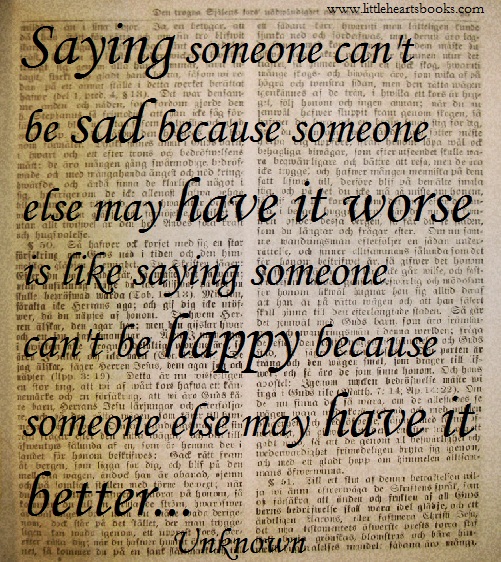
Before you judge someone, walk a mile in their shoes. ~Unknown
My mother always taught me to think about things from other people’s perspective before reacting to them, a life lesson that has translated into the empathetic, gentle style of parenting I teach, write about, and follow with my own children. Discerning what other people feel isn’t always easy, of course, and our own experiences, attitudes, and emotions can get in the way. But seeking to not just understand, but to really feel what another person feels is vital to true communication and connection. To that end, I try to always ask myself, whether interacting with my children, my husband, or any other person who crosses my path, “How would I feel if…”
So come, take a walk with me~
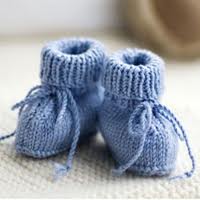 How would I feel if I was suddenly thrust from my safe, familiar world into a startlingly new and uncomfortable world where I couldn’t function on my own, where my very survival depended entirely on beings who I didn’t know, didn’t understand, and who didn’t understand me? Would I learn to feel safe in this new world if they left me for hours on end in dark places with no way to communicate, no way to meet my own needs? Or would I learn to trust these new beings if my needs were met day and night, if they were always available, always responsive, always gentle?
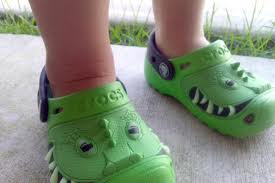 How would I feel if I was a small person in a big world, a world where large beings were constantly jabbering at me in a language I barely understood, a world where everything was a challenge, from climbing out of a chair to learning to control my bodily functions, a world where every day, all day long, I was confronted with new things to taste, new things to explore, new things to discover. If I tried to communicate and no one slowed down to listen, would I learn to listen? If I got overwhelmed by all the new challenges and was punished, would I learn how to cope with my emotions? If I was snatched away from my explorations with no warning, no explanation, would I learn to respect other people’s spaces and paces? Or would I learn to listen if I was heard, cope if I was helped, and respect if I was respected?
 How would I feel if I was an adult-sized person, my body flooded with a consistently inconsistent rush of mind-altering hormones, in a world of adults who demanded adult maturity from me, but treated me like a child? Would I learn to cope with the huge life changes taking place if my awkwardness incited conflict instead of compassion? Would I be willing to share my struggles if my still-growing communication skills were taken at face value instead of my heart being heard? Would I desire to make good choices if the most important people in my life didn’t trust me enough to let me make them? Or would I learn confidence by being understood, trust by being truly heard, responsibility by being trusted to be responsible?
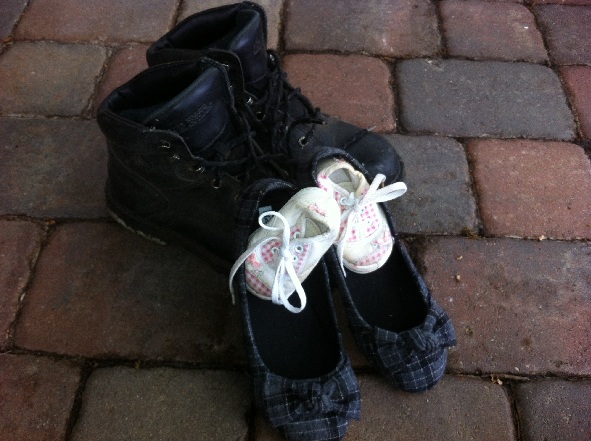 How would I feel if I was a new parent, struggling with exhaustion, overwhelmed by newness, desperate to make the right decisions for my precious new baby, but was surrounded by conflicting advice and head-shakers and nay-sayers? Would I learn to trust my instincts if every choice I made was the subject of commentary and unsolicited advice? Would I grow into my new role if I was pushed and shamed and coerced into following other people’s parenting choices? Would I learn to share my fears and concerns if they were met with negativity, ridicule, and debate? Or would I find my own path in the world of parenting if I was allowed to listen to my heart? Would I discover my parenting niche if I was trusted to make my own choices? Would I be open to new ideas and find support if my struggles were met with reassurance and compassion and acceptance?
 How would I feel if I was a strong, wise, gifted person in a body that was beginning to fail me with age? Would I feel valued if others only saw my frailty and not my strength? Would I offer wisdom if my life experiences were ridiculed? Would I share my gifts if no one bothered to slow down and recognize them? Or would I still feel I had life to live, something to give if my stories were heard, if my wisdom was received, if someone, anyone, took the time to sit with me and talk for awhile.
 Related posts:
The Seven Wonders of the World of Childhood
Playground Confessions~Look Who’s Talking!
The Measure of Success~Chinese Parents and French Parents Can’t BOTH Be Superior!
Award-winnning author, L.R.Knost, is the founder and director of the children's rights advocacy and family consulting group, Little Hearts/Gentle Parenting Resources, and Editor-in-Chief of Holistic Parenting Magazine. Books by L.R.Knost include Whispers Through Time: Communication Through the Ages and Stages of Childhood ; Two Thousand Kisses a Day: Gentle Parenting Through the Ages and Stages ; The Gentle Parent: Positive, Practical, Effective Discipline ; and Jesus, the Gentle Parent: Gentle Christian Parenting the first four books in the Little Hearts Handbook gentle parenting series, and children’s picture books Petey’s Listening Ears and the soon-to-be-released Grumpykins series.
A Return to Childhood
[By L.R.Knost, author of Two Thousand Kisses a Day: Gentle Parenting Through the Ages and Stages, Whispers Through Time: Communication Through the Ages and Stages of Childhood, and The Gentle Parent: Positive, Practical, Effective Discipline available on Amazon and through other major retailers.]
 There is such a rush these days to get children sleeping through the night, weaned off the breast, eating solid foods, potty trained, reading independently, and on and on, that we seem to have lost the ability to simply enjoy life as it happens and let our children do the same. Gone are the days of making mud-pies and playing in piles of leaves. They’ve been replaced with flashcards, language immersion (even in the womb!), educational dvd’s, and the like. Preschool has become the new kindergarten, with parents rushing to get on waiting lists for the ‘best of the best’ preschools, often even before their first prenatal appointment!
Therapists in New York have reported an increase in parents seeking psychiatric services for stress related to the intensely “cutthroat” admissions process for top-rated private preschools and kindergartens. “Parenting is a competitive sport,” says Dr. Lisa Spiegel. And that competition is leading parents to ask if their three-year-old should wear suits to preschool interviews, which designer purses are best to carry on school tours, and even if they should be induced into early delivery so their child “could be considered for kindergarten before the Sept. 1 cutoff date.” (New York Post, see link below)
One would assume, with all of this emphasis on independence and education, that we would be moving forward as a society to a more self-sufficient, competent, and well-educated populace which, by extension, might reasonably be assumed to have less need of welfare programs and prisons. One would assume wrong, unfortunately.
By way of comparison, in 1960, welfare spending in the United States was $48.20 per capita with 1.7% of the population receiving federal assistance. (infoplease.com) By 2010 it had increased to $2256.40 per capita (usgovernmentspending.com) with 8.0% of the population receiving assistance. (wiki.answers.com) In 1960, 0.18% of the US population was imprisoned, whereas in 2010 that number had climbed to 0.74% (businessinsider.com) with drug use, rape, and assault rates skyrocketing.
So what happened? Obviously, there are many contributing factors, but one often overlooked, powerful contributor is how we parent our children. Study after study has confirmed that early childhood experiences have a profound impact on adult behavior, achievement, and satisfaction with life. The modern emphasis on ever-earlier independence and academics seems to inadvertently be sacrificing the very things they are designed to accomplish, and the modern view of parenting as a “competition” is setting the stage for stress, conflict, and failure.
Perhaps it is time for parents to reevaluate their priorities and realize their children are blessings to be cherished and nurtured, not pawns in a cut-throat game of strategy and intrigue. Perhaps it is time for a return to childhood, to simplicity, to running and climbing and laughing in the sunshine, to experiencing happiness instead of being trained for a lifetime of pursuing happiness…perhaps it is time to let children be children again:
1) Let babies be babies~in other words, baby them! Babies are completely and totally helpless in every way. Medical experts agree that it isn’t possible to spoil a newborn, so responding promptly to cries will simply help them learn to trust that their needs will be met. Babies left to cry-it-out often do end up sleeping through the night earlier than babies whose needs are responded to because they have learned to give up on their needs being met. But that gain of sleeping through the night is accomplished at the loss of trust, and the resultant stress and long-term consequences simply aren’t worth it. (Surviving the First Three Months with a Newborn) Stress causes our bodies to release a hormone called cortisol which, when present for prolonged periods, can dramatically undermine brain development in babies and permanently impair brain function for life. Some causes of stress in babies are extended illnesses, detached parenting, and separation from their mothers, which has been linked to long-term anxiety and anti-social behavior. (News, Science and Environment)
2) Let human babies drink human milk~in other words, nurse them! Breastfeeding beyond the typical 6-12 month period has been shown to improve not only overall IQ’s in children, but also improve health and social outcomes. Children who are breastfed for 24+ months are less likely to have allergies and more likely to have healthy immune systems. (kellymom.com) Also, according to the World Health Organization, “a modest increase in breastfeeding rates could prevent up to 10% of all deaths of children under five,” due, in part, to tainted water supplies, but also due to the immunity factors. And, socially, studies have shown repeatedly that, “Meeting a child’s dependency needs is the key to helping that child achieve independence.” (Elizabeth N. Baldwin, Esq. ‘Extended Breastfeeding and the Law.’)
3) Let children know they matter~in other words, listen and respond to them! Strong, healthy attachment in parent/child relationships has been linked to increased success rates in future marriage, greater career satisfaction, and overall stability and emotional health in adulthood. Children raised with detached parents tend to be forced into premature independence through sleep training, rigid discipline, and too early and/or prolonged separation from parents, often resulting in long-term dependency, attachment, and satisfaction issues. “Decades of research, including longitudinal studies, have shown that as securely attached babies get older, they form better relationships with others, have higher self-esteem, are more flexible and resilient under stress, and perform better in every aspect of life, from schoolwork to peer interactions.” (Dr. Laura Markham)
4) Let children see you being ‘good’~in other words, model the behavior you desire! Children are born observers and the first people they observe, with an almost scientific intensity, are their parents. Modeling appropriate and desirable behavior to children such as self-control, compassion, helpfulness, listening, respect, etc is a powerful tool in passing along these qualities to the next generation. “Discipline is everything you put into children that influences how they turn out…Whatever your ultimate objectives, they must be rooted in helping your child develop inner controls that last a lifetime. You want the guidance system that keeps the child in check at age four to keep his behavior on track at age forty, and you want this system to be integrated into the child’s whole personality, a part of him or her.” (Dr. William Sears)
5) Let children play~in other words, don’t rush them into growing up! Study after study has shown that children learn more, retain knowledge better, and maintain their natural curiosity and love of learning when they are allowed to learn through a combination of unstructured and guided play. The trend these days is to start children in academic-centered preschools as early as two years old and then move them into academically rigorous kindergarten programs, often while still four years of age. “While many children do fine in kindergarten and first grade, by the time they reach second grade, ‘they can’t hold it together — they fall apart and really struggle.’” (Colvin) “Newspapers and magazines across the country are reporting that kindergarten is the new first grade—full of pressure and short on play.”(What to Expect in Kindergarten) “As the parent of a child entering kindergarten, you’re sure to be shocked and amazed by what’s changed since your days on the story rug. Kindergarten isn’t what it used to be…many of the changes you observe make kindergarten a more challenging and potentially pressuring stage, it’s all in the name of teaching your child more effectively.”(Kindergarten Assessment) However, effective teaching is a subjective subject. Is teaching effective if it results in children who are capable of rote memorization and passing standardized tests, but lack imagination, curiosity, and a love of reading? Or is teaching more effective if it results in children who are innovative, pioneering, and life-long learners?
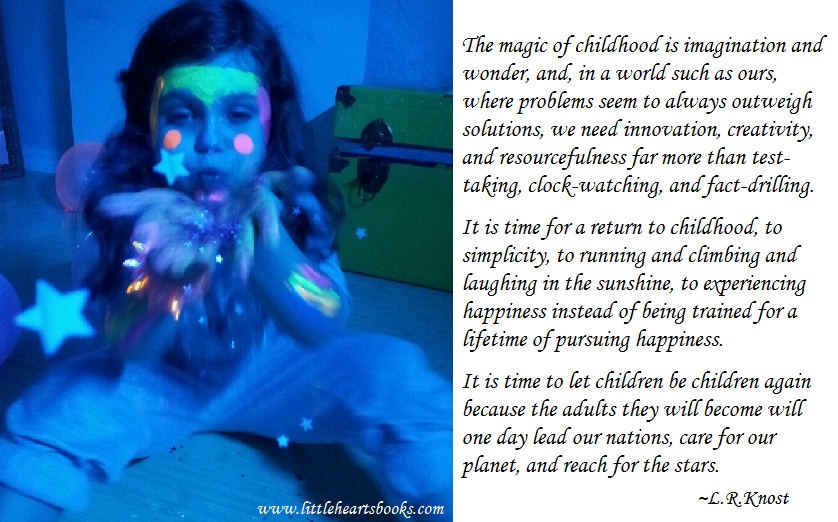

Do you think my little dirt magnet enjoyed her homeschool day?
Related posts:
The Seven Wonders of the World of Childhood
Raising Super Readers~The MARVELous Power of Comic Books!
The Measure of Success~Chinese Parents and French Parents Can’t BOTH Be Superior!
Alphabet Fun~Imagination From A to Z!
Live to Play~Play to Learn~Learn to Live!
One Slippery Sock & Other Silly Tools for your Parenting Toolbox!
Award-winnning author, L.R.Knost, is the founder and director of the children's rights advocacy and family consulting group, Little Hearts/Gentle Parenting Resources, and Editor-in-Chief of Holistic Parenting Magazine. Books by L.R.Knost include Whispers Through Time: Communication Through the Ages and Stages of Childhood ; Two Thousand Kisses a Day: Gentle Parenting Through the Ages and Stages ; The Gentle Parent: Positive, Practical, Effective Discipline ; and Jesus, the Gentle Parent: Gentle Christian Parenting the first four books in the Little Hearts Handbook gentle parenting series, and children’s picture books Petey’s Listening Ears and the soon-to-be-released Grumpykins series.
The Gift of Breastfeeding!
[Portions reprinted from Two Thousand Kisses a Day: Gentle Parenting Through the Ages and Stages by L.R.Knost. Whispers Through Time: Communication Through the Ages and Stages of Childhood, and The Gentle Parent: Positive, Practical, Effective Discipline also available on Amazon and through other major retailers.]
A newborn baby has only three demands. They are warmth in the arms of its mother, food from her breasts, and security in the knowledge of her presence. Breastfeeding satisfies all three. ~Grantly Dick-Read
Breastfeeding, like exercise, is one of the most highly preventive and cost-effective ways to protect the health of mothers, babies, the population, and the planet. Yet, the U.S. has one of the lowest rates of breastfeeding among industrialized countries and one of the highest rates of infant mortality. Our rates of breast cancer, diabetes, obesity, and asthma are growing at an alarming pace. It is estimated that normal breastfeeding rates could save the U.S. $13 billion and 911 lives annually on health care & associated costs for just 10 diseases.

Sweet, milky giggles
Baby’s trusting eyes look up
Forging bonds that last. R.H.
Excellent information from Kellymom about how to get a comfortable latch and position for nursing.

The Guggie Daily: God Wants to Breastfeed His People
 The Normal Newborn & Why Breastmilk isn’t Just Food

Breast Milk~The Original Soul Food
We have breasts to feed our young but we also have brains that tell us this is more than nutrition.. this is comfort, bonding, the original Soul food!

“Breastmilk, unlike formula is a living organism. When one looks at breastmilk under a microscope there is plenty of movement. Contrast that with formula, where the petri dish reveals a stagnant state. Formula is dead. It cannot change to meet the needs of a particular infant. It does not change during a feed…”

Lovely thoughts from a breastfeeding mama.
 What Kind of Woman Breastfeeds a Toddler?
An amazing array of women from every walk of life who share their breastfeeding journeys~Compiled and shared by The Mule
Low Milk Supply~Set up for failure
SIDS (Sudden Infant Death Syndrome), Asthma, Childhood Leukemia, Diabetes, Gastroenteritis, Otitis Media (ear infections), LRTIs (pneumonia, bronchitis, etc), Necrotizing Enterocolitis, Obesity, and other potentially life-altering or fatal conditions…
If you knew that there was one medicine or vitamin or herbal supplement that has been proven, PROVEN, beyond a shadow of a doubt in study after study by mainstream, published, respected doctors, researchers, and scientists, to significantly reduce the risk of every single one of those things listed above, would you give it to your baby?
Breast cancer, Ovarian Cancer, Diabetes, Heart Disease, Obesity…
What if that wonder drug could also drastically reduce your risk of each of these health threats?
13 billion…BILLION…dollars lost in the U.S. alone in PREVENTABLE medical costs.
If you knew that there was one thing you could do to save billions of taxpayer dollars that could go to feed the hungry, house the homeless, research cures for other devastating diseases, provide health care to the poor, would you do it?
The Journal of the American Academy of Pediatrics released a study in April of 2010 detailing just what that one medicine/vitamin/herbal supplement is…and the ‘miracle drug’ is  none other than BREASTFEEDING. The study concluded that, “The United States incurs $13 billion in excess costs annually and suffers 911 preventable deaths per year because our breastfeeding rates fall far below medical recommendations.” And those numbers are only based on breastfeeding benefits for the first six months of life! The World Health Organization, American Academy of Pediatrics, Centers for Disease Control, and others recommend breastfeeding for the first two years of a child’s life. Imagine the tally if the researchers had looked at the little lives lost and billions of dollars spent unnecessarily in a two year breastfeeding scenario instead of a six month scenario!
In 2009, the CDC released a Breast Feeding Report Card which showed that, while 74% of women start off breastfeeding, only 33% continue to three months and just 14% are exclusively breastfeeding by six months.
Clearly, then, the majority of women at least begin with the desire to breastfeed!
So why are breastfeeding rates so dismal in the United States? For one thing, U.S.hospitals scored a low D (63%) in their compliance with recommendations to provide breastfeeding 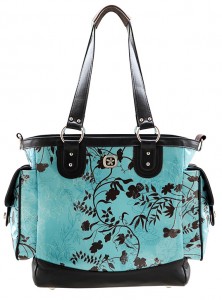 support for women in a 2007 CDC survey. One issue is that hospitals routinely send home ‘failure’ packets of formula with new mommies “just in case,” which sit temptingly in pretty, complementary diaperbags waiting for the inexperienced new mommy to face her first breastfeeding hurdle, her first feeding worry, her first sleep-deprived need to find any reassurance that she’s doing a good job feeding her baby during those first weeks. Another issue is that hospital lactation consultants are typically stretched far too thinly amongst many patients and are only available for a few minutes to get new mommies started, and then most insurance companies don’t cover follow-up lactation support after mommies leave the hospital. Other issues in the hospital include delaying the new mommy’s ability to begin breastfeeding immediately by removing the baby to a warming bed instead of laying the baby on the mommy’s tummy, and too early interventions such as eye ointment, bathing the baby, and taking the baby to the nursery to be evaluated in the absence of medical necessity.
But, even so, 74% of American women triumph over these issues and leave the hospital having established breastfeeding with their newborn. So what happens then? Why does that number fall so dramatically by more than half to 33% by three months and by nearly 80% down to only 14% of women by six months?
Some contributing factors are mothers who must return to workplaces which don’t support breastfeeding with long lunches to return home to breastfeed or flexible schedules which allow for frequent pumping, and insurance companies which don’t cover lactation consultants or breast pumps, and, in a small percentage of cases, health issues with the mother or baby.
All of these issues certainly need to be addressed by hospitals, insurance companies and businesses, and the government can be of service in these areas by providing tax incentives, education, and support.
But there are still more subtle issues that negatively affect breastfeeding rates. Some of these include older mothers relishing in telling horror stories about cracked nipples, thrush, clogged ducts, etc; pediatricians who use weight charts based on formula fed infants and scaring new mothers into thinking their babies aren’t gaining enough weight; and the pervasive, but false, belief that formula is just as good as breastmilk for babies.
One issue, though, that seems to crop up far more than others is low milk supply. Somehow, even though mothers’ bodies are capable of miraculously growing a human being for nine months and bringing that precious new life into the world, those same life-giving bodies are failing to provide life-giving (and saving!) nutrition to those precious babies. Why? For some, it is certainly just fear-mongering by those pediatricians using the formula fed babies’ charts or by grandmothers who believe that all babies should be chubby that lead new mothers to believe they have low supply, but there does seem to be an ever-increasing number of babies legitimately labeled as failure-to-thrive with low milk supply labeled the cause.
One crucial piece of false information can be blamed for the vast majority of low milk supply issues in the absence of a documented medical cause.
That false information? New mothers are told their babies should sleep through the night.
That is one of the most pernicious lies ever foisted on new parents. Babies biologically should NOT sleep through the night. Not only is the deep sleep required to sleep through the night actually a recognized factor in SIDS deaths, but babies who sleep through the night are also not nursing to stimulate breastmilk production, thus their mother’s milk begins to dry up. Clearly, that’s not a healthy biological design!
Here is a picture of what this vicious cycle can look like:
Lydia battles the lack of breastfeeding support at the hospital and triumphantly goes home a breastfeeding mother, formula ‘fail’ packet tucked securely in the chic little complementary diaperbag in the trunk along with stacks of information about how healthy formula is and lots of lovely formula coupons.
 She gets her precious baby home and settles in for her twelve week ‘babymoon’ before she has to return to work because that’s all the time her work allows. She’s already nervous about how she’s going to handle the return to work, leaving her sweet baby in someone else’s care, and trying to pump to maintain her milk supply and provide milk for her baby while she’s gone, but she pushes those thoughts aside and suppresses the anxiety as much as she can. The first few nights are pretty easy because her baby sleeps most of the time, so Lydia is able to get a little rest in between feedings. She reads up on some parenting advice in a couple of popular magazines and discovers that she should be working to schedule her baby’s feedings at 3-4 hour intervals. That makes her feel a bit worried because she’s just been feeding her baby whenever he seemed hungry, so she gets a notebook out and writes down a schedule.
Over the next couple of weeks, things get a bit more difficult as she walks and bounces and rocks her baby, anxiously watching the clock until she can satisfy her baby’s cries and nurse him. Her baby seems to be crying more and more often. As her stress level increases, she pours over parenting books and magazines, trying to find solutions to her baby’s distress. Over and over again, she reads that babies need to be on a strict schedule and be trained to self-soothe and sleep through the night.
Lydia desperately wants to be a good mother, so she braces herself and begins to stop nursing before her baby falls asleep and laying him down on his own to fall asleep alone. She cries listening to his screams, but confines herself to occasionally stepping into the room to pat him gently for a moment, tears streaming down her cheeks as she leaves him to cry himself to sleep.
A few weeks later, her pediatrician expresses some concern about her baby’s slowing weight gain, but cheerfully assures her that she has just become a ‘midnight snack’ for her little one and needs to begin cutting out night feeds so her baby can learn to sleep through the night.Lydia feels sick to her stomach as she leaves the doctor’s office, but is determined to put her feelings aside and be a good mother.
Lydia experiences some engorgement issues for the first few nights, but the discomfort is nothing compared her heartbreak at listening to her baby cry. Over the next few weeks, she notices a perceptible decrease in the volume of her breasts and her let down reflex feels weak. Her fears are confirmed when she takes her baby back to the pediatrician who is alarmed to find that Lydia’s baby has actually lost weight. Lydia leaves the pediatrician’s office with a diagnosis of failure-to-thrive for her precious baby, low milk supply for her, and a feeling of utter failure as a mother.
At home, Lydia searches for the chic little diaperbag with the formula ‘failure’ packet and mixes up a bottle, tears falling as she becomes just another statistic.
~~~~~~~~~
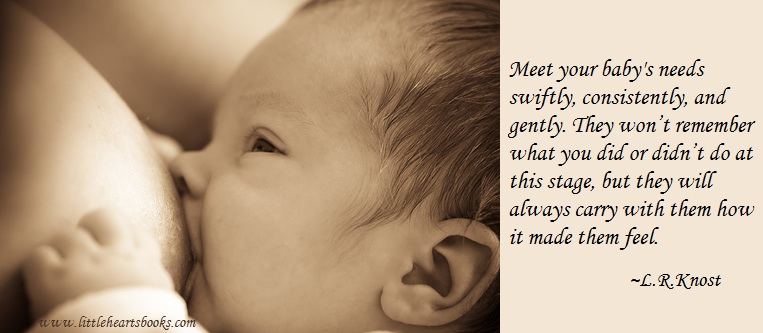
Feeling forced to ignore her natural mothering instincts because of prevailing mainstream parenting practices, Lydia’s anxiety steadily increased in her baby’s first weeks, negatively affecting her milk supply. Nursing on a schedule prevented her from receiving the stimulation of milk production inherent in the frequent suckling of a baby allowed to nurse on demand. But the breastfeeding coffin was sealed when night nursing ended and with it the loss of hours and hours of milk stimulation resulting in that modern epidemic ~ low milk supply.
 Related links:
Love in the Time of Cosleeping
And Baby Makes Three~Surviving the first three months with a newborn!
Breastfeeding, Babywearing, and Bouncing Back into Shape after Baby
A Boy, A Girl, and A Baby~Journey to Gentle Parenting
Babywearing Basics Resource Guide
Practical Gentle Discipline Guide
Award-winnning author, L.R.Knost, is the founder and director of the children's rights advocacy and family consulting group, Little Hearts/Gentle Parenting Resources, and Editor-in-Chief of Holistic Parenting Magazine. Books by L.R.Knost include Whispers Through Time: Communication Through the Ages and Stages of Childhood ; Two Thousand Kisses a Day: Gentle Parenting Through the Ages and Stages ; The Gentle Parent: Positive, Practical, Effective Discipline ; and Jesus, the Gentle Parent: Gentle Christian Parenting the first four books in the Little Hearts Handbook gentle parenting series, and children’s picture books Petey’s Listening Ears and the soon-to-be-released Grumpykins series.
Gentle Discipline Resource Guide
[Portions reprinted from The Gentle Parent: Positive, Practical, Effective Discipline by L.R.Knost available November 2013; Two Thousand Kisses a Day: Gentle Parenting Through the Ages and Stages and Whispers Through Time: Communication Through the Ages and Stages of Childhood now available on Amazon.]
 Many people believe that gentle parenting is a form of unparenting, but nothing could be further from the truth. Gentle parenting is involved parenting ~interactive, engaged, active parenting. It takes focused attention, planning, participation, research, and so much more to be an empathetic, responsive parent who is in tune with their child’s needs and who is prepared to make whatever sacrifices are necessary to meet those needs. That said, in any home, like in any civilized society, boundaries are necessary for everyone’s safety and comfort. It is in the choosing and enforcing of those boundaries that gentle parenting distinguishes itself. In a gently parented home, boundaries are focused on guiding rather than controlling children and are enforced through empathetic and creative resolutions rather than harsh punitive consequences. If you’d like to transition to a more gentle mode of parenting, but don’t know where to start, below are links to alternatives to punishment, and here is a guide to help you set yourself up for success in your journey to gentle parenting…12 Steps to Gentle Parenting.

When Things Get Physical: Hitting, Throwing, Kicking, and Biting
The concept of using consequences, physical or otherwise, as a deterrent for hitting is based on the misconception that small children have the capacity for forethought (i.e. If I hit, I will get in trouble. Therefore I will not hit.) and that they are choosing to disobey. The fact is that the prefrontal cortex, where reasoning, logic, and forethought take place, is highly immature in toddlers and preschoolers and actually doesn’t develop fully until the mid-twenties! Small children act instinctively and impulsively even when not stressed simply because that is what they are developmentally capable of, but when they are stressed even the small amount of self-control they may have attained flies right out the window, and before they know it (literally!) they’ve reacted physically to their stress. Read more
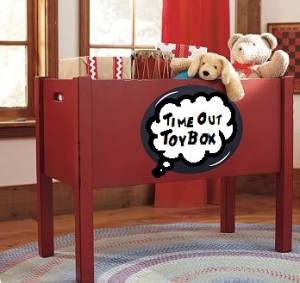 Testing the Boundaries~What’s a Parent to Do?
Typically, I advise parents to use Time-Ins instead of Time-Outs in order to connect-to-correct, but there is one area that I advise the use of Time-Outs…the ‘Time-Out Toy Box!’ When a toy is misused (i.e. thrown, used to hit, drawn on, fought over, etc) and a gentle redirection has been given, the next step for the toy is to be put in the ‘Time-Out Toy Box.’ Little ones generally find the concept of a toy being put in Time-Out rather humorous and go along with the removal without a fuss (the toy can be returned after an exaggeratedly stern warning to the toy letting it know what is expected of it and that it must listen to ‘the boss’ ~the child, lol. They love that!), but remember to communicate, listen, and be flexible. If the removal of a toy brings about a strong negative response, it may be that the inappropriate behavior was more than just…Read more

Few things ignite a parent’s temper like defiance. It feels like a slap in the face, a direct challenge to our authority. Power card…played. Gauntlet…thrown. Challenge…accepted?
Time out! No, not time-out as in punish your child, but time out as in hit the parental pause button, take a step back, assess the situation, and get some adult perspective.
There are three things to consider…Read more

Toddlers, Tantrums, and Time-In’s, Oh My!
Punishing them, yelling at them, sending them to their room, or putting them in time-out disconnects them even further from their source of security and not only delays a resolution of the issue, but misses an opportunity to equip them with the tools they need to handle future problems.
One effective tool for use in helping little ones cope with big emotions is a Calm-Me-Jar…Read more

Parenting a Strong-Willed Child
There are some children who are born into the world with the incredible life-gift of a strong will and an indomitable spirit. These children are often deeply misunderstood, and there are rows of books lining bookstore shelves with instructions about how to break their will, how to subdue their spirit, how to force their obedience. What an incredible loss of leadership, passion, and insight this world suffers when parents follow these punitive parenting practices. Not only can we parent these gifted children with gentleness and respect, but the gifts we get in return are priceless! …Read more
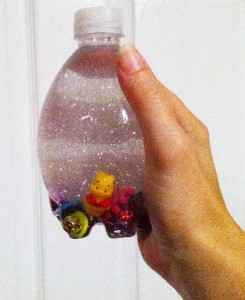 Easy Peasy DIY Parenting Tools
I-spy Water Jars, Quiet Bags, Calm-Me-Jars, Cozy Corners, Punch Bags, and more…Read more
 To a Toddler Sharing is a 4 Letter Word~MINE!
Almost from the moment a baby is born, parents teach them not to share. “No, no, sweetie. That’s mommy’s” and “That’s daddy’s, not yours” accompanied by the removal of whatever the forbidden item is are daily realities for little ones. This is unavoidable, of course, since bacteria-ridden keys don’t belong in little mouths and iphones don’t work well when soaked in drool.
But the challenge comes when our little ‘reflectors’ are expected to share their toys with anyone and everyone who takes a liking to them…Read more
 Spare the Rod: The Heart of the Matter
One of the hot-button issues when it comes to discipline and children is spanking, and the more Christian and conservative the audience, the more hot the debate becomes! There are no verses in the New Testament that support spanking, flogging, whipping, or otherwise hitting children. In the Old Testament there are…Read more
 Your Baby isn’t Trying to Annoy You; He’s Trying to Communicate! From the moment a child enters the world, they are trying to communicate. Crying, grunting, making eye contact, mirroring expressions, all of these things are the instinctive tools built into infants to reach out into a brand new world and make contact. They can do no more. It is entirely up to the parent to make the connection, to respond, to build those all-important ‘lines of communication’ that will be so vitally important to parents in later childhood. Communication is not something that just happens. It is not something that begins when a child becomes verbal, and it’s not a product of a child’s advancing maturity. Communication is a process, a relational building block, a result of intentional and responsive parenting. Read more
 Tots to Teens~Communication through the Ages and Stages
The evolution of children’s communication proceeds at a steady and relatively predictable pace, though the timing is influenced by factors such as individual personality, cognitive development, home environment, etc. Here’s what to expect through the ages and stages…
 Babes and Boundaries~A Gentle Parenting Perspective Gentle parenting doesn’t mean parenting without boundaries! Believe it or not, the foundation for discipline (guiding, leading, teaching…NOT punishment ) begins in the newborn and infancy stages. When parents respond quickly, consistently, and gently to their baby’s cries, the trust relationship that the parent is establishing becomes the cornerstone for later discipline. Boundaries need to be established for a child’s safety and growth into a successful citizen of our world. A child who is secure in the knowledge that he doesn’t have to fight to be heard or to have his needs met is more open and adaptable to limits. And when the ‘limit-setter’ is a person the child trusts, the enforcement of those boundaries becomes a matter of connection and communication instead of conflict and struggle. So, what might setting and enforcing boundaries using gentle parenting look like in real life? Read more
 Parenting in Public~What’s in Your Quiet Bag? More and more public places are becoming child un-friendly with snarky signs saying they’ll give your child an espresso and a pony if you don’t control him or charge you extra if you dare to enter their establishment and support their business with your hard-earned money or even flat out ban you altogether if you bring ‘the beast’ out in public with you! So what’s a parent to do? Read more
 Discipline & Behavior via Dr. Sears
You probably never thought of attachment tools, such as breastfeeding and babywearing, as being acts of discipline, but they are. Attachment parenting is like immunizing your child against emotional diseases later on. Your knowledge of your child becomes like a sixth sense enabling you to anticipate and control situations to keep your kids out of trouble. Discipline is based on building the right relationship with a child more than using the right techniques.
 Parenting toddlers made simple. via T.E.A.C.H. Through Love
Toddlers can be loud, boisterous, erratic, funny, messy, witty and smart all at the same time. They soak up everything they see and hear and that includes our reactions to their actions.
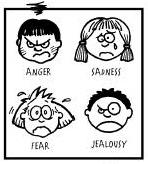
What Children Need Most When They Deserve It The Least via Happy Families
Parents prefer not to have their authority questioned. So rather than considering why a child may be resisting, they up the ante, doing their best puffer-fish impersonation, and make threats.
 Positive Parenting in Action: Exploration/Danger via Positive Parenting
Don’t mistake independence for defiance. Some toddlers are more strong-willed and independent than others. My first son was very mellow and content under my wing, while my second wanted independence early. He doesn’t want to hold my hand in parking lots (we’ll address that one!) because he says “I can walk by myself!”

With a healthy relationship based on open, honest communication, issues can be addressed as they arise and in a respectful and timely manner instead of a teen feeling the need to go ‘underground’ with their behavior or problems. Here are some practical tips for raising teens in a respectful and peaceful manner.
 Gentle Discipline: So what DO you do? via The Path Less Taken
Some people, for any number of reasons, do not know about alternatives. They don’t know that there’s another way. Some people want to do things differently, and want to break their cycle, but they honestly do not know where to start.
 Proactive Discipline and Well-behaved Children via Gentle Christian Mothers
Most people seem to think that physical punishment is the only way to elicit good behavior and assume that children who aren’t given prompt and regular spankings will be out of control “monsters”. Well, my kids are not perfect little robots. They have to be reminded to do things and they fight with each other. But my focus is not so much on obedience (do what I say right now!) as you might have expected. Instead my focus is on raising kids who are generally polite and content and care about how those around them feel. And that’s what I’ve got, kids who are noticeably considerate to adults and other children alike.
 6 Steps to Stop Yelling Dr. Laura Markham/Aha Parenting.com
We all know that our kids respond better if we don’t yell. Instead of escalating a difficult situation, if we can stay calm, it settles everyone else down. Our relationship with our child strengthens. They cooperate more. They start to control their own emotions more. Bottom line: How can you expect your child to control his own emotions if you don’t control yours?
 The One Thing You Can Do That Will Drastically Improve Your Interactions with Children via Real Child Development
If there was one thing you could do differently that would drastically improve your interactions with children would you want to know? Would you like to know the key that would increase cooperation, reduce tantrums, fighting and negative behavior?
 Gems via Mothering by Grace
This is a FAST way of making your child feel loved, valued and secure. GEMs help your kids feel affirmed and noticed, so their need to get your attention in negative ways decreases. Your energy levels will rise as you enjoy your child and remember what it’s all about. By focusing on your child and meeting their emotional needs for connection you are actually taking care of yourself at the same time. It takes only a few minutes to have a GEM, yet the positive effects last for ages.
 Why Spanking is Never Okay via Peaceful Parenting
Scientific research shows that physical punishment does not work in the long run, is associated with an increased risk for many behavioral and psychological problems, and is simply unnecessary given that we have non-violent discipline techniques that are very effective.
 Gentle Discipline Toolbox via Dulce de Leche
Gentle, effect tools for your parenting toolbox!
Related links:
Award-winnning author, L.R.Knost, is the founder and director of the children's rights advocacy and family consulting group, Little Hearts/Gentle Parenting Resources, and Editor-in-Chief of Holistic Parenting Magazine. Books by L.R.Knost include Whispers Through Time: Communication Through the Ages and Stages of Childhood ; Two Thousand Kisses a Day: Gentle Parenting Through the Ages and Stages ; The Gentle Parent: Positive, Practical, Effective Discipline ; and Jesus, the Gentle Parent: Gentle Christian Parenting the first four books in the Little Hearts Handbook gentle parenting series, and children’s picture books Petey’s Listening Ears and the soon-to-be-released Grumpykins series.
10 Steps to Surviving the First Three Months with a Newborn
[Reprinted from Two Thousand Kisses a Day: Gentle Parenting Through the Ages and Stages by L.R.Knost. Whispers Through Time: Communication Through the Ages and Stages of Childhood; The Gentle Parent: Positive, Practical, Effective Discipline; and Jesus, the Gentle Parent: Gentle Christian Parenting also now available on Amazon and through other major retailers.]
~~~~~~~~~~~~~~~~~~~~~
 So, your precious baby has finally arrived! After a perfect pregnancy and blissful labor and delivery, you’ve come home (in your pre-pregnancy clothes, of course!) with your beautiful baby, ready to start life as the perfect parents of a perfect child. Yeah, right! Actually, after a pregnancy in which you threw up more times than you can count and yet still managed to gain an embarrassing amount of weight, and where your feet swelled to unrecognizable lumps at the bottom of your legs, you finally suffered through a hideously long, painful labor and delivery only to arrive home (in your largest maternity outfit which barely fit!) with a screaming, vomiting, miniature human being who can’t tell you why he’s upset and who poops what can only be described as TAR! What are you going to do now?!?
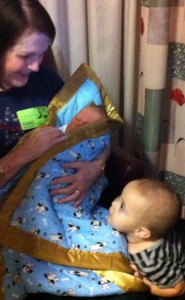 First, call your mommy! No, really, if you have a mom or a grandma or an aunt or a good friend who has any experience with babies, ask for help! As long as there have been babies being born, there have been women gathering around to help new mamas through those first intense weeks with a newborn. Experienced helpers can make all the difference in how well you survive the sleepless nights, crazy hormones, and vast uncertainties that come with being a new parent.
Beware, though, the experienced helpers who are a bit too helpful and try to push you out of the way even to the extent of trying to guilt you into leaving your baby behind to go on a walk or a date-night ‘for the good of your marriage.’ In the first place, having to leave your baby behind to preserve your marriage isn’t a great precedent to set with your husband. You two are in this together and setting a precedent of family first is a good idea! And secondly, the whole point of having help is not only for you to recover, but also so you can become experienced yourself in taking care of your baby. And on that note…
Second, while accepting help is vital, make sure that everyone knows that this baby is YOUR baby and YOU will decide what is best for you and your child. Listen to all the advice; take what makes sense to you; and chuck the rest. Let your helpers do the housework and the cooking and the errands while you take care of and get to know the new little addition to your family. If your instincts tell you to hold your baby, even while she sleeps, then hold your baby even while she sleeps! If your instincts tell you to nurse your crying baby even though you just nursed fifteen minutes ago, then nurse your baby! God gave you those instincts for a reason, so don’t ignore them!
Third, I know we’ve all heard the ‘sleep when your baby is sleeping’ advice. Listen to that advice! Short little naps may not seem all that helpful in theory, but they can be lifesavers when getting used to the rigors of new parenthood. And keep reminding yourself that it will get better, because it will!
Fourth, whether you’ve chosen to breastfeed or bottle feed, expect your little one to eat erratically right at first. Remember, babies nutritional needs were met with a constancy and lack of effort in utero that can’t be fully replicated outside the womb. Their tummies are only about the size of a walnut in the first days, so they can’t eat enough at a feeding to last them more than two or three hours at most, and often far less! Also, if you’re breastfeeding it’s common to worry that your baby isn’t getting enough milk, but if you keep in mind how itty bitty their little tummies are, you’ll realize that it doesn’t take much to fill them up. Things to consider with breastfeeding are getting a good latch and establishing your supply, among others, and it’s often helpful to consult a lactation specialist for guidance. There are excellent resources available in most communities through your local hospital as well as online resources such as La Leche League and Kellymom.com.
Fifth, while bathing baby may be fun, it really isn’t necessary and might be rather traumatic for them. ‘Topping and tailing’ is a term that means taking a warm, wet cloth (no soap) and gently washing their eyes (inner corner to outer corner to avoid infection), face, ears, head, and neck, and then washing their bottom, being careful to clean out all the little cracks and crevices. Follow that with cord care (gently cleaning the cord area with a cotton swab moistened with a bit of alcohol or just water), and you’re done!
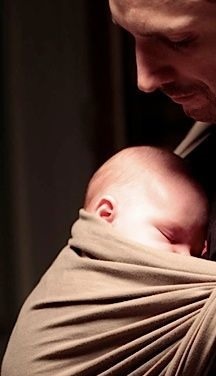 Sixth, birth is a huge transition for a baby. From a warm, dark, weightless environment where all their needs are met, sounds are muffled, and mama’s heartbeat lulls them to sleep, they are abruptly ejected into a cold, loud, bright world where they experience hunger and discomfort and loneliness and fear for the first time. You can help your little one cope by easing the transition for him. Keeping the lights a bit dimmer and the sounds a bit more muted right at first is helpful in welcoming your baby to your world. Also, it’s helpful to wear your baby in those first transitional weeks (and often far longer when you discover how convenient it is!). Babywearing is a term that refers to using a baby carrier, wrap, or sling to keep your baby close to you where he can hear your heartbeat and feel your warmth and closeness in an approximation of your womb. All of these things will help to reduce your baby’s stress as he acclimates to his new environment, and a less stressed baby tends to result in a less stressed mommy. And, don’t forget daddy! Babywearing is a wonderful way for daddies to bond with their babies. Studies have shown that close physical contact between fathers and their infants causes a hormonal response similar to when a mother gives birth, increasing the nurturing response naturally and paving the way for a healthy attachment and strong parent/child relationship.
Seventh, there is a big divide in parenting circles between the ‘co-sleepers’ and the ‘crib-sleepers’ so be aware that whichever choice you make will probably be challenged by more than one of your friends or relatives or even complete strangers who seem to have no issues with giving advice to someone they don’t know! Bottom line, if you choose to co-sleep, check here for ‘safe co-sleeping’ options, and then follow your instincts! If you choose to put your little one in a crib or bassinet, do yourself a favor and put it next to your bed to reduce your travel time in the middle of the night. You’ll thank me, I promise!
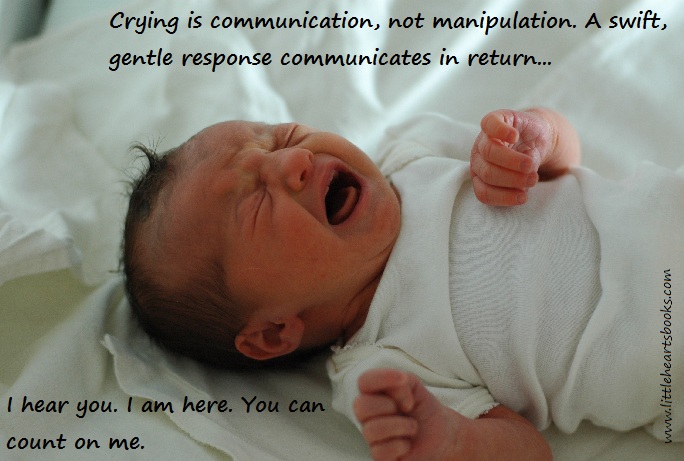 Eighth, your baby is completely and totally helpless in every way. Her main mode of communication is crying. Medical experts agree that it isn’t possible to spoil a newborn, and you are just at the beginning stages of building a trust relationship, so respond promptly to your little one’s cries! Your immediate response to your baby’s needs will help her begin to learn that she can count on you when she needs you and that she doesn’t have to ‘fight’ for your attention. Babies left to cry-it-out often do sleep through the night sooner than babies whose needs are responded to because they have learned to give up on their needs being met. But that ‘gain’ of sleeping through the night is accomplished at the ‘loss’ of trust, and the long-term consequences of a child giving up on her parents simply aren’t worth it.
Ninth, baby yourself! Whether you’ve had a c-section or a vaginal birth, your body has been through the wringer; your hormones are all over the place; and your lack of sleep is not helping matters! Have someone make you a ‘survival basket’ with water bottles, granola bars, minty gum, hand sanitizer, diapers, baby wipes, burp rags, and, most importantly, chocolate! It needs to be small and light enough for you to take from room to room with you while carrying your baby. Also, have someone make a comfy area in your living room for you to nurse (with your survival basket within reach!) and a changing area so you don’t have to go back and forth to the bedroom or nursery throughout the day. Take showers when you can. Accept casseroles and other offerings of meals from friends and church members and co-workers. And, if you don’t have help for the housework, just do the bare minimum so you can rest and recover and focus on getting to know your precious new baby!
Tenth, baby your marriage! This is a huge, huge, huge transition for you and your husband, so both of you apologize to each other in advance for any temper tantrums, thoughtless words, or unmet needs that might (will!) occur in the foreseeable future. You are going from ‘the two of us’ to ‘we three’ and, just as with anything else, change isn’t easy. Husbands, it’s not about you right now, period. Yes, you have your own issues to deal with in becoming a parent for the first time, but you need to put that aside for the first weeks and concentrate on your wife and child. Your wife isn’t just having to deal with becoming a mommy, but her body has been through an incredible transition during the previous nine months followed by the trauma of labor and delivery followed by crashing hormones, the trials of learning to breastfeed (or deal with engorgement issues if choosing to bottle feed), and the exhaustion of dealing with a newborn’s erratic sleep patterns. If she’s also had a c-section, you can add major abdominal surgery to that list! So, husbands, put your own issues aside and baby your wife and baby for the time being! Wives, a little verbal acknowledgement goes a long way with husbands, so try to muster up enough energy to tell your husband that you appreciate him and understand that he is trying to figure out this new life just like you are, and assure him that eventually you will be you again! (Yes, you will. It just takes time!)
Final thoughts: One of the things that has kept me going through giving birth to six children (and losing several others along the way) is the assurance that ‘this too shall pass.’ As with all changes in life, it takes time to adjust, but reminding yourself that this ‘will pass,’ and you will adjust, and life will go on is very, very helpful! Also, take time to enjoy the little things–the sweet smell of your newborn’s tiny head, the soft sounds of his breathing as he sleeps, the sight of your spouse staring into your beautiful baby’s eyes–because too soon this time will pass and these precious moments will become mere memories. Congratulations and God bless!
 Related links:
Love in the Time of Cosleeping
A Boy, A Girl, and A Baby~Journey to Gentle Parenting
300+ Nicknames for Your Babykins…Doodlebug…Snugglebunny…
200 Ways to Bless Your Children with a Happy Childhood
Babywearing Basics Resource Guide
Breastfeeding, Babywearing, and Bouncing Back into Shape after Baby
Practical, Gentle, Effective Discipline
Four Ways Attachment Parenting Can Reduce the Risk of SIDS
The Science of Sleep: Newborns
Where Did You Learn Love, Child?
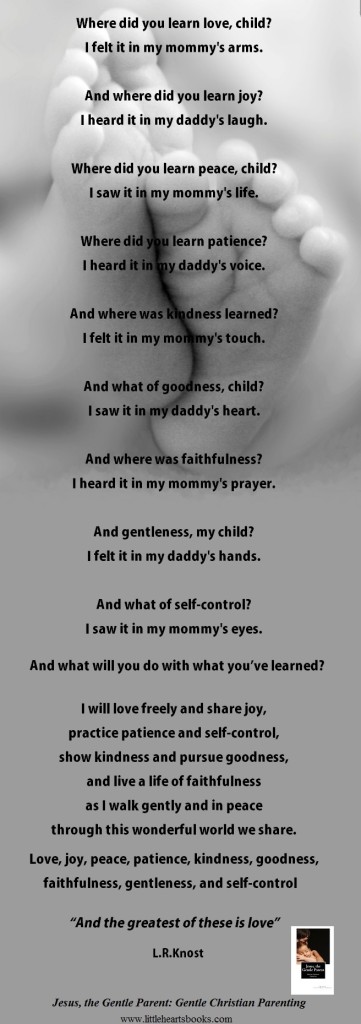
Award-winnning author, L.R.Knost, is the founder and director of the children's rights advocacy and family consulting group, Little Hearts/Gentle Parenting Resources, and Editor-in-Chief of Holistic Parenting Magazine. Books by L.R.Knost include Whispers Through Time: Communication Through the Ages and Stages of Childhood ; Two Thousand Kisses a Day: Gentle Parenting Through the Ages and Stages ; The Gentle Parent: Positive, Practical, Effective Discipline ; and Jesus, the Gentle Parent: Gentle Christian Parenting the first four books in the Little Hearts Handbook gentle parenting series, and children’s picture books Petey’s Listening Ears and the soon-to-be-released Grumpykins series.
Bizarre Anti-Cosleeping Ads in Milwaukee a Red Herring?
[By L.R.Knost, author of Two Thousand Kisses a Day: Gentle Parenting Through the Ages and Stages, Whispers Through Time: Communication Through the Ages and Stages of Childhood and The Gentle Parent: Positive, Practical, Effective Discipline.]
~~~~~~~~~~~~~~~~~~~~~

In Milwaukee, the local government has declared war on cosleeping. Billboards and signs with scary images of babies next to huge knives, surrounded by mounds of pillows and comforters, no adult in sight, proclaim that cosleeping is dangerous. Of course, the signs belie the message since there are no adults actually sleeping with the babies in the pictures, just knives and suffocation hazards and babies sleeping on their stomachs, all fear-triggering images for parents.
This campaign against cosleeping was launched after the release of the 2010 Fetal Infant Mortality Review (FIRM) Report detailing the statistics behind Milwaukee’s shocking infant death rate. According to Milwaukee’s Commissioner of Health, Bevan K. Baker, “The infant mortality rate in Milwaukee is worse than in almost any other developed country.” (pg 4) The idea that an American city could have such a tragic distinction is certainly staggering. Looking at the statistics reveals some sobering facts:
Infant Death and Stillbirth in Milwaukee
2005–2008 Stillbirths and Infant Deaths
- Of the 807 infant and prenatal deaths from 2005 to 2008, 308 were stillbirths and 499 were infant deaths from all other causes combined.
- 38%, more than a third, of all of the deaths were attributed to one cause, stillbirth. Poor medical care was cited as the overriding contributor.
- Of the 499 infant deaths, 53.7% were due to prematurity. Poor medical care was cited as the overriding contributor.
- More than 77% of the total deaths were due to stillbirth or prematurity with poor medical care cited as the overriding contributor.
- More than 85% of the total deaths were in the African-American community with poor medical care cited as the overriding contributor.
- Of the remaining deaths, 19% were due to congenital abnormalities, 18% to SIDS or accidental suffocation (refers to the sudden unexpected death of an infant due to overlay[adult accidentally smothering an infant], positional asphyxiation, or mechanical asphyxiation, [pg 2]~no breakdown of the numbers of SIDS, positional asphyxiation, or mechanical suffocation vs. overlay were provided in the report), 4.4% were due to infection, 2.4% to murder, and 2.4% to other.
- Note: The report’s ‘Findings,’ or summary, provided at the beginning of the document transposes the 18% of infant deaths from SIDS and accidental suffocation with the 19% of infant deaths from congenital abnormalities. (see pg 6)
- Of the 499 infant deaths, 329 were in the African-American community, and of that 193 were due to prematurity, 65 to congenital abnormality, 39 to SIDS and accidental suffocation, 16 to infection, 8 to murder, and 8 to other.
- Note: The report’s glossary defined accidental suffocation as “… overlay, positional asphyxiation, or mechanical asphyxiation” but throughout the rest of the document used the phrasing “SIDS, overlay, or accidental suffocation.”
- In summary, in excess of 85% of the total deaths were in the African-American community. More than 77% of the total deaths were due to stillbirth or prematurity. Poor medical care was cited as the overriding factor in these deaths. Of the 807 total deaths, 88 were due to either SIDS or positional asphyxiation or mechanical asphyxiation or overlay with no distinction in the causes provided.
- Note: Risk factors for stillbirth, prematurity, SIDS, etc. were listed and provided in multiple generic tables, but no tables or statistics about actual risk factors found in the Milwaukee deaths were provided.
So, with no actual numbers of how many of the 88 out of 807 deaths were due to ‘overlay,’ or adults laying on top of and smothering an infant, and with the overwhelming majority of deaths being related to poor medical care in their own report, the local Milwaukee government launched a multi-faceted campaign to…blame the grieving parents.
Not only are they spending taxpayer money to pay for advertising, consulting, billboards, etc in their attack on cosleeping, effectively shifting the limelight away from the real issue, but they also blamed smoking and maternal obesity for the extreme numbers of deaths due to stillbirth and prematurity. Their report, in contrast, showed maternal infection or medical condition to be the primary culprit (read-poor medical care).
Why the red herring? The report, while clearly skewed (see notes), still offered a look at the real issue plaguing Milwaukee: POOR MEDICAL CARE. The report recommended increased access to medical care and improvements in the quality of that care, and yet the focus of the economic and personnel resources of the city in response to the report have been blame-shifting, fear-mongering, and slight-of-hand. Without access to the city’s internal records, we may never know what really brought about Milwaukee’s dangerously substandard medical care implicated in the Fetal Infant Mortality Review, or discern the cause of the extreme bias toward African-American babies dying in Milwaukee, or discover the root of the subsequent bizarre publicity campaign by the local Milwaukee government against cosleeping, but we can be sure of one thing, “Something’s rotten in Denmark…er, Milwaukee.”
Here are some cosleeping research and safety resources:
Love in the Time of Cosleeping
Dr Sears Addresses Recent Cosleeping Concerns
Cosleeping: Fear Mongering, Flawed Research and How to Cosleep Safely
Co-Sleeping – Sorting the Truths from the Myths and the Downright Lies.
And a petition to remove the offensive ads:
Milwaukee, remove the fear mongering co-sleeping ads!
Award-winnning author, L.R.Knost, is the founder and director of the children's rights advocacy and family consulting group, Little Hearts/Gentle Parenting Resources, and Editor-in-Chief of Holistic Parenting Magazine. Books by L.R.Knost include Whispers Through Time: Communication Through the Ages and Stages of Childhood ; Two Thousand Kisses a Day: Gentle Parenting Through the Ages and Stages ; The Gentle Parent: Positive, Practical, Effective Discipline ; and Jesus, the Gentle Parent: Gentle Christian Parenting the first four books in the Little Hearts Handbook gentle parenting series, and children’s picture books Petey’s Listening Ears and the soon-to-be-released Grumpykins series.
A September to Remember: Babies deal with stress naturally
Today’s guest poster for ~A September to Remember~ is Leslie from THE MOM: INFORMED. Be sure to head over and check out her site!
 Stress. I have it, you have it, and chances are even your kids feel it. To deal with stress, most people self-soothe and learn a coping mechanism. Some people smoke, some people run, others take medicine. I notice that I have quite a few soother habits; I bounce my leg or twirl my hair or chew the inside of my cheek.
Some autistic folks develop quite the arsenal of self soothing exercises…some spin to center themselves, some flap their arms, some repeat words, numbers or phrases. People with OCD have their own unique quirks for dealing as well.
Babies and toddlers have ways to deal with stress themselves…crying, sucking, nursing, sleeping. Babies who nurse get their non-nutritive sucking needs met by suckling the breast. That’s how they seem to best get their stress dealt with. Bottle fed babies sometimes go for thumb or pacifier sucking to meet that need. Other kids hold blankets or dolls.
The point of this post is to get you to look at pacifying and thumb-sucking and non-nutritive nursing in a new light. It isn’t something for lazy mom’s to use. It isn’t something kids use as manipulation. It starts out as a reflex that is found to be quite soothing and stress relieving. Most kids stop using a pacifier between 2 and 4 all on their own. Most kids stop sucking their thumb between 4 and 6 all on their own. A couple of great medical posting on non-nutritive sucking and why it’s normal are HERE and HERE . Did you know that thumb-sucking and pacifier sucking release endorphins(the feel good hormone)? Yeah, that’s why it is an excellent tool for babies to cope with stress. Sucking starts out as a reflex that develops into a tool.
So, before you dismiss baby’s need outside of food or even your toddlers need, remember, it is a not a bad thing. It is healthy and natural. And for the most part…most kids give them up on their own when they are old enough to understand and deal with stress in a better manner.

- THE MOM: INFORMED
- My name is Leslie and I am PASSIONATE about educating moms through pregnancy, birth and beyond. I live by this quote: “If you don’t know your options, you don’t have any.” I want EVERY woman to KNOW ALL OF THEIR OPTIONS. I never again want a woman to have to say, “I just didn’t know/if only I had known.”
Award-winnning author, L.R.Knost, is the founder and director of the children's rights advocacy and family consulting group, Little Hearts/Gentle Parenting Resources, and Editor-in-Chief of Holistic Parenting Magazine. Books by L.R.Knost include Whispers Through Time: Communication Through the Ages and Stages of Childhood ; Two Thousand Kisses a Day: Gentle Parenting Through the Ages and Stages ; The Gentle Parent: Positive, Practical, Effective Discipline ; and Jesus, the Gentle Parent: Gentle Christian Parenting the first four books in the Little Hearts Handbook gentle parenting series, and children’s picture books Petey’s Listening Ears and the soon-to-be-released Grumpykins series.
Co-sleeping Safely~Is it possible? Decide for yourself!
 SIDS: The Latest Research on How Sleeping With Your Baby is Safe | Dr. Sears Official Website | Pare
Dr. Sears is considered the leading authority on gentle/attachment parenting and is a proponent of co-sleeping. Here he examines the research linking decreased SIDS risks with the increase in co-sleeping rates. Dr. Sears~ “Here are some ways to educate parents on how to sleep safely with their baby.”
 Cosleeping and Biological Imperatives: Why Human Babies Do Not and Should Not Sleep Alone
 Parenting – A Much Better Way » SIDS, Cribs and Cosleeping » Print
“While many theories are flying around about the cause of SIDS, most focus on the deepness of sleep and how it affects the child’s breathing…Another theory which you may not be familiar with is that the crib mattress itself is to blame for SIDS cases…Arsenic, phosphorus and antimony are intentionally added to crib mattresses by the manufacturers as fire retardants. SIDS was very rare prior to the 1950s when these additives became standard.”

 Breastfeeding Answers Made Simple – Breastfeeding Reporter – Unintended Consequences
 My Date With Dr. Ferber
 How They Do It In… Japan
Related posts:
And Baby Makes Three~Surviving the First Three Months with a Newborn
Bizarre Anti-Cosleeping Ads in Milwaukee a Red Herring?
A Boy, A Girl, and A Baby~Journey to Gentle Parenting
Award-winnning author, L.R.Knost, is the founder and director of the children's rights advocacy and family consulting group, Little Hearts/Gentle Parenting Resources, and Editor-in-Chief of Holistic Parenting Magazine. Books by L.R.Knost include Whispers Through Time: Communication Through the Ages and Stages of Childhood ; Two Thousand Kisses a Day: Gentle Parenting Through the Ages and Stages ; The Gentle Parent: Positive, Practical, Effective Discipline ; and Jesus, the Gentle Parent: Gentle Christian Parenting the first four books in the Little Hearts Handbook gentle parenting series, and children’s picture books Petey’s Listening Ears and the soon-to-be-released Grumpykins series.
Wishes Week 2011~Wrapping it up & putting a bow on top!

Thank you to all of my awesome guests this week for Wishes Week 2011! You gave me a very special birthday gift I will never forget by sharing your wishes with me. Here’s a ((hug)) for each one of you! And now, the ‘wrap up’~

Glimpses My opening contribution to Wishes Week 2011~Glimpses of hope and healing

Meanderings by Rosemary Jones Gritty urban prose by one of my favorite writers…powerful!

My Parenting Wish: Through A Child’s Eyes A beautifully intimate look at compassionate parenting by The Hippie Housewife. Love this!

Birth Wishes Thank you to Becoming Crunchy for this powerful and heartfelt look at birthing options and empowering women…awesome!!!

I wish that I were the Mother that I play at the grocery store. Here is a quirky look at the realities of mommyhood by Jessica, author of Parenting Wild Things!

“What I Wish Every Mother Knew About Babies and Sleep” This wins the prize for most viewed post of the week from Adventures in Mommyhood over at Instinctual Mamas. This is a passionate, informative, and convicting article on meeting babies’ needs gently. Beautiful!

Mommy Wishes From one Mommy’s heart to yours~Mommy Wishes by The Mom: Informed

When God says ‘No’ ~ Wishes Week 2011
~My closing post for Wishes Week~
Thank you to everyone who joined me for Wishes Week 2011! Your comments and ‘presence’ (lol) were much appreciated!
Award-winnning author, L.R.Knost, is the founder and director of the children's rights advocacy and family consulting group, Little Hearts/Gentle Parenting Resources, and Editor-in-Chief of Holistic Parenting Magazine. Books by L.R.Knost include Whispers Through Time: Communication Through the Ages and Stages of Childhood ; Two Thousand Kisses a Day: Gentle Parenting Through the Ages and Stages ; The Gentle Parent: Positive, Practical, Effective Discipline ; and Jesus, the Gentle Parent: Gentle Christian Parenting the first four books in the Little Hearts Handbook gentle parenting series, and children’s picture books Petey’s Listening Ears and the soon-to-be-released Grumpykins series.
Mommy Wishes
 When Little Hearts/Gentle Parenting Resources asked for everyone to post about their * WISHES*, I jumped at the chance, thinking of how it would be easy to come up with a *WISH* to write about. It turns out that I was wrong…it turns out that I have WAY too many *WISHES* I would like to see come true. I *WISH* I could adopt all of the kids with no parents or bad parents; I *WISH* I could bring peace to the world; I *WISH* I could cure cancer…
 their options for themselves and their kids. I *WISH* for all moms to take charge of their pregnancies, their births and their mothering. I want moms to be educated and strong. To know all the options and get to choose for themselves the best road to take. To never be at the mercy of another’s knowledge. There is a saying…I forget how it goes exactly, but, it’s something like, How can I make a choice if I didn’t know the options? Well, my *WISH* is for ALL women to know the options, that way they can make an informed decision and not rely on “experts”, family, friends, or partners to do their deciding for them. Instead of relying on what society tells them to do, they can take a stand and follow their heart and nature.
 Award-winnning author, L.R.Knost, is the founder and director of the children's rights advocacy and family consulting group, Little Hearts/Gentle Parenting Resources, and Editor-in-Chief of Holistic Parenting Magazine. Books by L.R.Knost include Whispers Through Time: Communication Through the Ages and Stages of Childhood ; Two Thousand Kisses a Day: Gentle Parenting Through the Ages and Stages ; The Gentle Parent: Positive, Practical, Effective Discipline ; and Jesus, the Gentle Parent: Gentle Christian Parenting the first four books in the Little Hearts Handbook gentle parenting series, and children’s picture books Petey’s Listening Ears and the soon-to-be-released Grumpykins series.
What I Wish Every Mother Knew About Babies and Sleep
My original guest post for Little Hearts Wishes Week was going to be a list of things I Wish I had Known Before I Became a Mom. However, the sleep portion sort of took a life of it’s own on and that combined with my total disgust for so called “sleep trainers” created this post instead. So my new wishes blog is“What I Wish Every Mother Knew About Babies and Sleep”
 1. There is no such thing as “Sleeping Through The Night”-
Babies do not just magically start sleeping 10+ hrs a night at 6-8 weeks old like so many claim. The term “sleeping through the night” simply means baby sleeps for a 5 hour or longer stretch at one time, and this does not usually begin until 4+ months. If baby goes down at 7pm and you don’t go to bed until 10, don’t be surprised when baby is back up at 12am.
Honestly, you don’t WANT your baby to sleep for long stretches like that anyways~it increases the risk of SIDS. We now know that babies need the constant stirring and waking to keep them from slipping into too deep of a sleep that they are then unable to rouse from.
Young children do not completely develop a true sleep pattern until around age 5. Before that the human sleep mechanisms are not completely formed. So from birth until 5 it is completely normal for your child to wake in the night, and they will. Each of my kids do not wake every night, but since I have four, I am up several times a night with someone (and Sariah does wake 1-2 times every night on top of me getting up with the others a minimum of 1-2 times).
Don’t fall into the Mommy Wars of “my baby is better than yours and this is why…”
To quote Dr. Sears: “An important fact for you to remember is that your baby’s sleep habits are more a reflection of your baby’s temperament rather than your style of nighttime parenting. And keep in mind that other parents usually exaggerate how long their baby sleeps, as if this were a badge of good parenting, which it isn’t. It’s not your fault baby wakes up.”
2. Co-Sleeping is perfectly natural, safe, and NO you will NOT end up with a 6 yr old in your bed still!-
Co-Sleeping, when done safely and correctly, will NOT spoil your baby, and actually INCREASES the success rates of breastfeeding, D ECREASES SIDS rates, and will INCREASE the amount of sleep everyone gets. Think about it, baby is right there with you (whether in your bed or in a side car crib) so when they do start to wake you can get to them quickly instead of stumbling around in the dark down hallways and into another room. The faster you can get to baby, the faster baby will return to sleeping.
I promise it will not last forever, and your baby will eventually transition into their own bed when they are ready. Don’t push them because, as crazy as it sounds now, when they are gone you will miss it. I miss snuggling with my Little Man at night. He stayed in our bed the longest of all of our kids (to date, as Sariah is still sleeping with us) and he was 3 when he transitioned into his own bed. A far cry for the 5-6 age range so many warned me I would be “stuck” with (and honestly I would not have considered myself “stuck” anyway).
3. Babies DO need to eat/drink at night and this does not mean only newborns-
Not only do babies need the nightly wakings to keep them from slipping into too deep of a sleep, they also need the constant night feedings to grow and remain healthy. It is not healthy, and actually can be dangerous, to try and force a baby to sleep through/skip a feeding that they need. Babies, especially newborns-3 months, are at risk of having their blood sugar levels dip dangerously low if they go too long without eating. If a baby wakes to eat, they are NOT trying to manipulate you. A baby cannot manipulate you, and it’s so sad that so many feel that they can.
Children from birth until about the age of 5 can and do need some sort of nourishment in the night. They are small and still growing at dramatic rates. Their systems are different than ours. Honestly, I wake up 1-2 times a night needing to use the restroom and get a drink, so if I am waking up thirsty, why should I tell my kids they have to wait until morning? My kids do not wake every single night asking for something to eat or drink, but when they do wake asking for that, I give it to them. I never ignore them or tell them they are not hungry/thirsty. I would not tell myself I am not hungry/thirsty when my body says I am, yet so many feel that a child’s pleas in the night for food or drink should just be ignored.
4. Please do not fall in the “sleep training” trap-
Sleep Training is harmful to babies, not only increasing their risk of SIDS, but also creating unsecure attachments which can hinder baby’s development. I know it’s hard, trust me I do! I have not slept through the night in almost 6 years now, not ONCE, EVER! Someone is always waking in this house.
I know you can become desperate for sleep, but please do not ever let that desperation go so far that you do things you do not feel comfortable with. If it feels wrong, if your body screams out at you that what you are doing is not right, listen! Trust your instincts, not what some author is trying to sell you. They are out to make money, and that’s it.
There are several so called “Sleep Trainers” and “Sleep Whisperers” out there, each more ignorant and dangerous than the next. This all started 50 years ago with Dr. Spock (no, not from Star trek!). He was the original CIO (cry it out) advocate and had an entire generation of parents believing their tiny babies were out to “get them” from the moment they were born. These “terrible” little babies were on a mission to break and control mommy and daddy, to “manipulate” from day 1 and parents had to rule with iron fists and learn to ignore those ‘manipulative” cries. Funny how so few realize the Dr. Spock recanted everything he taught on his death bed, stating he was wrong and that babies’ cries should be responded to. He said babies should never be left to simply CIO.
Since then many more quacks have paraded around the same CIO dribble as Dr. Spock in a pretty new packaged selling is as “sleep training” for babies. Currently, the worst one (in my opinion) would have to be Tizzie Hall. She calls herself “The Sleep Whisperer” and her method “Save Our Sleep”. Her so-called methods are what got me in such a “tizzie” that my entire blog morphed into this.
If you have never heard of her, like me, you probably live in the US. She is really big overseas in places like Europe, the UK, Ireland, Australia, etc. The Dangers of Baby Training (from FB) describes her as…
“She does have 2 little boys (aged 3 and 1) but wrote the book before she had children. She doesn’t have any qualifications past a normal high school education. Among other things she advocates crying, a 3 hourly feeding schedule if you BF or 4 hourly if you FF, overwrap babies with excessive bedding (which is what The Analytical Armadillo has been questioning recently), has some very misinformed views and ideas which are all based on her observations and opinions, rather than any that can be substantiated by scientific evidence and had some weird notions that babies can poo and vomit on cue to manipulate their parents. In her toddler book, she advocates the use of the ‘holding technique’ to restrain kids and teach them not to touch things (there’s a video on youtube of her demonstrating this) and thinks babies should only be fed purees until they are 12 months, then mashed food, then only real food at approx 24 months old and thinks BLW is ‘inappropriate.’ She is all over facebook at the moment (and not in a good way)…. “
These are quotes taken directly from Tizzie Hall herself either from her book or her forums/FB page. Ironically she has tried to come back and say many of these things she never said or were taken out of context. I have also been informed that she now charges for answers on her forum and refuses to answer anything on FB because those who were against her so called “system” would pick apart her answers….
“I often come across a baby who has learnt to vomit at bedtime during failed attempts at controlled crying. If you have one of these babies you will need to teach your child that vomiting will not get your attention or buy any extra time. This is hard, but it has to be done to stop the vomiting. The way you achieve this is to make the bed vomit-proof. Layer the towels in the bed and on the floor so it is easy for you to remove the vomit. When your baby vomits take the top towels away, leaving a second layer in case of a second vomit. If the vomit has gone on her clothing, undress her and put clean clothes on without taking her out of the cot by moving her to the other end. Do not make eye contact or talk to her while you do all this and be calm and confident through out, so you can fool your baby into thinking you don’t care about vomit.”
-This was taken directly from her book but she claims it was “out of context.” You be the judge.
To go along with this, in the article Victoria White: As a mother I take serious issue with the so- called Baby Whisperer Victoria quotes Tizzie about babies “manipulating” their parents by pooping and instructs parents to ignore this and let baby sleep in the poop to “teach them a lesson”
“‘When he pooed instead, they left him lying in his poo because they “realised” it had become “a game” They changed him after he’d gone to sleep. Don’t worry if you don’t get the bottom of your sleeping baby perfectly clean, says Tizzie, ‘a little bit of poo will not do any harm between then and the morning’.”
Or how about this winner, which is what sent me spiraling into this blog:
Question posted from a follower of the Save Our Sleep Program:
Q ~ ‘I’ve recently started my 7 month old on s.o.s routine. Day 4 and our nights are getting so much better. Before starting bub was waking every 2 hours sometimes less. My partner and I were exhausted. The first night he slept for 4 hours before needing to be resettled, second night was 7 hours and last night was 9.5 hours. Praying tonight is 12. Two little issues, first my boobs are killing me in the mornings now- I’m so engorged. And the second issue is that i think he is getting cold at night. I sleep him in a long sleeve onesie, a sleeping bag and a cellular blanket but he manages to wriggle out from under the blanket and when i go in to check on him he is sleeping on top of the blanket, and he is cold to touch.’
Tizzie’s response:
A ~ Do you have the bedding guide from the SOS website? It shows you what to dress bubs in for temps in various states. Best $9 you’ll ever spend! Need to make sure everything is 100% cotton (incl. mattress protector) otherwise bubs will sweat. Most of us use many more blankets than the guide, every bubs is different eg. I’m in Sydney and in a room of 24.2C my 6m has 12 blankets on + the clothing, bag and wrap mentioned in the guide.
Check out The Analytical Armadillo for a much deeper look into this issue, she actually asked Tizzie about the increased risk of SIDS in regards to babies over heating from too many blankets, here is some of Tizzie’s reply:
“As all of you know before giving any advice I do countless hours of research so I stand by all of my advice. These ladies don’t seem to be aware of the current SIDS guidelines stating as long as your babies head and face are uncovered and you are using cotton or bamboo bedding then it is perfectly safe to layer up the amount of these blankets to keep your baby warm. My opinion and research shows this in return keeps our babies in the safe back sleeping position. Also it is now clear overheating is only cited a risk factor and not as big a factor as was first thought but we do live in a generation with parents so scared of over heating their babies they are doing the opposite and under heating them which in my opinion a greater factor because a cold baby will roll to his or her tummy and sleep face down in the mattress.”
Click the link above to view her full response and so much more.
Sadly there are many more Tizzie Hall’s out there, people looking to make a quick buck on the desperation of sleep deprived parents at their wit’s end. They prey on this desperation to get parents to do things they otherwise would never even consider.
My wish is that parents would just throw all of this baby “training” crap out the window and trust their instincts! Listen to your baby; listen to your body. If it feels wrong, then it IS wrong. Your instincts are there for a reason. My second wish, that parents would stop listening to society and believing their babies are out to “get” and “control” them. A baby is not capable of manipulation; they have no understanding of that. They have simple, basic needs, and their only way to communicate those needs is to cry. Listen to their cries, respond to them, please do not ignore them. Studies now show that when babies are left to CIO or CC (controlled cry, a so called “nicer” form of CIO where you go in every 2, 4, 6 minutes and comfort baby only to leave again) they release the stress chemical cortisol, which is DAMAGING to their little brains. As little as 5 minutes of crying can actually cause damage and prolonged CIOing can lead to developmental delays later on.
I saw a great comparison the other day that took words about leaving a baby alone to CIO to teach them to stop “manipulating” and replaced the word ‘baby’ with ‘grandma’. It was a mock response to Tizzie Hall, thanking her for saving the author’s sleep. The author thanked Tizzie for giving the her the strength to ignore her elderly grandma’s cries in the night and show grandma who was boss in that house. When grandma vomited from being so upset, the author cleaned it up and left grandma without saying a word. After a few nights, grandma stopped crying, and the author said grandma doesn’t say or do much during the day, either, she just lays there silently. The author broke grandma’s spirit-is that what you really want to do to your child? Do you want to break your baby’s spirit, to teach them that mommy is “boss” and will not be “manipulated”? Sure, CIO seems to work. Babies do stop crying at night, but it’s not because you trained them to stop “manipulating” you, you simply trained them that mommy will not respond to their needs so why bother crying. (See full text here-Dear Sleep Trainer Expert,) It was a great visual to show that we would not treat an adult like this so why is it ok to treat an innocent baby this way?
A HUGE thank you shout must go to Anneke Temmink from The Dangers of Baby Training who provided me with all of the awesome links and quotes about the so called “sleep whisperer”. She is awesome!
Award-winnning author, L.R.Knost, is the founder and director of the children's rights advocacy and family consulting group, Little Hearts/Gentle Parenting Resources, and Editor-in-Chief of Holistic Parenting Magazine. Books by L.R.Knost include Whispers Through Time: Communication Through the Ages and Stages of Childhood ; Two Thousand Kisses a Day: Gentle Parenting Through the Ages and Stages ; The Gentle Parent: Positive, Practical, Effective Discipline ; and Jesus, the Gentle Parent: Gentle Christian Parenting the first four books in the Little Hearts Handbook gentle parenting series, and children’s picture books Petey’s Listening Ears and the soon-to-be-released Grumpykins series.
A Boy, A Girl, and A Baby~The Journey to Gentle Parenting

My sweet, quirky daughter-in-law!
Many, many years ago (more that I will admit to!) a small, scared, pregnant, teenaged girl walked down the aisle to her tall, scared, clueless, young man and they said their “I do’s.” But what were they going to do? No earthly idea! They didn’t have the internet to surf for blogs about parenting and marriage, couldn’t afford the few paltry magazines available on those subjects at the time, and weren’t convinced the way their parents had raised them was exactly what they wanted for their unexpected little blessing. So, they just joined hands and hearts and figured it out the old-fashioned way~through trial and error.
The young girl gave birth prematurely and, after a terrifying NICU stay, brought home her barely 5 lb baby boy. Since the young couple were living on one income and barely able to feed themselves, it made sense to them to breastfeed their little one. Neither one had ever even heard of a lactation consultant and no one at the hospital had mentioned breastfeeding at all, so the two young people just kept working through the cracked, bleeding nipples, engorgement, over-supply, and other issues until they got it figured out~and then they were breastfeeders!
The young girl discovered their first night home how much easier it was to simply take her baby boy into bed with her and breastfeed him when he was hungry~and then they were cosleepers!
Neither one of the young couple had ever read a parenting book and had never even heard the words ‘cry-it-out,’ so the two of them just did what came naturally and picked up their baby when he fussed or grunted or just looked cute and finally found it easier to just pop their little preemie into a baby carrier and tote him around with them wherever they went~and then they were babywearers!
As their precious little guy got bigger and began to explore his new world, the young couple delighted in everything he did and simply moved him and distracted him with songs and toys if he got into things. They couldn’t bear the thought of hurting their son, so just pulled him into their laps for a ‘time-in’ cuddle and chat if he got upset or needed to settle or be redirected~and then they were gentle discipliners!
As time went by and more children entered the family (six, to be exact!) other issues such as education and socialization had to be made, and, while at first the young couple followed the norm and the first two of their children started out in public school, it just didn’t sit well with the parenting style they’d developed. Neither one of them had ever known anyone who homeschooled, so that was a truly scary idea, but public education wasn’t for them and they were just too ‘economically challenged’ to afford any kind of private school. So, they did what they’d always done and withdrew their children from school and figured it out as they went along~and then they were homeschoolers!
Now, this journey might sound like an easy one when summed up this way, but I can assure you it wasn’t! The young couple, my amazing husband and I, encountered strong criticism of our parenting choices over and over through the years from many, and a refusal to accept or accommodate those choices from some. We were warned that our marriage would suffer at the very least, and our babies would suffocate at the worst, if we slept with them in our bed instead of putting them in isolation to sleep. We were informed that my breasts would look like deflated balloons and reach my knees by my thirties if I breastfed beyond a couple of months. We were admonished that our children would grow into spoiled brats if we responded to their needs instead of teaching them to ‘deal with it’ on their own, and would end up criminals if we encouraged and guided them instead of spanking them. We were advised that our children would be uneducated social outcasts (i.e. homeless or still living at home at forty!) if we homeschooled them instead of putting them into the institutional public education system. These challenges to our parenting style were difficult at the time, and they sometimes even resulted in people choosing to de-friend us (not facebook de-friending, silly, in real life!), but they had the powerful positive effect of making us really examine what our beliefs were and, as a result, strengthening and solidifying our beliefs and our family.
As for the dire warnings listed above: Our beautiful, strong, loving marriage is in it’s 25th year; our children all survived cosleeping (our littlest, 14 months, is still safely and contentedly sleeping in our bed); my breasts are, well, normal except for being a couple of cup sizes larger at the moment since I’m breastfeeding, lol; our children are, in order, a 24 yr old pastor (our firstborn son mentioned in the story above who is expecting his first son!), a 22 yr old family therapist, a 17 yr old entering his third year of pre-med, 12 and 5 yr old beautiful and well-behaved homeschooled girls with lots of friends (soooo not social outcasts!), and a sweet and happy 14 month old baby girl.
Our journey to gentle parenting has had another, somewhat unexpected, effect. While we may not agree with others’ parenting choices, we have been on the receiving end of criticism far too long to not have learned this lesson: Gentle parenting is for parents, too! We have learned to respond gently to our friends who don’t agree with us, even when they don’t respond gently to us. Responding with harshness and criticism doesn’t work with adults any better than it does with children! Responding gently to those who disagree with us may or may not affect their parenting choices, but what it does do is model respectful behavior and conflict resolution to our children and, most of the time, preserve dear friendships.
So there you have it~our journey to a breastfeeding, cosleeping, babywearing,

My funny, handsome ‘unexpected blessing’ on his wedding day!
gentle disciplining, homeschooling, happy family of eight! Well, including our awesome son-in-law, daughter-in-law, granddaughter, and grandson-on-the-way, I guess I should say family of 11 2/3! One boy, one girl, and one baby have come a long way, Baby!
Award-winnning author, L.R.Knost, is the founder and director of the children's rights advocacy and family consulting group, Little Hearts/Gentle Parenting Resources, and Editor-in-Chief of Holistic Parenting Magazine. Books by L.R.Knost include Whispers Through Time: Communication Through the Ages and Stages of Childhood ; Two Thousand Kisses a Day: Gentle Parenting Through the Ages and Stages ; The Gentle Parent: Positive, Practical, Effective Discipline ; and Jesus, the Gentle Parent: Gentle Christian Parenting the first four books in the Little Hearts Handbook gentle parenting series, and children’s picture books Petey’s Listening Ears and the soon-to-be-released Grumpykins series.
“There he is!” (via The Path Less Taken)

Guest post author Jennifer McGrail and kids from The Path Less Taken
The words were my husband’s, and the day was February 19th, 1997. We’d just gotten our first-ever look at our new son, the son that would transform us at once from simply a couple, to a couple of parents. I remember looking at him, his tiny body buried beneath the full head of black hair and the skin he’d yet to grow into. I remember staring at his face, memorizing its features, almost made breathless by a sudden realization: He was a whole, unique, brand-new person. And he was my son.
We would go on to have three more children after that day, and each time I welcomed them with that same sense of awe. What would they look like? Who would they be? Not just extensions of my husband and myself, they were their own little individuals. They had their own personalities, their own indomitable spirits, and their own beautiful souls.
So much of what mainstream parenting advice has to offer is based on the supposition that children need to be controlled, manipulated, and otherwise forced into behaving a certain way. In effect it tells us that they are somehow lesser citizens who wouldn’t possibly do the right thing unless they were prodded, punished, or cajoled into doing so. Gentle parenting believes very much the opposite. At its core, it is simply a call to return to treating children like people. To move away from a top-down system of rewards and punishments to one of love and partnership. It’s not about trying to be a perfect parent, but about striving to be a connected parent. It’s about placing your relationship with your children first, and about giving them the respect and the consideration that they both desire and deserve.
Every parenting decision I’ve made since that first day 14 years ago has been sent through the same filter: Is this manner of treating someone the same way I’d treat anyone whom I dearly loved? Am I showing them gentleness, kindness and respect? Am I treating them the way that I myself would want to be treated? Will this action or these words bring us closer together or will they pull us further apart?
I have made mistakes as a parent to be sure. But as I look back at the last fourteen years, the moments I’ve wished I could take back have always been the moments when I’ve been too reactive. Too quick to speak, and too slow to listen. Too quick to focus on a behavior, and too slow to focus on the child. Too quick to judge, and too slow to understand.
Not once have I regretted being gentle, or thoughtful, or kind. Not once have I ever thought, “What I really needed was to be more tough with them.” No, time and again, the answer was the same: What was needed was more compassion. More kindness. More understanding.
My relationship with my kids is one based on love, trust, and respect. It is a living, breathing organism that only thrives when it is made a priority. It only grows when it is tended to. And just like any other relationship, I get back whatever it is I put in. The best part about a good relationship with your kids though, is that you get it back ten times over.
Award-winnning author, L.R.Knost, is the founder and director of the children's rights advocacy and family consulting group, Little Hearts/Gentle Parenting Resources, and Editor-in-Chief of Holistic Parenting Magazine. Books by L.R.Knost include Whispers Through Time: Communication Through the Ages and Stages of Childhood ; Two Thousand Kisses a Day: Gentle Parenting Through the Ages and Stages ; The Gentle Parent: Positive, Practical, Effective Discipline ; and Jesus, the Gentle Parent: Gentle Christian Parenting the first four books in the Little Hearts Handbook gentle parenting series, and children’s picture books Petey’s Listening Ears and the soon-to-be-released Grumpykins series.