
‘Patience Doesn’t Feel Patient’ by Sarah Sprague – Friends of L.R.Knost Rock the Guest Posts while She Battles Cancer
 They say that bravery doesn’t feel brave or fearless because if you’re not afraid it is something other than bravery. I guess that patience is one of those things, as well.
From the outside it looks like calm and peace but from the inside it can feel more like the tested limits of self control.
Learning to be patient is learning how to separate what we feel from how we act. It is learning to accept our feelings while choosing to not act on them. It is learning to say to ourselves:
I can be angry without acting angry.
I can be impatient without acting impatient.
I can be upset without acting upset.
I can be hurt without acting hurt.
I can feel without acting on my feelings.
I can feel without reacting to what I feel.
When I choose to act patient I slow down. I speak more slowly than I normally would. I lower my volume and I pace my words so that they won’t rush together in an explosion of words that no one will understand and that will act as a precursor to yelling. There’s a rhythm to this patience that doesn’t feel patient. A slow rhythm. A careful spacing of words. A slowness to how my body moves as I make sure that no part of me will gain a momentum that will feel like hitting or grabbing or being anything other than soft and gentle.
- When my toddler hits again.
- When my seven year old is upset that he doesn’t understand his homework and is avoiding doing it instead of asking questions.
- When my four year old has snuck his safety scissors into the other room so that he can cut apart a travel pillow to see what is inside, and the entire world feels like it’s covered with tiny Styrofoam pellets.
- When the two-and-a-half gallon water dispenser has been opened by someone curious and it has flooded the kitchen.
- When my three year old fed the fish every container of fish food all at once and the twenty nine gallon aquarium needed to have all of its water cleaned and replaced at bedtime.
I slow down to try and run in quicksand. I go slow-motion like walking through an empty room with a strobe light. I try and move my body through a thickened air. And I try to slow every word down so that it comes with a peace and gentleness that doesn’t show any of the frustration that I feel.
I grasp at all of the excuses that my child doesn’t yet have the words to offer. I try and see what positive or curious motivations they might have, or what stresses may be driving them to this place. I try to wrap every part of my heart and brain around empathy and love.
He sits at the table fiddling with his pencil. Nothing has been done on his worksheet, not even his name. He has gotten up to do half a dozen things. I have to make dinner. I have to sweep the floors. I have to do all the things on my to-do list.
“Issac.. Can you please do your homework?” I ask.
“Okay.” He says. And he picks up his pencil and stares off into space.
I am feeling anything but patient. My daughter has not napped today and she claws at my knees to be picked up, asks to draw on his homework with his pencil, and wants no substitutes for this thing that she cannot have. So now I’m being screamed at. I tap at his worksheet and he tells me to help Keenie calm down. So I walk away to find her some playdoh so that we can work on his homework together.
I come back. Nothing’s been done.
Breathe. Slow down. Find the reasons. Seven hour days at school with fifteen minute recesses. Not nearly enough time to decompress after school. He’s having a hard time reconnecting to what he’s trying to do.
I move slowly, lay my hand on his shoulder as softly and gently as I can. On contact my own tense muscles relax. This is my child. My son. He is seven and I love him dearly.
I plant a kiss on his head, and sniff his hair the way I used to when he was tiny, when he was a toddler. It smells just like him.
My other hand comes down to his worksheet. I’m standing behind him, my body enveloping his. Supporting and soft and patient, not angry and looming. My finger pointing to where he needs to write his name. Slow voice. Quiet voice. “Isaac, what does this say?” I ask. Trying to get him to look at the worksheet long enough to begin writing.
He writes his name.
“Now what’s the next question?” I ask. Soft. Slow. Clear. Strong.
He doesn’t answer. He doesn’t move.
I tap the paper. His eyes move to where I’m pointing.
“Can you read this for me?” I ask. He reads the question out loud.
“Do you understand what the question is asking?” I ask.
The dam breaks. He doesn’t understand. He screeches frustration and tells me that he didn’t understand in class.
My frustration is gone. I understand now. We go over what he can do if he doesn’t understand something in class. I ask him if he wants me to help him figure out how he can answer the questions or if he wants me to write a note on the top so that his teachers will know he needs more help with this topic. He chooses to have me try and show him how to work out the answers.
I sit down next to him. He’s fully engaged now.
Patience did not feel patient at first. But then. At the end of it, when I’ve responded well? When the crisis is past. When the messes have been cleaned up? When I’ve helped my seven year old slow down to re-focus and understand what he refuses to understand? When I’ve had self control and when I have acted patient?
That is when patience feels patient. When we’re past the thing that has me pulling my hair out. When we’re past the thing that has me wanting to move faster and raise my voice. When we’re past the thing that has me wanting to throw a tantrum all of my own.
That.. Is when I feel patient. Radiant. Powerful.
And it takes my breath away.
Sarah Sprague, creator of the ‘Wait-It-Out’ gentle sleep learning method (WIO), writes at Nurshable: Joy in Gentle Parenting and can be found on Facebook at Nurshable.
Related posts:
My Cancer Story, Part 1: The Diagnosis
 Award-winnning author, L.R.Knost, is the founder and director of the children's rights advocacy and family consulting group, Little Hearts/Gentle Parenting Resources, and Editor-in-Chief of Holistic Parenting Magazine. Books by L.R.Knost include Whispers Through Time: Communication Through the Ages and Stages of Childhood ; Two Thousand Kisses a Day: Gentle Parenting Through the Ages and Stages ; The Gentle Parent: Positive, Practical, Effective Discipline ; and Jesus, the Gentle Parent: Gentle Christian Parenting the first four books in the Little Hearts Handbook gentle parenting series, and children’s picture books Petey’s Listening Ears and the soon-to-be-released Grumpykins series.

‘The Myth of Baby Sleep Regressions: What’s Really Happening to Your Baby’s Sleep?’ by Pinky McKay – Friends of L.R.Knost Rock the Guest Posts While She Battles Cancer
 The 4 month sleep regression, the 12 month sleep regression, the 18 month sleep regression – what is happening?
Of course, any time your baby’s sleep suddenly seems to go pear shaped , you wonder what am I doing wrong? Having a neat little term like ‘sleep regression’ gets you off the hook – it’s not you, it’s your baby. It’s a sleep regression. It’s normal and common and it will pass.
The term ‘sleep regression’ sounds more helpful than the patronising label ‘accidental parenting’ which implies you have done something to create your wakeful baby but you are such a half-wit you didn’t even realize you were doing something ‘wrong’. It sounds much smarter too and even a little bit intellectual, as though you have done your homework about infant sleep.
But here’s the thing: your baby isn’t having a ‘regression’. Sleep isn’t a milestone – even though it certainly feels like an achievement when your baby starts snoozing for several hours at a stretch. By the way, ‘all night’ in infant sleep studies means five hours sleep in a row –not eight hours like an adult or twelve hours like some baby books will tell you. The real, measurable, important milestones that signal your baby’s actual development can influence your baby’s sleep, or lack of it. So, when your baby, who has been sleeping in peaceful blocks, suddenly starts waking more frequently, it usually means he is approaching a real developmental milestone – he is not ‘regressing’, he is ‘progressing.’
Developmental milestones can be physical (rolling, crawling, cruising, walking), emotional (separation anxiety) and neurological. Neurological milestones are outlined in ‘The Wonder Weeks’ , a book by Dutch researchers, psychologists Franz Plooij and Hetty Van Der Rit , who observed many children in their homes over a number of years. They describe the ‘wonder weeks’ as critical periods of development that change the baby’s perception of his world. For instance, at 26 weeks, babies start to perceive distance. This means that as you walk away, your baby is now more aware of the distance that separates you and he will yell at you because the increasing distance between you and him is confusing and a bit scary.
As babies approach any new developmental phase, their perception of the world changes so, although this can be just a blip on the radar for some babies, more sensitive babies will need extra reassurance and can become quite clingy or generally unsettled at these times.
Because babies process information during their sleep – circulation to the brain almost doubles during REM sleep – it’s perfectly normal for them to wake more often as they are approaching new milestones. For instance, at around four months (the four month sleep ‘regression’ that everyone is talking about), babies are becoming much more aware of the world – they are babbling (this is the beginning of language acquisition), exploring things with their mouth (soon that will include their feet too as they suck their toes), they are recognizing familiar people (and becoming anxious around strangers – separation anxiety is kicking in), many babies are starting to roll over so they wake because they have unintentionally rolled onto their belly and this has woken them. They are confused and upset because they really wanted to be sleeping but that tiny brain processing information has resulted in some extra ‘practice’ of their new skill. All of this adds up to a very busy little brain that finds it difficult to switch off. And, as well as often having difficulty getting to sleep in the first place or resettling after being woken by their busy brains and bodies, when he wakes, confused, your baby will call for help from the most important person in his world – you.
Of course at any time if your baby suddenly becomes unsettled or wakeful, it’s important to check that there isn’t a medical reason for this or an impending illness such as sore ears or a urinary tract infection (babies generally wake when they wee if they have a UTI because it hurts), or if your baby has recently started family foods she isn’t upset by food sensitivities.
Once you have ruled out illness as a reason for sudden changes in your baby’s sleep patterns, consider your baby’s development: what new skills is your baby learning? Is she a bit more clingy during her awake times? Does she seem more sensitive right now? And try to see her wakefulness as a positive – she is not regressing, she is progressing. She is learning and developing in leaps and bounds. She isn’t waking because you have done anything wrong. You aren’t encouraging ‘bad habits’ you are helping your baby feel secure as she grows through these intense developmental stages. You don’t have to justify your baby’s behavior with fancy labels or reasons for her waking (except perhaps, to yourself if it makes you feel better).
The good news is that, as your baby masters each new milestone, there will be spells of sound sleep again – until the next developmental leap!
Pinky McKay is an International Board Certified Lactation Consultant and best selling author of Sleeping Like a Baby, 100 Ways to Calm the Crying, Parenting By Heart and Toddler Tactics. For more baby sleep tips, check out her bundle – Sleeping Like a Baby plus the recording package of interviews by leading international sleep researchers ‘The Truth About Infant Sleep – Science, Wisdom and Gentle Solutions’
Related posts:
My Cancer Story, Part 1: The Diagnosis
Award-winnning author, L.R.Knost, is the founder and director of the children's rights advocacy and family consulting group, Little Hearts/Gentle Parenting Resources, and Editor-in-Chief of Holistic Parenting Magazine. Books by L.R.Knost include Whispers Through Time: Communication Through the Ages and Stages of Childhood ; Two Thousand Kisses a Day: Gentle Parenting Through the Ages and Stages ; The Gentle Parent: Positive, Practical, Effective Discipline ; and Jesus, the Gentle Parent: Gentle Christian Parenting the first four books in the Little Hearts Handbook gentle parenting series, and children’s picture books Petey’s Listening Ears and the soon-to-be-released Grumpykins series.
Breastfeeding: Manna from God
[Excerpt reprinted from Jesus, the Gentle Parent: Gentle Christian Parenting by L.R.Knost. Two Thousand Kisses a Day: Gentle Parenting Through the Ages and Stages; Whispers Through Time: Communication Through the Ages and Stages of Childhood; and The Gentle Parent: Positive, Practical, Effective Discipline by L.R.Knost also available on Amazon and through other major retailers.]
~~~~~~~~~~~~~~
“But we proved to be gentle among you, as a nursing mother tenderly cares for her own children.”
1 Thessalonians 2:7
 Jesus’ mother, Mary, didn’t practice attachment parenting when raising little Jesus. The Bible does tell us that she breastfed Jesus, “Blessed is the mother who gave you birth and nursed you.” (Luke 11:27). The culture of the time tells us that she likely coslept with him in the small, one or two room house typical of that period and that she wore him close to her heart in the daylight hours in a wrap to keep him safe from the snakes and scorpions and other dangers that populated the region. So it is certain that she was a breastfeeding mama and almost certain that she was a cosleeping and babywearing mama.
But Mary didn’t practice attachment parenting as she was growing a tiny Savior. She simply parented Jesus in the naturally instinctive way that mothers have mothered their little ones since time began. Attachment parenting is merely a term coined much later to tie these natural parenting choices and others in with the modern research of psychologists like John Bowlby who found that the healthiest emotional and relational adults tended to have strong early attachments with a parent or primary caregiver.
The Bible reinforces those research findings by not just referring to breastfeeding as providing life-sustaining nutrition, but also as a source of comfort and connection, “For you will nurse and be satisfied at her comforting breasts.” (Isaiah 66:11)
God’s biological design for breastfeeding weaves a developing infant’s needs with a mother’s needs into a delicately synchronized dance, and even daddies get in on the dance! There is an inbuilt, biochemical response to the birth of a baby that affects both sexes in similar, though somewhat different ways. As the birth of a new baby nears, a mother’s oxytocin level, known as the ‘love hormone’ because of its ability to create warm feelings of safety and attachment, increases as part of the preparation for bringing a new life into the world and sustaining that life at her breast. Daddies also experience a rise in oxytocin, as well as an increase in estrogen, which results in their brains being pre-wired to love and protect their mate and offspring. Then, after birth and throughout the breastfeeding relationship, oxytocin levels in mamas and daddies remain elevated, rising and falling in rhythmic peaks and valleys in response to a baby’s ever-changing needs. This is no accident of nature. This is a beautiful biological design.
This lovely and perfect design also reveals itself in the balance of nutrients present in breastmilk. Breastmilk has the perfect composition of calories, nutrients, fats, and other components to ensure the optimal development of a growing infant. The composition of breastmilk shifts to accommodate growth spurts, sicknesses, and other needs throughout a mother and child’s nursing relationship. Interestingly, the ratios of each of the components change throughout the day to offer the most energy during the daylight hours and the highest concentrations of sleep-inducing nucleotides during nighttime feeding, so if a mama is pumping and storing breastmilk, it’s important to label the time of day the milk was pumped to avoid giving the more stimulating daytime milk at night!
Beyond the nutritional and bonding benefits of breastfeeding, there are also amazing health benefits to both mama and baby:
A reduction in the risk of SIDS, asthma, childhood leukemia, diabetes, gastroenteritis, otitis media (ear infections), LRTIs (pneumonia, bronchitis, etc), necrotizing enterocolitis, and obesity are just some of the protective benefits for babies. For mothers, breastfeeding has been correlated with a significant decrease in the risk of diseases such as breast cancer, ovarian cancer, diabetes, and heart disease to name just a few.
Additionally, the Journal of the American Academy of Pediatrics released a study in April of 2010 that concluded, “The United States incurs $13 billion in excess costs annually and suffers 911 preventable deaths per year because our breastfeeding rates fall far below medical recommendations.” Those numbers are only based on breastfeeding benefits for the first six months of life. The World Health Organization, American Academy of Pediatrics, Centers for Disease Control, and others recommend breastfeeding for the first two years of a child’s life. Imagine the tally if the researchers had looked at the lives lost and billions of dollars spent unnecessarily in a two year breastfeeding scenario instead of a six month scenario. (Two Thousand Kisses a Day: Gentle Parenting Through the Ages and Stages)
Some stumbling blocks in the breastfeeding relationship that mamas may encounter include the modern societal view of breasts as solely sexual objects which often leads those in public places, including many churches, to shame mothers into hiding in restrooms or vehicles or at the very least using covers that make breastfeeding far more difficult and clumsy than it needs to be. Biblically speaking, breasts are referred to half as often in reference to sexual relationships as they are in reference to the God-designed breastfeeding relationship between mothers and their little ones. Again, that is no accident!
Breastfeeding is not shameful and should not be hidden. As one of our current world leaders, Pope Francis, said during a 2014 baptism ceremony at the historic Sistine Chapel,
“Today the choir will sing, but the most beautiful choir of all is the choir of the infants who will make a noise. Some will cry because they are not comfortable or because they are hungry,” Francis said, according to Reuters. “If they are hungry, mothers, feed them, without thinking twice. Because they are the most important people here.”
He didn’t tell them to leave or to cover up or to make their babies wait. He tenderly told the young mothers to feed their babies when they’re hungry. End of story.
Another stumbling block to a healthy, full-term breastfeeding relationship is the increasingly prevalent diagnosis of low milk supply:
Even though mothers’ bodies are capable of miraculously growing a human being for nine months and bringing that precious new life into the world, those same life-giving bodies seem to be failing in ever-increasing numbers to provide life-giving nutrition to those precious babies because of issues with low milk supply.
Why is this happening? For some, it is certainly just pediatricians using formula-fed babies’ growth charts instead of breastfed babies’ charts or family and friends who believe that all babies should be chubby and content that lead new mothers to believe they have low supply, but there does appear to be an increasing number of babies legitimately labeled as failure-to-thrive with low milk supply determined to be the cause. (Two Thousand Kisses a Day: Gentle Parenting Through the Ages and Stages)
Often the low milk supply is caused by forcing babies to sleep alone and training them to sleep through the night. The fact is that babies aren’t biologically designed to sleep through the night. They are, though, biologically programmed to crave closeness with their mothers, and their proximity to and access to the breast throughout the night stimulates ongoing production of breastmilk, keeping up the mother’s supply naturally.As a simple matter of survival, it makes biological sense that God would build into babies a need to be near their primary source of safety, nutrition, and comfort:
Babies biologically should not sleep through the night. Not only is the deep sleep required to sleep through the night actually a recognized factor in SIDS (Sudden Infant Death Syndrome), but babies who sleep through the night are also not nursing to stimulate breastmilk production, thus their mother’s milk may begin to dry up. Clearly, that’s not a healthy biological design. (Two Thousand Kisses a Day: Gentle Parenting Through the Ages and Stages)
The bottom line is that breastfeeding is a biological norm created by God to meet a baby’s needs in the healthiest and most convenient way. That said, there are certainly times when a mother can’t breastfeed due to a medical condition, life circumstances, adoption, or other factors. In those cases mamas can still achieve a healthy attachment and strong, loving relationship and even boost their oxytocin ‘love hormone’ levels by holding their little ones close to their hearts during feeding, making eye contact and exchanging smiles and coos and giggles, kissing and nuzzling their babies’ fuzzy little heads, keeping their little ones close during the day in a baby wrap or sling, taking time out for a few periods of ‘kangaroo care’ each day, and meeting nighttime needs quickly, gently, and consistently. (end excerpt)
Related posts:
Ten Steps to Surviving the First Three Months with a Newborn
Love in the Time of Cosleeping
300+ Nicknames for Your Babykins…Doodlebug…Snugglebunny…
Babywearing Basics Resource Guide
Breastfeeding, Babywearing, and Bouncing Back into Shape after Baby
Jesus, the Gentle Parent: Gentle Christian Parenting
Tattered Tapestries: Weaving Trust Through the Chaos
Fear Doesn’t Lead to Faith: Becoming Your Child’s Safe Place
Where Did You Learn Love, Child?
Spare the Rod: The Heart of the Matter
Gentle Journeys: A Book Club for a New Generation
Award-winnning author, L.R.Knost, is the founder and director of the children's rights advocacy and family consulting group, Little Hearts/Gentle Parenting Resources, and Editor-in-Chief of Holistic Parenting Magazine. Books by L.R.Knost include Whispers Through Time: Communication Through the Ages and Stages of Childhood ; Two Thousand Kisses a Day: Gentle Parenting Through the Ages and Stages ; The Gentle Parent: Positive, Practical, Effective Discipline ; and Jesus, the Gentle Parent: Gentle Christian Parenting the first four books in the Little Hearts Handbook gentle parenting series, and children’s picture books Petey’s Listening Ears and the soon-to-be-released Grumpykins series.
Jesus, the Gentle Parent: Gentle Christian Parenting
Jesus, the Gentle Parent: Gentle Christian Parenting
by
L.R.Knost
Intelligent, Well-Researched, Compassionate ~ L.R.Knost has done it again. With her compassionate tone, relational style, and intelligent, well-researched writing, Jesus, the Gentle Parent is like a refreshing, peaceful  walk through the scriptures with a friendly and knowledgeable tour guide. This book differs from Two Thousand Kisses a Day, Whispers Through Time, and The Gentle Parent: Positive, Practical, Effective Discipline in that it takes a Christian approach to parenting as L.R. takes on big names in the Christian child-training sect such as Dr. James Dobson, Tedd Tripp, Gary Ezzo, and Michael Pearl, breaking down their doctrine and reexamining such issues as spanking, instant obedience, submission, free will, and more in light of the original Hebrew and Greek texts of the scriptures. As always, L.R. offers gentle parenting alternatives along with real-life examples of their applications, but in Jesus, the Gentle Parent she goes even further and shares parenting insights based on the life of Jesus that will turn the mainstream Christian world on its head. This is truly a grace-based parenting book which shows parents how to be “their children’s first taste of God” by following in the gentle, wise, grace-filled footsteps of Jesus. ~ The Parenting Review
Back cover: In this examination of mainstream Christian parenting practices and the doctrinal beliefs behind them, best-selling author, L.R.Knost, debunks common cultural and theological beliefs about spanking, original sin, sin nature, submission, authority, obedience, breaking a child’s will, and more, along with providing grace-filled, gentle solutions to behavior issues.
Here’s a bit from the foreword by Samuel S. Martin (Biblical scholar and author residing in Israel):
“Jesus, the Gentle Parent is a book to read, reread, and internalize.
In these pages, you will find keen insights and powerful Scriptural truths which I am only beginning to grasp the significance of, myself. Before agreeing to write the foreword for Jesus, The Gentle Parent, I carefully read and examined how L.R. had engaged the subject, and I can say without hesitation that I am a better person, a better father, a better human being, and a better Christian for doing so.
I come from a background of high academic achievement in the area of Biblical studies. My late father, Dr. Ernest L. Martin (1932-2002) was one of the founding members of the Foundation for Biblical Research and an internationally recognized Biblical scholar with multiple books and academic credits to his name.
Growing up, I lived in Israel (my permanent adult residence since 2001) for five summers, living in the Bible lands while my father was involved in the largest excavation taking place in the Middle East at that time. For my summer vacations, I toured Biblical sites in Israel as well visiting Greece and seeing where St. Paul journeyed.
I grew up in a house with a room dedicated to my father’s library which numbered over 10,000 volumes when he passed away. These are the tools that I was taught to use. I’ve been exercising these tools now for some twenty years as I have studied and written exhaustively about doctrinal issues, including publishing a book on corporal punishment (spanking) in the Bible in the hope of shedding new light on that issue.”
Check out Samuel Martin’s book: Thy Rod and Thy Staff, They Comfort Me: Christians and the Spanking Controversy
Other gentle parenting resources you may find helpful:
 Two Thousand Kisses a Day: Gentle Parenting Through the Ages and Stages Calm, Reassuring, Likable ~ Written in L.R.Knost’s signature easy-to-read and conversational style, ‘Two Thousand Kisses a Day’ offers an overview of gentle parenting from birth through young adulthood along with concrete suggestions and insights into how to implement gentle parenting in each stage of childhood. Her seasoned and practical approach based on extensive child development research and years of parent mentoring as well as over twenty-five years of parenting her six children is as likable as it is reassuring. Parents with children of any age will find this information-packed book with its bite-sized chapters and practical approach to parenting a helpful and encouraging addition to their home library, as well as a welcome gift for new or struggling parents. ~The Parenting Review
 Whispers Through Time: Communication Through the Ages and Stages of Childhood Sweet, Funny, Insightful ~ Award-winning ‘Whispers Through Time’ by L.R. Knost is destined to be a dog-eared favorite, passed down from generation to generation. L.R. Knost shows parents how to find their own answers for their own children and their own families in this guidebook as she challenges conventional thinking with a wisdom born of experience and a healthy dose of research to back it up. Written with the same unique blend of sweetness and humor, grit and honesty, reassurance and insight that made L.R. Knost’s first book, ‘Two Thousand Kisses a Day: Gentle Parenting Through the Ages and Stages,’ a best-seller, ‘Whispers Through Time’ has become a runaway hit in its own right. ~The Parenting Review
 The Gentle Parent: Positive, Practical, Effective Discipline Relaxed, Reassuring, Practical ~ Written by L.R.Knost, best-selling, award-winning author of ‘Two Thousand Kisses a Day’ and ‘Whispers Through Time,’ ‘The Gentle Parent: Positive, Practical, Effective Discipline’ shares the simple secrets of a peaceful, happy home in the Three C’s of gentle discipline–Connection, Communication, and Cooperation. In her signature relaxed and poetic style, L.R.Knost gently guides parents through the steps of applying the Three C’s in real-life scenarios from tantrums to defiance to parenting a strong-willed child to healing a broken parent/child relationship. Practical and proven, this newest installment in the Little Hearts Handbook parenting series will be tucked into diaper bags, kept handy on nightstands, and shared with good friends for its research-backed, experience-based, and humor-rich insights, ideas, and inspiration. ~The Parenting Review
 Gentle Parenting Workshop 1: Getting Started on Your Gentle Journey The Gentle Parenting Workshop series from award-winning author, L.R.Knost, is a companion series to her best-selling parenting books, ‘Two Thousand Kisses a Day,’ ‘Whispers Through Time,’ and the newest release, ’The Gentle Parent.’ This first workshop in the series, ‘Gentle Parenting Workshop 1: Getting Started on Your Gentle Journey,’ will help you set your gentle parenting goals, identify specific parenting problems, and target practical solutions to help you along on your journey to gentle parenting.
 Gentle Parenting Workshop 2: Healing from Your Past so You Don’t Pass it Along to Your Children, will help you walk through the steps of recovery from a painful past, leading you on a journey of healing and forgiveness, of unloading negative emotional baggage into the past where it belongs instead of unloading it onto your children and passing it along to the next generation, and of renewal to open the pathway to a more peaceful and gentle approach to parenting.
“Forgiving someone doesn’t mean telling them that hurting us was okay. It means telling ourselves that it’s okay to stop hurting. It doesn’t mean we have to trust them again. It means we can learn to trust ourselves again because we deserve it. It doesn’t mean we have to give them a free pass back into our lives. It means we are free to take our lives back again. Forgiving is letting the hurts of the past go so that we can move freely into the future.”
The Gentle Parenting Workshop 2 walks you through five stages of healing and emotional freedom, including multiple action steps for you to take along the way from making the decision to change to identifying your triggers to forgiving your own mistakes of the past to coping when life hits hard.
“When a tragedy strikes in the form of a death or a life-changing illness or an accident, or when our lives are suddenly turned upside-down due to a divorce or other major life event, we need to grieve the loss of our old lives, our old ‘normal,’ our younger, more carefree, and unwounded selves, so that we can embrace our new normal and learn to live fully and joyfully again. Just as if a person had hurt us, we are hurting humans and we need to take the time and make the investment in self-care to work through the hurt and emerge a wiser, more mature, and more compassionate human.”
Award-winnning author, L.R.Knost, is the founder and director of the children's rights advocacy and family consulting group, Little Hearts/Gentle Parenting Resources, and Editor-in-Chief of Holistic Parenting Magazine. Books by L.R.Knost include Whispers Through Time: Communication Through the Ages and Stages of Childhood ; Two Thousand Kisses a Day: Gentle Parenting Through the Ages and Stages ; The Gentle Parent: Positive, Practical, Effective Discipline ; and Jesus, the Gentle Parent: Gentle Christian Parenting the first four books in the Little Hearts Handbook gentle parenting series, and children’s picture books Petey’s Listening Ears and the soon-to-be-released Grumpykins series.
‘The Gentle Parent: Positive, Practical, Effective Discipline’
I’m so excited to share the release of The Gentle Parent: Positive, Practical, Effective Discipline, the third book in the Little Hearts Handbook series! The first reviews are in, and The Gentle Parent has already received 5-Star ratings and been called “food for a gentle parent’s soul” and “reassuring, relevant, and relatable for parents with children of all ages.” The Parenting Review shared this about The Gentle Parent:
“Relaxed, Reassuring, Practical ~ Written by L.R.Knost, best-selling, award-winning author of ‘Two Thousand Kisses a Day’ and ‘Whispers Through Time,’ ‘The Gentle Parent: Positive, Practical, Effective Discipline’ shares the simple secrets of a peaceful, happy home in the Three C’s of gentle discipline–Connection, Communication, and Cooperation. In her signature relaxed and poetic style, L.R.Knost gently guides parents through the steps of applying the Three C’s in real-life scenarios from tantrums to defiance to parenting a strong-willed child to healing a broken parent/child relationship. Practical and proven, this newest installment in the Little Hearts Handbook parenting series will be tucked into diaper bags, kept handy on nightstands, and shared with good friends for its research-backed, experience-based, and humor-rich insights, ideas, and inspiration.”
Here’s a peek at the book trailer:
Back cover copy
Written by best-selling parenting and children’s book author and mother of six, L.R.Knost, ‘The Gentle Parent: Positive, Practical, Effective Discipline’ provides parents with the tools they need to implement the Three C’s of gentle discipline–Connection, Communication, and Cooperation–to create a peaceful home and a healthy parent/child relationship. Presented in bite-sized chapters perfect for busy parents and written in L.R.Knost’s signature conversational style, ‘The Gentle Parent’ is packed with practical suggestions and real-life examples to help parents through the normal ups and downs of gentle discipline on the road to raising a generation of world changers.
Table of Contents
~Introduction
Chapter 1 The Problem with Punishment offers insight on the punishment versus discipline debate.
~A Gentle Beginning
Chapter 2 Foundations: Setting the Stage for Discipline shares how our parenting choices in the first days and weeks and months of our children’s lives affect discipline in later stages.
Chapter 3 Castles in the Air: Building on Trust shows how laying a foundation of trust and building on it day by day, night by night, gentle response by gentle response creates the parent/child relationship essential to gentle discipline.
Chapter 4 Safe Surroundings shares simple ways to use baby proofing as visual boundaries to begin gentle limit-setting.
Chapter 5 Reasonable Expectations offers insight into normal child development and how our expectations affect our parenting.
Chapter 6 The Three C’s of Gentle Discipline presents the basic tools of gentle discipline and their components.
~Toddler Time
Chapter 7 Sandbox Soapbox: Toddler Insights shares parenting insights from a toddler’s perspective.
Chapter 8 Toddlers, Tantrums, and Time-In’s, Oh my! gives specific interventions and preventions for coping with and preventing tantrums.
Chapter 9 When Things Get Physical: Hitting, Kicking, Throwing, and Biting offers tools for working through the physical stage with toddlers and preschoolers.
Chapter 10 Testing the Boundaries shares insights and parenting techniques for guiding children through testing behaviors.
Chapter 11 Parenting in Public provides specific parenting tools for coping with behaviors in public places such as parks, shops, and restaurants.
Chapter 12 Crying Wolf: Don’t Be an Old Yeller! gives insight into the consequences of yelling at children.
Chapter 13 Toxic Parenting: Spanking, Shaming, Threatening, Manipulating contrasts peaceful, connected parenting with punitive, controlling parenting and their outcomes.
Chapter 14 All the ‘Right’ Parenting Moves gives insight into the basic truth that we are imperfect humans raising imperfect humans in an imperfect world and therefore no parenting will produce perfection.
~A Preschooler with a Plan
Chapter 15 Hurting Parents, Hurting Children shares ways parents can heal from their emotional baggage instead of passing that baggage along to the next generation.
Chapter 16 The Gift of a Strong-Willed Child offers parents with the tools to help children gifted with a rich and vibrant spirit blossom while still providing them with guidance and limits.
Chapter 17 You’re Not the Boss of Me redefines defiance to give parents a new perspective and offers insights to help parents work through the more challenging behaviors of childhood.
Chapter 18 A Place for Me shares the value of children having a small space of their own to escape from the stresses and sensory overload that can often spark behavioral issues.
Chapter 19 When Children Act Out: Reflecting Our Emotions provides insight into the often unexpected outbursts that signal a child’s need for help in coping with family issues.
Chapter 20 For Everything There is a Season encourages parents to slow down and recognize the basic truth that children are not small adults and to appreciate the beauty of childhood through the eyes of their children.
~Middle Childhood: Becoming Their Own Person
Chapter 21 Thoughtful Cooperation vs. Thoughtless Compliance offers tools for equipping children with inner guidance systems rather than external controls.
Chapter 22 The Butterfly Effect shares intentional shifts we can make in our parenting choices to change the trajectory of our children’s future.
Chapter 23 The Color of Change provides step-by-step changes parents can make to move from a punitive, control-based parenting style to connected, communication-based parenting.
Chapter 24 Bridge Over Troubled Waters: Parenting a ‘Problem’ Child offers insight into the world of the sensitive child and offers parents the tools to guide and support their sensory-gifted children gently and successfully.
Chapter 25 Raising Problem Solvers shares strategies to help parents provide their children with effective problem-solving tools to take into the future.
~Gentle Parenting: Teens and Beyond
Chapter 26 Children of Violence gives a glimpse into a real-world scenario that children experience every day and offers insight into the root of violence and bullying in our society.
Chapter 27 The Discipline of Choice examines the life lessons learned through a teen’s their own choices and the value of unconditional support from a connected parent.
Chapter 28 Helping Hurting Teens compares and contrasts the results of punitive, control-based parenting on adolescents and offers parents alternatives to punishments.
Chapter 29 Twelve Life Lessons for Daughters and Chapter 30 Twelve Life Lessons for Sons reach out and touch parents’ hearts to reawaken their memories of their own adolescent struggles and esteem issues to help them connect with where their teens are so that they can more empathetically and effectively guide them through the often turbulent adolescent years.
Appendix A
Five Gentle Tools for Handling Lying shares a practical and gentle approach to lying.
Appendix B
Backtalk is Communication – LISTEN tackles the startling truth that when children talk back they are actually communicating.
Appendix C
Twelve Steps to Gentle Parenting: Setting Yourself Up for Success offers a twelve month, step-by-step approach to work toward a more gentle style of parenting.
Sample Chapters
The Gift of a Strong-Willed Child
Bridge Over Troubled Waters~Parenting a ‘Problem’ Child
Book Reviews and Author Interviews
I’m so honored to have these wonderful people and organizations participating in the book tour for The Gentle Parent: Positive, Practical, Effective Discipline. (Links will be added as the tour stops go live!)
The Natural Parent Magazine – Australia
Dr. Laura Markham – Clinical Child Psychologist
Green Child Magazine Holiday Gift Guide
Kidlutions: Solutions for Kids
Synergy: Gentle Parenting Resources ~ South Africa
Susan Heim, author/editor ‘Chicken Soup for the Soul’
Family Review Center
The San Francisco Review
The Peaceful Housewife
Littles Rule the Roost
The Mahogany Way
You can check out more reviews here: The Gentle Parent: Positive, Practical, Effective Discipline
*Note: For those outside the US who would like to purchase books by L.R.Knost without Amazon’s high international shipping costs, a limited supply is available directly from the author here.
Also, *FREE!* to download on Kindle (can be downloaded to your computer, iPhone, or iPad) all day on November 1st and 10th ~ Gentle Parenting Workshop 1: Getting Started on Your Gentle Journey
Award-winnning author, L.R.Knost, is the founder and director of the children's rights advocacy and family consulting group, Little Hearts/Gentle Parenting Resources, and Editor-in-Chief of Holistic Parenting Magazine. Books by L.R.Knost include Whispers Through Time: Communication Through the Ages and Stages of Childhood ; Two Thousand Kisses a Day: Gentle Parenting Through the Ages and Stages ; The Gentle Parent: Positive, Practical, Effective Discipline ; and Jesus, the Gentle Parent: Gentle Christian Parenting the first four books in the Little Hearts Handbook gentle parenting series, and children’s picture books Petey’s Listening Ears and the soon-to-be-released Grumpykins series.
Baby on the Way! 25 Tips to Prepare Children for a New Sibling
[By L.R.Knost, author of Two Thousand Kisses a Day: Gentle Parenting Through the Ages and Stages, Whispers Through Time: Communication Through the Ages and Stages of Childhood, and The Gentle Parent: Positive, Practical, Effective Discipline available on Amazon and through other major retailers.]
~~~~~~~~~~~~~~~~~~~~~
 Pregnancy is a time of introspection, excitement, and, often, anxiety for most new mamas. When those new mamas also have other small children at home, that anxiety can become overwhelming as they worry about how they’ll cope with more than one child and how the current little loves of their life will cope with a new sibling. While these are very valid concerns, there are steps you can take to prepare your child for a new sibling and help them to adjust when the new baby arrives that will also help you to cope with life as a mama of more than one little blessing.
Once you discover you’re expecting, you’ve got months and months to prepare your child for the arrival of a new sibling, so here are 25 tips for during your pregnancy and after the new baby arrives to make the new baby transition a smoother and sweeter journey for everyone:
- Help your older child make their own ‘sister/brother on the way’ announcements so they feel like they are part of the transition from the beginning.
- Bring them along to sonograms, doctor’s appointments, shopping for baby things, etc.
- Reassure them that parents’ love multiplies instead of divides and that they will always be loved and important. Point out other families with more than one child so they can see that truth for themselves. If they’re old enough to understand, try a simple illustration such as letting them put different colors of water beads, one for each family member including the baby-on-the-war, into a glass of water. Tell them the water is like love, and it grows the beads into a rainbow of beautiful colors just like love grows our hearts bigger and bigger so there’s plenty of love for everyone.
- Present the new baby-on-the-way as ‘theirs,’ a special gift sent just for them so they will have a best friend for life. Talk about their friends who have siblings and how they always have someone to play with and someone to help them when they need it.
- Find children’s books about welcoming a new sibling, taking care of a new baby, when mommy breastfeeds, etc. to read to them before the birth. Here is a great list to get you started.
- Let them help decorate the nursery, put together the stroller, pack up the hospital bag (or prepare for your homebirth), buckle in the car seat, etc.
- Ask the person giving your baby shower to let your child ‘co-host’ and help with the party planning, set-up, serving snacks, and playing games.
- Help them make a special ‘welcome’ gift for the new baby and wrap it in paper they’ve decorated with stamps or finger paint.
- Buy them a special ‘welcome’ gift that you give them when they visit their new sibling for the first time. One idea is to buy them a child-sized baby carrier along with a doll, some diapers, wipes, mini baby blankets, etc. so they can take care of their baby while you take care of yours.
- Help them make their own family scrapbook with places to put the new baby’s pictures and pictures of them with their new little sibling when the new baby comes.
- Tell them stories about when they were born and show them pictures of their homecoming and first weeks of life.
- Let them help you work on updating their baby book.
- Take them to pick out a baby book for the new baby.
- Begin an open-ended conversation about how they’re feeling about having a new baby in the family to allow them to express their natural worries about how their role in the family might change, if they will still be able to play with their own toys, if the baby will cry a lot, etc. Continue this conversation throughout your pregnancy and after the new baby arrives to keep the communication lines open and your connection intact.
- Take them to visit the hospital and stop at the gift shop to buy a baby gift and a little treat for them to build excitement.
- Have lunch at the hospital cafeteria two or three times leading up to your birth to help them get used to the environment.
- Work on building other attached relationships with significant adults in your child’s life (spouse, grandparents, aunts, uncles, etc.) so that your little one is used to having their needs attended to by someone other than mama at times and so they can play and get one-on-one time with another caregiver while mama is busy with the new baby.
- On their first visit with their new sibling, let them sit in bed with you and hold their new little sibling. Have a ‘big sister/brother’ t-shirt for them to wear and take lots of pictures of both of them together and with other family members. Ask whoever you have caring for your older child to stop on the way home to print out a few of the pictures and then help them put the pictures in the scrapbook they created with you at home.
- When the new baby arrives continue to present the baby as ‘theirs’ to love and enjoy and care for. Include them in helping with diaper changes, snuggling on your other side with storybooks for you to read while nursing/feeding the new baby, singing the baby to sleep, etc. Make sure you invite them to participate instead of insisting because they may need some time to adjust to the newness of everything before they’re ready.
- Keep your expectations in line with your child’s developmental stage and make accommodations whenever possible. For instance, expecting a toddler to willingly give up their crib to a new baby is probably unrealistic. Moving your toddler to a new bed early in your pregnancy and then involving them in getting the crib ready for the new baby later on, after they’ve adjusted to their new bed, might be more successful.
- If your older child is a toddler or preschooler, you can expect some regression into babyish behavior as they work to adjust to their new role and find their place in the new family dynamic. Don’t respond with punishment, shaming, or pressure to ‘be a big boy or girl.’ Instead allow them the space and time they need to explore how it feels to be a baby again while at the same time drawing their attention to the benefits of being the older sibling (i.e. “Look how you can walk on your strong legs wherever you want to go! Your baby sister can’t walk yet, can she?” or “Wow, you can pick out your own shoes and even put them on yourself! Your baby brother can’t do that yet, can he?” or “Look at all the yummy foods you get to eat. It’s nice being bigger so you don’t have to just have milk, isn’t it?”)
- Be specific about how your child should treat the new baby. Instead of “Be nice!” try “Can you use a kind voice with your brother?” and instead of “Don’t be so rough!” try “Can you give your sister a gentle hug?”
- Make sure your child’s boundaries are clear and consistent. If you let them hop around the baby’s bouncer to make the new baby laugh one day, you can be sure they’ll try bouncing around the baby’s bouncer again and again and again. If you think that’s dangerous, set a clear boundary, explain the reason for the boundary, and give them an alternative (i.e. “Hopping next to the baby is dangerous. You might fall on the baby and hurt him! That would make you sad, and the baby would be sad, too. If you need to hop, you can hop like a bunny over here next to me.”)
- Keeping a consistent, familiar routine for your older child will help them to feel less out-of-control as they adjust to all of the other changes going on in their life. Make sure you’re flexible and in-tune with your child’s changing needs, though. They will most likely communicate their natural anxiety at this big transition in the family with some acting out behaviors, clinginess, whining, and/or resistance to bedtime and other normal routines. For instance, they may have been fine with one story and a hug at bedtime before the new baby arrived, but after their new sibling comes home they may need extra cuddles, time, and the reassurance of your love and ongoing commitment to their wellbeing before they’re able to go to sleep.
- Talk, talk, talk to your little ones throughout each and every day. Your hands may be busy more often than not, but you can still maintain that all-important connection through communication!
Keep in mind that nothing will completely eliminate the possibility of some jealousy, regression, or acting out when a new baby arrives because it’s a huge transition and it will take time for everyone in the family to adjustment, but these suggestions will go a long way toward setting the stage for the smoothest transition possible.
 Related posts:
Ten Steps to Surviving the First Three Months with a Newborn
Love in the Time of Cosleeping
300+ Nicknames for Your Babykins…Doodlebug…Snugglebunny…
Babywearing Basics Resource Guide
Breastfeeding, Babywearing, and Bouncing Back into Shape after Baby
The Thoughtful Parent’s Guide to Positive Parenting Guides
The Taming of the Tantrum: A Toddler’s Perspective
Practical, Gentle, Effective Discipline
10 Ways to Play with your Children when Play is the Last Thing on your Mind
200 Ways to Bless Your Children with a Happy Childhood
Award-winnning author, L.R.Knost, is the founder and director of the children's rights advocacy and family consulting group, Little Hearts/Gentle Parenting Resources, and Editor-in-Chief of Holistic Parenting Magazine. Books by L.R.Knost include Whispers Through Time: Communication Through the Ages and Stages of Childhood ; Two Thousand Kisses a Day: Gentle Parenting Through the Ages and Stages ; The Gentle Parent: Positive, Practical, Effective Discipline ; and Jesus, the Gentle Parent: Gentle Christian Parenting the first four books in the Little Hearts Handbook gentle parenting series, and children’s picture books Petey’s Listening Ears and the soon-to-be-released Grumpykins series.
Two Thousand Kisses a Day: Gentle Parenting Through the Ages and Stages
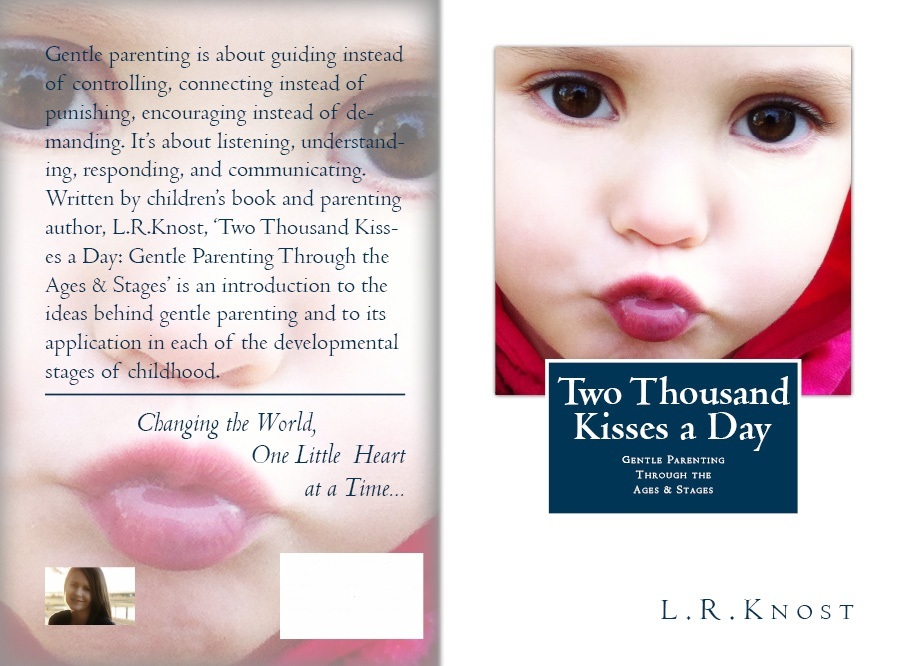 Two Thousand Kisses a Day: Gentle Parenting Through the Ages and Stages now available on Amazon:
~The birth story of a book~
A mother is born…
Many years ago (26 to be exact!), a small, scared, pregnant, teenage girl walked down the aisle to her tall, scared, clueless, young man and they said their “I do’s.”
But what were they going to do? No earthly idea! They didn’t have the internet to surf for blogs about parenting and marriage, couldn’t afford the few paltry magazines available on those subjects at the time, and weren’t convinced that the way their parents had raised them was exactly how they wanted to raise their unexpected little blessing. So, they simply joined hands and hearts and figured it out the old-fashioned way…through trial and error.
The young girl gave birth prematurely and, after a terrifying NICU stay, brought home her barely 5 lb baby boy. Since the young couple were living on one income and were barely able to feed themselves, it made sense to them to breastfeed their little one. Neither one had ever even seen a mother breastfeeding her baby or even heard of a lactation consultant and no one at the hospital had mentioned breastfeeding at all, so the two young people just kept working through the cracked, bleeding nipples, engorgement, over-supply, and other issues until they got it figured out…and then they were breastfeeders!
Neither one of the young couple had ever read a parenting book or had ever even heard the words ‘cry-it-out,’ and the young girl discovered their first night home how much easier it was to clear away all of the pillows and blankets to keep her baby safe and then simply take her little guy into bed with her and breastfeed him when he was hungry…and then they were co-sleepers!
‘Self-soothing’ was another term the two young people had never heard, so the two of them just did what came naturally and picked up their baby when he fussed or grunted or just looked cute and finally found it easier to just snuggle their little preemie into a baby carrier and tote him around with them wherever they went…and then they were babywearers!
As their precious little guy got bigger and began to explore his new world, the young couple delighted in everything he did and simply moved him or distracted him with songs and toys if he got into things. They couldn’t bear the thought of hurting their son, so punitive parenting just wasn’t an option. They decided to treat their little guy like a person instead of a possession and communicate with him instead of punishing him…and then they were gentle discipliners!
Now, this journey might sound like an easy one when summed up this way, but I can assure you it wasn’t. The young couple, my amazing husband and I, encountered strong criticism of our parenting choices through the years:
- We were warned that our marriage would suffer at the very least, and our babies would suffocate at the worst, if we slept with them in our bed instead of putting them in isolation to sleep.
- We were informed that my breasts would look like deflated balloons and reach my knees by my thirties if I breastfed more than a few weeks.
- We were admonished that our children would grow into spoiled brats if we responded to their needs instead of teaching them to ‘deal with it’ and ‘self-soothe’ their own, and would end up as social outcasts or criminals if we encouraged and guided them instead of spanking them.
These challenges to our parenting style were difficult at the time, and they sometimes even resulted in people choosing to de-friend us (not Facebook de-friending, in real life!), but that had the powerful positive effect of making us really examine what our beliefs were and, as a result, strengthening and solidifying our values, our marriage, and our family.
As for the dire warnings listed above:
- Our beautiful, strong, loving marriage is in its 27th year.
- Our children all survived and thrived on co-sleeping (our littlest is still safely and contentedly sleeping in our bed) and have, in their own time, moved happily to their own rooms.
- Except for being a couple of cup sizes larger at the moment since I’m breastfeeding a toddler, lol, my breasts are normal despite the fact that I’ve breastfed little ones for a cumulative 10+ years of my adult life!
- Our children are, in order, a 25-year-old Pastor (our firstborn son mentioned in the story above who is now a husband and father of two!), a 23-year-old Family Therapist, an 18-year-old pre-med university student on scholarship, 13- and 7-year-old beautiful and well-behaved homeschooled girls with lots of friends (soooo not social outcasts!), and a sweet and happy 2-year-old baby girl. Not a spoiled brat or criminal in the bunch!
Our journey to gentle parenting has had another, somewhat unexpected, effect. While we may not agree with others’ parenting choices, we have been on the receiving end of criticism far too long not to have learned this lesson: Gentle parenting is for parents, too! We have learned to respond gently to our friends who don’t agree with us, even when they don’t respond gently to us. Responding with harshness and criticism doesn’t work with adults any better than it does with children! Responding gently to those who disagree with us may or may not affect their parenting choices, but what it does do is model respectful behavior and conflict resolution to our children and, most of the time, preserve dear friendships.
A gentle parenting advocate is born…
This journey also resulted in a passion for children and family harmony that launched me many years ago into the world of parent coaching and child advocacy and later initiated the creation of Little Hearts/Gentle Parenting Resources as a consulting and educational resource for parents, caregivers, and educators. The culmination of this work led to the development of a series of gentle parenting handbooks designed to equip parents with the information and tools they need to gently guide their children from infancy through toddlerhood and the preschool years and on through middle childhood, the teen years, and beyond.
A book is born…
Two Thousand Kisses a Day: Gentle Parenting Through the Ages and Stages is the first in the series. It is an introduction to the ideas behind gentle parenting and provides practical examples of its application in each of the developmental stages of childhood such as the transition from diapers to potty, problems with sharing, coping with picky eaters, guiding children gently through behavioral issues, and more!
*also published in The Natural Parent Magazine
Award-winnning author, L.R.Knost, is the founder and director of the children's rights advocacy and family consulting group, Little Hearts/Gentle Parenting Resources, and Editor-in-Chief of Holistic Parenting Magazine. Books by L.R.Knost include Whispers Through Time: Communication Through the Ages and Stages of Childhood ; Two Thousand Kisses a Day: Gentle Parenting Through the Ages and Stages ; The Gentle Parent: Positive, Practical, Effective Discipline ; and Jesus, the Gentle Parent: Gentle Christian Parenting the first four books in the Little Hearts Handbook gentle parenting series, and children’s picture books Petey’s Listening Ears and the soon-to-be-released Grumpykins series.
300+ Nicknames for Your Babykins…Doodlebug…Snugglebunny…
[By L.R.Knost, author of Two Thousand Kisses a Day: Gentle Parenting Through the Ages and Stages, Whispers Through Time: Communication Through the Ages and Stages of Childhood, and The Gentle Parent: Positive, Practical, Effective Discipline available on Amazon and through other major retailers.]
 After nine months of googling, polling family and friends, making list after list, and agonizing over making The. Perfect. Choice. the moment arrives…you’ve finally chosen your expected blessing’s name. The perfect name. The name that will be with them forever. The name that will appear on their birth certificate, their highschool diploma, their voter ID card, their college degree, their marriage certificate. Your first parental decision…check! And then your little one arrives, and as you kiss that tiny, fuzzy little head, you find yourself whispering, “Welcome to the world, pumpkin.”
Wait a minute. Pumpkin? That’s not the name you agonized over! Why, after all the effort you put into choosing The. Perfect. Name. would you call your new arrival something entirely different?!?
Actually, it’s a good thing! Here are a few reasons why:
‘The perfect name’ is for the whole wide world to use in interacting with your little one, but a nickname is just for you, a symbol of the intimate, interdependant, loving connection between parent and child. Also, while ‘the perfect name’ may be perfect for certificates and licenses and diplomas, it doesn’t reflect the personality of this unique and adorable new person who has their own special purpose for being here. And, really, resisting giving your little cutie an equally cute nickname would be just as hard as resisting the urge to blow raspberries on their squishy tummy or kiss their soft cheeks a thousand times a day or stare into their curious little owl eyes.
So go ahead, choose ‘the perfect name’ for your tiny blessing so that they can be known to the world, and then, when you start getting to know your little hugabug or dynamo or sunshine, choose another ‘perfect’ name to reflect who they are and what they mean to you 🙂
Here’s a list of some popular, and some not so well-known, nicknames to check out. If you’ve got a nickname for your little one that’s not on the list, share it in the comments!
| Ace Angel Angel-baby Angel-face Bab Babes Baboo Babs Babushka Baby-blue Babycakes Baby-dear Baby-diddle Babydoll Baby-doo Baby-face Babykins Bambina Bambino Bean Beanie Beanie-baby Bear Bearie Beau-bear Bebo Birdie Bitsy Bitsy-boo Blossom Boo Boo-boo Boo-boo-bear Boss Bubba Bubba-bear Bubba-dee Bubba-diddle Bubbles Bubby Bubby-doo Bubkins Bubs Buckaroo Bud Buddy Buds Bug Bugabear Bugadoo Bugaloo Buggie Buggie-boo Buggie-bunny Bumble-bee Bumbles Bumpkins Bumpy Bunny Buttercup Captain Care Bear Champ Cherie Chickie Chickpea Chief China-doll Chipmunk Chunk Chunky-monkey Coco Cookie Cookie-monster Coppertop Cowboy Cricket Cubbie Cubbie-bear Cubster Cuddle-bunny Cuddles Cupcake Cupie-doll Cutiekins Cutie-patootie Cutie-pie Daisy Darling Dear Dear-one Dearie Diddle Diddle-doo Diddles Diddly-doo Diddly-bear Dilly-bar Dilly-boo Dilly-doo Dimples |
Dolly Doodle-bear Doodle-bug Doodlekins Doodles Dot Duckling Ducky Duddy Dumpling Dynamo Freckles Friend Funny-bunny Funny-face Fuzzy Fuzzy-bear Fuzzy-bunny Giggle-bear Giggle-bunny Giggles Gigi Goose Goosie-goose Half-pint Happy Hobbit Honey Hoss Hugabug Huggy-bear Huggy-buggy Huggy-bunny Hunny-bunny Itsy Itsy-bitsy Jazzy Jellybean Jocko Juggernaut Kiddo Kiki King-kong Kit Kitten Kitty Lad Laddie Lass Lassie Lil’ Bit Lil’ Boss Lil’ Guy Lil’ Man Lolly Lollypop Loo-loo Love-bug Lovie Lovie-dovie Milk-monkey Mima Moe Monkey Monkey-doodle Moogie Moogie-bear Mookie Moonbeam Mouse Mr. Man Muddles Muffin Muncha-munch Munchkin Munchy Nanners Ninja Nipper Nutter-butter Paddy Panda Panda-bear Peaches Peachy-pie Peanut Peanut-butter Pet Pinkie-pie Pinky Pippa Poodles Pooh Pooh-bear Poppet Poppy Precious Prince Princess Professor Professor X |
Puddin’ Puddin-pie Pumpkin Punkin’ Punkin-pie Punkin-wunkin Punky Pup Racer Rollie-pollie Roo Rookie Scooby Scooby-doo Scout Scrappy Scrappy-doo Shortcake Shortie Short-stuff Silly-bear Silly-goose Silly-pickle Silly-willy Slugger Smiley Smoochie Snickerdoodle Snoopy Snow-bunny Snugabug Snugabunny Snuggle-bunny Snuggles Sparky Sport Sprout Squeaker Squeaks Squirrel Squirt Squishy Star-bright Stinker Stinker-bear Stinker-winker Stinker-winker-bear Stretch Sugarplum Sunbeam Sunny Sunshine Sweet Sweetcakes Sweetheart Sweetie Sweetiekins Sweetpea Sweets Sweet-tater Sweet-treat Sweetums Tabby Tadpole Tater Taterkins Teddy Teddybear Teddykins Thumbkin Tiger Tigger Tilly Tink Tinker-doodle Tiny Toodle-bear Toodles Tootsie Tootsie-bear Tootsie-pop Tootsie-wootsie Turbo Turbo-man Turtle Tweety Tweety-bird Twinkie Twinkles Tyke Waddles Whiz-kid Widdle-waddle Wiggles Wiggle-bum Wiggle-worm Winnie Wookie Wookie-bear Youngin Zippy |
Related links:
Ten Steps to Surviving the First Three Months with a Newborn
Love in the Time of Cosleeping
Babywearing Basics Resource Guide
Breastfeeding, Babywearing, and Bouncing Back into Shape after Baby
25 Tips to Prepare Children for a New Sibling
Four Ways Attachment Parenting Can Reduce the Risk of SIDS
The Science of Sleep: Newborns
Award-winnning author, L.R.Knost, is the founder and director of the children's rights advocacy and family consulting group, Little Hearts/Gentle Parenting Resources, and Editor-in-Chief of Holistic Parenting Magazine. Books by L.R.Knost include Whispers Through Time: Communication Through the Ages and Stages of Childhood ; Two Thousand Kisses a Day: Gentle Parenting Through the Ages and Stages ; The Gentle Parent: Positive, Practical, Effective Discipline ; and Jesus, the Gentle Parent: Gentle Christian Parenting the first four books in the Little Hearts Handbook gentle parenting series, and children’s picture books Petey’s Listening Ears and the soon-to-be-released Grumpykins series.
12 Tips for Gently Parenting Your Adult Children (Hint: It starts when they’re newborns)
[Portions reprinted from Two Thousand Kisses a Day: Gentle Parenting Through the Ages and Stages by L.R.Knost. Whispers Through Time: Communication Through the Ages and Stages of Childhood; The Gentle Parent: Positive, Practical, Effective Discipline; and Jesus, the Gentle Parent: Gentle Christian Parenting also available on Amazon and through other major retailers.]
~~~~~~~~~~~~~~~~~~~~~
“Life is a succession of lessons which must be lived to be understood.” ~Ralph Waldo Emerson
 All stages of parenting come with their own unique learning curve, their own challenges and frustrations, their own compromises and sacrifices, and their own flubs, false steps, and failures. From those first terror-stricken days with a newborn to the sleep-deprived months of infancy to the challenges of toddlerhood and beyond, parenting is a journey, not a destination. And when subsequent little ones arrive, the journey starts all over again as we discover that the lessons learned from parenting one child don’t always apply to the next as each have their own incomparable personalities, quirks, and individual identities.
The principles of gentle parenting (connection, empathy, respect, etc.) don’t change as our children grow, just as they don’t change from one child to the next. What does change is our understanding of those principles as we grow in wisdom and experience as parents and as human beings. The practical application of gentle parenting principles, though, can look very different from child to child and life stage to life stage. For instance, with an introverted child gentle parenting might involve a greater degree of physical proximity and emotional support whereas with a very extroverted child it may involve a greater degree of energy direction and respectful guidance.
This constancy of principles and individualized application of gentle parenting is no less true when parenting our adult children than it is when parenting our minor children. As gentle parents, we are our children’s first and best friend in the purest and truest definition of friendship. That sets the stage for the transition from the early parent/friend years to the parent-friendship that will characterize our relationship when our children grow into adulthood.
Here are 12 practical tips for gently parenting your adult children:
1.) Begin to consciously pay attention to your own parents’ interactions with you. Mentally catalog what you find helpful and what you find intrusive, what is an acceptable level of involvement, advice, and interaction and what feels overbearing or lacking. Make a mental note (or make actual notes if you’re a list person like me) to remember those feelings when your own children become adults.
2.) Remember, parenting is literally ‘on the job’ learning. Your parents are discovering by trial and error (often lots of error) what their roles and boundaries are in this uncharted territory of parenting adults. Model giving your parents grace when they overstep or underplay their roles. This will set the stage for your children to extend the same grace to you when seemingly overnight you suddenly find yourself learning to parent your own adult children.
3.) While your child is an infant, meet their needs swiftly, consistently, and gently. They won’t remember what you did or didn’t do at this stage, but they will always carry with them the safety, security, and love that they feel in your responsiveness, and that is they will take with them into adulthood.
4.) When your child reaches toddlerhood, focus on connection rather than correction. What will matter most in later years won’t be whether they wore matching shoes or left the park without pitching a fit. What will matter is whether they felt heard, understood, and respected.
5.) As your child moves into the preschool and early childhood years, focus on communication, whether that takes the form of whining, tattling, endless questions or some combination of all three. Continue to build a trust relationship by hearing their heart rather than their tone and responding with gentle guidance.
6.) When your child reaches the middle stages of childhood, listening to the endless stories from your chatterbox or offering empathy and quiet support to your dreamer will help them as they explore who they are and who they want to be when they grow up. You are building the friendship of a lifetime in these interactions, so make them a priority.
7.) Once your child enters the teen years, consciously begin to gradually shift your role into a supporting rather than a leading act. Listen not to their words, their attitudes, their hormones, their angst. Listen instead to their struggles, their hopes, their dreams, their fears. Remember, you are the only adult in the relationship at this point. They still have a lot of maturing to do. Practice self-control. Be honest about your own struggles, fears, and failings. You’ll be amazed at what a connection point that is as your teen discovers that they aren’t alone in their humanness. Be the first one to listen, the first one to forgive, the first one to apologize, the first one to understand, the first one to back down and try to find another way when the going gets tough.
8.) When your child becomes an adult, let them set the pace. Some children will hit eighteen and be ready to move into a university dorm or get a job and an apartment right away. Others will need a slower transition. They may need to stay at home while going to university or while taking some time to try out different jobs as they explore this strange new world of adulthood. There’s nothing wrong with adult children living at home, especially in difficult economic times such as these, but if the time comes that you feel they need a gentle nudge out of the nest you can help them to find an acceptable roommate or two and guide them through the process of settling into independent adulthood.
9.) Once your child is out on their own, your role will shift fully to a support system. Offering unsolicited advice is fine as long as it is briefly stated…once. After that, it becomes intrusive. Offers of help and invitations to family events, etc. should follow the same guidelines.
10.) When your child starts a family of their own, consciously bring to mind how you felt at various times when your own parents supported you in your new role and/or interfered with the establishment of your new little family. Acknowledge to yourself (and to them) that they won’t do everything the way you did, that they will make decisions you wouldn’t make, that you will offer advice that won’t be heeded, and that they will make mistakes and have to learn from them just like you did, and remind yourself that those things are all perfectly okay.
11.) On the subject of making mistakes, remember, just as you wouldn’t want every youthful mistake, every wrong choice, every unfortunate decision to be broadcast to the world or even just joked about privately instead of being left in the past where it belongs, be sure to practice ‘The Golden Rule of Parenting’ and treat your children how you prefer to be treated.
12.) Keep in mind that the person you are now isn’t the person you were when you first started out on your journey into adulthood. Expecting your young adult children to think and experience and process life and events the way that you do now is like expecting a newborn baby to be able to pick up a book and read it. So set aside your expectations and just offer your support as they learn to navigate the world of adulthood on their own.
Remember, our life experience can help our adult children, but they need to gain their own life experiences. Our role as parents of adults is to find the balance between too much and too little of pretty much everything: advice, help, assistance, involvement, etc. The voice of experience has an immense amount of wisdom to offer, but only if it also has the wisdom to know when to remain silent.
Related posts:
Backtalk is Communication…LISTEN
The Gift of a Strong-Willed Child
Bridge Over Troubled Waters~Parenting a ‘Problem’ Child
Two Thousand Connection Points a Day: Attachment Parenting Beyond Infancy
A Boy, A Girl, and A Baby~Journey to Gentle Parenting
Award-winnning author, L.R.Knost, is the founder and director of the children's rights advocacy and family consulting group, Little Hearts/Gentle Parenting Resources, and Editor-in-Chief of Holistic Parenting Magazine. Books by L.R.Knost include Whispers Through Time: Communication Through the Ages and Stages of Childhood ; Two Thousand Kisses a Day: Gentle Parenting Through the Ages and Stages ; The Gentle Parent: Positive, Practical, Effective Discipline ; and Jesus, the Gentle Parent: Gentle Christian Parenting the first four books in the Little Hearts Handbook gentle parenting series, and children’s picture books Petey’s Listening Ears and the soon-to-be-released Grumpykins series.
Breastfeeding, Babywearing & Bouncing Back into Shape after Baby
[By L.R.Knost, author of Two Thousand Kisses a Day: Gentle Parenting Through the Ages and Stages, Whispers Through Time: Communication Through the Ages and Stages of Childhood, and The Gentle Parent: Positive, Practical, Effective Discipline available on Amazon and through other major retailers.]
~~~~~~~~~~~~~~~~~~~~~
 There is no such thing as a ‘miracle’ weight-loss plan, but living a healthy, active life and eating nutritious meals doesn’t have to be all about sweat, sacrifice, and self-discipline, either. It can be about having fun, eating foods you love, and, best of all, it can fit right in with your lifestyle! By following a few basic nutritional guidelines and finding ways to fit exercise into your daily life, you can create your own ‘life plan’ and start moving toward your weight-loss and health goals.
1.) Practice the 3 B’s
Breastfeeding~Did you know that one of the best ways to lose weight after giving birth is to breastfeed? Breastfeeding uses about 300-500 of the calories you eat each day. That means if you eat the full amount of daily recommended calories for your weight, you’re actually dieting! I don’t recommend calorie-counting as a means of weight loss, but that’s a pretty cool fact, anyway! And when you add the fact that breastfeeding significantly reduces your risk of breast cancer and is super healthy for baby…win-win-win!
Babywearing ~Did you know that in addition to all of the amazing benefits to your baby, babywearing also offers you an excellent opportunity for a daily workout? Wearing your baby works your core and glutes specifically and gives you a full body workout, as well! Who needs a gym when housecleaning, walks on the beach, strolls through the mall, and just daily life in general are an excellent workout, all while keeping baby next to your heart and close enough for kisses?!?
Bouncing~Did you know that kegels can actually do more harm than good? Shallow knee bends like the ones mommies use instinctively when they bounce to soothe a fussy baby are the preferred method of improving the pelvic girdle! So say goodbye to the sneezing/laughing ‘leakies’ and hello to buns and thighs of steel!
2.) Healthy Eating, It Does a Body Good
Did you know that a low fat diet can actually make you fat? A diet of full-fat milk, real butter, real cane sugar, extra virgin olive oil, coconut oil, fat-marbled meat, eggs, nuts of all kinds, cheeses, fruits, veggies, and whole grain pastas and breads is far more likely to help you lose weight and maintain a healthy weight for life.
Along with enjoying these yummy foods, you’ll lose weight faster and be overall healthier by avoiding High Fructose Corn Syrup (HFCS – it’s in practically everything…breads, juices, jellies, etc…so you’ll have to read labels carefully!) and other corn-derived syrups and sugars, along with food dyes, margarine, vegetable/canola/safflower oils, and artificial sweeteners.
If you’ve got a sweet-tooth, denying yourself a treat can lead to overeating as you try to satisfy that urge with other foods. One way to combat that is to indulge in a small amount of ice cream (without HFCS or other corn syrups!) or dark chocolate, preferably in the evening because raising your blood sugar earlier in the day tends to increase your appetite for the rest of the day.
Keep in mind, letting yourself become hungry is one of the surest paths to overeating! It’s far better to eat multiple, small, snack-type meals throughout the day than to wait for meals when you’ll be hungrier and more likely to eat too much. Other benefits to ‘snacking’ instead of eating three full-on meals are 1.) Maintaining a consistent blood sugar, which aids in appetite control and helps your body escape the ‘survival’ instinct to store fat; 2.) Reducing your appetite naturally by eating smaller amounts at a time which helps your stomach to shrink; and 3.) Increasing your metabolism by consistently keeping your digestive system heated up in ‘burn mode.’
Sample meal plan:
1st Breakfast~
¼ cup almonds & ¼ cup raisins
2nd Breakfast~
1 whole egg (Yes, eat the yolk, too! That’s where most of the healthy nutrients are.)
1 Whole wheat English muffin with real butter and ¼ cup natural fruit preserves
8 oz. cottage cheese
Elevensees~
½ cup pretzels & 2 oz. whole-fat cheese
Lunch~
Spinach salad with ¼ cup shredded carrots, ¼ cup dried apricots or cranberries, 2 oz. whole-fat shredded cheese, 4 oz. shredded pork, 2 tbs. minced almonds or sunflower seeds , and 2-4 tbs. Balsamic Vinaigrette (Read the label and watch out for HFCS!)
Tea~
8 oz. yogurt & ¼ cup granola & ¼ cup berries
Supper~
Fettucini Alfredo, Meatball Sub, Pizza, whatever you want! Just fill up your plate as you normally would, then put back half. After you eat, wait 20 minutes and, if you’re still hungry, eat ¼ of what you put back. (Supper is where most people ‘fail’ because that’s the time most social eating occurs. Rather than denying yourself and setting yourself up for failure, this plan allows you to enjoy the foods and social life you’re accustomed to, while still cutting out ¼ to ½ of the calories you’d normally eat at this meal.)
Dessert~
For those with a sweet tooth, after supper is the best time for a few ounces of dark chocolate or ice cream! Pastries and cakes aren’t good choices for a treat, but if you indulge occasionally, no worries 🙂
Bedtime snack~
¼ cup almonds & ¼ cup dried pomegranates or cranberries
You can take this sample plan and switch out items from the same food group so it fits your tastes. For instance, if you don’t like salads, you could switch out the lunch salad with a baked whole grain pork burrito and top it with lettuce, tomato, cheese, etc. Just try to make sure that for every protein/fruit/veggie/dairy you take out, you put the same amount back in. (Sorry about The Hobbit reference. I couldn’t resist!)
3.) A Grateful Heart is a Healthy Heart
Science has proven that a good outlook on life improves not only the quality of a person’s life, but also the length and health aspects of their life. Taking time to intentionally focus on the good things in your life will improve your health, satisfaction, and overall happiness. Here are some ideas:
A.) Get outdoors! Heading out into the sunshine has been shown to improve a person’s mood as well as their health. There’s something about standing in the midst of towering trees or watching butterflies flutter by in the garden that makes stress just melt away. (And a daily dose of sunshine-induced Vitamin D is good for your bones!)
B.) Walka-Walka-Walka! Walking improves circulation and deepens breathing, both of which will make you feel more alive and ready to take on the world!
C.) Count your blessings! Taking time each day to list and be thankful for the good things in your life helps to create balance, making life feel more manageable when it begins to feel overwhelming.
D.) Volunteer! Reaching out to help your fellow humans in need is a great way to make your life feel a lot more purposeful and to help you get a healthy perspective on the stresses in your life.
E.) Laugh out loud! We all type that little ‘lol’ all the time when we’re online, but did you know that actually doing it, really and truly laughing out loud, releases stress-relieving, feel-good endorphins in our bodies? So watch a comedy routine, catch a funny old sit-com rerun, or just sit and enjoy a child playing for ten minutes, and you’ll be sure to laugh away the blues!
*Obligatory disclaimer: I am not a doctor, nor do I play one on TV. This is a guide (not a diet) that I created to return to my pre-pregnancy (Well, pre-pregnancies, actually, since I have six children!) shape and weight in a healthy and swift fashion and that I continue to follow for weight maintenance and healthy nutrition. This guideline is not designed for special health needs. Be sure to check with your doctor or other health professional if you have any health concerns.
Related posts:
Babywearing Basics Resource Guide
10 Ways to Play with your Children when Play is the Last Thing on your Mind
Parenting, Trickery & The Great Obesity Lie
Award-winnning author, L.R.Knost, is the founder and director of the children's rights advocacy and family consulting group, Little Hearts/Gentle Parenting Resources, and Editor-in-Chief of Holistic Parenting Magazine. Books by L.R.Knost include Whispers Through Time: Communication Through the Ages and Stages of Childhood ; Two Thousand Kisses a Day: Gentle Parenting Through the Ages and Stages ; The Gentle Parent: Positive, Practical, Effective Discipline ; and Jesus, the Gentle Parent: Gentle Christian Parenting the first four books in the Little Hearts Handbook gentle parenting series, and children’s picture books Petey’s Listening Ears and the soon-to-be-released Grumpykins series.
Avenging Childhood~The Change Makers
As I drove out of my driveway this afternoon, I glanced up and saw The Avengers racing around my neighbor’s yard, intent on fighting crime (or each other or the dog or some dragonflies, lol). It made my heart so happy to see childhood…just real, everyday, the-way-children-through-the-ages-have-played kind of childhood at its most honest and robust and carefree. I jumped out of my van and proceeded to confirm my neighbor’s suspicions that I’m a little off my rocker by wildly waving my camera in the air and pointing at her adorable boys roughhousing, silently asking for permission to play paparazzi. She nodded, and the boys hammed it up for me for a few minutes, posing and posturing in their wonderful world of make-believe.

I climbed back into my van amidst my little girls’ giggles (pretty sure they were laughing more at me for taking pictures of the neighbors rather than laughing at the boys’ antics). As we headed off on our afternoon errands, I thought about how the world has changed, but children haven’t. Yes, over time the world will do its share of influencing or corrupting, as the case may be, but children are born children just like they have been since the beginning of time.
Every child is born a fresh, new, open book with pages and pages waiting to be filled.  Everything is new. Every day is an adventure. Every experience is an opportunity for discovery. Whether they’re boys or girls, whether they have average or advanced or impaired cognitive or motor abilities, whether they’re Asian or Caucasian, Black or Middle Eastern, Hispanic or (as a growing number are worldwide) a unique blend of races and ethnicities, they all start out the same…brand-new, innocent, precious beyond compare.
I am passionate about helping parents fill the first pages of their children’s lives with messages of gentle welcome, of needs met, of trust. I’m equally passionate about helping parents transition into later stages where they are simply there to offer guidance, support, and encouragement as their children begin filling the pages of their lives with their own choices, interests, and gifts.
I’ve heard it said that only those crazy enough to think they can change the world actually do change it. I honestly believe that changing the world starts at home with how we parent our children. Maybe my neighbor is right about me, after all. 🙂
*Book art via Anagram Bookshop*
Related posts:
Communication vs. Miscommunication
Playground Confessions~Look Who’s Talking!
The Measure of Success~Chinese Parents and French Parents Can’t BOTH Be Superior!
Award-winnning author, L.R.Knost, is the founder and director of the children's rights advocacy and family consulting group, Little Hearts/Gentle Parenting Resources, and Editor-in-Chief of Holistic Parenting Magazine. Books by L.R.Knost include Whispers Through Time: Communication Through the Ages and Stages of Childhood ; Two Thousand Kisses a Day: Gentle Parenting Through the Ages and Stages ; The Gentle Parent: Positive, Practical, Effective Discipline ; and Jesus, the Gentle Parent: Gentle Christian Parenting the first four books in the Little Hearts Handbook gentle parenting series, and children’s picture books Petey’s Listening Ears and the soon-to-be-released Grumpykins series.
A Mile In Their Shoes
Before you judge someone, walk a mile in their shoes. ~Unknown
My mother always taught me to think about things from other people’s perspective before reacting to them, a life lesson that has translated into the empathetic, gentle style of parenting I teach, write about, and follow with my own children. Discerning what other people feel isn’t always easy, of course, and our own experiences, attitudes, and emotions can get in the way. But seeking to not just understand, but to really feel what another person feels is vital to true communication and connection. To that end, I try to always ask myself, whether interacting with my children, my husband, or any other person who crosses my path, “How would I feel if…”
So come, take a walk with me~
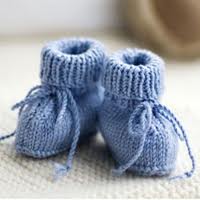 How would I feel if I was suddenly thrust from my safe, familiar world into a startlingly new and uncomfortable world where I couldn’t function on my own, where my very survival depended entirely on beings who I didn’t know, didn’t understand, and who didn’t understand me? Would I learn to feel safe in this new world if they left me for hours on end in dark places with no way to communicate, no way to meet my own needs? Or would I learn to trust these new beings if my needs were met day and night, if they were always available, always responsive, always gentle?
 How would I feel if I was a small person in a big world, a world where large beings were constantly jabbering at me in a language I barely understood, a world where everything was a challenge, from climbing out of a chair to learning to control my bodily functions, a world where every day, all day long, I was confronted with new things to taste, new things to explore, new things to discover. If I tried to communicate and no one slowed down to listen, would I learn to listen? If I got overwhelmed by all the new challenges and was punished, would I learn how to cope with my emotions? If I was snatched away from my explorations with no warning, no explanation, would I learn to respect other people’s spaces and paces? Or would I learn to listen if I was heard, cope if I was helped, and respect if I was respected?
 How would I feel if I was an adult-sized person, my body flooded with a consistently inconsistent rush of mind-altering hormones, in a world of adults who demanded adult maturity from me, but treated me like a child? Would I learn to cope with the huge life changes taking place if my awkwardness incited conflict instead of compassion? Would I be willing to share my struggles if my still-growing communication skills were taken at face value instead of my heart being heard? Would I desire to make good choices if the most important people in my life didn’t trust me enough to let me make them? Or would I learn confidence by being understood, trust by being truly heard, responsibility by being trusted to be responsible?
 How would I feel if I was a new parent, struggling with exhaustion, overwhelmed by newness, desperate to make the right decisions for my precious new baby, but was surrounded by conflicting advice and head-shakers and nay-sayers? Would I learn to trust my instincts if every choice I made was the subject of commentary and unsolicited advice? Would I grow into my new role if I was pushed and shamed and coerced into following other people’s parenting choices? Would I learn to share my fears and concerns if they were met with negativity, ridicule, and debate? Or would I find my own path in the world of parenting if I was allowed to listen to my heart? Would I discover my parenting niche if I was trusted to make my own choices? Would I be open to new ideas and find support if my struggles were met with reassurance and compassion and acceptance?
 How would I feel if I was a strong, wise, gifted person in a body that was beginning to fail me with age? Would I feel valued if others only saw my frailty and not my strength? Would I offer wisdom if my life experiences were ridiculed? Would I share my gifts if no one bothered to slow down and recognize them? Or would I still feel I had life to live, something to give if my stories were heard, if my wisdom was received, if someone, anyone, took the time to sit with me and talk for awhile.
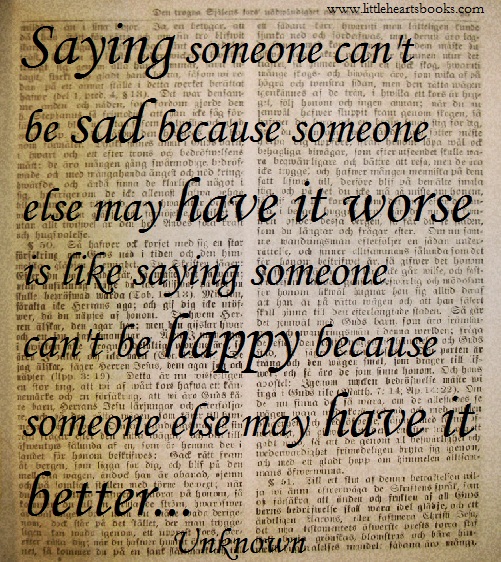 Related posts:
The Seven Wonders of the World of Childhood
Playground Confessions~Look Who’s Talking!
The Measure of Success~Chinese Parents and French Parents Can’t BOTH Be Superior!
Award-winnning author, L.R.Knost, is the founder and director of the children's rights advocacy and family consulting group, Little Hearts/Gentle Parenting Resources, and Editor-in-Chief of Holistic Parenting Magazine. Books by L.R.Knost include Whispers Through Time: Communication Through the Ages and Stages of Childhood ; Two Thousand Kisses a Day: Gentle Parenting Through the Ages and Stages ; The Gentle Parent: Positive, Practical, Effective Discipline ; and Jesus, the Gentle Parent: Gentle Christian Parenting the first four books in the Little Hearts Handbook gentle parenting series, and children’s picture books Petey’s Listening Ears and the soon-to-be-released Grumpykins series.
A Return to Childhood
[By L.R.Knost, author of Two Thousand Kisses a Day: Gentle Parenting Through the Ages and Stages, Whispers Through Time: Communication Through the Ages and Stages of Childhood, and The Gentle Parent: Positive, Practical, Effective Discipline available on Amazon and through other major retailers.]
 There is such a rush these days to get children sleeping through the night, weaned off the breast, eating solid foods, potty trained, reading independently, and on and on, that we seem to have lost the ability to simply enjoy life as it happens and let our children do the same. Gone are the days of making mud-pies and playing in piles of leaves. They’ve been replaced with flashcards, language immersion (even in the womb!), educational dvd’s, and the like. Preschool has become the new kindergarten, with parents rushing to get on waiting lists for the ‘best of the best’ preschools, often even before their first prenatal appointment!
Therapists in New York have reported an increase in parents seeking psychiatric services for stress related to the intensely “cutthroat” admissions process for top-rated private preschools and kindergartens. “Parenting is a competitive sport,” says Dr. Lisa Spiegel. And that competition is leading parents to ask if their three-year-old should wear suits to preschool interviews, which designer purses are best to carry on school tours, and even if they should be induced into early delivery so their child “could be considered for kindergarten before the Sept. 1 cutoff date.” (New York Post, see link below)
One would assume, with all of this emphasis on independence and education, that we would be moving forward as a society to a more self-sufficient, competent, and well-educated populace which, by extension, might reasonably be assumed to have less need of welfare programs and prisons. One would assume wrong, unfortunately.
By way of comparison, in 1960, welfare spending in the United States was $48.20 per capita with 1.7% of the population receiving federal assistance. (infoplease.com) By 2010 it had increased to $2256.40 per capita (usgovernmentspending.com) with 8.0% of the population receiving assistance. (wiki.answers.com) In 1960, 0.18% of the US population was imprisoned, whereas in 2010 that number had climbed to 0.74% (businessinsider.com) with drug use, rape, and assault rates skyrocketing.
So what happened? Obviously, there are many contributing factors, but one often overlooked, powerful contributor is how we parent our children. Study after study has confirmed that early childhood experiences have a profound impact on adult behavior, achievement, and satisfaction with life. The modern emphasis on ever-earlier independence and academics seems to inadvertently be sacrificing the very things they are designed to accomplish, and the modern view of parenting as a “competition” is setting the stage for stress, conflict, and failure.
Perhaps it is time for parents to reevaluate their priorities and realize their children are blessings to be cherished and nurtured, not pawns in a cut-throat game of strategy and intrigue. Perhaps it is time for a return to childhood, to simplicity, to running and climbing and laughing in the sunshine, to experiencing happiness instead of being trained for a lifetime of pursuing happiness…perhaps it is time to let children be children again:
1) Let babies be babies~in other words, baby them! Babies are completely and totally helpless in every way. Medical experts agree that it isn’t possible to spoil a newborn, so responding promptly to cries will simply help them learn to trust that their needs will be met. Babies left to cry-it-out often do end up sleeping through the night earlier than babies whose needs are responded to because they have learned to give up on their needs being met. But that gain of sleeping through the night is accomplished at the loss of trust, and the resultant stress and long-term consequences simply aren’t worth it. (Surviving the First Three Months with a Newborn) Stress causes our bodies to release a hormone called cortisol which, when present for prolonged periods, can dramatically undermine brain development in babies and permanently impair brain function for life. Some causes of stress in babies are extended illnesses, detached parenting, and separation from their mothers, which has been linked to long-term anxiety and anti-social behavior. (News, Science and Environment)
2) Let human babies drink human milk~in other words, nurse them! Breastfeeding beyond the typical 6-12 month period has been shown to improve not only overall IQ’s in children, but also improve health and social outcomes. Children who are breastfed for 24+ months are less likely to have allergies and more likely to have healthy immune systems. (kellymom.com) Also, according to the World Health Organization, “a modest increase in breastfeeding rates could prevent up to 10% of all deaths of children under five,” due, in part, to tainted water supplies, but also due to the immunity factors. And, socially, studies have shown repeatedly that, “Meeting a child’s dependency needs is the key to helping that child achieve independence.” (Elizabeth N. Baldwin, Esq. ‘Extended Breastfeeding and the Law.’)
3) Let children know they matter~in other words, listen and respond to them! Strong, healthy attachment in parent/child relationships has been linked to increased success rates in future marriage, greater career satisfaction, and overall stability and emotional health in adulthood. Children raised with detached parents tend to be forced into premature independence through sleep training, rigid discipline, and too early and/or prolonged separation from parents, often resulting in long-term dependency, attachment, and satisfaction issues. “Decades of research, including longitudinal studies, have shown that as securely attached babies get older, they form better relationships with others, have higher self-esteem, are more flexible and resilient under stress, and perform better in every aspect of life, from schoolwork to peer interactions.” (Dr. Laura Markham)
4) Let children see you being ‘good’~in other words, model the behavior you desire! Children are born observers and the first people they observe, with an almost scientific intensity, are their parents. Modeling appropriate and desirable behavior to children such as self-control, compassion, helpfulness, listening, respect, etc is a powerful tool in passing along these qualities to the next generation. “Discipline is everything you put into children that influences how they turn out…Whatever your ultimate objectives, they must be rooted in helping your child develop inner controls that last a lifetime. You want the guidance system that keeps the child in check at age four to keep his behavior on track at age forty, and you want this system to be integrated into the child’s whole personality, a part of him or her.” (Dr. William Sears)
5) Let children play~in other words, don’t rush them into growing up! Study after study has shown that children learn more, retain knowledge better, and maintain their natural curiosity and love of learning when they are allowed to learn through a combination of unstructured and guided play. The trend these days is to start children in academic-centered preschools as early as two years old and then move them into academically rigorous kindergarten programs, often while still four years of age. “While many children do fine in kindergarten and first grade, by the time they reach second grade, ‘they can’t hold it together — they fall apart and really struggle.’” (Colvin) “Newspapers and magazines across the country are reporting that kindergarten is the new first grade—full of pressure and short on play.”(What to Expect in Kindergarten) “As the parent of a child entering kindergarten, you’re sure to be shocked and amazed by what’s changed since your days on the story rug. Kindergarten isn’t what it used to be…many of the changes you observe make kindergarten a more challenging and potentially pressuring stage, it’s all in the name of teaching your child more effectively.”(Kindergarten Assessment) However, effective teaching is a subjective subject. Is teaching effective if it results in children who are capable of rote memorization and passing standardized tests, but lack imagination, curiosity, and a love of reading? Or is teaching more effective if it results in children who are innovative, pioneering, and life-long learners?
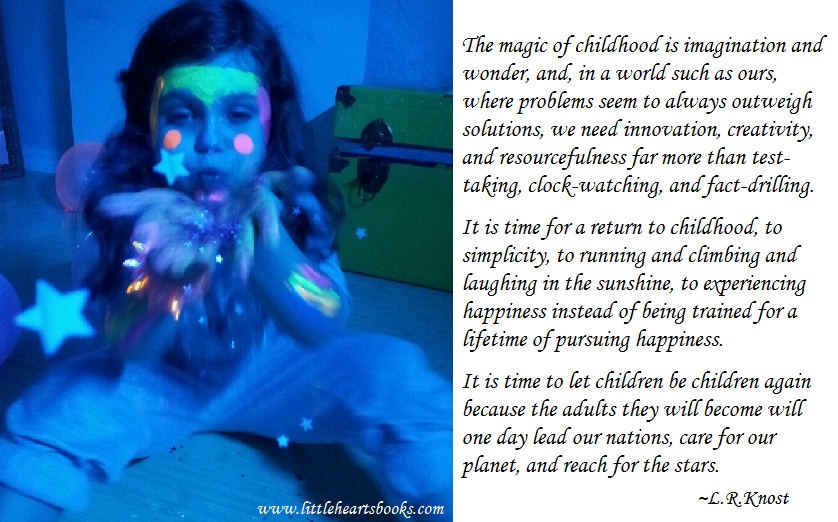

Do you think my little dirt magnet enjoyed her homeschool day?
Related posts:
The Seven Wonders of the World of Childhood
Raising Super Readers~The MARVELous Power of Comic Books!
The Measure of Success~Chinese Parents and French Parents Can’t BOTH Be Superior!
Alphabet Fun~Imagination From A to Z!
Live to Play~Play to Learn~Learn to Live!
One Slippery Sock & Other Silly Tools for your Parenting Toolbox!
Award-winnning author, L.R.Knost, is the founder and director of the children's rights advocacy and family consulting group, Little Hearts/Gentle Parenting Resources, and Editor-in-Chief of Holistic Parenting Magazine. Books by L.R.Knost include Whispers Through Time: Communication Through the Ages and Stages of Childhood ; Two Thousand Kisses a Day: Gentle Parenting Through the Ages and Stages ; The Gentle Parent: Positive, Practical, Effective Discipline ; and Jesus, the Gentle Parent: Gentle Christian Parenting the first four books in the Little Hearts Handbook gentle parenting series, and children’s picture books Petey’s Listening Ears and the soon-to-be-released Grumpykins series.
Babes and Boundaries~A Gentle Parenting Perspective
[Reprinted from Two Thousand Kisses a Day: Gentle Parenting Through the Ages and Stages by L.R.Knost. Whispers Through Time: Communication Through the Ages and Stages of Childhood also now available on Amazon]
 Parenting is soooo tiring and frustrating at times. Sometimes you just want to sit a small child down and say, “Do you know how much easier your life (and mine!) would be if you’d just be REASONABLE?!?” But we know that wouldn’t do any good because the words ‘reasonable’ and ‘toddler/preschooler’ just don’t play well together. The thing to remember is that gentle parenting doesn’t mean parenting without boundaries.
Believe it or not, the foundation for discipline (guiding, leading, teaching…NOT punishment ) begins in the newborn and infancy stages. When parents respond quickly, consistently, and gently to their baby’s cries, the trust relationship that the parent is establishing becomes the cornerstone for later discipline. Boundaries need to be established for a child’s safety and growth into a successful citizen of our world. A child who is secure in the knowledge that he doesn’t have to fight to be heard or to have his needs met is more open and adaptable to limits. And when the ‘limit-setter’ is a person the child trusts, the enforcement of those boundaries becomes a matter of connection and communication instead of conflict and struggle.
So, what might setting and enforcing boundaries using gentle parenting look like in real life? Here are a few examples:
- Your 18 month old has begun hitting you whenever you try the ‘remove and distract’ method of keeping her from sticking things into power outlets. In addition to covering the outlets with safety covers, a gentle parenting approach to hitting at this age would be to gently hold your child’s hand when she tries to hit, look her in the eye, and say quietly and firmly, “Gentle” or “Gentle hands,” while stroking your cheek with her hand. This sets a boundary that hitting is not okay while demonstrating what behavior is acceptable. Don’t expect this to be a one-time deal, though. Little ones learn through consistent and patient repetition.
- Your 2 year old drops to the ground in limp protest every time you try to leave ANYWHERE! First, giving a toddler some warning that a change is about to occur respects their often intense interest in and focus on their own activities. A gentle parenting approach might be to utilize the ‘countdown to leaving’ method to give them a time context (i.e. “Five more minutes! That means you have enough time for five more horsey rides on grandpa’s back!”… “Four more minutes! That means you can have four more jumps into the ballpit!”… “Three more minutes! That means you have enough time to build three more towers and knock them down!”… “Two minutes left! That means you have enough time to go down the slide two more times!”… “One more minute! That means you can look at one more book!”). Remember, children aren’t little robots we can just upload the right program into and expect it to work perfectly every time, so when your little human still impersonates a limp noodle despite your best efforts, quietly acknowledge his distress, “It’s hard to leave when you’re having fun, isn’t it?” and then gently pick him up and move him to the car/stroller, etc.
- Your 3 year old flat out refuses to wear shoes, period. In addition to giving choices, “Do you want to wear the red boots or the blue sneakers today?” and offering her the opportunity to assert her independence, “Would you like to put your shoes on yourself or do you want mommy to help?” sometimes all that is needed is a simple question, “Why don’t you want to wear shoes?” Three year olds are typically becoming articulate enough that, if they aren’t already stressed, they can do a pretty good job of explaining themselves. You might be surprised to hear something like, “Tomowow my boos hut my toes,” which when translated means, “The last time I wore my boots they hurt my feet, and now I think all shoes will hurt me.” Moving on to a more verbal communication stage of your relationship with your child when they’re ready might seem a no-brainer, but parents often get caught up in patterns of parenting from previous stages and it just doesn’t occur to them to simply ask their child what’s wrong. Again, this won’t always work, so when your little bohemian still rejects all things soled, calmly let her know that she will remain in the stroller/sling/cart and not do any walking until she decides she’s ready to put on her shoes.
One other note about parental boundaries is that it’s not just your children who will challenge them! Everyone and their mother (or especially their mother!) will take every ‘misbehavior’ by your child as an opportunity to give you unsolicited and often unwanted advice. Remember, when it comes down to it, it’s you, the parent, who determines what limits to set. Mrs. In-My-Day, Cousin Know-It-All, Mr. My-Way-Is-The-Only-Way, and Neighbor Nose-In-Everyone-Else’s-Business all have their own ideas that make sense to them, and that’s fine, but you are not them! You the unique parent of a unique individual, and you have the sole responsibility to raise that individual as you see fit (with reasonable limits set by your community as to what constitutes abuse, neglect, etc).
In practical application, boundaries do reflect the culture and environment in which a child lives. In a small, rural community in Spain, doors may be left open day and night and the neighbors may all be related. Small children might have the freedom to wander in and out of houses, play ball in the middle of the road, and plop down for an afternoon nap on a neighbor’s sofa. In a busy, urban city such as New York, doors may be kept locked, people may never have even met their neighbors, and playing in the street might be tantamount to a child endangerment charge.
The point is that boundaries aren’t a one-size-fits-all list that you can buy from Barnes & Noble, put on the fridge, and slap a sticker on every time a child complies. Boundaries are personal limits determined by the parent’s values and priorities and culture as well as reflecting the age and maturity of their child and the unique attributes of their community.
It may ‘take a village’ to raise a child, but remember, it’s you, the parent, who’s the leader of your tribe!
Related posts:
Testing the Boundaries~What’s A Parent To Do?
Toddlers, Tantrums, and Time-Ins, Oh My!
The Taming of the Tantrum: A Toddler’s Perspective
Award-winnning author, L.R.Knost, is the founder and director of the children's rights advocacy and family consulting group, Little Hearts/Gentle Parenting Resources, and Editor-in-Chief of Holistic Parenting Magazine. Books by L.R.Knost include Whispers Through Time: Communication Through the Ages and Stages of Childhood ; Two Thousand Kisses a Day: Gentle Parenting Through the Ages and Stages ; The Gentle Parent: Positive, Practical, Effective Discipline ; and Jesus, the Gentle Parent: Gentle Christian Parenting the first four books in the Little Hearts Handbook gentle parenting series, and children’s picture books Petey’s Listening Ears and the soon-to-be-released Grumpykins series.
30 Days of Thankfulness~Day 21~Fruit!
I am thankful for fruit!
~By Their Fruit They Will Be Known~
 “The fruit of the Spirit is love, joy, peace, patience, kindness, goodness, faithfulness, gentleness and self-control” (Galatians 5:22-23)
Love ~ Many parents say they make their parenting choices out of love, and I believe that is so very true, but if God is love as He says He is (and He is!), then our love needs to reflect His in every way, including in our parenting. And how does God show His love? Sacrificially, “For God so loved the world that He gave His only Son, that whoever believes in Him will not perish, but have everlasting life.” (John 3:16). Modeling God’s sacrificial love in our parenting is reflected by making parenting choices based on our children’s needs, not our convenience. Responsive parenting is truly a picture of God’s sacrificial, unconditional love in that, as we respond to our children where they are, (“This is how God showed His great love for us, that Christ died for us while we were still sinners [emphasis added]” Romans 5:8) comforting their cries, guiding their choices, providing for their needs, encouraging their individuality, we are, moment by moment, day by day, sacrificing our lives for them.
Joy ~ Parenting can be a challenge (Ask God. He’s got a lot of children, and they don’t behave all that well!) but taking joy in the journey and in our children makes all the difference. “At that time Jesus, full of joy through the Holy Spirit, said, ‘I praise you, Father, Lord of heaven and earth, because you have hidden these things from the wise and learned, and revealed them to little children.’” (Luke 10:21) Take time out each day to enjoy your children, or, better yet, to tell them what joy they bring to your life and specifically what unique things you enjoy about them!
Peace ~ It’s so, so hard making parenting choices, knowing our actions (or inactions!) will have an incredibly profound effect on a precious little life. God knows and sees and cares about every detail of our lives and our children’s lives.  And, in the same way that we want our little ones to trust us with their needs and concerns and desires, God wants us to trust Him and to have peace in Him. “Do not be anxious about anything, but in every situation, by prayer and petition, with thanksgiving, present your requests to God. And the peace of God, which passes understanding, will guard your hearts and your minds in Christ Jesus.” (Philippians 4:6-7)
Patience ~ “Be completely humble and gentle; be patient, bearing with one another in love.” (Ephesians 4:2) Children come into our lives as small bundles with big needs who don’t speak or understand our language and then proceed to grow into little people with their own temperaments, plans, and desires. Having patience as a parent should qualify as an extreme sport! But having and modeling patience with our children not only helps us to guide and grow them gently, but also encourages them to exercise patience with themselves and others throughout life…a rare, but lovely gift we can give the world through our children.
Kindness ~ My grandmother’s favorite verse was “Love is patient, love is kind. It does not envy, it does not boast, it is not proud. It does not dishonor others, it is not self-seeking, it is not easily angered, it keeps no record of wrongs.”  (1Corinthians 13:4-5) This is a beautiful example of how the Bible encourages us to treat others…including our children! Taking time out on occasion to examine our parenting practices and evaluate them in terms of how loving and patient and kind we are to our little ones is a vital part of effective parenting. It’s also important to make sure we aren’t parenting ‘for the neighbors,’ in other words, we aren’t making parenting choices based on a ‘who has the best kid’ competition (envy, boastful) or out of embarrassment over our children’s behavior (pride). Are we easily angered by our children? Do we dredge up their mistakes time and time again? If so, consciously working to break those bad habits and replace them with love and patience and kindness will have a dramatically positive impact on our parenting.
Goodness ~ “Still other seed fell on good soil. It came up, grew and produced a crop, some multiplying thirty, some sixty, some a hundred times.” (Mark 4:8) Of all things, shouldn’t our very first desire in parenting our children be to till the soil of their little hearts so tenderly, so carefully, so intentionally that their hearts are “good soil,” ready, eager, and willing to receive the Good News of Jesus’ birth, death, and resurrection for their sins? Instead of focusing on punishing our children’s mistakes, their ‘sins,’ thus negating the Gospel and undermining the very purpose for Jesus’ suffering, shouldn’t we model the grace and mercy and forgiveness we ourselves have been given? So what, exactly, is “good soil”?  Agriculturally speaking, which is what the parable Jesus told was based on, “good soil” is well-drained (not bogged down by over-watering, i.e. over-indulgent parenting), fresh (not over-used or over-worked, i.e. over-bearing parenting), fertilized (filled with good nutrients, i.e. needs met), composted (mixed with rubbish, i.e. sinful!), and enriched (earthy minerals intact, i.e. connected to their source~their parents).
Faithfulness ~ “The living, the living—they praise you, as I am doing today; parents tell their children about your faithfulness.” (Isaiah 38:19) God is faithful in His promises, faithful in His love, faithful in His parenting. In all things we need to reflect His character to our children so that when we tell them about ‘His faithfulness’ it isn’t only in words, but also in deeds. And what is faithfulness, exactly? It is defined as constancy, dependability, care, trustworthiness, devotion, honor, attachment, commitment. So let us parents, as reflections of God, be faithful to exhibit constancy, dependability, care, trustworthiness, devotion, honor, attachment, and commitment in our parenting choices!
Gentleness ~ “Let your gentleness be evident to all”…except your children. No, of course the Bible doesn’t say that! God actually instructs us to “Let your gentleness be evident to ALL (emphasis added)” in Philippians 4:5. Tender, compassionate, merciful, warmhearted, sensitive, approachable, good-humored…these are all synonyms for gentleness, and gentle parenting reflects all of these qualities. Let’s take a look at the antonyms (opposites) of the word gentle in the thesaurus~harsh, tough, violent, sharp, rigid, severe, unrelenting, unforgiving, punitive, unpleasant, pitiless, stern. “Let your gentleness be evident to all” including (especially!) our littlest, most defenseless, and truly precious gifts from God~our children!
Self-control ~ “Like a city whose walls are broken through is a person who lacks self-control.” (Proverbs 25:28) City walls being broken through was a tragedy of great proportions in the Bible, whereas a city gladly throwing open its gates to welcome its King was a time of rejoicing. The ‘city walls’ were used metaphorically  in the Bible to refer to a person’s will. Many times the words ‘break a child’s will’ are thrown around and spoken as if directly from the mouth of God. But God, as our heavenly Parent, doesn’t seek to break our wills. Instead, He teaches us to trust Him by His own love, joy, peace, patience, kindness, goodness, faithfulness, gentleness and by His self-control in not stomping us out of existence as we deserve by our sinfulness. And, after building that trust-relationship with us, He gently calls us to joyfully and voluntarily lay down our wills out of trust and gratitude and to open our hearts and minds and lives to Him, welcoming in our King. This is the heart of trust-based obedience!
Related links:
Spare the Rod: The Heart of the Matter
Award-winnning author, L.R.Knost, is the founder and director of the children's rights advocacy and family consulting group, Little Hearts/Gentle Parenting Resources, and Editor-in-Chief of Holistic Parenting Magazine. Books by L.R.Knost include Whispers Through Time: Communication Through the Ages and Stages of Childhood ; Two Thousand Kisses a Day: Gentle Parenting Through the Ages and Stages ; The Gentle Parent: Positive, Practical, Effective Discipline ; and Jesus, the Gentle Parent: Gentle Christian Parenting the first four books in the Little Hearts Handbook gentle parenting series, and children’s picture books Petey’s Listening Ears and the soon-to-be-released Grumpykins series.
10 Steps to Surviving the First Three Months with a Newborn
[Reprinted from Two Thousand Kisses a Day: Gentle Parenting Through the Ages and Stages by L.R.Knost. Whispers Through Time: Communication Through the Ages and Stages of Childhood; The Gentle Parent: Positive, Practical, Effective Discipline; and Jesus, the Gentle Parent: Gentle Christian Parenting also now available on Amazon and through other major retailers.]
~~~~~~~~~~~~~~~~~~~~~
 So, your precious baby has finally arrived! After a perfect pregnancy and blissful labor and delivery, you’ve come home (in your pre-pregnancy clothes, of course!) with your beautiful baby, ready to start life as the perfect parents of a perfect child. Yeah, right! Actually, after a pregnancy in which you threw up more times than you can count and yet still managed to gain an embarrassing amount of weight, and where your feet swelled to unrecognizable lumps at the bottom of your legs, you finally suffered through a hideously long, painful labor and delivery only to arrive home (in your largest maternity outfit which barely fit!) with a screaming, vomiting, miniature human being who can’t tell you why he’s upset and who poops what can only be described as TAR! What are you going to do now?!?
 First, call your mommy! No, really, if you have a mom or a grandma or an aunt or a good friend who has any experience with babies, ask for help! As long as there have been babies being born, there have been women gathering around to help new mamas through those first intense weeks with a newborn. Experienced helpers can make all the difference in how well you survive the sleepless nights, crazy hormones, and vast uncertainties that come with being a new parent.
Beware, though, the experienced helpers who are a bit too helpful and try to push you out of the way even to the extent of trying to guilt you into leaving your baby behind to go on a walk or a date-night ‘for the good of your marriage.’ In the first place, having to leave your baby behind to preserve your marriage isn’t a great precedent to set with your husband. You two are in this together and setting a precedent of family first is a good idea! And secondly, the whole point of having help is not only for you to recover, but also so you can become experienced yourself in taking care of your baby. And on that note…
Second, while accepting help is vital, make sure that everyone knows that this baby is YOUR baby and YOU will decide what is best for you and your child. Listen to all the advice; take what makes sense to you; and chuck the rest. Let your helpers do the housework and the cooking and the errands while you take care of and get to know the new little addition to your family. If your instincts tell you to hold your baby, even while she sleeps, then hold your baby even while she sleeps! If your instincts tell you to nurse your crying baby even though you just nursed fifteen minutes ago, then nurse your baby! God gave you those instincts for a reason, so don’t ignore them!
Third, I know we’ve all heard the ‘sleep when your baby is sleeping’ advice. Listen to that advice! Short little naps may not seem all that helpful in theory, but they can be lifesavers when getting used to the rigors of new parenthood. And keep reminding yourself that it will get better, because it will!
Fourth, whether you’ve chosen to breastfeed or bottle feed, expect your little one to eat erratically right at first. Remember, babies nutritional needs were met with a constancy and lack of effort in utero that can’t be fully replicated outside the womb. Their tummies are only about the size of a walnut in the first days, so they can’t eat enough at a feeding to last them more than two or three hours at most, and often far less! Also, if you’re breastfeeding it’s common to worry that your baby isn’t getting enough milk, but if you keep in mind how itty bitty their little tummies are, you’ll realize that it doesn’t take much to fill them up. Things to consider with breastfeeding are getting a good latch and establishing your supply, among others, and it’s often helpful to consult a lactation specialist for guidance. There are excellent resources available in most communities through your local hospital as well as online resources such as La Leche League and Kellymom.com.
Fifth, while bathing baby may be fun, it really isn’t necessary and might be rather traumatic for them. ‘Topping and tailing’ is a term that means taking a warm, wet cloth (no soap) and gently washing their eyes (inner corner to outer corner to avoid infection), face, ears, head, and neck, and then washing their bottom, being careful to clean out all the little cracks and crevices. Follow that with cord care (gently cleaning the cord area with a cotton swab moistened with a bit of alcohol or just water), and you’re done!
 Sixth, birth is a huge transition for a baby. From a warm, dark, weightless environment where all their needs are met, sounds are muffled, and mama’s heartbeat lulls them to sleep, they are abruptly ejected into a cold, loud, bright world where they experience hunger and discomfort and loneliness and fear for the first time. You can help your little one cope by easing the transition for him. Keeping the lights a bit dimmer and the sounds a bit more muted right at first is helpful in welcoming your baby to your world. Also, it’s helpful to wear your baby in those first transitional weeks (and often far longer when you discover how convenient it is!). Babywearing is a term that refers to using a baby carrier, wrap, or sling to keep your baby close to you where he can hear your heartbeat and feel your warmth and closeness in an approximation of your womb. All of these things will help to reduce your baby’s stress as he acclimates to his new environment, and a less stressed baby tends to result in a less stressed mommy. And, don’t forget daddy! Babywearing is a wonderful way for daddies to bond with their babies. Studies have shown that close physical contact between fathers and their infants causes a hormonal response similar to when a mother gives birth, increasing the nurturing response naturally and paving the way for a healthy attachment and strong parent/child relationship.
Seventh, there is a big divide in parenting circles between the ‘co-sleepers’ and the ‘crib-sleepers’ so be aware that whichever choice you make will probably be challenged by more than one of your friends or relatives or even complete strangers who seem to have no issues with giving advice to someone they don’t know! Bottom line, if you choose to co-sleep, check here for ‘safe co-sleeping’ options, and then follow your instincts! If you choose to put your little one in a crib or bassinet, do yourself a favor and put it next to your bed to reduce your travel time in the middle of the night. You’ll thank me, I promise!
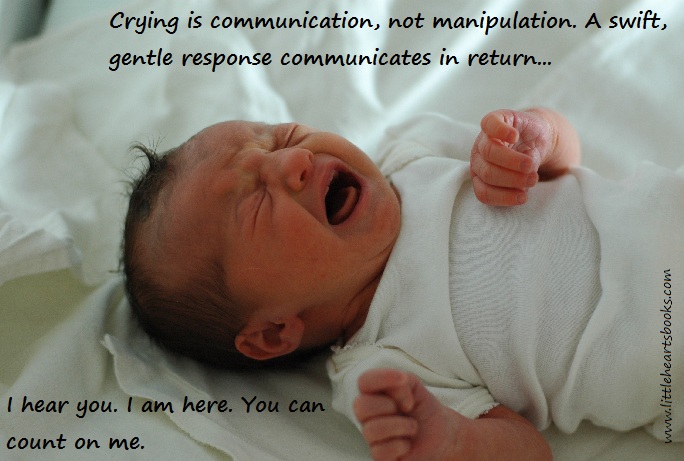 Eighth, your baby is completely and totally helpless in every way. Her main mode of communication is crying. Medical experts agree that it isn’t possible to spoil a newborn, and you are just at the beginning stages of building a trust relationship, so respond promptly to your little one’s cries! Your immediate response to your baby’s needs will help her begin to learn that she can count on you when she needs you and that she doesn’t have to ‘fight’ for your attention. Babies left to cry-it-out often do sleep through the night sooner than babies whose needs are responded to because they have learned to give up on their needs being met. But that ‘gain’ of sleeping through the night is accomplished at the ‘loss’ of trust, and the long-term consequences of a child giving up on her parents simply aren’t worth it.
Ninth, baby yourself! Whether you’ve had a c-section or a vaginal birth, your body has been through the wringer; your hormones are all over the place; and your lack of sleep is not helping matters! Have someone make you a ‘survival basket’ with water bottles, granola bars, minty gum, hand sanitizer, diapers, baby wipes, burp rags, and, most importantly, chocolate! It needs to be small and light enough for you to take from room to room with you while carrying your baby. Also, have someone make a comfy area in your living room for you to nurse (with your survival basket within reach!) and a changing area so you don’t have to go back and forth to the bedroom or nursery throughout the day. Take showers when you can. Accept casseroles and other offerings of meals from friends and church members and co-workers. And, if you don’t have help for the housework, just do the bare minimum so you can rest and recover and focus on getting to know your precious new baby!
Tenth, baby your marriage! This is a huge, huge, huge transition for you and your husband, so both of you apologize to each other in advance for any temper tantrums, thoughtless words, or unmet needs that might (will!) occur in the foreseeable future. You are going from ‘the two of us’ to ‘we three’ and, just as with anything else, change isn’t easy. Husbands, it’s not about you right now, period. Yes, you have your own issues to deal with in becoming a parent for the first time, but you need to put that aside for the first weeks and concentrate on your wife and child. Your wife isn’t just having to deal with becoming a mommy, but her body has been through an incredible transition during the previous nine months followed by the trauma of labor and delivery followed by crashing hormones, the trials of learning to breastfeed (or deal with engorgement issues if choosing to bottle feed), and the exhaustion of dealing with a newborn’s erratic sleep patterns. If she’s also had a c-section, you can add major abdominal surgery to that list! So, husbands, put your own issues aside and baby your wife and baby for the time being! Wives, a little verbal acknowledgement goes a long way with husbands, so try to muster up enough energy to tell your husband that you appreciate him and understand that he is trying to figure out this new life just like you are, and assure him that eventually you will be you again! (Yes, you will. It just takes time!)
Final thoughts: One of the things that has kept me going through giving birth to six children (and losing several others along the way) is the assurance that ‘this too shall pass.’ As with all changes in life, it takes time to adjust, but reminding yourself that this ‘will pass,’ and you will adjust, and life will go on is very, very helpful! Also, take time to enjoy the little things–the sweet smell of your newborn’s tiny head, the soft sounds of his breathing as he sleeps, the sight of your spouse staring into your beautiful baby’s eyes–because too soon this time will pass and these precious moments will become mere memories. Congratulations and God bless!
 Related links:
Love in the Time of Cosleeping
A Boy, A Girl, and A Baby~Journey to Gentle Parenting
300+ Nicknames for Your Babykins…Doodlebug…Snugglebunny…
200 Ways to Bless Your Children with a Happy Childhood
Babywearing Basics Resource Guide
Breastfeeding, Babywearing, and Bouncing Back into Shape after Baby
Practical, Gentle, Effective Discipline
Four Ways Attachment Parenting Can Reduce the Risk of SIDS
The Science of Sleep: Newborns
Where Did You Learn Love, Child?
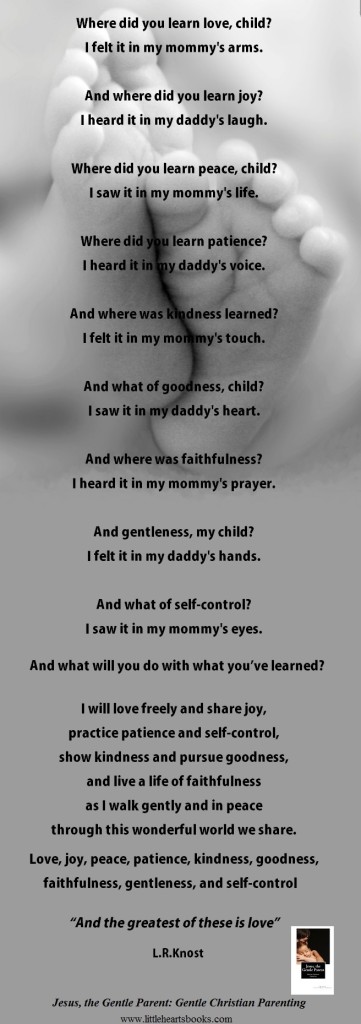
Award-winnning author, L.R.Knost, is the founder and director of the children's rights advocacy and family consulting group, Little Hearts/Gentle Parenting Resources, and Editor-in-Chief of Holistic Parenting Magazine. Books by L.R.Knost include Whispers Through Time: Communication Through the Ages and Stages of Childhood ; Two Thousand Kisses a Day: Gentle Parenting Through the Ages and Stages ; The Gentle Parent: Positive, Practical, Effective Discipline ; and Jesus, the Gentle Parent: Gentle Christian Parenting the first four books in the Little Hearts Handbook gentle parenting series, and children’s picture books Petey’s Listening Ears and the soon-to-be-released Grumpykins series.
Bizarre Anti-Cosleeping Ads in Milwaukee a Red Herring?
[By L.R.Knost, author of Two Thousand Kisses a Day: Gentle Parenting Through the Ages and Stages, Whispers Through Time: Communication Through the Ages and Stages of Childhood and The Gentle Parent: Positive, Practical, Effective Discipline.]
~~~~~~~~~~~~~~~~~~~~~

In Milwaukee, the local government has declared war on cosleeping. Billboards and signs with scary images of babies next to huge knives, surrounded by mounds of pillows and comforters, no adult in sight, proclaim that cosleeping is dangerous. Of course, the signs belie the message since there are no adults actually sleeping with the babies in the pictures, just knives and suffocation hazards and babies sleeping on their stomachs, all fear-triggering images for parents.
This campaign against cosleeping was launched after the release of the 2010 Fetal Infant Mortality Review (FIRM) Report detailing the statistics behind Milwaukee’s shocking infant death rate. According to Milwaukee’s Commissioner of Health, Bevan K. Baker, “The infant mortality rate in Milwaukee is worse than in almost any other developed country.” (pg 4) The idea that an American city could have such a tragic distinction is certainly staggering. Looking at the statistics reveals some sobering facts:
Infant Death and Stillbirth in Milwaukee
2005–2008 Stillbirths and Infant Deaths
- Of the 807 infant and prenatal deaths from 2005 to 2008, 308 were stillbirths and 499 were infant deaths from all other causes combined.
- 38%, more than a third, of all of the deaths were attributed to one cause, stillbirth. Poor medical care was cited as the overriding contributor.
- Of the 499 infant deaths, 53.7% were due to prematurity. Poor medical care was cited as the overriding contributor.
- More than 77% of the total deaths were due to stillbirth or prematurity with poor medical care cited as the overriding contributor.
- More than 85% of the total deaths were in the African-American community with poor medical care cited as the overriding contributor.
- Of the remaining deaths, 19% were due to congenital abnormalities, 18% to SIDS or accidental suffocation (refers to the sudden unexpected death of an infant due to overlay[adult accidentally smothering an infant], positional asphyxiation, or mechanical asphyxiation, [pg 2]~no breakdown of the numbers of SIDS, positional asphyxiation, or mechanical suffocation vs. overlay were provided in the report), 4.4% were due to infection, 2.4% to murder, and 2.4% to other.
- Note: The report’s ‘Findings,’ or summary, provided at the beginning of the document transposes the 18% of infant deaths from SIDS and accidental suffocation with the 19% of infant deaths from congenital abnormalities. (see pg 6)
- Of the 499 infant deaths, 329 were in the African-American community, and of that 193 were due to prematurity, 65 to congenital abnormality, 39 to SIDS and accidental suffocation, 16 to infection, 8 to murder, and 8 to other.
- Note: The report’s glossary defined accidental suffocation as “… overlay, positional asphyxiation, or mechanical asphyxiation” but throughout the rest of the document used the phrasing “SIDS, overlay, or accidental suffocation.”
- In summary, in excess of 85% of the total deaths were in the African-American community. More than 77% of the total deaths were due to stillbirth or prematurity. Poor medical care was cited as the overriding factor in these deaths. Of the 807 total deaths, 88 were due to either SIDS or positional asphyxiation or mechanical asphyxiation or overlay with no distinction in the causes provided.
- Note: Risk factors for stillbirth, prematurity, SIDS, etc. were listed and provided in multiple generic tables, but no tables or statistics about actual risk factors found in the Milwaukee deaths were provided.
So, with no actual numbers of how many of the 88 out of 807 deaths were due to ‘overlay,’ or adults laying on top of and smothering an infant, and with the overwhelming majority of deaths being related to poor medical care in their own report, the local Milwaukee government launched a multi-faceted campaign to…blame the grieving parents.
Not only are they spending taxpayer money to pay for advertising, consulting, billboards, etc in their attack on cosleeping, effectively shifting the limelight away from the real issue, but they also blamed smoking and maternal obesity for the extreme numbers of deaths due to stillbirth and prematurity. Their report, in contrast, showed maternal infection or medical condition to be the primary culprit (read-poor medical care).
Why the red herring? The report, while clearly skewed (see notes), still offered a look at the real issue plaguing Milwaukee: POOR MEDICAL CARE. The report recommended increased access to medical care and improvements in the quality of that care, and yet the focus of the economic and personnel resources of the city in response to the report have been blame-shifting, fear-mongering, and slight-of-hand. Without access to the city’s internal records, we may never know what really brought about Milwaukee’s dangerously substandard medical care implicated in the Fetal Infant Mortality Review, or discern the cause of the extreme bias toward African-American babies dying in Milwaukee, or discover the root of the subsequent bizarre publicity campaign by the local Milwaukee government against cosleeping, but we can be sure of one thing, “Something’s rotten in Denmark…er, Milwaukee.”
Here are some cosleeping research and safety resources:
Love in the Time of Cosleeping
Dr Sears Addresses Recent Cosleeping Concerns
Cosleeping: Fear Mongering, Flawed Research and How to Cosleep Safely
Co-Sleeping – Sorting the Truths from the Myths and the Downright Lies.
And a petition to remove the offensive ads:
Milwaukee, remove the fear mongering co-sleeping ads!
Award-winnning author, L.R.Knost, is the founder and director of the children's rights advocacy and family consulting group, Little Hearts/Gentle Parenting Resources, and Editor-in-Chief of Holistic Parenting Magazine. Books by L.R.Knost include Whispers Through Time: Communication Through the Ages and Stages of Childhood ; Two Thousand Kisses a Day: Gentle Parenting Through the Ages and Stages ; The Gentle Parent: Positive, Practical, Effective Discipline ; and Jesus, the Gentle Parent: Gentle Christian Parenting the first four books in the Little Hearts Handbook gentle parenting series, and children’s picture books Petey’s Listening Ears and the soon-to-be-released Grumpykins series.
A September to Remember: Babies deal with stress naturally
Today’s guest poster for ~A September to Remember~ is Leslie from THE MOM: INFORMED. Be sure to head over and check out her site!
 Stress. I have it, you have it, and chances are even your kids feel it. To deal with stress, most people self-soothe and learn a coping mechanism. Some people smoke, some people run, others take medicine. I notice that I have quite a few soother habits; I bounce my leg or twirl my hair or chew the inside of my cheek.
Some autistic folks develop quite the arsenal of self soothing exercises…some spin to center themselves, some flap their arms, some repeat words, numbers or phrases. People with OCD have their own unique quirks for dealing as well.
Babies and toddlers have ways to deal with stress themselves…crying, sucking, nursing, sleeping. Babies who nurse get their non-nutritive sucking needs met by suckling the breast. That’s how they seem to best get their stress dealt with. Bottle fed babies sometimes go for thumb or pacifier sucking to meet that need. Other kids hold blankets or dolls.
The point of this post is to get you to look at pacifying and thumb-sucking and non-nutritive nursing in a new light. It isn’t something for lazy mom’s to use. It isn’t something kids use as manipulation. It starts out as a reflex that is found to be quite soothing and stress relieving. Most kids stop using a pacifier between 2 and 4 all on their own. Most kids stop sucking their thumb between 4 and 6 all on their own. A couple of great medical posting on non-nutritive sucking and why it’s normal are HERE and HERE . Did you know that thumb-sucking and pacifier sucking release endorphins(the feel good hormone)? Yeah, that’s why it is an excellent tool for babies to cope with stress. Sucking starts out as a reflex that develops into a tool.
So, before you dismiss baby’s need outside of food or even your toddlers need, remember, it is a not a bad thing. It is healthy and natural. And for the most part…most kids give them up on their own when they are old enough to understand and deal with stress in a better manner.

- THE MOM: INFORMED
- My name is Leslie and I am PASSIONATE about educating moms through pregnancy, birth and beyond. I live by this quote: “If you don’t know your options, you don’t have any.” I want EVERY woman to KNOW ALL OF THEIR OPTIONS. I never again want a woman to have to say, “I just didn’t know/if only I had known.”
Award-winnning author, L.R.Knost, is the founder and director of the children's rights advocacy and family consulting group, Little Hearts/Gentle Parenting Resources, and Editor-in-Chief of Holistic Parenting Magazine. Books by L.R.Knost include Whispers Through Time: Communication Through the Ages and Stages of Childhood ; Two Thousand Kisses a Day: Gentle Parenting Through the Ages and Stages ; The Gentle Parent: Positive, Practical, Effective Discipline ; and Jesus, the Gentle Parent: Gentle Christian Parenting the first four books in the Little Hearts Handbook gentle parenting series, and children’s picture books Petey’s Listening Ears and the soon-to-be-released Grumpykins series.
A September to Remember: I am a good mom, and other reasons labels don’t work…



Award-winnning author, L.R.Knost, is the founder and director of the children's rights advocacy and family consulting group, Little Hearts/Gentle Parenting Resources, and Editor-in-Chief of Holistic Parenting Magazine. Books by L.R.Knost include Whispers Through Time: Communication Through the Ages and Stages of Childhood ; Two Thousand Kisses a Day: Gentle Parenting Through the Ages and Stages ; The Gentle Parent: Positive, Practical, Effective Discipline ; and Jesus, the Gentle Parent: Gentle Christian Parenting the first four books in the Little Hearts Handbook gentle parenting series, and children’s picture books Petey’s Listening Ears and the soon-to-be-released Grumpykins series.
Co-sleeping Safely~Is it possible? Decide for yourself!
 SIDS: The Latest Research on How Sleeping With Your Baby is Safe | Dr. Sears Official Website | Pare
Dr. Sears is considered the leading authority on gentle/attachment parenting and is a proponent of co-sleeping. Here he examines the research linking decreased SIDS risks with the increase in co-sleeping rates. Dr. Sears~ “Here are some ways to educate parents on how to sleep safely with their baby.”
 Cosleeping and Biological Imperatives: Why Human Babies Do Not and Should Not Sleep Alone
 Parenting – A Much Better Way » SIDS, Cribs and Cosleeping » Print
“While many theories are flying around about the cause of SIDS, most focus on the deepness of sleep and how it affects the child’s breathing…Another theory which you may not be familiar with is that the crib mattress itself is to blame for SIDS cases…Arsenic, phosphorus and antimony are intentionally added to crib mattresses by the manufacturers as fire retardants. SIDS was very rare prior to the 1950s when these additives became standard.”

 Breastfeeding Answers Made Simple – Breastfeeding Reporter – Unintended Consequences
 My Date With Dr. Ferber
 How They Do It In… Japan
Related posts:
And Baby Makes Three~Surviving the First Three Months with a Newborn
Bizarre Anti-Cosleeping Ads in Milwaukee a Red Herring?
A Boy, A Girl, and A Baby~Journey to Gentle Parenting
Award-winnning author, L.R.Knost, is the founder and director of the children's rights advocacy and family consulting group, Little Hearts/Gentle Parenting Resources, and Editor-in-Chief of Holistic Parenting Magazine. Books by L.R.Knost include Whispers Through Time: Communication Through the Ages and Stages of Childhood ; Two Thousand Kisses a Day: Gentle Parenting Through the Ages and Stages ; The Gentle Parent: Positive, Practical, Effective Discipline ; and Jesus, the Gentle Parent: Gentle Christian Parenting the first four books in the Little Hearts Handbook gentle parenting series, and children’s picture books Petey’s Listening Ears and the soon-to-be-released Grumpykins series.
Wishes Week 2011~Wrapping it up & putting a bow on top!

Thank you to all of my awesome guests this week for Wishes Week 2011! You gave me a very special birthday gift I will never forget by sharing your wishes with me. Here’s a ((hug)) for each one of you! And now, the ‘wrap up’~

Glimpses My opening contribution to Wishes Week 2011~Glimpses of hope and healing

Meanderings by Rosemary Jones Gritty urban prose by one of my favorite writers…powerful!

My Parenting Wish: Through A Child’s Eyes A beautifully intimate look at compassionate parenting by The Hippie Housewife. Love this!

Birth Wishes Thank you to Becoming Crunchy for this powerful and heartfelt look at birthing options and empowering women…awesome!!!

I wish that I were the Mother that I play at the grocery store. Here is a quirky look at the realities of mommyhood by Jessica, author of Parenting Wild Things!

“What I Wish Every Mother Knew About Babies and Sleep” This wins the prize for most viewed post of the week from Adventures in Mommyhood over at Instinctual Mamas. This is a passionate, informative, and convicting article on meeting babies’ needs gently. Beautiful!

Mommy Wishes From one Mommy’s heart to yours~Mommy Wishes by The Mom: Informed

When God says ‘No’ ~ Wishes Week 2011
~My closing post for Wishes Week~
Thank you to everyone who joined me for Wishes Week 2011! Your comments and ‘presence’ (lol) were much appreciated!
Award-winnning author, L.R.Knost, is the founder and director of the children's rights advocacy and family consulting group, Little Hearts/Gentle Parenting Resources, and Editor-in-Chief of Holistic Parenting Magazine. Books by L.R.Knost include Whispers Through Time: Communication Through the Ages and Stages of Childhood ; Two Thousand Kisses a Day: Gentle Parenting Through the Ages and Stages ; The Gentle Parent: Positive, Practical, Effective Discipline ; and Jesus, the Gentle Parent: Gentle Christian Parenting the first four books in the Little Hearts Handbook gentle parenting series, and children’s picture books Petey’s Listening Ears and the soon-to-be-released Grumpykins series.
Mommy Wishes
 When Little Hearts/Gentle Parenting Resources asked for everyone to post about their * WISHES*, I jumped at the chance, thinking of how it would be easy to come up with a *WISH* to write about. It turns out that I was wrong…it turns out that I have WAY too many *WISHES* I would like to see come true. I *WISH* I could adopt all of the kids with no parents or bad parents; I *WISH* I could bring peace to the world; I *WISH* I could cure cancer…
 their options for themselves and their kids. I *WISH* for all moms to take charge of their pregnancies, their births and their mothering. I want moms to be educated and strong. To know all the options and get to choose for themselves the best road to take. To never be at the mercy of another’s knowledge. There is a saying…I forget how it goes exactly, but, it’s something like, How can I make a choice if I didn’t know the options? Well, my *WISH* is for ALL women to know the options, that way they can make an informed decision and not rely on “experts”, family, friends, or partners to do their deciding for them. Instead of relying on what society tells them to do, they can take a stand and follow their heart and nature.
 Award-winnning author, L.R.Knost, is the founder and director of the children's rights advocacy and family consulting group, Little Hearts/Gentle Parenting Resources, and Editor-in-Chief of Holistic Parenting Magazine. Books by L.R.Knost include Whispers Through Time: Communication Through the Ages and Stages of Childhood ; Two Thousand Kisses a Day: Gentle Parenting Through the Ages and Stages ; The Gentle Parent: Positive, Practical, Effective Discipline ; and Jesus, the Gentle Parent: Gentle Christian Parenting the first four books in the Little Hearts Handbook gentle parenting series, and children’s picture books Petey’s Listening Ears and the soon-to-be-released Grumpykins series.
A Boy, A Girl, and A Baby~The Journey to Gentle Parenting

My sweet, quirky daughter-in-law!
Many, many years ago (more that I will admit to!) a small, scared, pregnant, teenaged girl walked down the aisle to her tall, scared, clueless, young man and they said their “I do’s.” But what were they going to do? No earthly idea! They didn’t have the internet to surf for blogs about parenting and marriage, couldn’t afford the few paltry magazines available on those subjects at the time, and weren’t convinced the way their parents had raised them was exactly what they wanted for their unexpected little blessing. So, they just joined hands and hearts and figured it out the old-fashioned way~through trial and error.
The young girl gave birth prematurely and, after a terrifying NICU stay, brought home her barely 5 lb baby boy. Since the young couple were living on one income and barely able to feed themselves, it made sense to them to breastfeed their little one. Neither one had ever even heard of a lactation consultant and no one at the hospital had mentioned breastfeeding at all, so the two young people just kept working through the cracked, bleeding nipples, engorgement, over-supply, and other issues until they got it figured out~and then they were breastfeeders!
The young girl discovered their first night home how much easier it was to simply take her baby boy into bed with her and breastfeed him when he was hungry~and then they were cosleepers!
Neither one of the young couple had ever read a parenting book and had never even heard the words ‘cry-it-out,’ so the two of them just did what came naturally and picked up their baby when he fussed or grunted or just looked cute and finally found it easier to just pop their little preemie into a baby carrier and tote him around with them wherever they went~and then they were babywearers!
As their precious little guy got bigger and began to explore his new world, the young couple delighted in everything he did and simply moved him and distracted him with songs and toys if he got into things. They couldn’t bear the thought of hurting their son, so just pulled him into their laps for a ‘time-in’ cuddle and chat if he got upset or needed to settle or be redirected~and then they were gentle discipliners!
As time went by and more children entered the family (six, to be exact!) other issues such as education and socialization had to be made, and, while at first the young couple followed the norm and the first two of their children started out in public school, it just didn’t sit well with the parenting style they’d developed. Neither one of them had ever known anyone who homeschooled, so that was a truly scary idea, but public education wasn’t for them and they were just too ‘economically challenged’ to afford any kind of private school. So, they did what they’d always done and withdrew their children from school and figured it out as they went along~and then they were homeschoolers!
Now, this journey might sound like an easy one when summed up this way, but I can assure you it wasn’t! The young couple, my amazing husband and I, encountered strong criticism of our parenting choices over and over through the years from many, and a refusal to accept or accommodate those choices from some. We were warned that our marriage would suffer at the very least, and our babies would suffocate at the worst, if we slept with them in our bed instead of putting them in isolation to sleep. We were informed that my breasts would look like deflated balloons and reach my knees by my thirties if I breastfed beyond a couple of months. We were admonished that our children would grow into spoiled brats if we responded to their needs instead of teaching them to ‘deal with it’ on their own, and would end up criminals if we encouraged and guided them instead of spanking them. We were advised that our children would be uneducated social outcasts (i.e. homeless or still living at home at forty!) if we homeschooled them instead of putting them into the institutional public education system. These challenges to our parenting style were difficult at the time, and they sometimes even resulted in people choosing to de-friend us (not facebook de-friending, silly, in real life!), but they had the powerful positive effect of making us really examine what our beliefs were and, as a result, strengthening and solidifying our beliefs and our family.
As for the dire warnings listed above: Our beautiful, strong, loving marriage is in it’s 25th year; our children all survived cosleeping (our littlest, 14 months, is still safely and contentedly sleeping in our bed); my breasts are, well, normal except for being a couple of cup sizes larger at the moment since I’m breastfeeding, lol; our children are, in order, a 24 yr old pastor (our firstborn son mentioned in the story above who is expecting his first son!), a 22 yr old family therapist, a 17 yr old entering his third year of pre-med, 12 and 5 yr old beautiful and well-behaved homeschooled girls with lots of friends (soooo not social outcasts!), and a sweet and happy 14 month old baby girl.
Our journey to gentle parenting has had another, somewhat unexpected, effect. While we may not agree with others’ parenting choices, we have been on the receiving end of criticism far too long to not have learned this lesson: Gentle parenting is for parents, too! We have learned to respond gently to our friends who don’t agree with us, even when they don’t respond gently to us. Responding with harshness and criticism doesn’t work with adults any better than it does with children! Responding gently to those who disagree with us may or may not affect their parenting choices, but what it does do is model respectful behavior and conflict resolution to our children and, most of the time, preserve dear friendships.
So there you have it~our journey to a breastfeeding, cosleeping, babywearing,

My funny, handsome ‘unexpected blessing’ on his wedding day!
gentle disciplining, homeschooling, happy family of eight! Well, including our awesome son-in-law, daughter-in-law, granddaughter, and grandson-on-the-way, I guess I should say family of 11 2/3! One boy, one girl, and one baby have come a long way, Baby!
Award-winnning author, L.R.Knost, is the founder and director of the children's rights advocacy and family consulting group, Little Hearts/Gentle Parenting Resources, and Editor-in-Chief of Holistic Parenting Magazine. Books by L.R.Knost include Whispers Through Time: Communication Through the Ages and Stages of Childhood ; Two Thousand Kisses a Day: Gentle Parenting Through the Ages and Stages ; The Gentle Parent: Positive, Practical, Effective Discipline ; and Jesus, the Gentle Parent: Gentle Christian Parenting the first four books in the Little Hearts Handbook gentle parenting series, and children’s picture books Petey’s Listening Ears and the soon-to-be-released Grumpykins series.