
Toddlers, Tantrums, and Time-in’s, Oh my!
[Reprinted from The Gentle Parent: Positive, Practical, Effective Discipline by L.R.Knost. Whispers Through Time: Communication Through the Ages and Stages of Childhood and Two Thousand Kisses a Day: Gentle Parenting Through the Ages and Stages also available on Amazon and through other major retailers.]
~~~~~~~~~~~~~~~~~~~~~
 When a little person feels frustrated, overwhelmed, or just plain old out-of-sorts (read: tantrum time!) it’s tempting for parents to focus on correction rather than connection. But when children are intensely stressed, the prefrontal cortex of the brain, which in early childhood is an underdeveloped, mushy grey sponge waiting to be formed, is flooded with cortisol, the ‘stress hormone.’ The result is what is known as the fight-freeze-or-flight syndrome in which higher brain functions (learning, reason, self-control) are markedly hampered and lower brain functions (instinct, physical reactions) take over. This is an in-built survival mechanism that gradually comes under conscious control through years of growth in a safe and supportive environment. Interestingly, it is theorized that this underdeveloped ‘sponginess’ is why small children are able to learn new languages more quickly than older children and adults. They are, in a very literal way, absorbing information raw, unhampered by the processing and reason of a more mature brain.
Expecting young children to have the maturity and self-control to overcome this God-given survival instinct is unrealistic. Threatening, punishing, or even reasoning with them while their higher brain functions are suppressed is futile and actually just adds more stress to the situation (more stress = fuel on the tantrum-fire!).
What they really need is help…
- First, help coping with their big emotions
- Then, help reconnecting with their source of safety and security (you!)
- And last, help processing the problem that sent them into a maelstrom of emotion in the first place.
Punishing them, yelling at them, sending them to their room, or putting them in time-out disconnects them even further from their source of security and not only delays a resolution of the issue, but misses an opportunity to equip them with the tools they need to handle future problems.
This is where the Three C’s of gentle discipline come into play.
Connection:
- Remaining present and supportive until they are able to calm down enough to accept your help
- Drawing them close when they’re ready (time-in)
Communication:
- Validating their emotions by labeling them and empathizing (i.e. “You’re sad because we have to leave the park. I’m sad, too. The park is fun!”)
- Offering words to help them express their frustrations using reflective language (i.e. “It’s hard to do things we don’t like, isn’t it?”)
Cooperation:
- Helping them move on by redirecting their attention to the future (i.e. “When we get home we’re going to make a snack. Would you like grapes or bananas today?”)
- Modeling coping skills and self-control by calming your own reaction to their meltdown and helping them process their big emotions
These are all ways of reconnecting with your toddler or preschooler to help them successfully navigate their present difficulty as well as to cope with difficulties they’re confronted with in the future.
One effective tool for use in helping little ones cope with big emotions is a Calm-Me-Jar made from small, round, plastic bottles such as AquapodTM water bottles. They are perfect for small hands to shake and manhandle to their heart’s content.
To make your own Calm-Me-Jar, fill up a plastic water bottle with warm water and basic craft glitter glue in whatever color you like. You can add some extra glitter and a drop of food coloring to customize your glitter jar to your child’s tastes, and then when you have the look you want, be sure to hot glue the top on to prevent spills.
When my little ones have meltdowns, or, if I can catch it, before they reach that point, I pull out one of the Calm-Me-Jars and shake it up and just let them hold it while I hold them (when they are ready to be held) and talk or sing quietly. When I feel their body relaxing and their breathing slow down, I might say something like, “It’s sad when we can’t have a toy, isn’t it?” or whatever else will reflect what they seem to be unable to express.
When an older preschooler or early elementary-aged child has a meltdown, or, again, before if I can catch it, I first connect, “I’m here. I can see you’re upset. How can I help?” and listen as they try to verbalize their feelings. If they’re having trouble with the words, instead of immediately supplying the words for them, I’ll offer them a Calm-Me-Jar and ask if they’d like to show me how they’re feeling. They will often shake the Calm-Me-Jar vigorously while jumping up and down and twisting all around, which is a great physical outlet for their intense feelings. I watch until I see their movements slowing and their breathing evening out, and when they’ve calmed just enough to hear me, I quietly talk them through the calming process, “Look at all that fairy dust bouncing around like crazy! I bet that’s how it feels inside when you’re so upset. Look at how it’s starting to slow down and settle to the bottom. If we breathe really slowly, we can feel ourselves settling like the fairy dust. Want to try it with me?” Then, if there are any behavior issues we need to address, we’ll work through those afterward when they’re calm, connected, and capable of interacting and understanding.
Here’s an example of how Calm-Me-Jars are helpful in ‘listening between the lines’ to my children’s behavior so I can meet them where they are and help them process their big feelings:
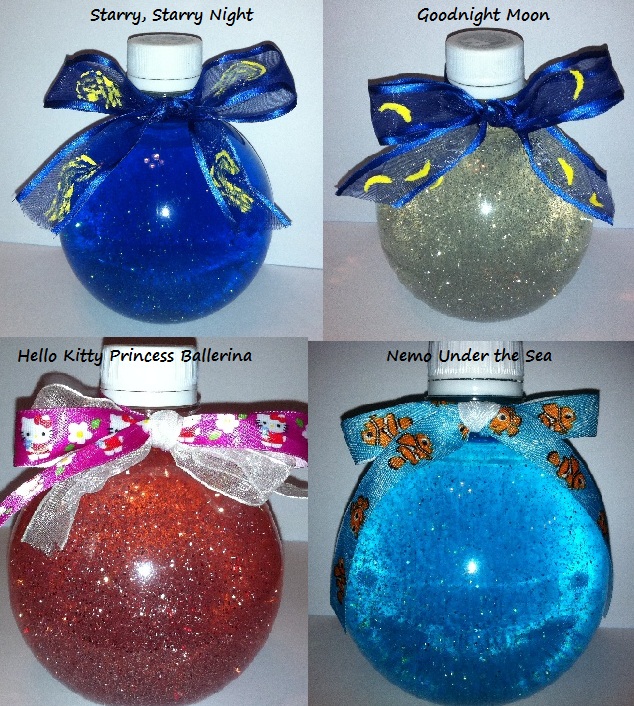
My five-year-old is a tiny girl with BIG emotions, and she really likes using Calm-Me-Jars to work through her feelings. We’ve put several together such as a silvery one she named Goodnight Moon, a light blue one she named Nemo Under the Sea, a pink one she named Hello Kitty Princess Ballerina, and a dark blue one she named Starry, Starry Night. When she is mad at one of her siblings, she’ll often bring me one of her Calm-Me-Jars (Goodnight Moon is a favorite in the evening!) and work out some of her upset physically by shaking the jar like crazy while she jumps up and down and tells me how mad she is. When she’s a bit calmer, we’ll have a little cuddle and watch the glitter settle while saying goodnight to the moon, all the furniture, and whatever other silliness we come up with until she’s calm. If there’s a discipline issue or she needs some help working things out with a sibling, we’ll work through it at that point because I know that’s when she can hear me and really process what I’m saying. If she chooses Starry, Starry Night we might sing Twinkle, Twinkle Little Star or step outside and see if there are any stars out yet. If she decides on Hello Kitty Princess Ballerina she’ll often dance her frustrations away while shaking her Calm-Me-Jar. And if she picks out Nemo Under the Sea we’ll ‘speak whale’ like Dory from Finding Nemo or we’ll make fishy faces at each other until we’re both giggling.
As you can see, my feisty little girl’s choice of Calm-Me-Jar shows me what she needs to do to work through her emotions of the moment, whether it’s to act things out physically in acceptable ways or to connect through song or through silliness.
The key is being in tune with your little one enough to understand their personality and work with it instead of against it. My five-year-old is spunky and silly, so having a long, serious talk would drive her crazy and accomplish nothing. We quickly decide together how she’ll approach whatever the problem was the next time she encounters it, and then she’s ready to move on, whereas when some of my older ones were little they really liked to talk things through (and still do!). My toddler, on the other hand, doesn’t have tantrums because that simply isn’t part of her own unique personality, but she’s still fascinated by her Calm-Me-Jar and loves to sit with me and watch the “pintess faywe dut” (“princess fairy dust”) glitter settle when she’s feeling a bit cranky or out-of-sorts.
Remember, there is no cure for tantrums because they are simply a normal result of a normal developmental stage of childhood. Trying to avoid tantrum triggers (tiredness, hunger, overstimulation, etc.) is always a good first step, along with remaining in-tune, responsive, and available, but when all else fails and a tantrum does occur, reacting with an adult tantrum is tantamount to throwing fuel on a toddler-tantrum-fire. So instead of losing it when your little one loses it, take an adult time-out, breathe deeply to gain control of your own emotions, and then grab the Three C’s of gentle discipline from your parenting toolbox and work with your child, not against them.
“Reactors react to a crisis with a meltdown. Responders respond to a crisis with help. To raise a mature, stable adult, be a first responder, not a nuclear reactor!” ~ L.R.Knost
Related posts:
The Gift of a Strong-Willed Child
Backtalk is Communication…LISTEN
When Children Act Out ~ Reflecting Our Emotions
Bridge Over Troubled Waters~Parenting a ‘Problem’ Child
The Taming of the Tantrum: A Toddler’s Perspective
Practical, Gentle, Effective Discipline
200 Ways to Bless Your Children with a Happy Childhood
When Children Hit~10 Tips for Parents
 Award-winnning author, L.R.Knost, is the founder and director of the children's rights advocacy and family consulting group, Little Hearts/Gentle Parenting Resources, and Editor-in-Chief of Holistic Parenting Magazine. Books by L.R.Knost include Whispers Through Time: Communication Through the Ages and Stages of Childhood ; Two Thousand Kisses a Day: Gentle Parenting Through the Ages and Stages ; The Gentle Parent: Positive, Practical, Effective Discipline ; and Jesus, the Gentle Parent: Gentle Christian Parenting the first four books in the Little Hearts Handbook gentle parenting series, and children’s picture books Petey’s Listening Ears and the soon-to-be-released Grumpykins series.

When Children Hit~10 Tips for Parents
[Portions reprinted from The Gentle Parent: Positive, Practical, Effective Discipline by L.R.Knost. Two Thousand Kisses a Day: Gentle Parenting Through the Ages and Stages and Whispers Through Time: Communication Through the Ages and Stages of Childhood also available on Amazon and through other major retailers.]
 Toddlers and preschoolers are still in the early stages of learning to communicate verbally. Add to that the fact that they have little-to-no impulse control and very immature social skills, and you’ve got a recipe for an instinctive physical response (i.e. hitting, kicking, biting, hair pulling, throwing things, etc.) to situations in which they are frustrated, angry, scared, or just tired and out-of-sorts.
Many parents who practice gentle discipline wonder where their little one picked up the behavior, not realizing that it is a normal and age-appropriate reaction, albeit an unacceptable one. Very often parents are advised to spank their child to train them not to hit others, especially those who are smaller and weaker than they are. (more…)
Award-winnning author, L.R.Knost, is the founder and director of the children's rights advocacy and family consulting group, Little Hearts/Gentle Parenting Resources, and Editor-in-Chief of Holistic Parenting Magazine. Books by L.R.Knost include Whispers Through Time: Communication Through the Ages and Stages of Childhood ; Two Thousand Kisses a Day: Gentle Parenting Through the Ages and Stages ; The Gentle Parent: Positive, Practical, Effective Discipline ; and Jesus, the Gentle Parent: Gentle Christian Parenting the first four books in the Little Hearts Handbook gentle parenting series, and children’s picture books Petey’s Listening Ears and the soon-to-be-released Grumpykins series.
Seuss-ified~Craft-astic~Snack-errific~Education-cool~Fun!
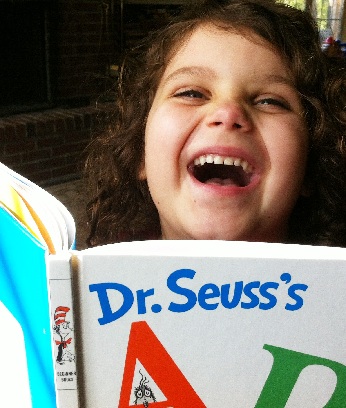
“You’re never too old, too wacky, too wild, to pick up a book and read to a child!”
Seussville~Read Across America
March 1st is World Book Day, and March 2nd is Dr. Seuss’ Birthday Extravaganza which includes the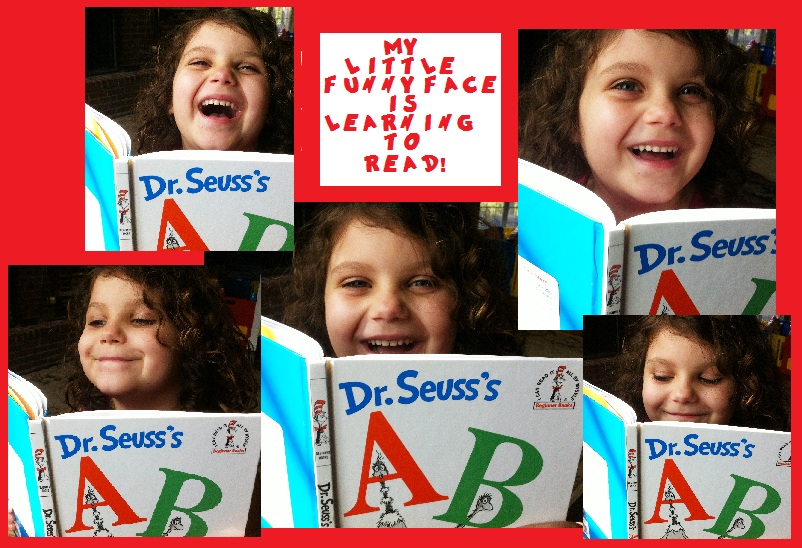 release of the much-anticipated new movie, The Lorax! If you’re a book-obsessed, homeschooling, movie-loving, Seussiac like I am, it’s practically a national holiday! And when you add my excitement over my newest little home-grown reader, it’s definitely time for a Seusserrific Celebration!
In honor of all of this wonderfulness and to help launch my new little reader into the wonderful world of books, I’ve been scouring the web, the bookshelves, and my scattered brain for all the Seussical fun I could find for my little people and yours. Here are a few of my finds!
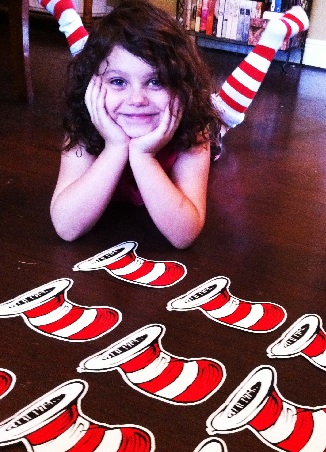 Staples has these awesome Cat in the Hat cutouts intended for use on a bulletin board, but we repurposed them for several games such as BIG LETTER~little letter Match-up and Seusstastic Scavenger Hunt. For BIG LETTER~little letter Match-up I drew capital letters and their counterparts on the backs of the cutouts and laid them out in a 3 x 3 grid. For Seusstastic Scavenger Hunt I wrote clues on the cutouts to help my little people find Dr. Seuss books I’d hidden throughout the house and tucked the clues in each book so that when they found one book and we read it, they’d find the next clue hidden in the pages of the book they’d just found…a two-fer! So fun!

We also made up a Go Fish in the Bowl game matching upper and lower case letters. It’s just your basic Go Fish, but somehow on Cat in the Hat cut-outs it became magical!
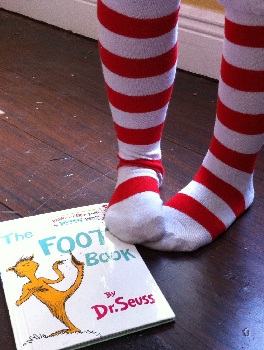 The simple addition of some stripey ‘Seuss Socks’ (Dollar Tree!) was enough to make The Foot Book even more engaging than it already is on its own!
Some leftover pieces of an old game yielded a plastic Green Eggs and Ham to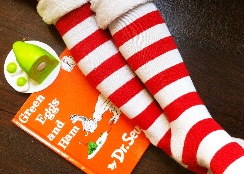 play a Would You~Could You spin on the old Mother May I game. We placed the Green Eggs and Ham game piece at one end of the room and took turns asking questions like ‘Would you, could you let me take three steps forward?’ and giving directions like ‘Could you, would you jump up and down and take one step back?’
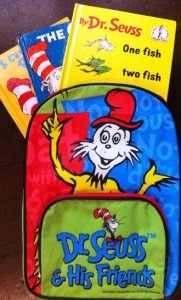
We’re putting together a Seuss Quiet Bag which we’ll be adding to over time, and I’m working on making a Cat in the Hat Calm-Me-Jar for our bag. I’ll post a picture here as soon as it’s done! Right now we’ve got favorite books and our Go Fish in the Bowl cards in this cute, little Seuss backpack I found at a thrift store.

The Cat in the Hat Can Help You with That!
Here it is! Meet the The Cat in the Hat Can Help You with That Calm-Me-Jar!
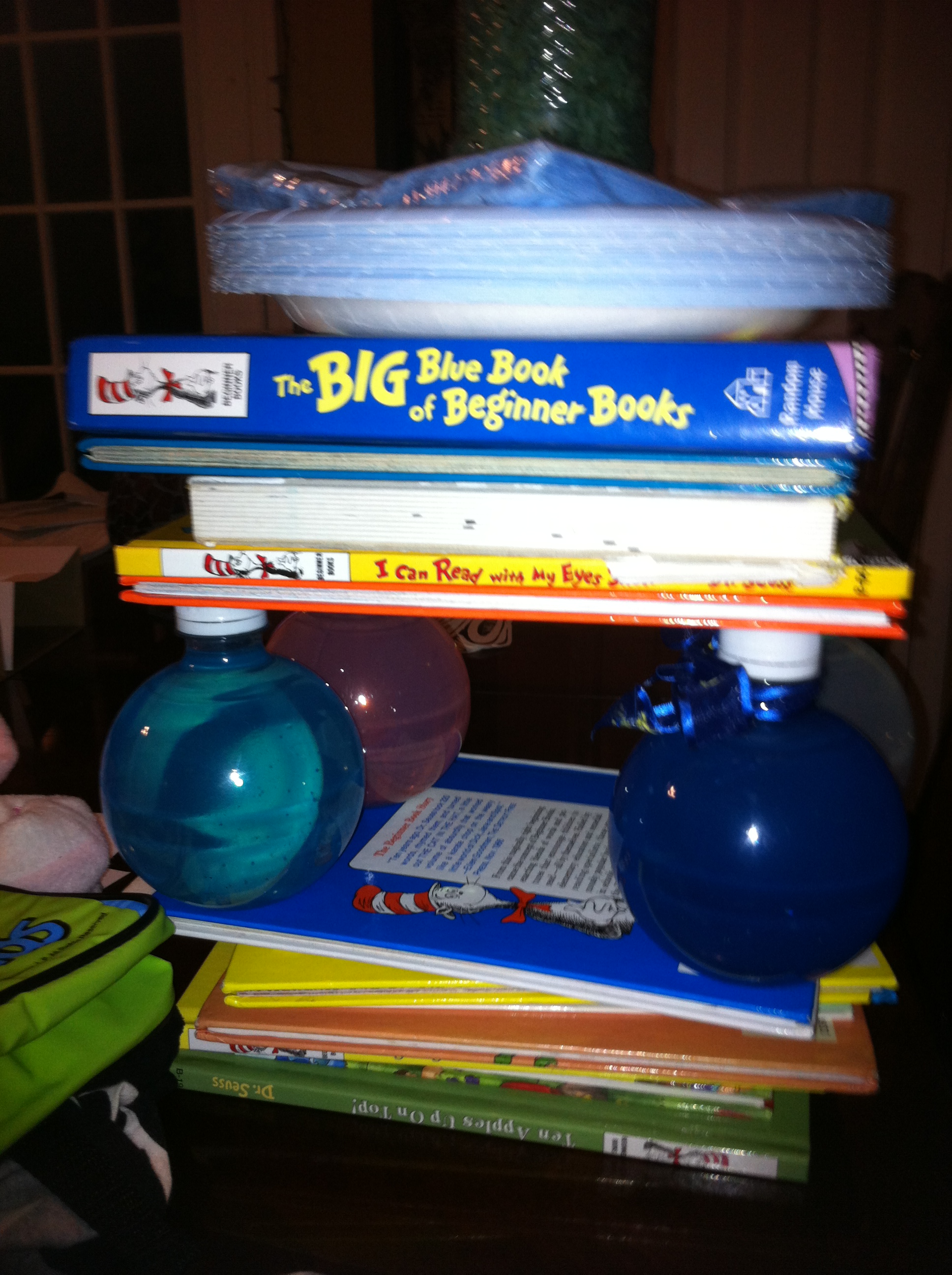
And here is my six year old’s contribution to the Seuss Birthday celebration~Seuss Tower! Watch out Donald, my little funny-face is out to trump you, lol!
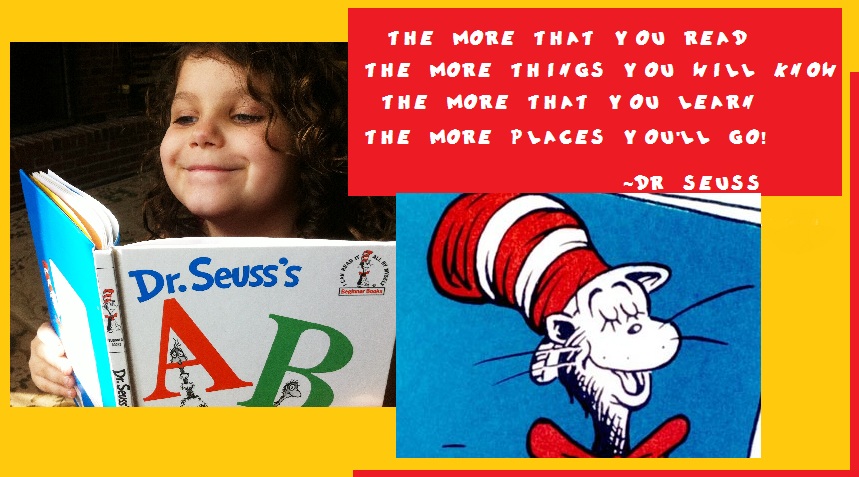
Check out these 7 Tips for Raising Bookworms!
Here are some awesomely Seusstastic links to crafts and games and yummy Seuss treats you and your little ones will love!

Source: zakkalife.blogspot.com via Linda on Pinterest
Make Seusstastic Lorax trees from pencils!

Source: meetthedubiens.com via Linda on Pinterest
Oreos, white and red chocolate, and marshmallows equal Seussalicious Cat in the Hat cookies!

Source: madtownmacs.blogspot.com via Linda on Pinterest
A Seussville craft for little Seusslets to create!

And check out this abSeusslutely ObSeussed site for literally hundreds and hundreds of Seusstastic crafts, books, games, recipies, ideas, and links!
Related posts:
Children who love to read…READ! Engaging children’s hearts in the wonder of reading instead of just training their minds in its mechanics. Raising Bookworms
It’s time for a return to childhood, to simplicity, to running and climbing and laughing in the sunshine, to experiencing happiness instead of being trained for a lifetime of pursuing happiness…it’s time to let children be children again. A Return to Childhood
Think homeschooled children are unsocialized, over-controlled, locked-away-from-the-world misfits? Think again! My Renaissance Girl
A Seussical List of Parenting Tips!
Alphabet Fun~Imagination From A to Z!
Live to Play~Play to Learn~Learn to Live!
Making Money Matters Make Cents
One Slippery Sock & Other Silly Tools for your Parenting Toolbox!

Award-winnning author, L.R.Knost, is the founder and director of the children's rights advocacy and family consulting group, Little Hearts/Gentle Parenting Resources, and Editor-in-Chief of Holistic Parenting Magazine. Books by L.R.Knost include Whispers Through Time: Communication Through the Ages and Stages of Childhood ; Two Thousand Kisses a Day: Gentle Parenting Through the Ages and Stages ; The Gentle Parent: Positive, Practical, Effective Discipline ; and Jesus, the Gentle Parent: Gentle Christian Parenting the first four books in the Little Hearts Handbook gentle parenting series, and children’s picture books Petey’s Listening Ears and the soon-to-be-released Grumpykins series.
Testing the Boundaries~What’s A Parent To Do?
 [Portions reprinted from The Gentle Parent: Positive, Practical, Effective Discipline by L.R.Knost. Two Thousand Kisses a Day: Gentle Parenting Through the Ages and Stages and Whispers Through Time: Communication Through the Ages and Stages of Childhood now available on Amazon and through other major retailers.]
Challenging behavior in our children can be really…well, challenging! How do you ‘handle’ a child who suddenly refuses to wear shoes or sit in her carseat/seatbelt or eat, period? Here are some tips to help you regain that snuggly, loving relationship you used to enjoy before your baby became a…gulp…PERSON!
1.) Remove the word ‘handle’ from your parenting vocabulary entirely. Your child isn’t a lion to be tamed or a dog to be trained! He’s a person, an individual with thoughts, interests, concerns, wants, and needs that are totally separate from yours. Respecting him as a separate individual not only models the value we need to place on others in our homes and communities, but also sets the stage for a mutually respectful relationship in his teen years and beyond.
2.) Slow down! Often simplifying our lives is the key to simplifying our parenting issues. Rushing a child from one activity to the next doesn’t expand her horizons; it stunts her creativity and inherent zest for life, which are the building blocks of a life-long love of learning. When she digs her heels in, pay attention! She’s trying to communicate a very deep need for time and space to learn about the world, to play and grow, and to just ‘be.’
3.) Small children have very little control over their lives, and the more powerless they feel, the more likely they are to make eating, getting dressed, going to the potty, etc. a battle of wills. Giving choices, engaging your child in making plans, and being flexible and responsive on a daily basis are good ‘proactive’ parenting, but little people are notorious for their awkward timing in deciding to suddenly assert their independence! Be prepared for those challenging moments by deciding ahead of time how you will respond. (See below for some ideas!)
4.) Listen, listen, listen! The first question parents ask me is almost always, “How do I get my child to listen?” And my first response is usually, “How well do you listen?” As Ralph Waldo Emerson so aptly put it, “What you do speaks so loud that I cannot hear what you say.” In other words, our children learn best by imitation. If every time our little ones ask for our attention we say, “Just a minute,” then we cannot expect instant attention from them. If when they speak to us our eyes constantly stray back to our computers and iPhones, we should not be surprised if they have a hard time looking at us when we ask them to. Listening is a two-way street that starts and ends with us, the adults.
5.) Boundaries are our friends! Many people believe that Gentle Parenting is a form of un-parenting, but nothing could be further from the truth. Gentle Parenting is involved parenting~interactive, engaged, active parenting. It takes focused attention, planning, participation, research, and so much more to be an empathetic, responsive parent who is in tune with their child’s needs and who is prepared to make whatever sacrifices are necessary to meet those needs. That said, in any home, like in any civilized society, boundaries are necessary for everyone’s safety and comfort. It is in the choosing and maintaining of those boundaries that Gentle Parenting distinguishes itself. In a gently parented home, boundaries are focused on guiding rather than controlling children and are maintained through empathetic and creative resolutions rather than harsh punitive consequences. (See below for some ideas!)
6.) Watch your attitude! Do you have angry eyes? A sharp tone? Do you issue commands and demand compliance? Do you sigh and roll your eyes when frustrated with your little one? All of these things contribute to creating resistance in children. Really, who wants to cooperate with someone who is demanding, impatient, sarcastic, angry, etc? Does feeling like a burden or a failure ever motivate anyone? Is a desire to please rooted in correction or connection? Think about how you like to be treated by authority figures (supervisors, law enforcement, etc.) and then treat your children the way you want to be treated! This not only reduces challenging behavior, but also models The Golden Rule~Do to others as you want them to do to you…an excellent life lesson!
Here are some ideas for your Gentle Parenting toolbox:
- Little one refusing to put on shoes before leaving the house? First, ask him why he doesn’t want to wear them. A toddler most likely won’t be able to/want to explain, but you’re modeling courtesy and opening up a dialogue, both good connection points. A three-year-old, though, might just surprise you with a very logical, in their own mind at least, response! Second, don’t react; just scoop the shoes up, and take them with you. If the refusal to wear shoes continues at the park/in the library/at the doctor’s office, etc. calmly tell him he can sit in your lap or in the stroller and hang out with you until he’s ready to wear his shoes.
- If a tantrum results, remember to stay calm (deep breathing, counting silently, and saying a quick prayer for guidance are all helpful!) and remain present. Some children respond well to a parent quietly talking, offering words to express what the child may be experiencing (i.e. “It’s frustrating when we have to do things we don’t like. I can see that you’re angry, and that’s okay. Let’s just sit here together for a while.”), while other children become more upset when a parent attempts to interact with them during a tantrum and are comforted simply by your quiet presence, a gentle back rub, or playing with a Calm-Me-Jar . Getting to know your child is an important part of Gentle Parenting and will help you to ‘read’ these situations so you can be responsive to their unique needs.
- A place for Time-Outs. Typically, I advise parents to use Time-Ins instead of Time-Outs in order to connect-to-correct, but there is one area that I advise the use of Time-Outs…the ‘Time-Out Toy Box!’ When a toy is misused (i.e. thrown, used to
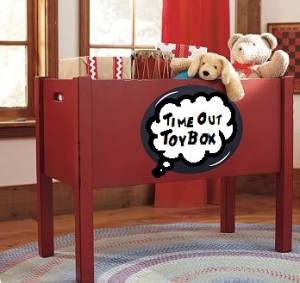 hit, drawn on, fought over, etc) and a gentle redirection has been given, the next step for the toy is to be put in the ‘Time-Out Toy Box.’ Little ones generally find the concept of a toy being put in Time-Out rather humorous and go along with the removal without a fuss (the toy can be returned after an exaggeratedly stern warning to the toy letting it know what is expected of it and that it must listen to ‘the boss’ ~the child, lol. They love that!), but remember to communicate, listen, and be flexible. If the removal of a toy brings about a strong negative response, it may be that the inappropriate behavior was more than just over-exuberance, in which case a Time-In might be needed. Again, being in tune with your child will help you to ‘read’ the situation and respond appropriately.
- The most challenging, independent children tend to be the ones who need the most intentional parental reconnection. Strong will=Strong need! It is often the strongest-willed children who identify most closely with their parents, oddly enough. While there is no denying how difficult it can be to raise a strong-willed child, seeing the purpose behind the behavior can make the journey much more manageable. Try to view their seemingly constant testing as them doing ‘research’ on you, seeing where your strengths and weaknesses are, and discovering all the ins and outs of being you. Also, taking the time to explain why you make the decisions you do, why you said this, why you didn’t say that, answering the endless questions patiently and openly, can alleviate some of the challenging behavior by offering them insights into who you are without them having to ‘dig’ it out of you!
Related posts:
Practical, Gentle, Effective Discipline
The Taming of the Tantrum: A Toddler’s Perspective
When Children Hit~10 Tips for Parents
Easy Peasy DIY Parenting Tools
To a Toddler Sharing is a 4 Letter Word~MINE!
Tots to Teens~Communication through the Ages and Stages
Parenting in Public: Toddler Time
Award-winnning author, L.R.Knost, is the founder and director of the children's rights advocacy and family consulting group, Little Hearts/Gentle Parenting Resources, and Editor-in-Chief of Holistic Parenting Magazine. Books by L.R.Knost include Whispers Through Time: Communication Through the Ages and Stages of Childhood ; Two Thousand Kisses a Day: Gentle Parenting Through the Ages and Stages ; The Gentle Parent: Positive, Practical, Effective Discipline ; and Jesus, the Gentle Parent: Gentle Christian Parenting the first four books in the Little Hearts Handbook gentle parenting series, and children’s picture books Petey’s Listening Ears and the soon-to-be-released Grumpykins series.
Toddlers, Tantrums, and Time-Ins, Oh My!
[Portions reprinted from The Gentle Parent: Positive, Practical, Effective Discipline by L.R.Knost. Whispers Through Time: Communication Through the Ages and Stages of Childhood and Two Thousand Kisses a Day: Gentle Parenting Through the Ages and Stages also available on Amazon and through other major retailers.]
 When a little person feels frustrated, overwhelmed, or just plain old out-of-sorts (read: tantrum time!) it’s tempting for parents to focus on correction rather than connection. But when children are intensely stressed, the prefrontal cortex of the brain (which in early childhood is an under-developed, mushy ‘ball of playdoh’ waiting to be formed) is flooded with cortisol, aka the ‘stress hormone.’ The result is what is known as the fight-freeze-or-flight syndrome in which higher brain functions (learning, reason, self-control) are markedly hampered and lower brain functions (instinct, physical reactions) take over. This is an in-built survival mechanism that gradually comes under conscious control through years of growth in a safe and supportive environment.
Expecting young children to have the maturity and self-control to overcome this God-given survival instinct is unrealistic. Threatening, punishing, or even reasoning with them while their higher brain functions are suppressed is futile and actually just adds more stress to the situation (more stress=fuel on the tantrum-fire!).
What they really need is help…first, help coping with their big emotions…then, help reconnecting with their source of safety and security (you!)…and last, help processing the problem that sent them into a maelstrom of emotion in the first place. Punishing them, yelling at them, sending them to their room, or putting them in time-out disconnects them even further from their source of security and not only delays a resolution of the issue, but misses an opportunity to equip them with the tools they need to handle future problems.
Drawing them close (time-in), offering words to help them express their frustrations (reflective language), and modeling coping skills and self-control for them are all ways of reconnecting with them to help them successfully navigate their present difficulty as well as cope with those they’re confronted with in the future.
One effective tool for use in helping little ones cope with big emotions is a Calm-Me-Jar.
Here are our Calm-Me-Jars~

They are made from the little round plastic Coke bottles sold around Christmas time. (Other times of the year you can get Aquapod water bottles which are similar.) I like them because, first, they aren’t glass (who really wants to hand an upset toddler or preschooler a glass anything?!?) and, second, they are perfect for small hands to shake and manhandle to their heart’s content.
Glitter glue gel didn’t work at all because it stayed all clumped up. Just basic craft glitter glue from the Dollar Tree worked really well, though. Cold water kept the glue clumpy, too, so lukewarm tap water is the best bet. I used colored glitter glue with a tiny drop of food coloring in the colored Calm-Me-Jars, and just silver glitter glue with the clear one. I also added actual glitter to each jar because the glitter in the glue was itsy bitsy. The combination of the two types of glitter really turned out pretty. Add about one ounce of glitter glue in each bottle and then as much glitter as you like and a tiny bit of food coloring if you want to make the colors deeper.
When each of the bottles had the look we wanted, we glued the tops down with hot glue, then added ribbons for decorations. Our original Calm-Me-Jars are approaching a year old, and they haven’t become cloudy or clumpy, etc, so it seems that as long as you keep the lids on, they’ll last indefinitely! Here’s a closer view:
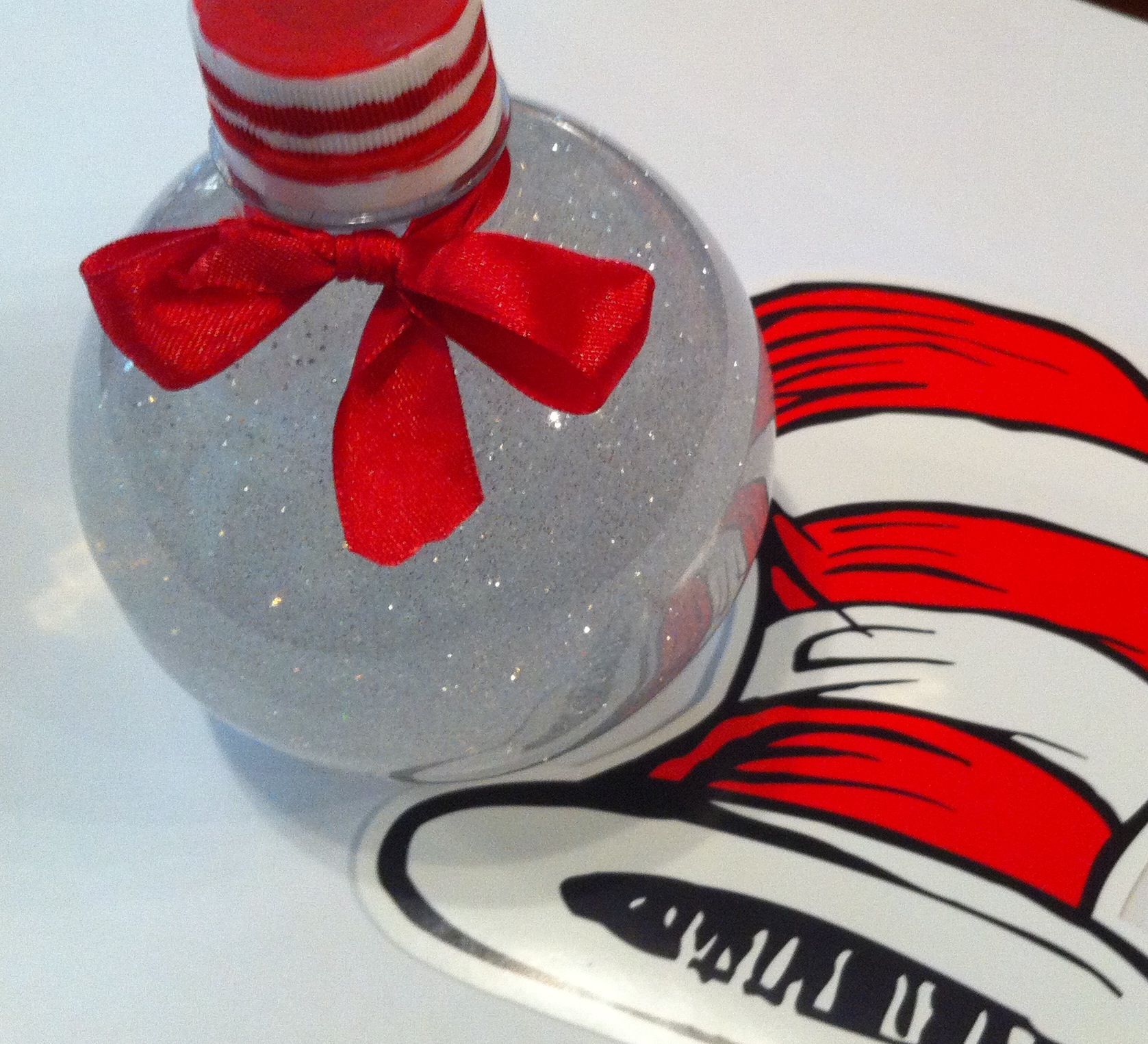
The Cat in the Hat Can Help You with That!
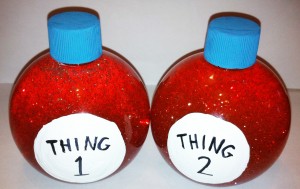
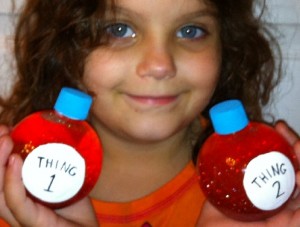
(If you’re really into Dr Seuss, here’s some Seussical fun for your little one!)
When my littler ones have meltdowns (or, if I can catch it, before they reach that point), I pull out one of the Calm-Me-Jars and shake it up and just let them hold it while I hold them or, if they aren’t ready to be touched, I stay close by and talk or sing quietly. When I feel their body relaxing and their breathing slow down, I might say something like, “It’s sad when we can’t have a toy, isn’t it?” or whatever else will reflect what they seem to be unable to express.
If they’ve hit someone or thrown something, I first reflect what my little person is feeling (after tending to the other child if they are hurt or upset), then, when they’re a bit calmer, I go on to reflect what the other person might be feeling, “It hurts Sissy when you hit her.” Then I offer a suggestion about the next step. “Why don’t we go ask Sissy if she’s okay? If she has a boo-boo, we might need to get a bandage for her.” It’s very intriguing for little ones to feel like they can ‘fix’ something, and often the idea that they have that kind of power makes all the difference in the frequency and intensity of meltdowns, not to mention the positive impact of learning to think and care about the feelings of others.
When an older preschooler/early elementary-aged child is about to have a meltdown, I first try to help them begin to recognize those feelings by verbalizing for them, “I see you’re feeling upset. It’s hard not getting things we want, isn’t it?” (Or “having to do things we don’t want to” etc). Then, depending on how much they seem to need connection vs. simply calming down, I either ask if they want to use their Cozy Corner (see below) to help them calm down, “Do you want to head over to your Cozy Corner for a few minutes and grab one of your Calm-Me-Jars so you can have a break for a bit?”
Or if they need to connect, I scoop them against my side into a big hug and head into the Cozy Corner with them (or just my rocking chair) for a cuddle (aka a time-in). While we’re cuddling, or before if they’re feeling too angry to be touched, I let them shake the Calm-Me-Jar as hard and often as they want right at first as a physical outlet for their intense feelings, watching to see when their breathing begins to even out and their body to relax. When they’ve calmed just enough to hear me, I quietly talk them through the calming process, “Look at all that fairy dust bouncing around like crazy! I bet that’s how it feels inside when you’re so upset. Look at how it’s starting to slow down and settle to the bottom. If we breathe really slowly, we can feel ourselves settling like the fairy dust.” Sometimes we sing a quiet song or I offer to read a book or pray with or for them, depending on the circumstances.
When my five-year-old is mad at one of her siblings, she’ll often bring one of her Calm-Me-Jars (Goodnight Moon is a favorite at night!) and work out some of the upset physically by shaking the jar like crazy and telling me how angry she is. When she’s a bit calmer, we’ll have a little cuddle and watch the glitter settle while saying goodnight to the moon, all the furniture, and whatever other silliness we come up with until she’s calm. If there’s a discipline issue, we’ll work through it at that point because I know that’s when she can hear me and really process what I’m saying. (With Starry, Starry Night we sometimes sing Twinkle, Twinkle Little Star; with Hello Kitty Princess Ballerina she likes to dance her frustrations away while the glitter dances with her; and with Nemo Under the Sea we speak ‘whale’ like Dorry or make fishy faces at each other.)
The key to all of this is being in tune with your little one enough to understand their personality and work with it instead of against it. My five-year-old is spunky and silly, so having a long, serious talk would drive her nuts and accomplish nothing, whereas when some of my older ones were little they really liked to talk things through (and still do!).
Here are some Cozy Corner ideas for when your little people need a little space to cope with this great big world:
 Set aside a small corner of the family room so they can still be close to you and let them help decorate it and choose a favorite blanket, some comfy pillows, and a few special books and stuffed friends to keep there. Here’s a cool tutorial for how to make this tent for under $25!
Let them help name their special place so they’ll know it’s theirs. Some suggestions are Cozy Corner, Comfort Zone, Quiet Cave, or Happy Place. And keep in mind, the Cozy Corner is a place for little ones (usually preschool and older) to go when they decide they want a break, not when we decide they need a break (or that we need a break, lol!). It’s a safe, comfortable, quiet place for them to relax alone if they want to or for us to join them for a time-in cuddle or chat.
And, for times when all else fails, sometimes a little fairy magic is all it takes to turn a bad day into a good one or to help a little one fall asleep. When your toddler/preschooler is a bit cranky, sloooww down, give lots of cuddles, listen, listen, listen, and ask if 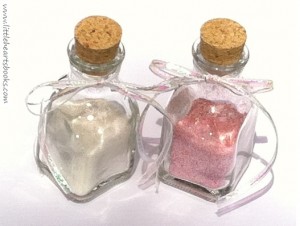 they need you to sprinkle some fairy dust on them to turn their frown upside down! For sleeping issues, sprinkle a bit of fairy ‘sleeping’ dust on their bed and stay with your little one, softly humming, stroking their back, or just quiet and reassuring, depending on their needs (they’ll let you know!) until they’re asleep. It’s typically the long, dark, lonely separation from mama causing the problem, instead of a sleep issue, anyway!
You can click on the picture to follow the link to buy these adorable fairy dust jars filled with microfine glitter, or you can go to Michaels and buy some cute little bottles and microfine glitter (You can find it next to the fabric paints and t-shirts instead of with the regular glitter, for some reason. Lol) and make your own little bottles of fairy dust!
Related posts:
Practical, Gentle, Effective Discipline
200 Ways to Bless Your Children with a Happy Childhood
Testing the Boundaries~What’s A Parent To Do?
When Children Hit~10 Tips for Parents
Easy Peasy DIY Parenting Tools
One Slippery Sock & Other Silly Tools for your Parenting Toolbox!
Award-winnning author, L.R.Knost, is the founder and director of the children's rights advocacy and family consulting group, Little Hearts/Gentle Parenting Resources, and Editor-in-Chief of Holistic Parenting Magazine. Books by L.R.Knost include Whispers Through Time: Communication Through the Ages and Stages of Childhood ; Two Thousand Kisses a Day: Gentle Parenting Through the Ages and Stages ; The Gentle Parent: Positive, Practical, Effective Discipline ; and Jesus, the Gentle Parent: Gentle Christian Parenting the first four books in the Little Hearts Handbook gentle parenting series, and children’s picture books Petey’s Listening Ears and the soon-to-be-released Grumpykins series.