
[Portions reprinted from Whispers Through Time: Communication Through the Ages and Stages of Childhood by L.R.Knost. Two Thousand Kisses a Day: Gentle Parenting Through the Ages and Stages and The Gentle Parent: Positive, Practical, Effective Discipline also available on Amazon and through other major retailers.]
~~~~~~~~~~~~~~~~~~~~~
 On a recent trip to the park, I overheard a parent ranting and raving about a little one “being a brat and always pitching fits.” It took me less than two seconds of looking at the child to realize his mother had put him down on hot asphalt without shoes on, and his ‘fit’ was actually cries of pain as he danced around trying to keep his poor little feet off the asphalt while trying to push past his mommy to get back into the car. In a few years this mother will wonder why her ten-year-old is always so sullen and silent.
Later the same day in Wal-mart, a three-year-old asked her mommy what plastic wrap was for. The mother rolled her eyes and snapped, “For wrapping food in plastic, duh.” A few years from now, this mother will confess to a friend that she has no idea why her nine-year-old is so mouthy and rude.
Minutes later, a two-year-old riding past me in a shopping cart pointed at a toy and babbled in her cute baby language, looking at her daddy with a delighted smile. Her father ignored her first few attempts to get his attention, then finally barked, “Shut up!” without ever looking at her. In a few years this father will complain to his co-workers that his teenaged daughter never talks to him.
Communication in my son’s Tae Kwon Do classes is called, “The link between the world and me.” In the parent/child relationship, communication is entirely…hear this…entirely the responsibility of the parent. From the moment a child enters the world, they are trying to communicate. Crying, grunting, making eye contact, mirroring expressions, all of these things are the instinctive tools built into infants to reach out into a brand new world and make contact. They can do no more. It is entirely up to the parent to make the connection, to respond, to build those all-important ‘lines of communication’ that will be so vitally important to parents in later childhood. Communication is not something that just happens. It is not something that begins when a child becomes verbal, and it’s not a product of a child’s advancing maturity. Communication is a process, a relational building block, a result of intentional and responsive parenting.
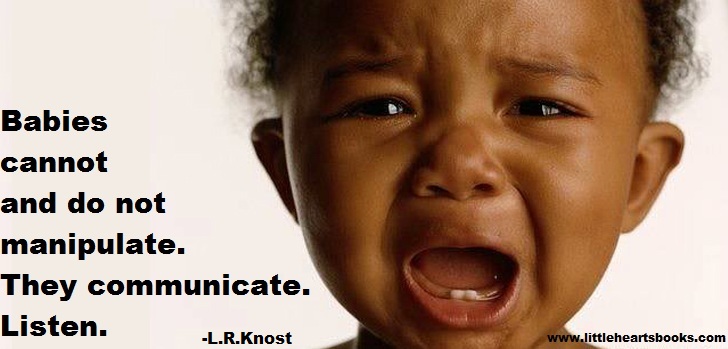 Crying is often mischaracterized as manipulation, and adults are certainly capable of using it that way. But to project such motivations on a baby is to grant them a level of skill and control far, far beyond their capabilities, and that is a potentially disastrous mistake. A parent’s perception of the motivation behind their child’s behavior is often the single most powerful determinant of the parent’s response. And the parental response or lack of response to a nonverbal child’s cries either builds or damages their communication and connection. There is no in between, no neutral.
Babies cannot and do not manipulate. They communicate. Listen. Respond. You aren’t being manipulated. You are being a parent.
And hear this well, parents, your relationship with your teenager is being established now, while your child is still a toddler. Your discipline issues with your nine-year-old are being minimized or intensified right now, while he is reaching out to you in infancy. Preschooler’s tantrums are being moderated or exacerbated at this moment by your response or lack of response to your baby’s cries.
 And the responsibility for building communication and connection with your child doesn’t end when your child becomes verbal. There is a reason children aren’t classified as adults until they are, in fact, adults. They simply do not have the judgment, experience, or maturity of an adult. Parents, you are the center of your child’s world for many years, and they will model themselves after the example you set.
If you listen to them, they will learn to listen. If you are rude to them, they will learn to be rude. If you treat them with respect, they will learn to be respectful. If you are angry, demanding, and harsh with them, they will learn to be angry, demanding, and harsh.
You decide every day by your parenting choices what kind of an adult you are going to raise. So live out how you want your children to turn out. That is the heart and soul of gentle, effective parenting.
Related posts:
The Taming of the Tantrum: A Toddler’s Perspective
When Children Act Out ~ Reflecting Our Emotions
Backtalk is Communication…LISTEN
Testing the Boundaries~What’s a Parent to Do?
Toddlers, Tantrums, and Time-Ins, Oh My!
Spare the Rod: The Heart of the Matter
 Award-winnning author, L.R.Knost, is the founder and director of the children's rights advocacy and family consulting group, Little Hearts/Gentle Parenting Resources, and Editor-in-Chief of Holistic Parenting Magazine. Books by L.R.Knost include Whispers Through Time: Communication Through the Ages and Stages of Childhood ; Two Thousand Kisses a Day: Gentle Parenting Through the Ages and Stages ; The Gentle Parent: Positive, Practical, Effective Discipline ; and Jesus, the Gentle Parent: Gentle Christian Parenting the first four books in the Little Hearts Handbook gentle parenting series, and children’s picture books Petey’s Listening Ears and the soon-to-be-released Grumpykins series.


 into the skin of a human.
 I, however, am NOT a perfect parent. In the time it’s taken me to write this so far, I’ve failed at pretty much every single one of those perfect parenting qualities. I only say that to point out that we aren’t shooting for perfection here.
 This adorable little person has been a royal pain in the ‘caboose’ for the last few weeks. She has whined, cried, ignored direct requests, climbed on me, hung on me, played with her food, snatched things from the baby, been in my face and space incessantly, and on and on. And the more difficult she got, the more I ‘powered up’ on her. Oh, I didn’t yell or punish. No, I pulled out all my gentle parenting techniques, spoke calmly and respectfully to her, offered diversions and alternatives, read her books and provided lots of reasonable and kind council. She occasionally responded with a half-hearted attempt at cooperation or humorously declined to cooperate, but more often than not just dug in her heels and determinedly upset the normally peaceful and happy timbre of our home.
 my little caboose, “No,” as she made one unfortunate decision after another. Over and over, I heard her whine and argue and cry. Over and over, I heard the older ones correct her, not hatefully or harshly, but repeatedly, gently, and firmly. And, over and over, I realized I was hearing myself as my older children reflected what they were seeing and hearing from me…repeated, gentle, firm correction…but no listening…none. And my heart broke. I realized that I had been parenting from a position of disconnect from my precious little caboose. Between jumping through all the hoops necessary to get a homeschooler into a pre-med university program to working with my publisher on the super slow and cumbersome process of getting my books onto store shelves, to writing an upcoming book, my busy schedule had overtaken my parenting.
 The little caboose chugged along, clickety-clack, clickety-clack, happy as could be as she followed her mama engine and brother and sister cars along the tracks. Up and down hills, around curves and through tunnels they went, all strung together with their secure couplings. And at the end of each day, they headed back to the station to get all fueled up and rested for the next glorious day. One day, the little caboose was startled when mama engine took off extra early without checking to make sure all the couplings were tightened. As they chugged forward, the little caboose could feel her coupling slipping a bit, and she ‘choo-chooed’ loudly to get mama engine’s attention. But mama engine was too busy to notice and kept picking up speed as they began their journey up and down the hills. Alarmed now, little caboose tried to pull backwards and slow the train down, but mama engine chugged on, ‘choo-chooing’ encouragingly. Little caboose felt her coupling getting looser and looser as mama engine sped toward the dangerous curves and tunnels ahead. In a panic, little caboose screeched ‘choo-choo’ over and over and tugged and pulled backward frantically. Mama engine just chugged on, this time ‘choo-chooing’ firmly and giving a gentle extra tug forward. Little caboose spent the rest of the day screeching ‘choo-choo’ and pulling and tugging backward until they finally arrived back at the station, everyone exhausted and cranky from the difficult day. Little caboose was so overwrought from the fear of being disconnected all day that she continued to screech ‘choo-choo’ and pull at her coupling even after they were stopped for the night. Mama engine chugged ominously in her direction, determined to restore order, but suddenly paused, hearing for the first time the fear and exhaustion in little caboose’s ‘choo-choos.’ She looked carefully and noticed the loose coupling. Pulling little caboose closer than close, mama engine tightened the coupling and ‘choo-chooed’ a soft, reassuring lullaby, and little caboose finally stopped her screeching and tugging and relaxed gratefully into her mama engine’s embrace.
 Create opportunities for your child to talk. Open conversations to get them started, then stop talking and stop planning your response and stop mentally going over your to-do list and just listen. Take your child with you whenever you can, wherever you’re going. Involve them in your day. Invite them into your life. ENJOY them and get to know them, get to really KNOW the unique and remarkable person they are. They are a precious, priceless gift, and their childhood will be over before you know it. And, at the end of that week, take another mental snapshot of what a day with your child looks like. Then you can decide which path to take. Will you go backward or forward? Is connecting with your child worth your time and effort? What will you choose?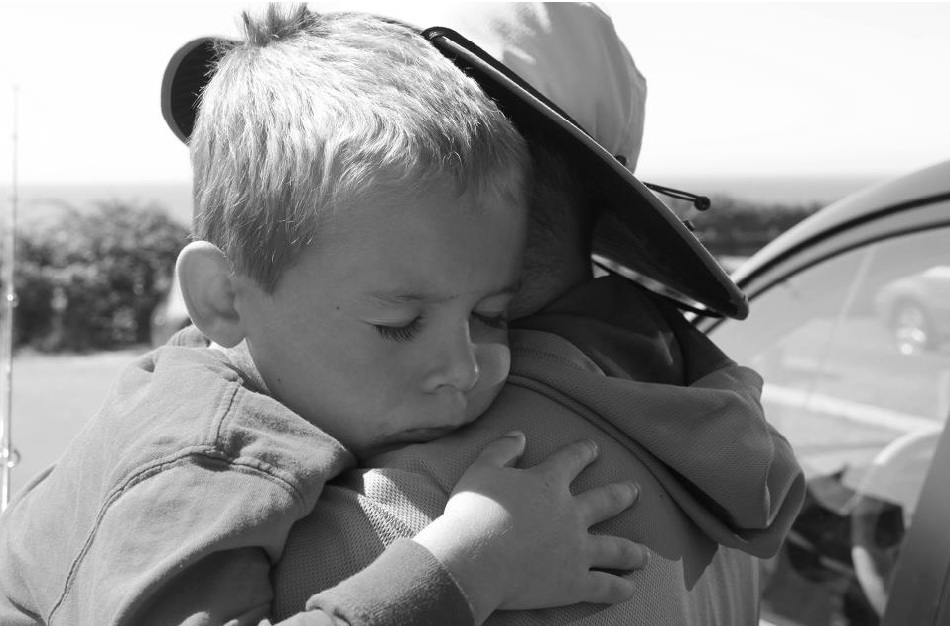
 ~Hana Williams: Another child “disciplined” to death~
 A few other amazing gentle parenting crusaders:
 My SPD/SLD/ADD (Sensory Processing Disorder, Specific Learning Disability-Dyslexia, Visual and Auditory Processing Disorders, Attention Deficit Disorder, etc) sweetie, aka Renaissance Girl, has raised the bar on my homeschooling skills more times than I can count. Her beautiful mind sees the world through a unique
  her, the artistic and musical gifts she’s been given are incredible, and her gentle, sensitive soul is a rare and precious treasure. Many years of therapy have yielded the ability to read, and she’s like a butterfly newly emerged from her cocoon. Jane Eyre, Little Women, Anne of Green Gables, all have sent her beautiful mind soaring to different times and places, and all have become intimate, lifelong friends with my sweet girl. I am so blessed to be entrusted with such a unique child to guide and grow and love!




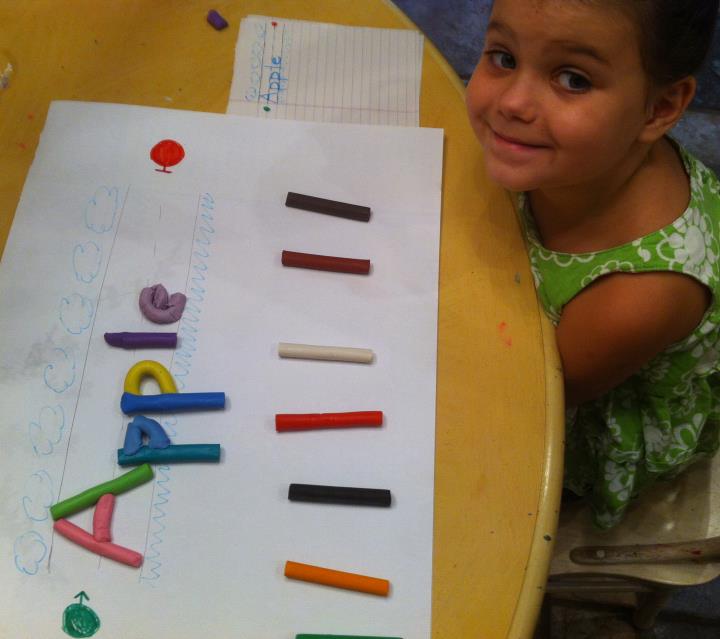


 When a little person feels frustrated, overwhelmed, or just plain old out-of-sorts (read: tantrum time!) it’s tempting for parents to focus on correction rather than connection. But when children are intensely stressed, the prefrontal cortex of the brain (which in early childhood is an under-developed, mushy ‘ball of playdoh’ waiting to be formed) is flooded with cortisol, aka the ‘stress hormone.’ The result is what is known as the fight-freeze-or-flight syndrome in which higher brain functions (learning, reason, self-control) are markedly hampered and lower brain functions (instinct, physical reactions) take over. This is an in-built survival mechanism that gradually comes under conscious control through years of growth in a safe and supportive environment.



 Set aside a small corner of the family room so they can still be close to you and let them help decorate it and choose a favorite blanket, some comfy pillows, and a few special books and stuffed friends to keep there.

 Grief
Grief